May 16, 2026
The Legal Architecture Behind Cross-Border Mining Accountability
For decades, a persistent assumption ran through the global mining industry: that the corporate structures separating parent companies from their overseas subsidiaries could function as a practical shield against liability when disasters occurred far from home. That assumption has been systematically dismantled over the past decade, and no single case has done more to accelerate that dismantling than the litigation arising from the 2015 collapse of the Fundão tailings dam in Mariana, Brazil.
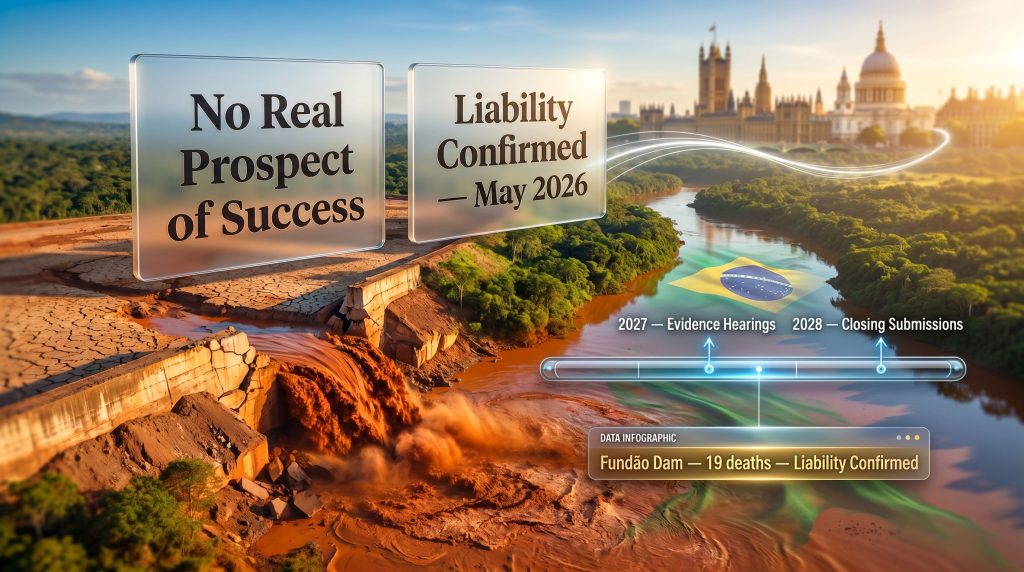
In May 2026, the Court of Appeal of England and Wales refused BHP's application for permission to appeal the High Court's liability ruling, finding that the grounds advanced by the mining giant had no real prospect of succeeding. The BHP Mariana dam appeal denied outcome is not merely a procedural footnote in a long-running legal saga. It represents a structural inflection point for how multinational resource companies understand, manage, and disclose their exposure to environmental harm caused anywhere in their corporate family tree.
When big ASX news breaks, our subscribers know first
Understanding the Fundão Dam Collapse: Scale, Mechanism, and Lasting Harm
What Made the Fundão Dam Failure So Catastrophic?
The Fundão tailings dam was an upstream-raised structure, a construction method now widely understood to carry substantially higher failure risk than downstream or centreline alternatives. Upstream-raised dams are built progressively, with each successive raise constructed over previously deposited tailings material rather than on stable engineered ground. This method is faster and cheaper, but it creates inherent structural vulnerabilities, particularly when the underlying tailings become saturated or experience seismic stress.
When the dam failed on 5 November 2015, it released an estimated 40 to 60 million cubic metres of iron ore tailings into the Rio Doce watershed, one of the largest tailings dam failures ever recorded globally. The consequences were severe and far-reaching:
- 19 people lost their lives in the immediate collapse
- Entire communities in Mariana and surrounding municipalities were displaced
- Approximately 650 kilometres of waterways were contaminated, extending from the dam site to the Atlantic Ocean
- Fishing communities, indigenous groups, and agricultural producers along the Rio Doce lost their primary sources of livelihood
- The river ecosystem, which took millions of years to develop, suffered damage that environmental scientists estimate could take generations to fully recover
The dam was operated by Samarco Mineração, a joint venture owned equally by BHP and Vale. Critically for the subsequent litigation, BHP's ultimate parent entity held a significant corporate and listing presence in the United Kingdom, creating the legal nexus that enabled English courts to assert jurisdiction over the case.
The Upstream Construction Method: A Risk Factor Hidden in Plain Sight
One of the less publicly discussed dimensions of the Mariana disaster is how long the risks associated with upstream-raised tailings dams had been understood within the technical community before the Fundão failure. Industry guidance had flagged the elevated seismic and saturation risks of upstream construction for years. Yet the method remained widespread globally, in part because of its cost advantages during periods of high commodity prices when capital allocation priorities favoured production expansion over infrastructure safety investment.
The Global Industry Standard on Tailings Management (GISTM), developed in the aftermath of the February 2019 Brumadinho dam collapse in which more than 270 people were killed, now explicitly addresses construction methodology. It requires operators to assess and, where necessary, remediate or decommission upstream-raised structures that do not meet contemporary safety thresholds. Furthermore, compliance with GISTM is increasingly tracked by institutional investors and major stock exchanges as a core ESG metric. Understanding mine reclamation importance in this context has never been more critical for responsible operators.
What the Court of Appeal's Decision Actually Means
The Permission Threshold in English Appellate Law
English appellate procedure operates on a filtered basis. A party wishing to challenge a court ruling cannot simply file an appeal as of right in most civil matters. Instead, they must first obtain permission, which courts grant only where the proposed grounds of appeal demonstrate a real prospect of success, or where there exists some other compelling reason for the appeal to proceed.
The Court of Appeal's refusal of BHP's application in May 2026 was not a technical dismissal on procedural grounds. It was a substantive finding that BHP's legal arguments, having been examined at the permission stage, could not realistically overturn the High Court's liability determination. This distinction matters enormously for understanding the weight of the ruling.
| Legal Stage | Outcome | Significance |
|---|---|---|
| High Court liability trial | Liability established against BHP | BHP found responsible for Fundão dam collapse |
| BHP permission to appeal application | Refused by Court of Appeal (May 2026) | Grounds found to have no real prospect of success |
| Ordinary appellate routes in England | Effectively exhausted | Liability finding now stands as operative determination |
| Stage 2 proceedings | Scheduled to commence | Causation, loss categories, and damages quantum |
Why Liability Is Only the Beginning
A common misconception in public discourse about major litigation is that a liability finding resolves the central question of the case. In reality, establishing that a defendant is responsible is legally distinct from determining what they must pay and to whom. The Stage 2 proceedings in this case will address:
- The precise causal connection between BHP's conduct and each category of loss suffered by individual claimants
- The types of compensable damage, spanning environmental degradation, economic loss, personal injury, psychological harm, property damage, and cultural harm to communities
- The total quantum of damages, which given the reported claimant group numbering in the hundreds of thousands, could represent one of the largest damages assessments in English legal history
Evidence hearings are scheduled for 2027, with closing submissions expected in 2028. The process will be extraordinarily complex, involving expert testimony on hydrology, ecology, epidemiology, and economic modelling across a claimant population spread across multiple Brazilian states.
The Broader Precedent: What This Ruling Means for Global Mining Liability
Cross-Border Jurisdiction and the Parent Company Problem
The Mariana litigation has resolved one of the most contested questions in international environmental law: whether a parent company incorporated and listed in a developed jurisdiction can be held liable in its home courts for environmental harm caused by an overseas subsidiary or joint venture. English courts accepted jurisdiction on the basis that BHP's ultimate parent entity had sufficient presence and connection to the United Kingdom.
This is not a narrow or technical ruling. It establishes that the corporate veil, long used as a practical barrier between parent-level strategy and operational liability, cannot reliably insulate a parent company when claimants can demonstrate sufficient parent-level involvement in the governance, risk management, or operational oversight of the subsidiary that caused the harm.
"The Mariana case demonstrates that the legal geography of environmental liability is shifting. Where the disaster occurs no longer determines where accountability can be sought."
For multinational miners with assets across emerging markets in Africa, Southeast Asia, Latin America, and Central Asia, this ruling should prompt a fundamental reassessment of how corporate governance frameworks are structured, documented, and disclosed. Consequently, understanding management red flags in governance structures has become an essential skill for investors evaluating mining companies with overseas operations.
Comparing the Mariana Case to Other Major Mining Disasters
| Disaster | Location | Deaths | Legal Jurisdiction | Status (2026) |
|---|---|---|---|---|
| Fundão Dam, Mariana | Brazil | 19 | England and Wales + Brazil | Liability confirmed; damages pending |
| Brumadinho Dam, Vale | Brazil | 270+ | Brazil | Criminal and civil proceedings ongoing |
| Mount Polley tailings breach | Canada | 0 | Canada | Regulatory action only; no criminal convictions |
| Ok Tedi copper mine | Papua New Guinea | 0 (environmental) | Australia | Settled out of court (1996) |
The Mariana case stands apart from its comparators in one critical respect: it is the first major instance where a foreign parent company has had liability confirmed through contested English court proceedings, rather than settling before or during trial. That distinction gives the ruling genuine precedential weight.
BHP's Financial Exposure and the Uncertainty Ahead
Why the Quantum Phase Creates a New Layer of Risk
BHP's balance sheet is substantial, but the confirmation of liability introduces a qualitatively different form of financial uncertainty than existed before the appeal ruling. During the liability phase, there remained a possibility, however diminishing, that the case could be unwound on appeal. That possibility has now been foreclosed for all practical purposes in England.
Analyst estimates of potential total damages in this litigation have ranged widely, with some assessments suggesting exposure running into multiple billions of dollars depending on how English courts treat the various loss categories and how they account for remediation already undertaken through other channels. BHP has not disclosed a specific financial provision that captures the full scope of potential English court damages.
Key financial uncertainty factors for investors to monitor include:
- How courts characterise and value environmental remediation costs already expended through the Renova Foundation, Brazil's designated remediation body
- Whether English courts permit offsetting of prior Brazilian compensation payments against any English damages award
- The treatment of future environmental restoration costs that may not yet have been incurred
- The evidentiary weight given to long-term ecological assessments of the Rio Doce basin's recovery trajectory
BHP's Position on the Renova Foundation
BHP has consistently argued that the Renova Foundation, established under Brazilian law and funded by Samarco, BHP, and Vale, represents the appropriate and comprehensive mechanism for compensating affected communities and remediating environmental damage. The company has pointed to billions of reais committed through this body for restoration work in the Rio Doce basin.
However, English courts have not accepted that the existence of Brazilian remediation processes extinguishes the independent rights of claimants to pursue compensation in England. The two proceedings operate in parallel, with the English litigation providing a separate and additional accountability pathway rather than an alternative to Brazilian processes.
ESG Implications: How Institutional Capital Should Respond
Tailings Dam Risk as a Material Financial Exposure
One of the more significant industry-level consequences of the BHP Mariana dam appeal denied outcome is the pressure it places on how institutional investors evaluate tailings dam risk within mining portfolios. For too long, tailings management has been treated in ESG frameworks primarily as a disclosure and reporting issue rather than a material financial liability.
In addition, the broader mining sustainability transformation underway across the sector means that companies failing to integrate operational accountability into their ESG frameworks face growing exposure. The metrics that sophisticated investors should now be monitoring across their mining holdings include:
| Risk Indicator | Why It Matters |
|---|---|
| Dam consequence classification (Extreme/Very High) | Determines regulatory scrutiny intensity and required capital investment |
| Construction method (upstream vs. downstream/centreline) | Upstream dams carry materially higher failure probability |
| Independent technical review panel frequency | Governance quality indicator |
| Proximity to populated areas and waterways | Amplifies human and environmental liability magnitude in failure scenarios |
| Remediation fund provisioning | Signals financial preparedness for worst-case outcomes |
| GISTM compliance status | Emerging baseline expectation from institutional capital |
There are estimated to be more than 3,500 active tailings storage facilities globally, with a significant additional number of inactive or abandoned structures that retain failure risk. The proportion of these constructed using upstream methodology, particularly in older mining jurisdictions, remains a largely unquantified liability sitting within the balance sheets of companies that may not have fully assessed it.
The Mandatory Due Diligence Trend
The Mariana litigation coincides with a broader global regulatory movement toward mandatory human rights and environmental due diligence at the corporate group level. Legislative frameworks emerging across the European Union, the United Kingdom, and other jurisdictions are progressively requiring companies to identify, prevent, and account for adverse impacts throughout their operations and supply chains, including those of subsidiaries and joint venture partners.
The legal logic being embedded in these frameworks closely mirrors the argument that succeeded in the English courts against BHP: that parent-level entities cannot treat the adverse consequences of subsidiary operations as outside their sphere of responsibility. Furthermore, natural capital in mining is increasingly being incorporated into these due diligence frameworks as regulators and investors demand more comprehensive environmental accounting.
The next major ASX story will hit our subscribers first
The Claimants and the Law Firm Behind the Case
A Decade-Long Pursuit of Accountability
The claimant group is represented by law firm Pogust Goodhead, which has pursued this litigation through English courts over multiple years on behalf of affected individuals and communities across Brazil. The claimants include:
- Residents of Mariana and surrounding municipalities displaced by the disaster
- Indigenous communities whose cultural and subsistence practices depended on the Rio Doce river system
- Fishermen and agricultural producers who lost income when the river was contaminated
- Businesses and individuals whose economic activity was disrupted along the 650-kilometre contamination zone
The decision to pursue litigation in England rather than relying solely on Brazilian proceedings was driven by the inadequacy of earlier remediation processes in the eyes of affected communities. Those communities found the pace and scope of Renova's work insufficient relative to the scale of harm experienced. The English legal pathway provided leverage that Brazilian proceedings alone could not deliver.
Key Takeaways for Industry Observers and Investors
The BHP Mariana dam appeal denied ruling in May 2026 carries consequences that extend well beyond BHP's own legal position. For instance, those monitoring the global mining sector must now reckon with definitive feasibility studies that incorporate legal and environmental liability assessments far more rigorously than before. The following conclusions are now reasonably well established:
- Liability has been confirmed at the High Court level and cannot be challenged through ordinary appellate routes in England
- The Stage 2 damages process, with hearings from 2027, will determine the financial quantum of BHP's obligations
- The precedent that parent companies can face liability in their home courts for overseas disasters is now validated through contested litigation, not just settlement
- Tailings dam risk, particularly involving upstream-constructed structures, must be treated as a material financial liability rather than a reputational or disclosure issue
- ESG frameworks that do not incorporate rigorous operational accountability standards for tailings management are increasingly inadequate for institutional risk assessment purposes
- The interaction between English court awards and prior Brazilian remediation payments will be a critical variable in the damages phase, with significant implications for how courts approach parallel international proceedings in future cases
This article is intended for informational purposes only and does not constitute legal or financial advice. Readers should seek independent professional guidance when making investment decisions related to companies involved in significant litigation.
Want To Stay Ahead Of High-Impact ASX Mineral Discoveries Before The Market Moves?
Discovery Alert's proprietary Discovery IQ model delivers real-time alerts on significant ASX mineral discoveries, cutting through complex data to surface actionable opportunities for both short-term traders and long-term investors — explore historic discovery returns that demonstrate just how transformative early positioning can be, then begin your 14-day free trial at Discovery Alert to secure your market-leading edge.