May 16, 2026
The Economics of Going Circular: Why Southeast Asia's Recycling Race Matters Now
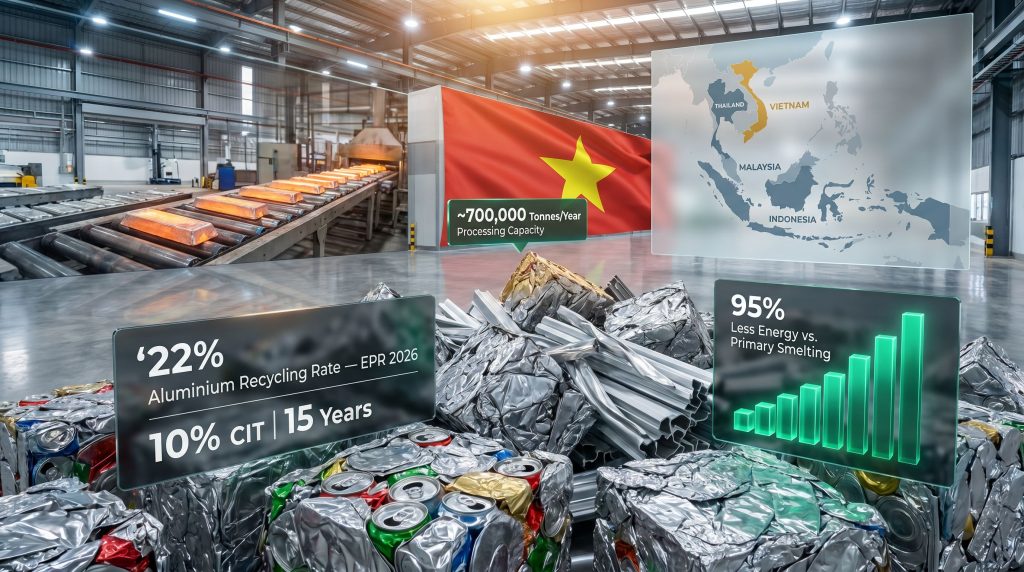
Across the global metals industry, a structural realignment is quietly underway. The economics of secondary aluminium production have grown increasingly compelling as energy costs rise, carbon regulations tighten, and primary smelting faces intensifying scrutiny. Recycled aluminium produces roughly 3% of the greenhouse gas emissions of its primary equivalent and consumes up to 95% less energy during processing. These numbers are not marginal improvements — they represent a categorical difference in industrial footprint, and they are reshaping where capital flows, where recycling infrastructure gets built, and which nations emerge as the next generation of materials recovery hubs.
Vietnam has entered this competition with a well-structured legislative toolkit and a set of Vietnam aluminium scrap recycling incentives that have drawn attention from traders, processors, and investors across the Asia-Pacific region. However, ambition and execution are different currencies, and the distance between them in Vietnam remains considerable.
When big ASX news breaks, our subscribers know first
What Vietnam's Incentive Framework Actually Offers
The Corporate Income Tax Preferential Rate
The centrepiece of Vietnam's recycling incentive package is a preferential corporate income tax (CIT) rate of 10%, available to licensed recycling and waste-treatment companies for a period of 15 years. For context, Vietnam's standard CIT rate sits at 20%, meaning qualifying recyclers receive a sustained half-rate concession across a period long enough to support meaningful capital investment cycles.
This is not a temporary stimulus measure. It reflects a structural policy choice embedded in Vietnam's revised Corporate Income Tax legislation, designed to formalise recycling activity and attract the kind of patient capital that industrial-scale recycling operations require.
How Vietnam Compares to Regional Competitors on Tax Incentives
| Country | Corporate Tax Incentive for Recyclers | Duration |
|---|---|---|
| Vietnam | 10% preferential rate | 15 years |
| Thailand | Standard rate with sector exemptions | Varies |
| Malaysia | Green investment tax allowances | Project-based |
| Indonesia | Tax holidays for priority industries | Up to 20 years |
Beyond the CIT concession, the framework includes a 2% annual interest-rate subsidy on loans for qualifying green recycling projects, reducing the financing cost of capital-intensive equipment and facility construction. Battery recyclers gain access to an additional layer of support, with individual grants reaching up to VND 20 billion (approximately USD 800,000) per applicant. Furthermore, these measures reflect a broader regional push, similar to battery recycling in China, where state-backed incentives have accelerated secondary materials processing at scale.
The battery recycler support packages reveal something important about the underlying intent of Vietnam's industrial strategy. The incentive architecture extends well beyond aluminium into the broader materials recovery chain, including battery-grade metals that sit at the intersection of EV supply chains and circular economy policy.
The Extended Producer Responsibility Framework: Obligations from May 2026
Alongside the tax incentives, Vietnam is activating a mandatory Extended Producer Responsibility (EPR) framework with effect from 25 May 2026. Under this system, producers and importers of designated product categories must either meet recycling rate targets directly or contribute financially to the Vietnam Environment Protection Fund. The battery raw materials market is increasingly shaping how such frameworks are designed across the region.
The mandated minimum recycling rates are as follows:
| Material Category | Minimum Recycling Rate Required |
|---|---|
| Aluminium Packaging | 22% |
| Steel and Metal Packaging | 20% |
| Rechargeable Batteries | 8-12% |
| Electronic Equipment | 3-15% |
Aluminium packaging carries the highest single recycling obligation of any packaging category, reflecting both its material value and its relatively high recyclability compared to mixed plastics or composite materials. The dual-pathway compliance mechanism — where non-compliant producers can redirect contributions to the Environment Protection Fund rather than face direct penalties — ensures that capital continues flowing toward recycling infrastructure even when individual producers fall short of targets.
The Supply Chain Reality Behind the Policy Headlines
A Structural Feedstock Problem
Vietnam's recycling policy framework is architecturally coherent, but the domestic scrap supply infrastructure it depends upon remains deeply fragmented. The country's informal recycling sector is dominated by more than 4,000 small craft villages, where materials are processed without standardised environmental controls or quality certification.
Against this backdrop, Vietnam has only an estimated 35 to 54 formally licensed recycling companies, a ratio that exposes the scale of the formalisation challenge ahead. The country also imports over 70% of its key steelmaking raw materials, a dependency that extends into aluminium scrap and signals that domestic collection systems cannot currently supply the volumes required to run large-scale secondary smelting operations at meaningful capacity utilisation rates. Consequently, as investor attitudes toward Vietnam suggest, enthusiasm for the policy framework has not yet translated into broad-based capital deployment.
The Import Grade Bottleneck and Pricing Distortions
Vietnam restricts the grades of aluminium scrap that can be legally imported, creating intense competition for approved categories such as extrusion scrap. This restriction has produced a counterintuitive pricing outcome: Vietnamese buyers have at times paid higher prices than Thai buyers for the same scrap grades, despite Thailand operating significantly greater overall recycling capacity.
This pricing distortion does not reflect genuine demand strength on Vietnam's part. It reflects structural scarcity created by import controls, and it creates margin risk for recyclers who enter the market expecting pricing to normalise as capacity scales. Illegal trade channels add further complexity, as industry participants have noted that prohibited materials — including baled used beverage cans (UBC) — continue to enter the country through unofficial routes, undermining the integrity of the formal supply chain and creating compliance risk for licensed operators.
Capacity vs. Demand: A Significant Imbalance
| Metric | Estimated Figure |
|---|---|
| Vietnam Aluminium Scrap Processing Capacity | ~700,000 tonnes/year |
| Domestic ADC12 Demand | ~120,000 tonnes/year |
| Implied Capacity Utilisation | Significant overcapacity risk |
This gap between installed processing capacity and domestic demand for secondary alloy, particularly ADC12 (a cast aluminium alloy widely used in automotive die-casting), raises questions about where recycled output will be absorbed if domestic manufacturing demand does not scale commensurately.
Demand Headwinds: China, Japan, and the EV Variable
China's Domestic ADC12 Surge
China has historically been a significant buyer of imported cast aluminium alloy, but that dynamic is shifting. Chinese imports of cast aluminium alloy declined 16.8% year-on-year in 2025, driven by rapid growth in domestic ADC12 production capacity. As Chinese producers become increasingly self-sufficient in secondary alloy, the export market for Vietnamese-processed scrap narrows.
There is an additional layer of demand uncertainty tied to EV policy. Reduced emphasis on electric vehicle subsidies in China's latest Five-Year Plan may suppress downstream aluminium demand from the automotive sector. In addition, battery storage expansion globally has been one of the primary growth drivers for secondary alloy consumption, and any slowdown in that trend compounds the demand risk for Vietnamese processors.
Japan's Automotive Slowdown
Japan represents another demand risk. Weak automotive sales have pushed Japanese imports of cast aluminium alloys in the first quarter of 2026 to their lowest first-quarter level since 2013. For a country that has historically been one of Asia's most consistent buyers of secondary aluminium, this represents a meaningful structural shift rather than a temporary cyclical dip.
Chinese Exporters Targeting Vietnam
Ironically, as Chinese domestic demand contracts, Chinese secondary alloy producers are increasingly directing exports toward Vietnam to compensate for the shortfall at home. This means Vietnamese recyclers face competitive pressure not only from established regional players in Thailand and Malaysia, but also from Chinese exporters actively undercutting local production economics. Furthermore, the broader US-China trade war continues to reshape how materials flow across the region, adding further unpredictability to trade patterns that affect Vietnam's positioning.
Global Scrap Trade Disruption: Threats and Openings
The broader global scrap trade environment is in flux, and Vietnam's positioning must be understood within this context. The China tariff impacts on raw material flows are already redirecting scrap volumes across Asia, creating both openings and risks for emerging recycling hubs.
-
The US-China tariff escalation, which saw duties on US goods entering China reach 125% in April 2025, prompted Chinese buyers to redirect aluminium and copper scrap flows through Southeast Asia and Japan.
-
Europe is considering export levies on aluminium scrap in 2026, which could redirect European supply volumes toward alternative markets including Vietnam.
-
Port inspection tightening in Thailand, Malaysia, and Japan is creating logistical friction that may favour Vietnamese ports in the near term.
-
Alternative routing through Bangladesh and Pakistan is being explored by some Chinese traders, but cashflow challenges and port infrastructure limitations continue to constrain those options.
These disruptions create genuine windows of opportunity, but they are cyclical and contingent rather than structural advantages Vietnam can rely upon for long-term investment cases.
Thailand vs. Vietnam: The Investment Comparison
| Investment Factor | Vietnam | Thailand |
|---|---|---|
| Recycling Policy Framework | Developing (EPR from 2026) | More established |
| Manufacturing Demand Base | Emerging | Mature automotive sector |
| Global Automaker Presence | Growing | Strongly embedded |
| Regulatory Transparency | Improving | Generally higher |
| Fiscal Incentives for Recyclers | Strong (10% CIT, subsidies) | Moderate |
| Domestic Scrap Supply Infrastructure | Fragmented | More developed |
Industry participants who track both markets closely point to Thailand's more advanced recycling ecosystem as a key differentiator. Thailand benefits from deeper integration with global automotive manufacturers and a more mature industrial demand base for secondary aluminium. Vietnam's fiscal incentives are arguably stronger on paper, but incentives alone do not substitute for a developed downstream market or reliable feedstock supply.
The Middle East is also emerging as a competing destination for scrap-related capital. Countries including the UAE and Saudi Arabia are investing in port infrastructure and processing facilities with the explicit aim of becoming major global scrap transshipment hubs, according to the Bureau of Middle East Recycling (BMR). An analysis of ASEAN aluminium scrap trade further illustrates how Vietnam fits within this broader competitive landscape across the region.
The next major ASX story will hit our subscribers first
How to Access Vietnam's Recycling Incentive Programs: A Step-by-Step Guide
-
Register as a licensed recycling entity under the 2020 Law on Environmental Protection, ensuring full compliance with air, water, and solid waste treatment standards required for formal recognition.
-
Apply for Corporate Income Tax preferential status under the revised CIT legislation to access the 10% rate over a 15-year period.
-
Engage with EPR compliance programmes by positioning the operation as a certified third-party recycling partner for manufacturers and importers who must meet mandated targets from May 2026.
-
Access green project financing by applying for the 2% annual interest-rate subsidy available on qualifying infrastructure loans.
-
Explore battery recycler support packages if operations extend into lithium-ion or other rechargeable battery processing, where individual grants of up to VND 20 billion (USD 800,000) are available.
-
Align with the Vietnam Environment Protection Fund to position the business as a certified recycling partner for EPR-obligated producers redirecting compliance contributions.
Three Scenarios for Vietnam's Recycling Sector by 2035
Scenario 1: Accelerated Formalisation. EPR enforcement strengthens over time, domestic collection infrastructure scales through public-private partnerships, and foreign capital enters through joint ventures with local manufacturers. Vietnam builds a genuine secondary aluminium industry anchored by beverage can collection and automotive casting demand.
Scenario 2: Stagnant Middle Ground. Incentives attract initial investment, but informal networks persist, feedstock quality remains inconsistent, and downstream demand fails to absorb available recycled output. The sector grows slowly but remains fragmented and import-dependent.
Scenario 3: Regional Consolidation Loss. Vietnam loses the investment competition to Thailand and the Middle East, becoming a secondary scrap processing market rather than a primary recycling hub. Chinese ADC12 oversupply continues to suppress regional pricing, and Vietnam's overcapacity problem deepens.
The path between Scenario 1 and Scenario 3 will be determined largely by execution quality rather than policy design. Vietnam's incentive framework is architecturally sound, but investors who rely on Vietnam aluminium scrap recycling incentives alone — rather than building vertically integrated collection-to-casting operations — will be exposed to feedstock and demand risks that no tax concession can fully offset.
Key Facts: Vietnam Aluminium Scrap Recycling Incentives at a Glance
-
Vietnam's EPR framework mandates a 22% recycling rate for aluminium packaging from May 2026
-
Qualifying recycling companies can access a 10% preferential CIT rate for up to 15 years
-
Green recycling projects qualify for a 2% annual interest-rate subsidy on project financing
-
Battery recyclers may access support packages worth up to VND 20 billion (USD 800,000) per applicant
-
Vietnam's aluminium scrap processing capacity stands at approximately 700,000 tonnes/year against domestic ADC12 demand of only around 120,000 tonnes/year
-
Recycled aluminium produces approximately 3% of the emissions of primary aluminium and uses up to 95% less energy
-
More than 4,000 informal craft villages dominate domestic scrap collection, compared to only 35 to 54 formally licensed recycling facilities
-
Chinese cast aluminium alloy imports fell 16.8% year-on-year in 2025, reducing the primary export market for Vietnamese secondary alloy processors
Disclaimer: This article contains forward-looking analysis, market projections, and scenario assessments based on available industry data and publicly reported information. These projections involve inherent uncertainty and should not be construed as investment advice. Market conditions, regulatory frameworks, and trade dynamics are subject to change. Readers should conduct independent due diligence before making investment decisions.
Want to Stay Ahead of the Next Major Resource Discovery?
While Vietnam's aluminium recycling sector reshapes regional materials flows, Discovery Alert's proprietary Discovery IQ model continuously scans ASX announcements in real time, instantly identifying significant mineral discoveries across aluminium, battery metals, and more than 30 other commodities — translating complex data into actionable investment insights. Explore how historic discoveries have generated extraordinary returns and begin your 14-day free trial today to position yourself ahead of the broader market.