July 8, 2026
The Engineering Bottleneck at the Heart of Global Copper Expansion
The global copper industry faces a constraint that rarely makes headlines: the extreme scarcity of firms capable of designing and building a large, modern copper smelter from the ground up. Unlike open-pit mine construction, which draws on a relatively broad pool of civil engineering contractors, copper smelter design is a discipline mastered by only a handful of specialised organisations worldwide. This technical reality sits at the centre of BHP's decision to award the BHP Olympic Dam expansion contract to China Nerin Engineering, a choice that reveals as much about the global engineering landscape as it does about BHP's strategic priorities.
Understanding why this contract matters requires looking beyond the headline dollar figure and examining the metallurgical complexity involved, the production ambitions at stake, and the nuanced geopolitical calculus that any major mining company must navigate in the current environment.
When big ASX news breaks, our subscribers know first
Olympic Dam as a Processing Transformation, Not Just a Mine Expansion
Olympic Dam, located in South Australia's Gawler Craton, is a genuinely singular geological asset. It hosts one of the largest known accumulations of copper, uranium, gold, and silver in a single orebody anywhere on Earth. The deposit is classified as an IOCG deposits system, a relatively rare geological formation where copper mineralisation is associated with iron oxide alteration rather than the porphyry or sediment-hosted environments more common globally. This geological character contributes to a complex ore blend that presents distinct metallurgical challenges during processing.
BHP's proposed Smelter and Refinery Expansion (SRE) is fundamentally about unlocking the downstream value of this resource base. The critical distinction here is that this is not a programme to dig more ore out of the ground. It is a plan to dramatically increase the capacity to process ore that is already being mined, converting copper concentrate into refined copper metal within South Australia rather than shipping unprocessed material to overseas smelters.
Production Targets That Would Reshape Global Supply Balances
The production ambitions embedded in the SRE programme are substantial relative to current South Australian output:
| Production Milestone | Target Volume | Indicative Timeline |
|---|---|---|
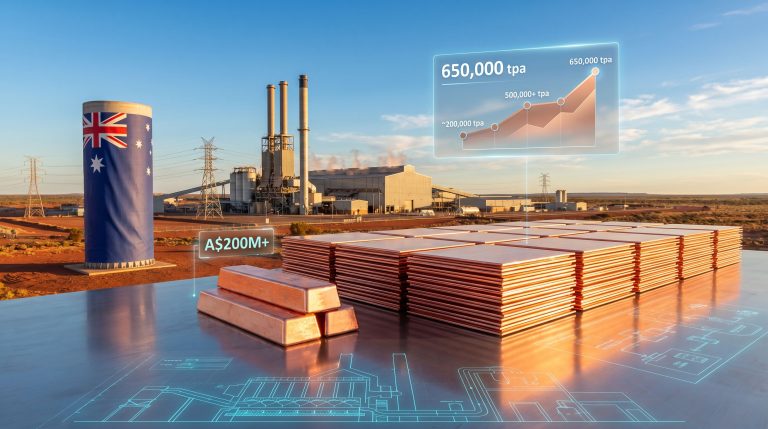
| Near-term expansion target | 500,000 tonnes per annum | Through the 2030s |
| Long-term production ambition | Up to 650,000 tonnes per annum | End of the 2030s |
| Pre-expansion South Australian output | Materially below 500,000 tpa | Current baseline |
Reaching 500,000 tonnes of refined copper per annum from a single Australian jurisdiction would place South Australia among the most consequential copper producing regions on the planet. For context, total global refined copper production currently sits in the range of 25 to 26 million tonnes annually, meaning a single facility of this scale would represent roughly two percent of world supply — an individually meaningful increment in a market where new large-scale additions are exceptionally rare.
Breaking Down the China Nerin Contract Structure
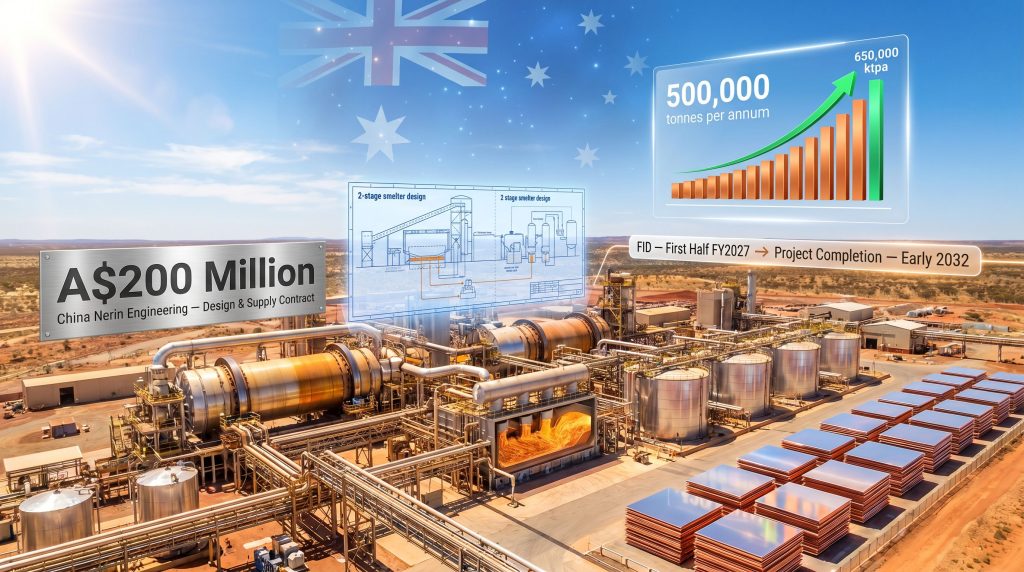
The contract awarded to China Nerin Engineering is valued at more than A$200 million (approximately US$138.8 million) and is structured to reflect the phased nature of BHP's capital commitment process. Furthermore, the copper supply crunch facing the global market makes the timing and scale of this investment particularly significant.
The agreement covers two primary domains:
- Design and engineering services for key processing facilities within the new smelter and refinery complex, including a new two-stage copper smelting system
- Procurement and supply of critical processing equipment, subject to BHP approving the project's Final Investment Decision
The two-stage smelting architecture referenced in the contract is technically significant. Modern large-scale copper smelters typically employ flash smelting or bath smelting technologies that process concentrates in two distinct conversion stages, producing blister copper that is subsequently refined to cathode-grade metal. The engineering precision required across each stage — including gas handling systems, anode furnaces, and refinery tankhouse design — demands highly specialised competence.
Why the Staged Execution Model Protects BHP's Capital Position
The contract's staged structure is a deliberate risk management mechanism. Only the design and study components activate immediately upon contract award. The supply phase, which would involve the physical procurement and delivery of major equipment, remains contingent on BHP's board approving the Final Investment Decision (FID).
The FID is the formal board-level threshold at which a mining company transitions from spending on studies to committing full project capital. Until that decision is made, all engineering expenditure is classified as study cost, representing a fraction of total project investment.
Key project milestones under the current schedule:
- Design and study phase executes immediately, running through 2026 and into 2027
- FID is targeted for the first half of BHP's 2027 financial year
- Construction and commissioning follows FID approval, spanning approximately five years
- Project completion is targeted for early 2032
- Production ramp-up toward 500,000 tpa commences from 2032 onward
Why China Nerin Engineering Won This Contract
China Nerin Engineering is not a general construction contractor that happened to submit a competitive tender. It is a dedicated metallurgical engineering design institute with a track record specifically in large copper smelter construction. The firm has been involved in designing and building seven large modern copper smelters globally in recent years, a portfolio concentration that very few engineering organisations anywhere in the world can match.
This specialisation matters enormously in a field where design errors carry catastrophic consequences. Copper smelters operate at temperatures exceeding 1,200 degrees Celsius, handle highly corrosive materials, and generate sulphur dioxide off-gas streams that require sophisticated gas capture and acid plant systems. Getting the engineering wrong is not a recoverable situation once construction is underway.
The Global Smelter Engineering Capability Gap
China currently accounts for an estimated 40 to 45 percent of global copper smelting capacity, a dominance built over two decades of sustained domestic infrastructure investment. That concentration of operational experience has, predictably, generated a concentration of engineering expertise. In addition, Chinese metallurgical engineering firms have accumulated design knowledge and construction experience at scales that Western counterparts have not replicated in the same period.
The practical consequence is a constrained global contractor pool. For a project of Olympic Dam's ambition, the realistic shortlist of engineering firms with demonstrable large-scale smelter design credentials is short. Excluding Chinese firms from consideration would not simply introduce competitive tension — it would materially narrow the available options and risk compromising both the quality and timeline of a project measured in billions of dollars. Consequently, copper smelting expansion decisions of this magnitude increasingly intersect with broader questions of geopolitical strategy.
The Dual-Contract Architecture of the SRE Programme
The Nerin agreement operates within a broader engineering governance structure that BHP has assembled for the BHP Olympic Dam expansion contract to China Nerin Engineering programme:
| Contract | Counterparty | Approximate Value | Scope |
|---|---|---|---|
| EPCM Study Contract | Fluor Australia and Hatch (Joint Venture) | ~A$40 million | Engineering, procurement and construction management studies |
| Design and Supply Contract | China Nerin Engineering | A$200 million+ | Processing facility design and major equipment supply |
Separating the EPCM management function from the specialist design and supply role is standard practice in large mining capital projects. The Fluor/Hatch joint venture provides independent project management oversight and construction expertise, while Nerin contributes the deep metallurgical design capability that the smelter architecture demands. This structure distributes technical risk and preserves independent oversight of Nerin's deliverables.
Interpreting the Geopolitical Dimension
The decision to award a major contract to a Chinese engineering firm does not exist in a political vacuum. Western governments, including Australia, have been actively developing critical minerals strategies aimed at reducing dependence on Chinese processing capacity. The apparent tension between those policy objectives and BHP's vendor selection warrants careful unpacking.
Three analytical frameworks offer more nuanced perspectives than a straightforward contradiction narrative:
Frame 1: Commercial Fiduciary Logic
BHP operates under obligations to shareholders to pursue the most technically capable and cost-effective contracting approach available. In a specialist field with a thin global contractor pool, selecting the firm with the deepest relevant track record is entirely consistent with fiduciary responsibility, irrespective of that firm's national origin.
Frame 2: The Capability Gap Is Real, Not Rhetorical
The absence of sufficient large-scale smelter engineering capacity in Western firms is not a talking point. It is a structural reality produced by decades of underinvestment in domestic copper processing infrastructure across Europe, North America, and Australia. Rebuilding that capacity is a multi-decade project in itself.
Frame 3: Australian Processing as the Strategic Outcome
Perhaps the most counterintuitive analytical point is this: the SRE's purpose is to build smelting and refining infrastructure within Australia, directly reducing the volume of copper concentrate that currently travels overseas for processing, including to Chinese smelters. Engaging Chinese engineering expertise to construct Australian processing capacity may, in the long run, reduce Chinese leverage over Australian copper value chains rather than extend it.
The ultimate strategic test is not which firm designed the facility, but where the value-add processing occurs. If Olympic Dam reaches 500,000 tonnes of refined copper produced in South Australia, the value capture equation shifts decisively onshore.
The next major ASX story will hit our subscribers first
The Rare Earths Layer: A Secondary Strategic Dimension
Olympic Dam's geological complexity extends beyond its copper, uranium, and gold endowment. The deposit has attracted attention from industry observers who have called on BHP to formally evaluate the rare earth element potential within the broader resource. IOCG-type deposits can host elevated concentrations of light rare earth elements, and Olympic Dam's processing streams generate residues that may carry recoverable REE content.
This dimension intersects with the SRE in a speculative but important way. The engineering design phase now underway with Nerin represents an early window in which processing circuit architecture could theoretically be configured to accommodate future rare earths recovery pathways. Retrofitting a smelter complex for REE recovery after construction is substantially more expensive than integrating that capability into the original design. Whether BHP is actively considering this possibility within the current study scope has not been confirmed, but the design phase timing creates optionality that will not exist once the facility is built.
What the FID Represents for Copper Market Participants
For investors and copper market participants, the FID decision targeted for the first half of BHP's 2027 financial year carries significance well beyond a single company's capital budget. Global copper demand forecasts, driven by electrification across transport infrastructure, renewable energy systems, and industrial applications, consistently point toward a structural supply deficit emerging through the late 2020s and deepening into the 2030s. However, copper investment strategies must account for the considerable lead times and capital intensity that projects of this nature demand.
New large-scale refined copper supply additions are among the most capital-intensive and time-consuming industrial investments that exist. The Olympic Dam SRE, if it proceeds through FID to construction, would represent one of the most significant capacity additions to the global refined copper supply picture in the coming decade. This would be delivered not from a new greenfield discovery but from a transformation of existing infrastructure at one of the world's largest known copper orebodies. BHP's copper expansion plans reflect a broader industry pivot toward maximising value from proven, large-scale resource bases rather than pursuing costlier greenfield alternatives.
FAQ: BHP Olympic Dam Expansion and the China Nerin Contract
What is the total value of the China Nerin contract?
The contract is valued at more than A$200 million (approximately US$138.8 million). Full details of the project scope are available via the South Australian Government's major projects register.
Is the full contract value committed?
No. The supply component activates only if BHP approves the Final Investment Decision. Design and study phases are active immediately.
When is BHP's FID expected?
BHP has indicated the FID is targeted for the first half of the 2027 financial year.
What is China Nerin Engineering's relevant experience?
The firm is a specialist metallurgical engineering design institute with involvement in the design and construction of seven large modern copper smelters in recent years.
What other firms are involved in the Olympic Dam expansion?
A joint venture between Fluor Australia and Hatch holds a separate approximately A$40 million EPCM study contract covering project management oversight for the broader programme.
What is BHP's production target for South Australian copper?
The near-term target is 500,000 tonnes per annum through the 2030s, with a longer-term ambition of reaching 650,000 tonnes per annum by the end of that decade.
Disclaimer: This article contains forward-looking statements and references to production targets, investment timelines, and market forecasts. These are subject to material risks and uncertainties. The Final Investment Decision has not yet been made. Nothing in this article constitutes financial or investment advice. Readers should conduct their own due diligence before making any investment decisions.
Want to Capitalise on the Next Major Copper Discovery Before the Broader Market?
Discovery Alert's proprietary Discovery IQ model delivers real-time alerts on significant ASX mineral discoveries — instantly transforming complex mineral data into actionable opportunities for both short-term traders and long-term investors. Explore historic examples of exceptional mineral discovery returns and begin your 14-day free trial today to position yourself ahead of the next major copper market move.