July 8, 2026
The Race to Rewire Global Copper Supply Chains
The copper market is approaching an inflection point that has been building for years. Structural shifts in how electricity is generated, stored, and distributed have created a demand profile for refined copper that existing global mine and smelter capacity cannot easily satisfy. Wood Mackenzie and other commodities research groups have consistently flagged a potential refined copper deficit widening through the late 2020s and into the 2030s, driven by accelerating deployment of electric vehicles, utility-scale battery storage, offshore wind installations, and grid modernisation programmes across the United States, Europe, and Asia.
Against this backdrop, the decisions being made today about smelter and refinery capacity will determine how effectively the global economy navigates its energy transition. Few projects sit more centrally in that calculation than the BHP Olympic Dam smelter expansion contract, and the awards announced in July 2026 mark a decisive step in moving that project from concept to construction-ready. For context on the broader copper supply crunch facing global markets, the structural forces driving demand are well documented.
When big ASX news breaks, our subscribers know first
Olympic Dam: Understanding What Makes This Deposit Genuinely Exceptional
Most large copper mines are exactly that: copper mines. Olympic Dam is something structurally different. Located in the Stuart Shelf region of South Australia, it hosts one of the largest known accumulations of copper, uranium, gold, and silver within a single orebody. The deposit is classified as an iron oxide copper gold system, a geological category associated with deep crustal fluid interaction and exceptional mineralisation continuity at depth.
What distinguishes Olympic Dam from other large copper systems is not just its size but its integrated processing infrastructure. The site contains the only major copper smelter and refinery operating in Australia, meaning it can take copper concentrate through to refined cathode product entirely on-site. Most Australian copper producers ship concentrate offshore for smelting, typically to Asian smelters. Olympic Dam's ability to produce London Metal Exchange-grade copper cathode domestically gives it a strategic position within Australia's critical minerals supply chain that no other site can replicate.
The Polymetallic Co-Production Advantage
The uranium, gold, and silver content at Olympic Dam meaningfully changes the project economics compared to a single-commodity copper operation. Uranium produced as a co-product supports the site's operating cost structure, while gold and silver recoveries add further revenue diversification. This polymetallic nature means that copper price volatility, while still the primary driver of project economics, is partially buffered by co-product revenues.
In periods of uranium price strength, as has been observed through 2023 to 2025, this co-production dynamic becomes particularly valuable to BHP's internal return calculations. Furthermore, Australia's critical minerals policy framework increasingly recognises the strategic importance of polymetallic deposits such as this.
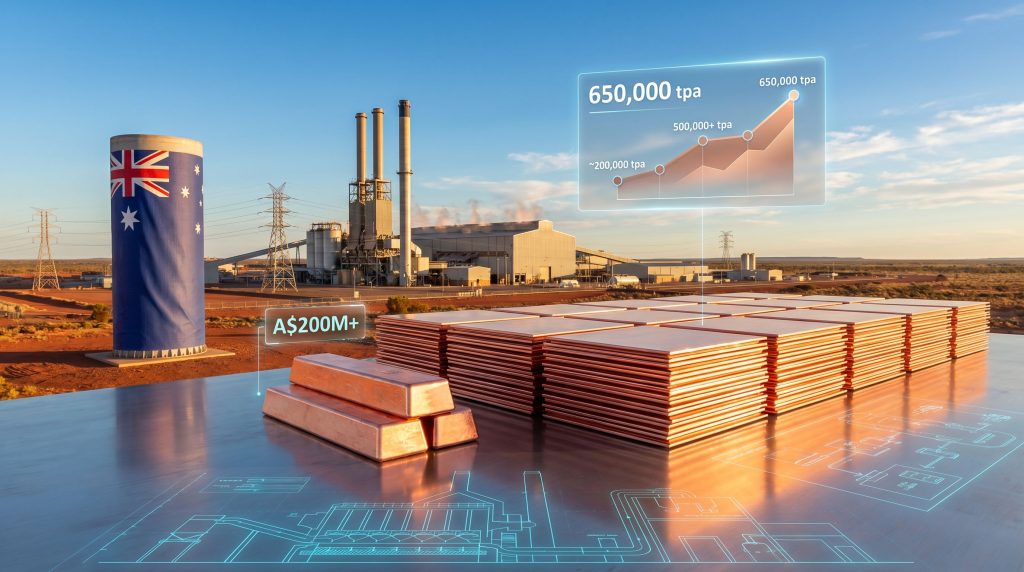
Current production sits at approximately 200,000 tonnes per annum (tpa) of copper cathode. The planned expansion targets more than 500,000 tpa in the early 2030s, rising to a long-range ceiling of 650,000 tpa by the mid-2030s. Achieving that upper production ceiling would position Olympic Dam among the top five copper producing operations globally by output volume.
| Production Milestone | Target Volume | Indicative Timeline |
|---|---|---|
| Current Baseline | ~200,000 tpa | Existing operations |
| Phase One Target | 500,000+ tpa | Early 2030s |
| Long-Range Target | 650,000 tpa | Mid-2030s |
The BHP Olympic Dam Smelter Expansion Contracts: What Was Actually Awarded
On 8 July 2026, BHP confirmed two separate contract awards tied to the BHP Olympic Dam smelter expansion contract program. Understanding the distinction between these two agreements matters, because they serve fundamentally different functions within the project's development architecture.
Contract One: China Nerin Engineering's Design and Supply Agreement
BHP awarded China Nerin Engineering a contract valued at more than A$200 million (approximately US$138.8 million) for the design and supply of key processing facilities at Olympic Dam. China Nerin Engineering is a Beijing-headquartered metallurgical engineering firm with a long operational history in non-ferrous smelting design, particularly within copper and lead-zinc processing systems.
Several features of this contract structure deserve careful attention:
- The agreement is executed in staged phases, aligned to BHP's internal study milestones rather than a fixed construction timeline.
- The physical supply component of the contract is conditional on BHP approving a positive Final Investment Decision (FID). If the FID is not approved, the supply obligations do not activate.
- China Nerin Engineering has publicly indicated a completion target of early 2032, consistent with Phase One production targets.
- The scope covers design and supply of processing facilities integral to the smelter and refinery expansion, though the precise equipment categories have not been publicly itemised.
The conditional supply structure gives BHP a meaningful contractual off-ramp if project economics, regulatory conditions, or capital allocation priorities shift materially before the FID window in the first half of FY2027.
Contract Two: The Fluor Australia and Hatch EPCM Agreement
A separate contract valued at approximately US$40 million was awarded to a joint venture between Fluor Australia and Hatch. This agreement covers Engineering, Procurement, and Construction Management (EPCM) responsibilities, specifically focused on overall project strategy, study-phase coordination, and planning management in the period leading up to BHP's FID.
EPCM contracts of this type are standard practice in large-scale mining and processing capital projects. The EPCM contractor acts as the integrating intelligence across engineering disciplines, procurement strategy, and contractor management, without necessarily holding construction risk directly. The Fluor-Hatch joint venture brings complementary strengths: Fluor's global EPCM track record across resources and processing infrastructure, and Hatch's deep specialisation in metals and minerals processing engineering.
Side-by-Side Contract Comparison
| Contract Attribute | China Nerin Engineering | Fluor Australia and Hatch JV |
|---|---|---|
| Contract Value | A$200M+ (~US$138.8M) | ~US$40M |
| Contract Type | Design and Supply | EPCM |
| Execution Model | Staged | Staged |
| FID Dependency | Supply component conditional | Study phase pre-FID |
| Projected Completion | Early 2032 | Aligned to FID timeline |
| Primary Role | Processing facility design and supply | Strategy, planning and study management |
What the Two-Stage Smelting Configuration Actually Means
The technical heart of the expansion is a shift from Olympic Dam's existing Direct-to-Blister Flash Furnace configuration to a two-stage smelting architecture. This distinction is not purely an engineering detail: it has direct implications for throughput capacity, energy efficiency, and the site's ability to process a wider range of concentrate feed grades.
In the current single-stage process, copper concentrate is converted directly to blister copper in a single high-intensity flash furnace step. This is efficient at existing volumes but creates bottlenecks when throughput targets scale significantly. The two-stage approach separates the process into:
- Matte smelting in a new furnace, converting concentrate to copper matte (an intermediate product typically containing 60 to 75 percent copper).
- Converting, in which copper matte is processed to blister copper in a dedicated converting vessel, before final refining to cathode.
The existing Direct-to-Blister Flash Furnace is repurposed within this new configuration rather than decommissioned, preserving the capital already embedded in that infrastructure. This approach consequently reduces the greenfield capital requirement while enabling the step-change in capacity that BHP's production targets demand.
Critical Enabling Infrastructure
The smelter expansion cannot function in isolation. Two infrastructure programmes are central to making Phase One operationally viable:
- Northern Water Project: Upgraded water supply systems designed to meet the significantly higher processing volumes associated with 500,000 tpa copper cathode production. Water availability in South Australia's arid interior is a genuine constraint that requires capital-intensive supply infrastructure.
- 275kV Electricity Transmission Line: A new high-voltage transmission connection from Davenport to Olympic Dam, designed to meet the substantially higher power demand of an expanded smelting and refining operation. Flash furnace smelting is energy-intensive; scaling throughput by more than 2.5 times requires a corresponding expansion of reliable power supply.
The China Nerin Engineering Selection: Reading the Procurement Signal
The decision to award the largest single contract in the BHP Olympic Dam smelter expansion contract program to a Chinese metallurgical engineering firm will attract scrutiny given the current geopolitical environment surrounding critical minerals supply chains. Several contextual factors are worth understanding.
China Nerin Engineering, operating under the umbrella of China ENFI Engineering Corporation (a subsidiary of China Minmetals), has accumulated significant design experience across copper, lead, zinc, and other non-ferrous smelting systems globally. In the specific domain of flash furnace and bath smelting design for copper processing, Chinese engineering firms have developed genuine competitive capability over the past two decades.
This has occurred partially through technology transfer arrangements with Finnish engineering group Outotec (now Metso Outotec) and through domestic project experience. From a procurement strategy perspective, BHP's contract award reflects a technical capability assessment rather than a geopolitical one. The staged, FID-conditional contract structure limits financial exposure before the project receives full board approval.
Investors and industry observers should note that the conditional contract structure is a risk management mechanism, not an unconditional commitment to construction. BHP retains meaningful optionality through to its FID decision window.
Whether the selection of a Chinese engineering contractor creates downstream regulatory complexity for Olympic Dam remains an open question. Australia's critical minerals framework has been evolving, and foreign involvement in processing infrastructure for strategic minerals may attract additional review as policy settings continue to develop.
The FID Decision: What BHP Must Resolve Before 2027
BHP has indicated a target FID window in the first half of the 2026–27 financial year. Several workstreams must converge before that decision can be taken with confidence. Completing a robust definitive feasibility study across all major project components is one of the most critical requirements.
Additional workstreams include:
- Resolution of impact assessment processes under South Australia's development framework, where the expansion has been classified as impact-assessed development by the Minister for Energy and Mining.
- Finalisation of power and water infrastructure agreements to support expanded operations.
- Capital allocation competition within BHP's broader portfolio, including Chilean copper assets and other major capital programmes.
- Copper price assumptions embedded in the project's long-term economic model.
Risk Factors That Could Influence the FID Outcome
No major capital decision of this magnitude is free of material risk factors. The key variables that could alter the FID timeline or outcome include:
- Copper price volatility: At current copper prices, Olympic Dam expansion economics appear supportive. However, a sustained price decline toward US$7,500 per tonne or below would require recalibration of the project's internal rate of return assumptions.
- Construction cost inflation: Global engineering and construction markets have experienced significant labour and materials cost escalation. South Australia's resources construction sector faces particular workforce availability constraints.
- Regulatory approval timing: Impact assessment processes can be extended by community consultation requirements, environmental review periods, or technical queries from regulatory decision-makers.
- Geopolitical considerations: The involvement of a Chinese engineering contractor may attract additional scrutiny from regulatory or policy bodies as Australia's critical minerals governance framework continues to evolve.
The next major ASX story will hit our subscribers first
Why This Matters Beyond BHP's Balance Sheet
The BHP Olympic Dam smelter expansion is significant not just as a corporate capital project but as a structural contribution to global copper supply availability through the 2030s. The International Copper Association and multiple independent commodities analysts have highlighted that no single project currently in the development pipeline represents a more consequential addition to refined copper capacity in a Western-aligned jurisdiction.
Australia's position as a producer of refined copper, rather than simply copper concentrate, carries strategic value as importing nations seek to reduce dependence on Chinese smelting and refining capacity. Currently, China processes approximately 40 percent of global copper concentrate into refined metal. An expanded Olympic Dam would, in addition, provide a meaningful alternative source of refined copper cathode for markets seeking supply chain diversification.
For investors considering copper investment strategies in this environment, the Olympic Dam expansion represents one of the most closely watched catalysts in the sector. The 2027 FID window is therefore a decision point with implications that extend well beyond BHP's own production targets. It represents a test of whether large-scale copper processing capacity can be built in high-cost, regulated Western jurisdictions at the pace and scale that the global energy transition requires.
Disclaimer: This article contains forward-looking statements and production targets based on publicly available information and company announcements. These projections are subject to material risks and uncertainties including commodity price movements, regulatory outcomes, and capital allocation decisions. Nothing in this article constitutes financial or investment advice. Readers should conduct their own due diligence before making investment decisions. Further reporting on BHP's copper strategy and the Olympic Dam expansion programme is available at miningweekly.com.
Want to Track the Next Major Copper Discovery Before the Market Does?
Discovery Alert's proprietary Discovery IQ model delivers real-time alerts on significant ASX mineral discoveries — including copper — instantly empowering subscribers to identify actionable opportunities as the global copper supply crunch intensifies. Explore historic discoveries and their extraordinary returns on Discovery Alert's dedicated discoveries page, or begin your 14-day free trial today to position yourself ahead of the market.