July 8, 2026
The Three-Track Approval Challenge Reshaping Canada's Copper Future
Across the global mining industry, a recurring pattern has emerged over the past two decades: the gap between discovering a world-class copper deposit and actually putting it into production has widened dramatically. Regulatory complexity, Indigenous rights frameworks, and environmental scrutiny have collectively extended pre-construction timelines from years into decades for large-scale projects. Understanding why this happens, and how developers navigate it, is increasingly central to evaluating any major copper project on its merits.
The Yellowhead copper mine environmental approval process, currently advancing through British Columbia's multi-layered assessment architecture, illustrates this dynamic with unusual clarity. The project is not simply awaiting a single regulatory verdict. It is simultaneously navigating three independent approval tracks, each with its own timeline, stakeholder requirements, and legal weight.
When big ASX news breaks, our subscribers know first
Canada's Copper Supply Gap and Why Yellowhead's Scale Matters
Canada has long been a significant copper producer, but its output relative to surging global demand has been gradually eroding. The country's existing major copper operations are mature assets, many operating well into their productive lifecycles. New large-scale supply from domestic sources has been limited, creating a structural gap that clean energy transition demand is expected to widen considerably.
Copper sits at the intersection of virtually every major decarbonisation technology. Electric vehicles require roughly three to four times more copper than internal combustion engine equivalents. Offshore wind turbines, grid-scale battery storage systems, and expanded electricity transmission infrastructure all consume copper at rates that existing global mine supply struggles to match. The S&P Global The Future of Copper report projected that without significant new mine supply, annual copper deficits could reach several million tonnes by the mid-2030s. Furthermore, the copper supply crunch facing producers globally makes projects of this scale increasingly critical.
Against this backdrop, Yellowhead's proposed production profile carries real weight. The numbers involved are significant:
| Parameter | Detail |
|---|---|
| Mine Type | Open-pit |
| Location | Thompson-Nicola Region, BC |
| Distance from Kamloops | ~150 km northeast |
| Ore Processing Rate | 90,000 tonnes/day |
| Projected Mine Life | 25 years |
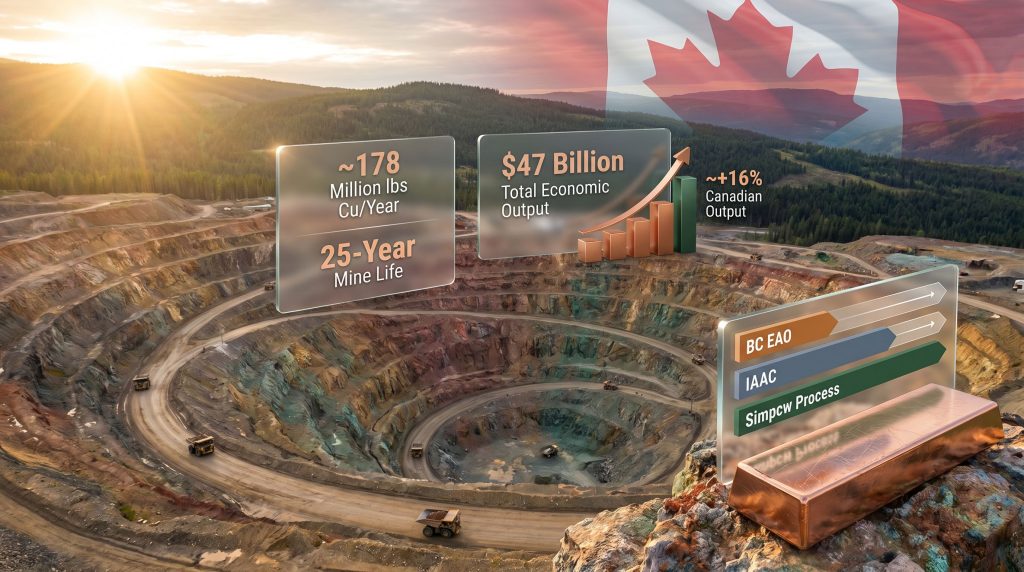
| Average Annual Copper Output | ~178 million lbs (copper in concentrate) |
| Canada Production Impact | ~+16% vs. 2025 levels |
| Projected National Ranking | Second-largest copper producer in Canada |
Processing 90,000 tonnes of ore per day over a 25-year mine life, Yellowhead would produce approximately 178 million pounds of copper in concentrate annually. At that scale, it would rank as Canada's second-largest copper producer and increase the country's total annual copper output by roughly 16% relative to 2025 production levels. For a single project to move the national supply needle that significantly speaks to the deposit's exceptional scale. In addition, understanding global copper supply forecast trends helps contextualise just how consequential this project could be.
British Columbia's Thompson-Nicola Region as a Copper Corridor
The Thompson-Nicola region has quietly become one of western Canada's most prospective copper addresses. Its geological setting, characterised by large porphyry copper systems, has historically hosted significant base metal mineralisation. Porphyry copper deposits, the dominant source of the world's copper supply, are formed through magmatic-hydrothermal processes associated with ancient subduction zones.
British Columbia's geology reflects precisely this tectonic history, making it one of the world's premier porphyry copper provinces alongside Chile, Peru, and the American Southwest. Yellowhead's open-pit extraction methodology is well-suited to the geometry typical of porphyry systems, which tend to be large, low-to-moderate grade, and amenable to bulk mining methods. The trade-off is surface disturbance at significant scale, which is precisely why the environmental assessment process is so rigorous for projects of this type.
How British Columbia's Environmental Assessment Process Actually Works
The BC Environmental Assessment Office (EAO) operates a structured, phased review process that is more demanding than many other Canadian provincial frameworks. Understanding its mechanics is essential for interpreting where Yellowhead actually sits in the approval sequence. The BC mining claims framework underpinning these processes adds further layers of regulatory rigour that developers must carefully navigate.
The EA phase sequence unfolds as follows:
- Initial Project Description (IPD) submission and acceptance
- Planning Phase entry, triggering parallel EAO and federal IAAC processes
- Detailed Project Description (DPD) submission incorporating technical refinements and community feedback
- Readiness Decision by the EAO
- Process Planning and formal Scoping
- Environmental Assessment Certificate issuance (if approved at provincial level)
- Federal Impact Assessment decision by IAAC
- Construction phase (estimated 2 to 3 years post-approval)
Trekor Metals, the TSX-listed company formerly known as Taseko that owns the Yellowhead project, filed and received acceptance of its Initial Project Description in July 2025. The subsequent submission of the Detailed Project Description in mid-2026 represents the next formal milestone, triggering the EAO's readiness decision process. The DPD is not merely a restatement of earlier documentation. It incorporates technical work conducted since the IPD, along with adjustments informed by community consultation, without altering the fundamental project design or production objectives.
Critically, the DPD submission does not itself constitute environmental approval. It is the gateway to the next phase of review, not the conclusion of it.
More than 1,000 local community members participated in open houses and engagement events hosted by the project team during the early consultation period. That level of community participation is notable and reflects the scale of local interest in a project of this economic magnitude.
The Federal Dimension: IAAC's Parallel Role
Large projects in Canada that meet certain thresholds trigger review not only at the provincial level but also through the federal Impact Assessment Agency of Canada (IAAC) under the Impact Assessment Act. This creates a dual-track assessment structure where both processes run concurrently, but neither is subordinate to the other.
In October 2025, the federal assessment clock for Yellowhead was suspended. Under the Impact Assessment Act, timeline suspensions can occur when additional information is required or when coordination with other processes is needed. The practical effect is a pause in the federal review timeline, creating uncertainty around when that track will resume and complete.
The conditions required to lift such a suspension are not always publicly disclosed in granular detail, which adds a layer of opacity to overall project timing for external observers. This federal dimension is frequently underappreciated by investors focused on provincial-level milestones. Even if the BC EAO process advances smoothly, the project cannot proceed to construction without a positive federal impact assessment decision as well.
The Simpcw Process: Why Indigenous Consent Is the Project's Most Structurally Uncertain Variable
Of the three approval tracks facing Yellowhead, the Simpcw Process is arguably the least predictable and the most legally foundational. The Yellowhead copper mine environmental approval sits within Simpcw First Nation territory, approximately 150 km northeast of Kamloops. The Simpcw Process is described as an Indigenous-led, consent-based decision-making model operating concurrently with, but entirely independently from, the provincial and federal assessments.
The distinction between consultation and consent is not semantic. Consultation is a procedural obligation the Crown must fulfil. Consent, in the context of the Simpcw Process, is a substantive outcome that the project requires in order to proceed.
The legal architecture underpinning this requirement draws from the constitutional protections afforded to Indigenous peoples under Section 35 of the Constitution Act, 1982, as interpreted through landmark Supreme Court of Canada decisions including Haida Nation v. British Columbia and Tsilhqot'in Nation v. British Columbia. The trajectory of Canadian jurisprudence has progressively strengthened the weight of Indigenous consent in resource project approvals, particularly in British Columbia.
In early 2026, formal negotiations began between the Province of British Columbia and Simpcw First Nation on a consent decision-making agreement. This agreement would provide regulatory clarity about how and when Simpcw consent will be sought, and how its timeline coordinates with the provincial and federal tracks. The negotiation of this agreement is itself a prerequisite for structured consent discussions, meaning the project is still in early stages of what could be a lengthy process.
Scoping work within the Simpcw Process is currently advancing, which is a constructive sign. However, the outcome of consent negotiations is inherently uncertain, and no precedent from the Yellowhead process itself can yet be drawn upon.
| Approval Track | Current Status | Key Risk Factor | Timeline Certainty |
|---|---|---|---|
| BC EAO (Provincial) | DPD submitted; readiness decision pending | Scope complexity, technical review depth | Moderate |
| IAAC (Federal) | Planning Phase; clock suspended Oct 2025 | Timeline resumption conditions unclear | Low to Moderate |
| Simpcw Process (Indigenous) | Consent agreement under negotiation (2026) | Consent outcome uncertain | Low |
The Economic Case: What $47 Billion in Output Really Means
A comprehensive economic impact study commissioned for the Yellowhead project projects total economic output of $47 billion for Canada over the mine's operational life, with value-added GDP contribution reaching $27.3 billion. Approximately 70% of this economic activity is expected to occur within British Columbia's Thompson-Nicola region, making it a genuinely transformative proposition for what is currently a mid-sized regional economy anchored by agriculture, forestry, and existing resource industries.
| Economic Metric | Projected Value |
|---|---|
| Total Economic Output (Canada) | $47 billion |
| Value-Added GDP Contribution | $27.3 billion |
| Share of Activity in Thompson-Nicola | ~70% |
| Direct Employment During Operations | 525 workers |
| Total Employment (Direct + Indirect + Induced) | ~3,305 jobs |
| Projected Mine Life | 25 years |
The 525 direct jobs during operations, expanding to approximately 3,305 positions when indirect and induced employment effects are included, would represent a substantial labour market intervention in a region where large-scale employment opportunities are not abundant. Economic multiplier effects from mining operations of this scale typically ripple through accommodation, transport, supply chain services, healthcare, and retail sectors in the surrounding communities.
It is worth noting, however, that economic impact projections of this type are inherently forward-looking and subject to assumptions about copper prices, operational costs, and macro conditions over a 25-year horizon. They should be read as indicative of the project's potential scale rather than guaranteed outcomes. Consequently, understanding copper exploration importance as a driver of long-term economic value helps frame these figures appropriately.
Technical Workstreams Advancing Alongside Regulatory Processes
One of the strategically important aspects of Trekor's approach is that technical and environmental studies are advancing in parallel with the regulatory process rather than sequentially. A site investigation and drilling programme was planned for summer 2026, designed to generate additional geotechnical, hydrogeological, and resource characterisation data that will inform both the ongoing assessment process and eventual mine design refinements.
This parallel workstream strategy serves two purposes. First, it keeps the technical knowledge base current and reduces the risk of information gaps emerging during regulatory review. Second, it signals operational readiness to regulators and investors without pre-empting approval outcomes. For a project still years from potential construction, maintaining technical momentum is both practically important and reputationally valuable. Indeed, the future of copper mining increasingly depends on exactly this kind of integrated, concurrent approach to development and assessment.
The next major ASX story will hit our subscribers first
What Comes Next and What Stakeholders Should Monitor
The road from current regulatory status to potential construction involves multiple sequential and parallel milestones, none of which is guaranteed:
- Readiness decision from the BC EAO following DPD review
- Formal process planning and scoping across all three assessment tracks
- Environmental Assessment Certificate issuance at the provincial level
- Resumption and completion of the federal IAAC timeline
- Finalisation of the Simpcw consent decision-making agreement
- The consent decision itself from Simpcw First Nation
- Post-approval permitting, project financing, and construction readiness phases
- Construction estimated at 2 to 3 years following all approvals
For those following the project's progress, the Simpcw consent agreement negotiation represents the most structurally uncertain variable in the approval sequence. Progress or stagnation in those negotiations will be a leading indicator of the project's overall timeline trajectory. The conditions under which the federal IAAC clock suspension is lifted represent a secondary but significant uncertainty. Results from the summer 2026 drilling programme will provide technical credibility signals that independent analysts will use to assess resource confidence.
The Yellowhead copper mine environmental approval is best understood as a process whose ultimate timeline is determined by whichever of its three approval tracks takes longest, not by the average or the fastest. Investors and stakeholders who anchor their timeline expectations to provincial EA milestones alone risk significantly underestimating the complexity of the path to construction.
The project's scale, its economic significance to British Columbia, and copper's structural importance to clean energy supply chains all argue for sustained engagement with its regulatory journey. However, the multi-jurisdictional nature of that journey means patience, not proximity to any single milestone, is the appropriate analytical frame for evaluating where Yellowhead sits today.
This article contains forward-looking information regarding project timelines, economic projections, and regulatory outcomes. Such statements involve inherent uncertainties, and actual results may differ materially from those projected. This article does not constitute financial or investment advice.
Want to Track the Next Major Copper Discovery Before the Market Does?
Discovery Alert's proprietary Discovery IQ model delivers real-time alerts on significant ASX mineral discoveries — instantly transforming complex mineral data into actionable investment insights for both short-term traders and long-term investors. Explore historic examples of exceptional discovery returns and begin your 14-day free trial at Discovery Alert to position yourself ahead of the market.