July 8, 2026
The Engineering Ambition Reshaping One of the World's Great Copper Corridors
Large-scale copper districts do not emerge overnight. They are the product of decades of geological work, sustained capital commitment, and increasingly, the willingness to deploy frontier technology in some of the most physically demanding environments on earth. The Atacama Desert in northern Chile has long been the epicentre of this story, hosting a concentration of copper mineralisation that has no equal anywhere in the world. Within this corridor, a transformation is underway that carries implications far beyond one company's balance sheet.
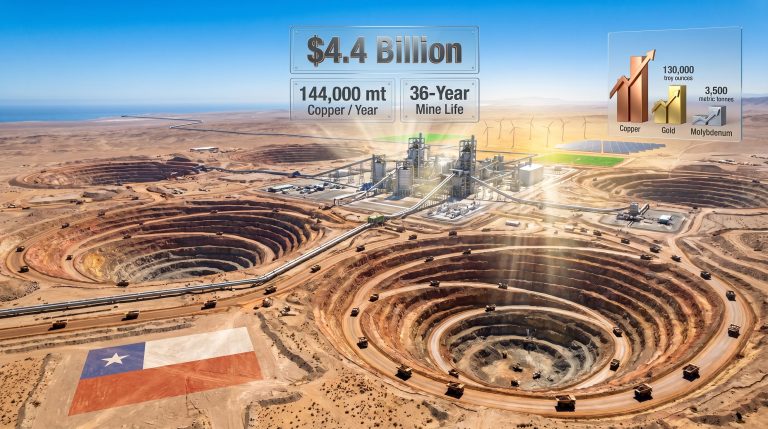
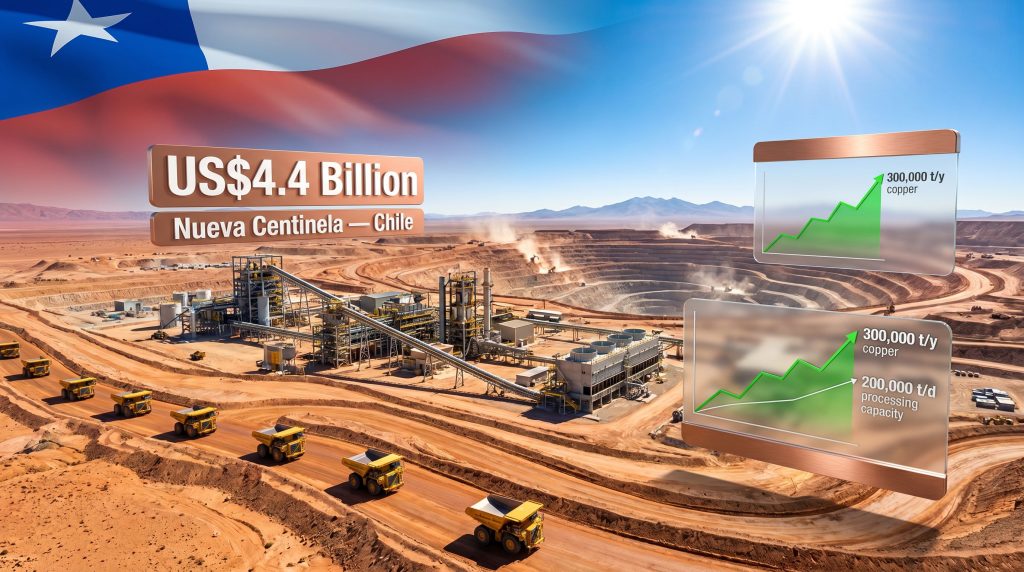
The Nueva Centinela project in Chile represents a defining inflection point in how major copper operations are structured, funded, and run in the 21st century. At US$4.4 billion, it stands as the largest single mining investment in Chile in more than five years, and its design ambitions go well beyond simply adding throughput capacity. Furthermore, the Chile copper price outlook suggests this investment arrives at a strategically opportune moment for the broader industry.
When big ASX news breaks, our subscribers know first
From Two Pits to a Five-Deposit Copper District
Understanding what Nueva Centinela actually means requires appreciating how quickly the underlying operation has evolved. Minera Centinela only began operating in 2014, born from the integration of the Esperanza and Tesoro open pits into a unified processing and logistics framework. That dual-pit structure served the operation well through its first decade, but it carried inherent limitations in terms of mine life and scalable production.
The transition to a genuine copper district changes that calculus entirely. A mining district, as distinct from a single mine, is defined by the simultaneous operation of multiple ore deposits sharing centralised infrastructure. This model delivers compounding efficiency gains: shared processing facilities reduce per-tonne capital costs, centralised tailings management lowers environmental complexity, and coordinated logistics across deposits smooths production variability.
Centinela's current deposit architecture includes:
| Deposit | Ore Type | Operational Status |
|---|---|---|
| Esperanza | Sulphide | Active, established operation |
| Tesoro | Oxide / Sulphide | Active, original integration pit |
| Esperanza Sur | Sulphide | Active, fully autonomous pit model |
| Encuentro Sulfuros | Sulphide | Active, autonomous fleet from 2026 |
| Polo Sur Oxides | Oxide | Pre-development phase |
Additional mining phases at Mirador and El Llano pits sit within the district boundary and represent medium-to-long-term production continuity. The combined resource base across the district encompasses approximately 45 million tonnes of sulphide ore and 40 million tonnes of copper oxide material, providing feedstock security across both concentrator and leach-based processing streams.
What the US$4.4 Billion Capital Commitment Actually Builds
The financial scale of the Nueva Centinela project in Chile is striking, but the more instructive question is how that capital is deployed. The project is not a single-asset construction program; it is a fully integrated infrastructure build-out designed to transform the district's operating architecture from the ground up.
| Project Component | Function |
|---|---|
| Second Concentrator Plant | Core processing hub; 95,000 t/d ore throughput capacity |
| Expanded Esperanza Sur Pit | Extended open-cut mining feeding the new plant |
| Seawater Pipeline | Water supply from Esperanza pier, reducing freshwater dependency |
| Thickened Tailings Deposit | Engineered waste management with reduced environmental footprint |
| Molybdenum Plant Expansion | Captures by-product value from sulphide ore processing |
The engineering, procurement, and construction contract for the concentrator plant alone exceeded US$1 billion, awarded in 2021 to a joint venture between Chilean construction firm SalfaCorp and international engineering group Fluor Corporation. This single contract captures the enormous logistical complexity involved in building concentrator infrastructure at high altitude in a remote desert environment. In addition, Wood Group was engaged to develop major expansion engineering work across key components of the project.
The project is wholly funded through Minera Centinela, a subsidiary of Antofagasta Minerals (AMSA), the operating arm affiliated with the Chilean Luksic Group. The US$4.4 billion commitment represents the centrepiece of AMSA's reported US$3.4 billion 2026 Chile-wide investment plan, illustrating how central this expansion is to the company's forward strategy.
Construction commenced in April 2024. The new concentrator plant is targeting start-up in 2027, with full design capacity and maximum production rates expected to be achieved by 2029.
Production Targets: What Full Ramp-Up Actually Delivers
The production mathematics of Nueva Centinela are compelling when examined in detail. Centinela produced 240,000 tonnes of fine copper in 2025. Once the second concentrator reaches full operating rate by 2029, district-wide output is projected to reach at least 300,000 tonnes per year, an increase of approximately 30% relative to the pre-expansion baseline.
Beyond copper, the expanded operation captures meaningful by-product value:
| Commodity | Projected Annual Incremental Output |
|---|---|
| Copper (fine) | ~144,000 to 170,000 additional tonnes |
| Molybdenum | ~3,500 tonnes |
| Gold | ~130,000 ounces |
Molybdenum is worth highlighting separately. It is a dense, high-melting-point metal used extensively in steel alloys for aerospace, defence, and energy applications. Its recovery from porphyry copper deposits like those at Centinela is a function of processing chemistry and grade, and the dedicated molybdenum plant expansion signals that AMSA is prioritising full recovery of the ore's economic value rather than treating by-products as incidental.
The combined processing capacity of the district, once both concentrators are running, will reach approximately 200,000 tonnes of ore per day. At the district level, total material movement, encompassing ore, waste rock, and other handling, is projected at 1.3 million tonnes per day, a figure that begins to rival the throughput volumes of the largest copper mines operating globally.
At full production, Centinela is expected to rank among the top 15 copper-producing mines globally by annual output, placing it alongside recognised tier-one operations in Chile, Peru, and the Democratic Republic of Congo.
Altitude, Remoteness, and the Engineering Variables That Don't Appear in Feasibility Studies
One of the least-discussed dimensions of operating in the Centinela district is the compounding difficulty introduced by its physical location. All five deposits sit at elevations exceeding 4,000 metres above sea level, within the Atacama Desert in the Sierra Gorda commune, approximately 180 kilometres from the city of Antofagasta.
Elevation at this scale is not merely a logistical inconvenience. It introduces measurable technical penalties across almost every category of mining operation:
- Engine power reduction: Diesel engines lose approximately 3% of their rated power output for every 300 metres of elevation above sea level. At 4,000+ metres, heavy haul trucks and processing equipment operate at significantly below their sea-level design specifications.
- Wind loading: High-altitude Atacama conditions produce strong, sustained wind events that require equipment to be engineered to higher safety standards than would apply at lower elevations. This affects crane operations, blasting procedures, and the structural design of surface infrastructure.
- Maintenance logistics: Many operational zones within the district sit more than 12 hours by road from the nearest urban service centre. This means that equipment failures cannot be remedied through conventional just-in-time supply chain responses. On-site workshop infrastructure, positioned at the client's own facilities, has become the operational standard, enabling 24-hour continuous maintenance cycles without dependency on external logistics networks.
- Worker health: Sustained exposure to high-altitude conditions imposes physiological constraints on human labour, including reduced cognitive performance and physical endurance over extended shifts, which partly explains the accelerated push toward automation at this particular operation.
These factors are not unique to Centinela, but they are acutely felt here, and they explain why the autonomous haulage program is being treated as a structural feature of the district's long-term operating model rather than a technology pilot.
Autonomous Haulage: The Operational Backbone of a Modern Copper District
Centinela's automation journey began in 2023, when the Esperanza Sur pit became the first fully autonomous operation within AMSA's entire portfolio. This is a meaningful distinction. Full autonomy in a mining pit context means that haul trucks operate without onboard drivers across the entire haulage cycle, coordinated through fleet management systems and real-time positioning technology.
The deployment model is now being scaled across the district:
- Autonomous truck operations extended to Encuentro Sulfuros pit from 2026
- AMSA's target of 26 autonomous trucks operating in Encuentro Sulfuros by end of 2026
- Additional autonomous equipment includes electric and hydraulic shovels operating under equivalent management systems
- Esperanza Sur functions as the operational template, with its performance data informing deployment parameters at each new site
The case for autonomous haulage at high altitude is stronger than it would be at lower-elevation operations precisely because of the challenges described above. Autonomous systems are not affected by altitude-induced fatigue, do not require shift rotations driven by physiological constraints, and can operate through low-visibility wind events that would require human operators to cease work.
The productivity arithmetic is also compelling. Autonomous haul trucks typically achieve utilisation rates of 85 to 90 percent of available hours compared to roughly 65 to 75 percent for conventionally operated fleets, primarily because they eliminate shift handover time, meal breaks, and the human response latency that occurs during adverse conditions. Across a fleet of 26 trucks processing 1.3 million tonnes of material per day, those incremental utilisation gains translate into material reductions in per-tonne operating cost.
The next major ASX story will hit our subscribers first
Timeline: From Groundbreaking to Full Production
The commissioning pathway for a concentrator of this scale follows a structured sequence that mining engineers describe as ramp-up, and understanding it helps contextualise the 2027 to 2029 timeline.
- April 2024: Construction commenced across all major project components
- Q1 2026: Pre-commissioning activities underway, including individual equipment testing, systems integration, and process verification
- 2027: Targeted start-up of the second concentrator plant, with initial ore feed introduced under controlled conditions
- 2027 to 2029: Progressive output ramp-up, with metallurgical performance benchmarks validated at each throughput increment
- 2029: Full design capacity achieved, representing the point at which maximum annual copper production rates are realised
The gap between plant start-up and full-rate production is standard practice for large-scale concentrators. Metallurgical recovery rates, reagent consumption, and equipment wear profiles all need to be calibrated against actual ore characteristics before throughput can be pushed to design limits. Rushing this phase risks permanent damage to grinding mills and flotation circuits that can cost far more to repair than the incremental production foregone during a disciplined ramp.
Water Strategy in the World's Driest Desert
One aspect of Nueva Centinela's infrastructure program that carries particular long-term significance is its approach to water. The Atacama Desert is not merely arid; it is the driest non-polar desert on earth, and freshwater access has historically been among the most contentious issues facing Chilean mining expansion.
The seawater pipeline component of the project, sourcing water directly from the Esperanza pier on the Pacific coast, reflects a broader industry shift toward desalinated and raw seawater use in mineral processing. Porphyry copper flotation circuits can operate effectively on seawater, though they require chemistry adjustments to manage the effects of chloride ions on froth stability and copper recovery.
AMSA has publicly committed to sourcing 90% of its water from seawater or recirculated process water before 2030 across its Chilean operations. The Nueva Centinela seawater pipeline is a direct expression of that commitment. For a district projected to move 1.3 million tonnes of material per day, water supply security is not a peripheral operational concern; it is foundational to the project's viability over its 30-year extended life.
Employment, Supply Chains, and the Regional Economy
The economic footprint of the Nueva Centinela project in Chile extends considerably beyond the fence line of the operation itself. During the peak construction phase, the project supported approximately 13,000 workers, a figure that reflects the sheer logistics complexity of building major industrial infrastructure at altitude in a remote desert location.
Once fully commissioned, the expanded operation is expected to create approximately 1,000 additional permanent positions, supplementing the current Minera Centinela workforce of approximately 9,400 workers including direct employees and contractor personnel.
The supply chain implications are broader still:
- District-level material movement of 1.3 Mt/d generates sustained demand for explosives, grinding media, reagents, fuel, tyres, and maintenance services
- Long-duration procurement contracts associated with a 30-year operational horizon provide supply chain partners with investment visibility rarely available in shorter-cycle projects
- Port logistics operators and marine infrastructure providers at the Antofagasta coast benefit from concentrate export volumes that will grow materially as production ramps
- Engineering consultancies, environmental monitoring services, and specialist equipment suppliers all see demand uplift proportional to the district's expanding scope
The economic contribution of a 30-year copper district does not compress into a single headline employment figure. Its most significant regional impact is the sustained, compounding demand signal it creates for an entire industrial ecosystem across the Antofagasta Region.
Chile's Position in Global Copper Supply and Why Centinela Matters Now
Chile consistently accounts for approximately 25 to 27% of global mined copper output, making it the single most important source nation in the world for a metal that sits at the intersection of virtually every major decarbonisation technology. Electric vehicle drivetrains, grid-scale battery storage systems, offshore wind turbines, and solar photovoltaic installations all consume copper at rates that substantially exceed the technologies they are replacing. Chile's copper supply role within this global framework cannot be overstated, and Centinela sits squarely at the heart of that contribution.
Independent forecasts from organisations including the International Energy Agency and Wood Mackenzie project that the copper supply crunch could see demand exceed supply by several million tonnes annually through the 2030s if new project pipelines do not accelerate. Against that backdrop, the timing of Nueva Centinela's production ramp carries strategic weight.
The expansion aligns almost precisely with the period of most acute projected supply pressure:
| Year | Centinela Milestone | Market Context |
|---|---|---|
| 2024 | Construction commenced | Global copper supply deficit forecasts intensifying |
| 2027 | Plant start-up | Demand from EV and grid investment accelerating |
| 2029 | Full production rate | Peak projected supply gap period |
| 2030+ | Sustained 300,000+ t/y | Long-term structural demand maintained |
At full production, Centinela's status as a top-15 global copper mine places it alongside operations that define the supply baseline for global manufacturing. Its multi-deposit district model mirrors the structures of other world-class copper districts including Escondida in Chile and Kamoa-Kakula in the Democratic Republic of Congo, operations that have become reference points for what large-scale, long-life copper production looks like in the modern era. Major copper expansion plans elsewhere suggest that this district model is becoming the industry standard for next-generation tier-one assets.
The 30-Year Mine Life Extension: What It Means for Asset Valuation
For investors and analysts assessing the Nueva Centinela project in Chile through a financial lens, the mine life extension is arguably the single most significant number in the entire program. Without the expansion infrastructure, the existing Centinela operation faced a finite depletion horizon constrained by accessible reserves under the original pit designs.
Extending operational life by a minimum of 30 years does several things simultaneously:
- It reclassifies Centinela from a finite-life asset into what valuers describe as a long-life tier-one operation, a category that commands structurally higher valuation multiples
- It justifies the deployment of automation infrastructure whose cost payback period extends well beyond what a shorter mine life could support
- It provides the operational continuity needed to develop the later-stage deposits, including Polo Sur Oxides and the Mirador and El Llano phases, which would be uneconomic to develop as standalone operations
- It anchors AMSA's long-term capital allocation strategy, signalling to debt and equity markets that the company's production profile has a durable foundation rather than a declining reserve base
The district's combined resource inventory of approximately 85 million tonnes across sulphide and oxide material types provides the geological underpinning for this claim, though it is worth noting that resource estimates are subject to ongoing revision as drilling programs advance and economic parameters evolve. Readers should treat forward-looking production and resource figures as projections subject to change rather than guaranteed outcomes. Furthermore, Antofagasta's official approval announcement for the second concentrator provides additional context on the investment rationale underpinning the 30-year operational horizon.
Frequently Asked Questions: Nueva Centinela Project
What is the Nueva Centinela project?
Nueva Centinela is a US$4.4 billion expansion of the Minera Centinela copper mine in Chile's Antofagasta Region. The program centres on the construction of a second concentrator plant capable of processing 95,000 tonnes of ore per day, alongside pit expansions, a seawater pipeline, molybdenum plant expansion, and engineered tailings infrastructure.
Who owns and operates the Nueva Centinela project?
The project is owned and operated by Minera Centinela, a subsidiary of Antofagasta Minerals (AMSA), which is affiliated with the Chilean Luksic Group.
When will Nueva Centinela start producing copper?
The new concentrator plant is scheduled to begin start-up operations in 2027, with full design capacity and maximum production rates targeted for 2029.
How much copper will Nueva Centinela produce at full capacity?
Once fully operational, the expanded Centinela district is projected to produce at least 300,000 tonnes of fine copper per year, representing approximately a 30% increase over the 2025 production baseline of 240,000 tonnes.
How many jobs does the project create?
The project supported approximately 13,000 workers during peak construction and is expected to generate approximately 1,000 additional permanent positions once operational, supplementing an existing workforce of around 9,400 people.
How long will Centinela operate after the expansion?
The Nueva Centinela program extends the operational life of Minera Centinela by a minimum of 30 years beyond what the original infrastructure could sustain.
What makes Centinela a copper district rather than a single mine?
Centinela operates across five distinct ore deposits, sharing centralised processing, water supply, and logistics infrastructure. This multi-deposit configuration, combining assets at different stages of development and with different ore types, defines the district model.
Nueva Centinela as a Blueprint for Next-Generation Copper Mining
The convergence of factors that define the Nueva Centinela project in Chile is unusual even by the standards of major global mining investment. A US$4.4 billion capital commitment. A five-deposit district architecture spanning approximately 85 million tonnes of combined mineral resources. A fully autonomous pit operating at 4,000 metres above sea level as the template for fleet-wide deployment. A seawater pipeline eliminating freshwater dependency in the world's driest desert. And a production timeline calibrated almost exactly to the period of most acute projected global copper supply pressure.
Each of these elements would be noteworthy in isolation. Together, however, they constitute something more significant: a proof of concept for what next-generation tier-one copper production looks like when capital scale, operational innovation, and geological endowment are aligned within a single district framework.
The phased development pipeline at Centinela, encompassing Polo Sur Oxides, Mirador, El Llano, and whatever geological work reveals beyond the current boundary, suggests that the 2029 production horizon is not a ceiling but a platform. The infrastructure being commissioned today will support production scenarios that current planning documents do not yet fully articulate.
For Chile's national copper industry, for the global supply chains that depend on consistent metal output, and for the investors and analysts tracking the evolution of large-scale mining in the 21st century, the Nueva Centinela project represents a case study worth watching closely through the coming decade.
This article contains forward-looking statements and projections based on currently available information. Production targets, resource estimates, timelines, and financial figures are subject to change and should not be treated as guaranteed outcomes. Readers should conduct independent research before making any investment decisions.
Want to Track the Next Major ASX Mineral Discovery Before the Market Does?
Discovery Alert's proprietary Discovery IQ model delivers real-time alerts the moment significant mineral discoveries hit the ASX, transforming complex geological data into clear, actionable insights for both short-term traders and long-term investors — start your 14-day free trial today or explore historic discovery returns to understand just how transformative a major find can be.