July 8, 2026
The Structural Copper Deficit and Why Brownfield Scale Now Matters More Than Ever
The global copper market is confronting a supply architecture problem that decades of underinvestment have made increasingly difficult to solve. Greenfield copper development, once the industry's primary growth engine, has become structurally impaired by permitting timelines stretching 15 to 20 years, sovereign water restrictions across arid mining jurisdictions, and capital costs that have inflated well beyond original project estimates. Against this backdrop, brownfield expansions at established, permitted, and infrastructure-rich mining districts have emerged as the most credible pathway for delivering new copper supply before demand overwhelms availability.
Furthermore, the structural copper supply crunch has intensified pressure on producers to fast-track credible projects. It is within this context that the Centinela $4.4 billion investment deserves to be examined not as a corporate announcement, but as a strategic response to one of the most consequential supply-demand mismatches in modern commodities history.
When big ASX news breaks, our subscribers know first
What Is the Centinela Mining District and How Did It Reach This Scale?
The Centinela copper mining district, located in Chile's Antofagasta Region, was created through the operational integration of the Esperanza and Tesoro mines in 2014. That merger was not simply an administrative consolidation; it established a unified ore processing corridor capable of exploiting multiple ore bodies across a contiguous land package under a single operational framework.
Over the 12 years since integration, the district has undergone continuous technological and infrastructural evolution. What began as two mid-scale open-pit copper operations has matured into a multi-pit, multi-technology complex processing both sulfide and oxide ores through parallel metallurgical streams. By 2027, Centinela is projected to become the only mining district in Chile operating five open pits simultaneously, a configuration that represents not just scale, but a fundamentally different operational philosophy built around distributed ore feed and blending flexibility.
This milestone did not emerge from a single investment decision. It is the product of a decade of phased capital deployment, progressive technology integration, and expanding reserve definition that has progressively unlocked the district's geological potential. Understanding the Chile copper market outlook helps contextualise why developments of this magnitude carry such outsized global significance.
The $4.4 Billion Capital Commitment: Scale, Structure, and Strategic Logic
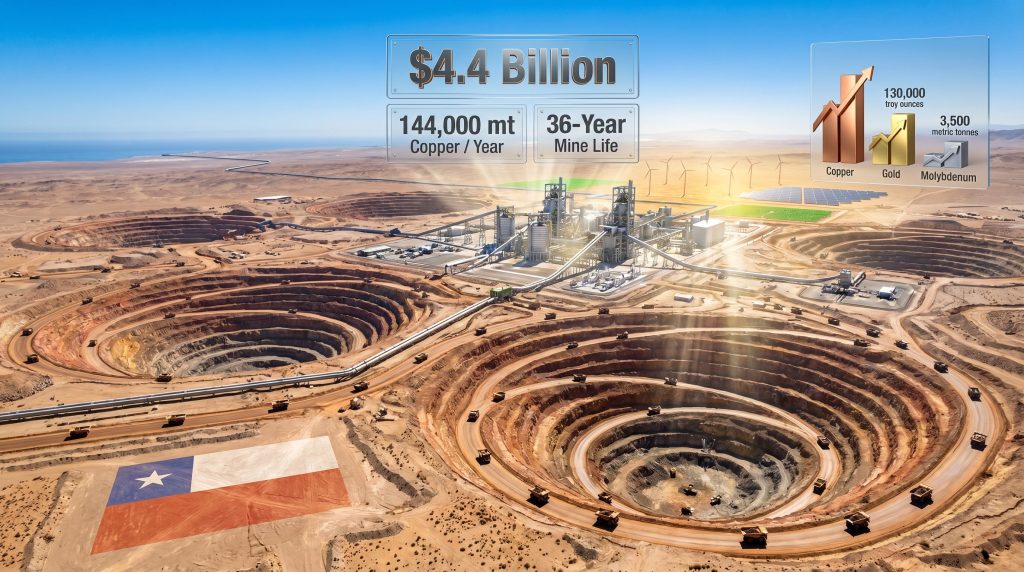
Antofagasta Minerals, in partnership with Japanese trading and investment group Marubeni Corporation, formally sanctioned the Nueva Centinela expansion in December 2023. The Centinela $4.4 billion investment represents the single largest capital commitment in Antofagasta Minerals' corporate history and has been recognised by industry bodies as Chile's largest mining investment in the past five years, earning the designation of Mining Financing of the Year in 2024.
The core engineering objective is the construction of a second concentrator plant capable of processing 95,000 tonnes of ore per day. When combined with existing processing infrastructure, the district will achieve a combined throughput approaching an estimated 1.3 million metric tonnes of material moved per day across all five active pits.
How the Financing Is Structured
The capital architecture behind the project reflects sophisticated project finance thinking designed to limit equity dilution while maintaining shareholder returns discipline.
| Financing Component | Approximate Share | Key Parties |
|---|---|---|
| Shareholder equity contribution | 40% (~$1.76 billion) | Antofagasta Minerals, Marubeni Corporation |
| Project finance debt | 60% (~$2.64 billion) | JBIC, Kexim, Export Development Canada |
| Total project cost | 100% | $4.4 billion |
The participation of JBIC (Japan Bank for International Cooperation) and Kexim (Export-Import Bank of Korea) in the debt facility is analytically significant. These institutions do not deploy capital on commercial terms alone; their involvement reflects the strategic imperative of Japan and South Korea to secure long-term copper supply chains for their advanced manufacturing and electric vehicle industries. Export Development Canada's participation adds a Western critical minerals supply security dimension to the financing consortium.
"The 60/40 debt-to-equity ratio is consistent with best-practice project finance for large-scale mining assets, balancing lender security requirements against shareholder return expectations throughout a multi-decade asset life."
A less commonly understood aspect of export credit agency (ECA) financing in copper mining is the conditionality that often accompanies it. ECAs increasingly embed environmental and social governance requirements into loan covenants, effectively mandating renewable energy sourcing, water management standards, and community engagement frameworks as conditions of financing. Centinela's design choices in these areas are not incidental; they are structurally aligned with the requirements of its sovereign lending partners.
Annual Production Profile: What the Second Concentrator Will Deliver
The second concentrator plant's projected output positions it among the most significant incremental copper supply additions globally in the current development pipeline.
| Commodity | Projected Annual Output | Strategic Role |
|---|---|---|
| Copper | 144,000 metric tonnes | Primary revenue driver |
| Gold | 130,000 troy ounces | Major by-product credit |
| Molybdenum | 3,500 metric tonnes | High-value industrial by-product |
The 144,000 metric tonne per year copper increment alone would rank among the largest copper mines globally if treated as a standalone operation. More importantly for project economics, the substantial gold and molybdenum by-product streams will materially reduce the net cash cost per pound of copper produced, shifting the project's cost curve positioning favourably relative to peers that lack polymetallic by-product credits.
Total copper-equivalent production from the second concentrator is projected at approximately 170,000 tonnes per year when by-product contributions are included. This by-product richness is a function of Centinela's specific geological setting within the Antofagasta porphyry copper belt, where mineralisation characteristically carries elevated gold and molybdenum associations relative to many other Chilean copper districts.
The Geology Behind the Numbers
Porphyry copper systems of the type hosted at Centinela are among the most economically significant ore deposit types on Earth. They form through large-scale hydrothermal activity associated with subduction-related magmatism, producing disseminated copper sulphide mineralisation over vast volumes of rock. The Antofagasta Region sits within one of the world's most prolific porphyry copper metallogenic belts, extending along the Andean Cordillera.
What distinguishes Centinela's resource base is its scale combined with mineralogical diversity. The district encompasses resources of nearly 45 million metric tonnes of sulfide material alongside approximately 40 million metric tonnes of copper oxide material. The parallel processing of sulfide ore through conventional froth flotation and oxide ore through hydrometallurgical (SX-EW) circuits allows the operation to extract economic value from ore types that would be uneconomic in a single-technology processing environment.
The Polo Sur Oxidos project, running in parallel with the concentrator expansion, is specifically designed to extend the hydrometallurgical line's operational life by continuing to process oxide ores using existing infrastructure and local labour, avoiding the capital cost of new SX-EW plant construction.
Mine Life Extension: Converting Stranded Reserves Into Generational Value
Perhaps the least appreciated dimension of the Centinela $4.4 billion investment is its function as a mine life extension mechanism. Without the second concentrator, significant volumes of the district's sulphide ore resource would remain economically stranded, as existing processing capacity would be insufficient to treat them within commercially viable timeframes.
The second concentrator unlocks access to approximately 2 billion tonnes of ore reserves, underpinning a projected mine life of 36 years from commissioning, extending Centinela's operational horizon to approximately 2060 and beyond. This transforms what might otherwise have been a finite mid-life asset into a multi-generational mining district capable of sustaining continuous production across multiple commodity cycles.
New development phases at the Mirador and El Llano pits contribute incremental ore feed to sustain throughput across the expanded district. The five-pit simultaneous operation model, furthermore, distributes geotechnical and grade variability risk across multiple ore sources rather than concentrating it in a single pit.
"From an investor perspective, 36-year mine life certainty fundamentally changes the discounted cash flow profile of the asset. Long-duration copper assets with defined reserve bases attract structurally different investor capital than projects with 10 to 15 year horizons, particularly in a market where copper's long-term demand trajectory is supported by electrification infrastructure requirements."
Autonomous Haulage: Technology as an Economic Assumption, Not a Pilot Program
Autonomous mining technology is often presented as a future capability or experimental deployment. At Centinela, however, it functions as a core operational assumption embedded directly into the economics of the second concentrator's business case.
Autonomous haulage operations began at the Esperanza Sur deposit in 2023 and were subsequently extended to Encuentro Sulfuros in 2026, making both deposits the only autonomous mining operations within the entire Antofagasta Minerals portfolio. Centinela is on track to operate a fleet of more than 100 autonomous trucks by the end of 2026, placing it among the largest autonomous haulage deployments in Chile.
Why Autonomy Matters in the Antofagasta Context
The operational logic for autonomous haulage at Centinela is particularly compelling for reasons that extend beyond generic productivity arguments:
- Skilled haul truck operators are a constrained resource in northern Chile's mining labour market, where multiple large operations compete for qualified personnel
- Autonomous systems typically demonstrate 10 to 20% improvements in truck utilisation rates relative to manned operations, through elimination of shift change delays, fatigue breaks, and inconsistent speed profiles
- Multi-pit operations benefit disproportionately from autonomy because fleet management systems can optimise routing across multiple pit ramps and dump points simultaneously, a task that is cognitively complex for human dispatchers managing large fleets
- Integrating autonomous systems from the commissioning phase rather than retrofitting them into an established manned operation significantly reduces transition costs and disruption
A critical insight rarely surfaced in mainstream mining coverage is that autonomous haulage economics are most powerful when combined with high-throughput operations. At 95,000 tonnes per day, the second concentrator demands continuous, high-volume ore delivery with minimal variance in feed rate. Autonomous trucks, which operate on consistent speed and routing profiles, are consequently better suited to meeting this consistency requirement than variable manned operations.
The next major ASX story will hit our subscribers first
Sustainability Architecture: Why ESG Is Structurally Embedded, Not Decorative
| Sustainability Feature | Specification | Competitive Significance |
|---|---|---|
| Electricity source | 100% renewable energy | Eliminates processing Scope 2 emissions |
| Water source | Raw seawater, no desalination | Reduces energy intensity vs. desalination peers |
| Labour approach | Local supplier and workforce utilisation | Embedded social licence framework |
The decision to use raw seawater directly, rather than desalinated water, carries economic implications that are frequently underestimated. Desalination is an energy-intensive process that adds meaningful operating cost to Chilean copper producers operating in the Atacama Desert region, where freshwater is critically scarce. Centinela's process design, engineered to use raw seawater in its flotation circuits, eliminates this cost layer entirely.
Combined with 100% renewable electricity sourcing, these design choices reduce Centinela's carbon intensity per tonne of copper produced to levels increasingly demanded by downstream copper consumers in automotive, electrical infrastructure, and electronics sectors seeking to verify the emissions credentials of their supply chains. In addition, these choices satisfy the ESG covenants increasingly embedded by export credit agencies into their financing conditions.
Centinela's Role in Antofagasta's 900,000-Tonne Production Ambition
Antofagasta Minerals has articulated a long-term portfolio target of producing 900,000 tonnes of copper annually from its Chilean operations. The second concentrator's 144,000 mt/year copper increment represents a material contribution toward closing the gap between current group production levels and that strategic ceiling.
The broader copper price growth drivers underpinning this ambition — electrification, renewable infrastructure, and electric vehicle adoption — reinforce the commercial logic of accelerating supply additions at scale. When fully operational, Centinela is expected to achieve top-15 global copper mine status by annual output volume, attracting premium offtake relationships and institutional investor interest.
Regional and National Economic Significance
Chile currently accounts for approximately 25 to 27% of global copper mine production, a share that has faced quiet erosion pressure as ore grades at mature operations decline and permitting complexity for new projects increases. Chile's copper supply gap makes brownfield expansions of Centinela's magnitude among the most effective mechanisms for defending that production share without requiring the decade-plus permitting timeline associated with greenfield development.
Minera Centinela CEO Nicolás Rivera, speaking at the Exponor trade show, emphasised that the investment's significance extends beyond production metrics, noting that "the expansion's positive impact on regional suppliers, employment, and community opportunities represents a dimension of the project's value that reaches well beyond the mine boundary."
The $4.4 billion construction programme generates substantial procurement demand for Chilean engineering, construction, and equipment supply chains throughout its build phase, with operational employment across a five-pit, dual-concentrator district at full capacity supporting thousands of direct and indirect positions within the Antofagasta Region.
Construction-to-Production Timeline
| Milestone | Target Date | Significance |
|---|---|---|
| Project formally approved | December 2023 | Capital commitment locked |
| Construction commencement | 2024 | Procurement mobilised |
| Autonomous fleet exceeds 100 trucks | End of 2026 | Operational technology benchmark |
| Five pits operating simultaneously | 2027 | District configuration milestone |
| First copper from second concentrator | 2027 | Revenue generation commences |
| Full production ramp-up | Post-2027 | 144,000 mt/year copper output |
| Projected mine life end | ~2060+ | 36-year horizon from commissioning |
Why the Centinela Model May Define the Next Generation of Copper Supply
The Centinela $4.4 billion investment converges several structural advantages that are increasingly difficult to replicate in new copper project development globally:
- Established permits and infrastructure remove the decade-plus greenfield development timeline
- Polymetallic by-product credits from gold and molybdenum improve cost curve positioning and reduce copper price sensitivity
- ECA-backed project finance provides concessional debt at scale unavailable to purely commercially financed projects
- Autonomous technology integration from commissioning provides productivity and labour constraint advantages baked into the base case
- Renewable energy and seawater design satisfies increasingly mandatory ESG financing covenants and downstream customer requirements
- 36-year mine life certainty attracts long-duration institutional capital with lower required return thresholds
As the global copper market faces a structural supply deficit through the 2030s driven by electrification, renewable energy infrastructure buildout, and electric vehicle adoption, projects combining these characteristics will command premium financing terms, premium offtake relationships, and ultimately premium valuation recognition from sophisticated investors who understand the difference between copper assets and copper supply.
Disclaimer: This article contains forward-looking statements, production projections, and financial estimates based on publicly available information and industry analysis. Actual outcomes may differ materially from projections due to commodity price volatility, operational factors, regulatory changes, and broader macroeconomic conditions. This content does not constitute financial advice. Readers should conduct independent due diligence before making any investment decisions.
Want to Capitalise on the Next Major Copper Discovery Before the Broader Market?
Discovery Alert's proprietary Discovery IQ model scans ASX announcements in real time, instantly identifying significant mineral discoveries — including copper — and converting complex data into actionable investment insights for traders and long-term investors alike. Explore historic examples of major discoveries and their returns on Discovery Alert's dedicated discoveries page, or start your 14-day free trial today to position yourself ahead of the market.