July 8, 2026
The Geology Beneath the Strategy: Why VMS Copper-Gold Systems Are Reshaping Mid-Tier Miner Expansion Plans
Volcanogenic massive sulphide deposits occupy a unique position in the global mining hierarchy. Formed through ancient seafloor hydrothermal activity, these systems concentrate copper, gold, zinc, and silver into structurally compact, high-grade zones that are simultaneously attractive and geologically complex. For a mid-tier gold producer seeking to diversify its commodity exposure and geographic footprint in a single transaction, a well-positioned VMS target inside a geologically prolific ophiolite belt can represent exactly the kind of asymmetric opportunity that repositions a company's long-term narrative.
That is precisely the lens through which the Solidcore Oman copper-gold project joint venture deserves to be examined. Rather than a routine exploration deal, this agreement reflects a carefully constructed post-restructuring growth architecture, one built on deliberate capital redeployment, commodity diversification logic, and a calculated bet on one of the world's most underexplored but geologically significant copper terrains.
When big ASX news breaks, our subscribers know first
From Kazakhstan to the Arabian Peninsula: Understanding Solidcore's Strategic Repositioning
A Company Rebuilt Around a New Growth Thesis
Solidcore Resources holds the position of Kazakhstan's second-largest gold producer, a title that carries considerable weight in a country with substantial precious metals output. However, the company's current form is largely the product of a significant structural decision made in 2024: the divestment of its Russian operations.
That exit was not a retreat. It was a calculated elimination of sanctions-related exposure that had created financial and reputational overhang for the business. By separating from Russian assets, Solidcore freed both capital and strategic bandwidth, enabling a clean repositioning toward jurisdictions where institutional capital can flow without compliance constraints.
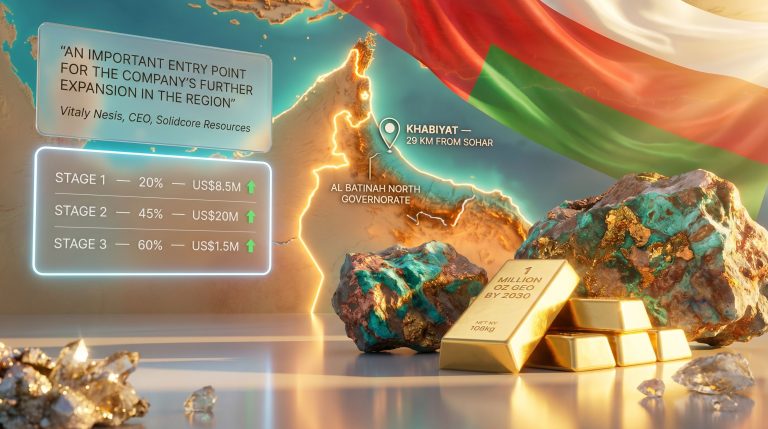
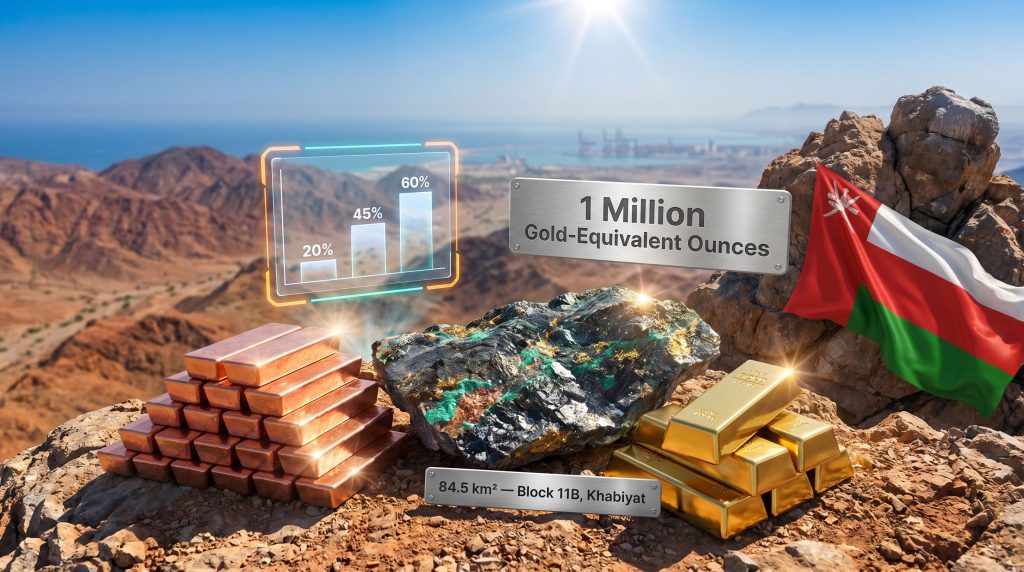
The immediate consequence of that restructuring was the articulation of a new growth target: reaching 1 million gold-equivalent ounces of annual production by 2030. Achieving that milestone from the existing Kazakh asset base alone is a mathematical improbability. External resource acquisition, whether through exploration joint ventures, M&A, or development partnerships, is not optional. It is the structural requirement of the growth plan.
The primary corridors identified for that expansion are Central Asia and the Middle East, with base metals diversification explicitly named as a strategic pillar alongside continued gold production growth.
Why Oman Fits the Framework
Oman's appeal as a mining jurisdiction is geological before it is geopolitical. The country hosts the Semail Ophiolite Belt, widely regarded among economic geologists as one of the most significant copper-bearing geological formations on Earth. Ophiolites are ancient sections of oceanic crust and upper mantle that have been thrust onto continental margins through tectonic processes. Oman's ophiolite sequence is unusually well-preserved and extensively exposed, creating surface and near-surface access to VMS-style mineralization that would otherwise require far deeper exploration in other terrains.
Beyond geology, Oman offers comparative advantages over other potential target jurisdictions:
- Political stability relative to many mineral-rich regions in Africa or parts of Central Asia
- Proximity to Asian commodity markets, particularly for copper concentrates destined for Chinese smelters
- Improving mining sector governance, with Minerals Development Oman (MDO) serving as the state's structured commercialisation vehicle for attracting foreign mining capital
- Infrastructure accessibility, including established port facilities at Sohar that reduce logistics costs for any future concentrate or product export
Furthermore, Middle East exploration licensing has evolved considerably in recent years, creating more structured and transparent entry frameworks for international mining companies. The combination of world-class geology with a state partner actively seeking international technical and capital partners creates a structurally appealing entry environment for a company at Solidcore's stage of international expansion.
Breaking Down the Khabiyat Project: Geology, Location, and What VMS Mineralization Actually Means
Project Parameters at a Glance
| Parameter | Detail |
|---|---|
| Project Name | Khabiyat (Block 11B) |
| Location | North Al Batinah Governorate, Oman |
| Distance to Sohar Port | ~29 km |
| License Area | 84.5 km² |
| Mineralization Style | Volcanogenic Massive Sulphide (VMS) |
| Primary Metals | Copper and Gold |
The project sits approximately 29 kilometres from Sohar, one of Oman's most strategically important industrial and port cities. That proximity matters significantly for any future development scenario. Concentrate transport costs, access to power infrastructure, and connection to export logistics networks are all meaningfully reduced by this location relative to remote inland deposits.
What Makes VMS Deposits Both Valuable and Complex?
VMS deposits form when superheated, metal-rich hydrothermal fluids are expelled from vents on or beneath the seafloor. As these fluids cool upon contact with seawater, metals precipitate and accumulate in layered, massive sulphide bodies. The result is typically a deposit with elevated concentrations of copper, gold, zinc, and silver within a geographically compact footprint.
Several characteristics define VMS systems that exploration investors should understand. The ore deposit formation process drives several important investment considerations:
- High-grade potential: The precipitation mechanism tends to concentrate metals efficiently, making VMS deposits among the highest-grade base metal systems globally when located in the right geological setting.
- Structural complexity: VMS bodies can be discontinuous, folded, or displaced by later tectonic activity, meaning resource continuity requires systematic drilling to confirm, not assumed from surface expressions.
- Multi-metal co-production: The presence of both copper and gold within the same system provides natural hedging across commodity cycles, a feature particularly valued by producers seeking to balance precious and base metal revenues.
- Ophiolite affinity: Oman's Semail Ophiolite is one of the premier global environments for VMS-style copper-gold mineralisation, with a centuries-long copper production history providing empirical confirmation of the belt's fertility.
Understanding ore deposit formation across different geological settings helps contextualise why Oman's ophiolite environment is so significant to this project.
VMS systems in ophiolite settings represent some of the most historically productive copper sources in human history. Oman's Magan copper trade, which supplied Bronze Age civilisations across the ancient world, drew from precisely the same geological formations now being systematically explored by modern mining companies.
The Khabiyat license encompasses 84.5 km² of this prospective terrain, a meaningful land package that allows for systematic geophysical surveys and multi-target drill programmes before the exploration budget is exhausted.
The Three-Phase Earn-In: A Capital-Efficient Path to Majority Ownership
How the JV Structure Protects Solidcore's Downside While Preserving Upside
The joint venture between Solidcore and MDO operates as a staged earn-in arrangement, a structure commonly used in mineral exploration to limit upfront capital exposure while maintaining a defined path to controlling ownership. Rather than acquiring a majority stake outright, Solidcore progresses through three phases, each requiring defined capital deployment in exchange for an incremental equity position.
| Phase | Cumulative Stake | Capital Commitment | Key Milestone |
|---|---|---|---|
| Phase 1 | 20% | $8M exploration + $500K to MDO | Initial surveys and drill targeting |
| Phase 2 | ~45% | Additional $20M | JORC-compliant resource estimate |
| Phase 3 | 60% | Priced on CuEq/peer multiples | Majority JV ownership achieved |
Phase 1: Low-Cost Entry With Defined Geological Objectives
The initial earn-in requires $8 million in exploration expenditure combined with a $500,000 upfront cash payment to MDO. This stage funds geological mapping, geophysical programmes (likely including ground electromagnetics and gravity surveys suited to VMS targeting), and initial drill hole planning. The relatively modest entry cost preserves Solidcore's balance sheet while establishing a geological knowledge base for subsequent investment decisions.
Phase 2: Resource Definition and the JORC Threshold
The second phase requires a further $20 million commitment, with the central deliverable being a JORC-compliant mineral resource estimate. The JORC Code, administered by the Joint Ore Reserves Committee, is the internationally recognised framework for classifying and reporting mineral resources. Its significance goes beyond regulatory compliance:
- Institutional investors and project financiers treat JORC-standard resources as a prerequisite for capital commitment
- A published JORC resource converts an exploration story into a bankable asset with defined tonnage, grade, and classification confidence
- Independent Competent Persons must validate all resource estimates under JORC, providing a credibility layer that internal estimates cannot replicate
For the Khabiyat project, achieving a JORC resource estimate at Phase 2 would consequently represent the inflection point between speculative exploration and quantifiable resource value.
Phase 3: Majority Control at Market-Referenced Pricing
The final earn-in tranche delivers an additional 15% stake, taking Solidcore to a maximum of 60% ownership. The pricing mechanism references copper-equivalent metrics and peer trading multiples, meaning the cost of acquiring this final stake is anchored to market conditions at the time of completion rather than fixed at deal signing. This protects MDO from undervaluation in a rising copper market while giving Solidcore a transparent framework for modelling acquisition costs.
Beyond the 60% threshold, further funding obligations are shared proportionally between both partners, aligning long-term financial incentives across the joint venture.
MDO's Role and Oman's Broader Mining Ambitions
The State Partner as Strategic Enabler
Minerals Development Oman is not merely a passive participant in the Khabiyat JV. As the Omani government's primary vehicle for commercialising the country's mineral endowment, MDO structures partnerships to retain sovereign resource ownership while accessing the technical expertise and exploration capital that international mining companies provide.
MDO's involvement sits within the broader framework of Oman Vision 2040, the sultanate's long-term economic diversification agenda, which identifies mining as a priority sector for reducing the economy's dependence on hydrocarbon revenues. While this policy context creates a generally supportive environment for foreign mining investment, it does not constitute project-specific government backing or accelerated permitting for any individual project.
For Solidcore, partnering with MDO provides:
- Sovereign credibility that strengthens relationships with future project financiers
- Local regulatory knowledge that reduces jurisdictional navigation risk
- Alignment with a state entity that has an institutional interest in seeing the project progress through defined milestones
According to reporting from Muscat Daily, this deal marks a meaningful moment in Oman's broader strategy to attract technically capable international partners to its mining sector.
Oman's Copper Legacy: Historical Context and Modern Exploration
A Mining Landscape With Ancient Roots
| Project | Location | Mineralization | Status |
|---|---|---|---|
| Khabiyat (Block 11B) | North Al Batinah | VMS Copper-Gold | Exploration |
| Lasail / Bayda / Ghuzayn | Al Batinah | VMS Copper | Historical producer |
| Maqail | Dhofar | Copper-Zinc | Exploration |
Oman's copper production history extends back approximately 5,000 years. The ancient Magan civilisation, recognised in Mesopotamian records as a major copper trading culture, sourced its metal from the same ophiolite belt that modern explorers are now systematically targeting with satellite imagery, downhole geophysics, and 3D geological modelling. The continuity between ancient smelting sites and modern VMS exploration targets is not coincidental. It reflects the geological reality that the Semail Ophiolite consistently hosts economic copper mineralisation across its full strike extent.
The Khabiyat license area of 84.5 km² is substantial within this context, providing sufficient ground to test multiple VMS targets across a meaningful portion of the ophiolite sequence.
The next major ASX story will hit our subscribers first
Copper's Structural Role in the Energy Transition and What It Means for This JV
The Commodity Logic Behind Base Metal Diversification
Solidcore's explicit strategic objective to diversify into base metals is not simply a portfolio management decision. It reflects a considered view on where commodity demand is heading through the 2030s. The ongoing copper supply crunch is adding urgency to exploration activity worldwide, particularly in historically underexplored regions like Oman.
Copper sits at the centre of every major electrification pathway: electric vehicle manufacturing, grid-scale battery storage, renewable energy transmission infrastructure, and data centre buildout all require significantly more copper per unit of output than the fossil fuel systems they are replacing. Several independent commodity research houses have projected structural supply deficits for refined copper extending through the 2030s, driven by the combination of rising demand and a multi-year shortage of new mine supply coming through development pipelines.
The dual commodity structure of the Khabiyat project, copper and gold within the same VMS system, provides Solidcore with a natural portfolio hedge:
- Gold functions as a defensive store of value, typically performing well during periods of macroeconomic uncertainty, currency weakness, or geopolitical stress
- Copper provides leverage to industrial demand growth, particularly the structural, multi-decade demand driven by decarbonisation infrastructure investment
For a producer whose existing asset base is predominantly gold, the appeal of gold-copper exploration through an earn-in JV rather than a fully priced development acquisition represents a capital-efficient entry into the transition metals thematic.
Key Risks Every Investor Should Understand Before Assessing This Deal
Exploration-Stage Uncertainty Is the Starting Point, Not the Ceiling
The Khabiyat project is unambiguously pre-resource. No JORC-compliant mineral resource estimate has been published. All capital commitments in Phases 1 and 2 precede any confirmed economic mineralisation, and the presence of VMS-style geology does not guarantee the discovery of a commercially viable deposit.
Key risk factors include:
- Geological risk: VMS deposits can be spatially discontinuous. Drill results may confirm mineralisation in one area while revealing gaps or grade variability in others. Resource continuity is established only through systematic drilling, not inferred from surface geochemistry or geophysics alone.
- Earn-in execution risk: If Solidcore fails to meet phased capital commitments, the consequence could be diluted ownership or forfeiture of the earned stake. The earn-in structure protects the project but creates an internal performance obligation.
- Commodity price sensitivity: The economic threshold for developing a copper-gold project shifts materially with metal prices. Long-term copper and gold price assumptions built into any future feasibility study will drive project economics.
- Jurisdictional maturity: Oman's mining regulatory framework, while improving, remains less established than tier-one jurisdictions such as Australia or Canada. Permitting timelines, regulatory consistency, and community engagement processes are still developing.
- Partner alignment: MDO retains majority ownership through the first two phases. The governance dynamics between a sovereign state entity and a private international miner require sustained attention to ensure strategic objectives remain aligned across project milestones.
As noted by GCC Business News, the partnership structure is designed to balance these risks, though investors should remain clear-eyed about the exploration-stage nature of the project.
Important disclaimer: This article is for informational purposes only and does not constitute financial or investment advice. Exploration-stage mining projects carry significant geological, financial, and jurisdictional risks. Past performance of similar projects does not guarantee outcomes for the Khabiyat copper-gold joint venture. Independent financial advice should be sought before making any investment decisions.
Frequently Asked Questions: Solidcore Oman Copper-Gold Project Joint Venture
What is the Solidcore Oman copper-gold project joint venture?
The Solidcore Oman copper-gold project joint venture is a staged earn-in agreement between Kazakhstan's Solidcore Resources and state-owned Minerals Development Oman, covering the Khabiyat (Block 11B) copper-gold exploration license in North Al Batinah Governorate, Oman.
How large is the Khabiyat exploration license?
The license covers 84.5 km² in North Al Batinah Governorate, situated approximately 29 km from the port city of Sohar, providing strong logistical positioning for any future development scenario.
What is Solidcore's maximum ownership stake?
Through three earn-in phases, Solidcore can acquire up to 60% ownership of the joint venture, beginning with an initial 20% stake earned through $8 million in exploration expenditure and a $500,000 cash payment to MDO.
Why does JORC compliance matter for this project?
A JORC-compliant resource estimate is the internationally recognised standard that converts drilling data into reportable mineral resource classifications. It is a prerequisite for institutional investment and project financing, and it represents a defined Phase 2 deliverable for the Khabiyat joint venture.
Is the Khabiyat project Solidcore's first international exploration venture?
Yes. The Khabiyat project marks Solidcore's first exploration investment outside Kazakhstan, representing a structural milestone in the company's geographic diversification following the 2024 divestment of its Russian operations.
Want to Know Which ASX Companies Are Targeting the Next Major Copper-Gold Discovery?
Discovery Alert's proprietary Discovery IQ model scans ASX announcements in real time, delivering instant alerts on significant mineral discoveries — including copper-gold systems — so subscribers can identify actionable opportunities before the broader market reacts. Explore historic discoveries and their remarkable returns on Discovery Alert's dedicated discoveries page, then begin your 14-day free trial at discoveryalert.com.au to position yourself ahead of the next major find.