July 7, 2026
The Mine Development Clock Is Already Running Out of Time
Every tonne of copper pulled from the ground today is the product of decisions made one, two, or even three decades ago. The industry's defining constraint is not geological scarcity, it is temporal. Copper deposits are not rare, but the years required to transform a promising drill result into a functioning mine most certainly are. With that reality now colliding head-on with the fastest demand acceleration in the metal's modern history, the Mexican copper mining opportunity has moved from a regional story to a globally consequential one.
Understanding why requires stepping back from any single project or price move and examining the structural forces reshaping the entire copper market from both ends of the supply-demand equation simultaneously.
When big ASX news breaks, our subscribers know first
What Is Actually Driving the Global Copper Deficit
Demand Has Become Societal, Not Sectoral
For most of the twentieth century, copper demand tracked industrial cycles. When manufacturing expanded, copper rose. When it contracted, the metal fell. That cyclical relationship has been fundamentally altered by the convergence of three structural forces that do not follow traditional economic rhythms.
The first is electrification at scale. An electric vehicle contains roughly four times the copper of a conventional internal combustion engine car, and that premium is locked into the physics of electric motors, battery management systems, and charging infrastructure. There is no engineering workaround that eliminates copper from these systems at commercially viable cost.
The second force is renewable energy buildout. Wind turbines, utility-scale solar arrays, and the high-voltage transmission networks required to move their output all carry substantial copper intensity. A single offshore wind turbine can require several tonnes of copper in its generator and cabling alone, and the transmission upgrades needed to integrate distributed generation across national grids represent a demand layer that will persist for decades.
The third and fastest-moving force is artificial intelligence infrastructure. This one has caught many commodity analysts off-guard because its copper appetite is embedded not in the AI algorithms themselves but in the physical data centres required to run them. J.P. Morgan estimates that data centres will consume approximately 475,000 tonnes of copper in 2026 alone, and the Copper Development Association has calculated that a single large-scale AI campus can require up to 50,000 tonnes of copper to build out its high-density electrical backbone. As hyperscale operators race to deploy computing capacity faster than their competitors, copper procurement has become a critical path item in AI infrastructure timelines.
Juan Ignacio Diaz, President and CEO of the International Copper Association, has articulated the nature of this demand shift clearly, noting that energy systems, electric vehicles, data centres, and industrial applications all depend on copper, and that this demand is rising because society requires it, not because any single industry has chosen to consume it. That distinction matters enormously for long-range supply planning. Furthermore, understanding the copper price drivers behind this shift is essential for investors assessing long-term positioning.
The Supply Side Cannot Respond at the Required Speed
Mine development is measured in geological time, not quarterly earnings cycles. The global average from initial exploration drilling to first commercial production spans 17 to 25 years, a timeline that reflects the sequential requirements of resource definition, feasibility studies, environmental assessments, permitting, financing, construction, and commissioning. No amount of capital acceleration meaningfully compresses this sequence below roughly 15 years for a large-scale greenfield operation.
This creates a mathematically precise problem. The demand acceleration driven by AI, electrification, and renewables began materialising as an investable thesis around 2018 to 2020. Even if every major copper discovery made since then receives perfect permitting and unlimited capital, the earliest those deposits can contribute meaningful production is the mid-2030s. In the intervening decade, the world must rely on expanding existing mines, reactivating marginal operations, and processing lower-grade stockpiles. Consequently, the copper supply crunch is not a future scenario — it is already unfolding.
The long-range projections from major forecasters confirm this arithmetic leads to sustained deficits:
| Forecasting Body | Projection | Timeframe |
|---|---|---|
| International Copper Study Group (ICSG) | ~150,000t structural shortfall | End of 2026 |
| J.P. Morgan | ~330,000t supply gap | 2026 |
| International Energy Agency (IEA) | Mine output covers ~70% of energy-transition needs | By 2035 |
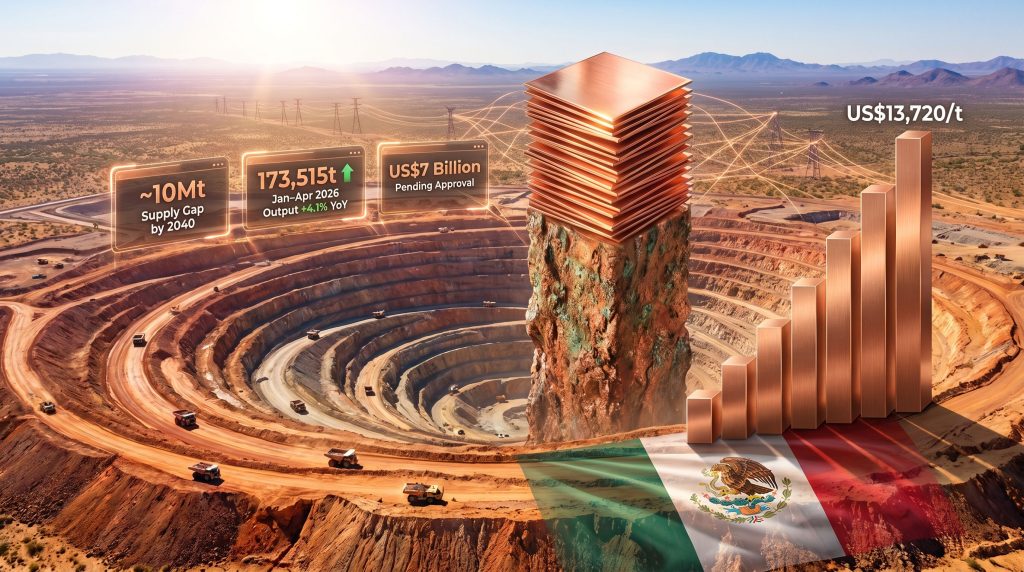
| S&P Global | ~10Mt cumulative deficit | By 2040 |
| McKinsey & Company | Structural undersupply confirmed | Long-term horizon |
The ICSG's revised outlook is particularly significant because it represents a reversal of the surplus projections that same body had published for 2025 and 2026. The last time the copper market experienced a structural deficit of this type was 2009. The current deficit is projected to persist and deepen, not correct itself through normal market mechanisms, because the supply response simply cannot arrive quickly enough.
Why Mexico Has Moved to the Centre of the Copper Investment Conversation
Production Momentum and Geological Endowment
Mexico ranks as the tenth largest copper producer globally, a position that understates its strategic relevance because of the country's geology, infrastructure base, and proximity to the North American market. Copper accounts for 27.2% of Mexico's total mining and metallurgical output, making it the single most important commodity in the national mining sector by value contribution.
The production data for early 2026 reflects genuine operational momentum rather than base-effect flattery. INEGI figures for January through April 2026 place national copper output at 173,515 tonnes, representing a 4.1% year-on-year increase and the strongest four-month opening performance recorded since at least 2019. This is occurring against a backdrop of prices approaching all-time highs, with copper trading near US$13,720 per tonne on global exchanges. At that price level, projects that were marginal at US$9,000 per tonne become highly economical, and existing operations generate cash flows that justify accelerated reinvestment.
Sonora: A Copper Province of Global Significance
Within Mexico, Sonora state is not merely a leading producer — it is the gravitational centre around which the country's entire copper industry orbits. The state accounts for 34.4% of Mexico's total mineral production and delivered 47,361 tonnes of copper in the January to April 2026 period, up 2.7% year-on-year. These figures are anchored by two of the world's most significant copper operations:
- Buenavista del Cobre (operated by Grupo México): One of the world's largest open-pit copper mines, producing over 450,000 tonnes annually with active expansion programs underway
- La Caridad: Contributing approximately 119,960 tonnes per year as a complementary large-scale operation within the same geological corridor
Sonora also hosts 203 active mining projects spanning not just copper but also lithium, graphite, silver, and rare earth elements. This multi-mineral profile means the state's infrastructure investment in roads, power, water, and processing has a shared cost base across multiple commodities, improving the economics of copper development relative to more isolated deposits elsewhere. For a broader perspective on mining operations in Mexico, the scale of Sonora's contribution becomes even more apparent.
The geology underpinning Sonora's copper dominance is porphyry copper systems — large-tonnage, low-to-moderate grade deposits formed by magmatic intrusion processes. These systems are globally prised because their scale allows for long mine lives and consistent production profiles. A well-defined porphyry deposit in Sonora is not a speculative exploration play; it is a manufacturing asset with predictable operating parameters.
Emerging Production Centres Beyond Sonora
While Sonora dominates current output, the Mexican copper mining opportunity extends geographically into other states with distinct geological characters:
- San Luis Potosí recorded the fastest percentage production growth of any Mexican state in early 2026, with output rising 69.9% year-on-year to reach 2,399 tonnes for the four-month period. While the absolute tonnage remains modest, the growth rate signals active development activity and improving operational efficiency.
- The Sinaloa/Chihuahua corridor hosts the Santo Tomás porphyry deposit being advanced by Oroco Resource Corp, with a projected mine life of 22.6 years, 4,774 million pounds of payable copper, and a post-tax net present value of US$1.48 billion. Long-life porphyry assets of this scale are increasingly rare globally, which explains the investor attention the project has attracted. Indeed, identifying a major copper system of comparable scale anywhere in the Americas is becoming progressively more difficult.
Major Projects Reshaping Mexico's Copper Investment Landscape
The development pipeline illustrates the scale of capital being directed toward Mexican copper assets at current price levels:
| Project | Operator | Investment | Target Output | Expected Timeline |
|---|---|---|---|---|
| El Pilar | Southern Copper (Sonora) | US$310 million | 36,000t cathodes/year | Active development |
| El Arco | Southern Copper (Baja California) | US$2.9 billion | 190,000t/year | ~2030 |
| Santo Tomás | Oroco Resource Corp | TBC | 4,774M lb payable Cu | Long-term development |
| Piedras Verdes | Various | TBC | TBC | Renewed interest |
Federal authorities have signalled a commitment to faster permitting processes in 2026, with approximately US$7 billion in mining investment currently awaiting regulatory approval. The velocity at which these approvals move through the system will be a primary determinant of how much of the projected global copper deficit Mexican production can realistically address. For investors monitoring the sector, permitting timelines have become as important a variable as commodity prices in project valuation models.
Moreover, projects that have already completed a definitive feasibility study are particularly well-positioned to move rapidly once regulatory approvals are secured.
"The relationship between permitting speed and production timing is non-linear. A six-month delay in approval at the feasibility stage can push first production back by two years when construction scheduling and financing syndication are factored in."
Mexico's Competitive Position: Genuine Advantages and Real Constraints
Where Mexico Holds a Structural Edge
The Mexican Mining Chamber (CAMIMEX) has identified the country's mineral processing infrastructure as among the most capable in Latin America, positioning Mexico as a leader in the region for converting extracted ore into marketable concentrate and refined product. This infrastructure advantage is compounded by several additional competitive factors:
- USMCA integration provides preferential trade access to the United States and Canadian markets for both mining equipment imports and refined metal exports, reducing logistics costs and import duties relative to non-USMCA producers
- Geological depth across multiple mineral systems means that exploration success in Mexico tends to yield large-scale, long-life deposits rather than small high-grade pockets requiring frequent capital reinvestment
- Political recalibration under President Claudia Sheinbaum has reversed the exploration concession freezes that constrained the sector under the previous administration, reopening Mexico to international capital in a way that many investors had written off as unlikely
- Proximity to North American end-markets for copper-intensive manufacturing, including EV production facilities, data centre construction, and grid infrastructure investment, creates a logistical advantage over South American producers for certain offtake arrangements
The Structural Constraints That Demand Investor Attention
CAMIMEX has been equally direct about where Mexico's copper sector falls short. Despite its processing leadership in Latin America, domestic copper refining capacity is insufficient to handle all the concentrate produced nationally. This bottleneck means Mexico exports value-added processing opportunity along with its concentrate, effectively subsidising the refining industries of other countries rather than capturing that margin domestically.
The export concentration issue is arguably more urgent. Approximately 94% of Mexico's copper exports were directed to China in 2021, with less than 1% reaching U.S. buyers. This concentration creates multiple categories of risk simultaneously:
- Geopolitical exposure: Any deterioration in Mexico-China trade relations, or broader U.S.-China tensions affecting Mexican trade flows, could disrupt the primary revenue channel for copper exports
- Pricing leverage: A buyer accounting for 94% of purchases holds substantial negotiating power over contract terms, treatment charges, and price realisation
- Strategic vulnerability: Western governments actively seeking to build copper supply chains independent of Chinese influence cannot rely on Mexican output that is contractually committed to Chinese buyers
How Mexico Compares to Other Latin American Copper Producers
| Metric | Mexico | Chile | Peru |
|---|---|---|---|
| Global Production Rank | 10th | 1st | 2nd |
| Key Production Hub | Sonora State | Atacama Region | Andes Corridor |
| Refining Capacity | Insufficient for full output | World-class | Moderate |
| Export Diversification | ~94% to China (2021) | Diversified | Diversified |
| Permitting Environment (2026) | Improving | Stable | Constrained |
| USMCA Trade Access | Yes | No | No |
| Major Projects in Pipeline | El Arco, El Pilar, Santo Tomás | Multiple greenfield expansions | Quellaveco, Tía María |
The USMCA advantage deserves particular emphasis in this comparison. Neither Chile nor Peru has a preferential trade agreement with the United States that covers copper and copper products. As the U.S. accelerates domestic manufacturing reshoring and energy infrastructure investment, the ability to source copper from a USMCA partner with preferential access terms is a meaningful differentiator that is not yet fully reflected in project valuations.
The next major ASX story will hit our subscribers first
Opportunities for International Players in Mexico's Copper Sector
Equipment, Technology, and Operational Services
Large open-pit copper operations in Sonora and elsewhere require continuous capital expenditure on mobile equipment, processing technology, and mine automation systems. Operators at the scale of Buenavista del Cobre run fleets of several hundred large mining trucks and substantial crushing and concentration infrastructure. Several key procurement priorities are emerging across the sector:
- Mining machinery suppliers capable of maintaining consignment inventories near operating mine sites, reducing equipment downtime and associated revenue loss
- Automation and remote monitoring systems that reduce operational costs and improve safety metrics required for ESG-compliant financing
- Water management and tailings containment technologies, increasingly critical as environmental licensing requirements become more sophisticated
The Offtake Diversification Opportunity
The near-total export dependence on China creates a structural opening that Western buyers have been slow to exploit. Long-term offtake agreements negotiated now, at a moment when Chinese buyers still dominate Mexican copper flows, could be structured on commercially competitive terms while simultaneously addressing the strategic diversification goals of North American and European industrial consumers.
The USMCA framework provides an administrative and logistical foundation for redirecting concentrate and refined copper flows toward U.S. end-users, but commercial will and procurement strategy must complement the policy framework. The reshoring of U.S. manufacturing and the domestic energy infrastructure buildout implied by grid modernisation targets create proximate, growing demand for copper that could logically be sourced from USMCA-partner Mexico rather than via transoceanic supply chains. This geographic and trade-framework alignment represents one of the least-discussed but potentially most durable aspects of the Mexican copper mining opportunity.
Frequently Asked Questions: Mexico's Copper Mining Sector
Why is the Mexican copper mining opportunity attracting attention right now?
The convergence of near-record copper prices approaching US$13,720 per tonne, rising domestic production output, an improving permitting environment, and accelerating global demand from AI infrastructure and electrification has created a rare alignment of favourable conditions for Mexican copper assets.
What makes Sonora the dominant copper-producing state in Mexico?
Sonora's geological endowment includes world-class porphyry copper systems that support large-scale, long-life mining operations. The state hosts over 203 active mining projects, two of the world's largest individual copper mines, and processing infrastructure that reduces the capital intensity of bringing new deposits into production.
How long does it take to develop a new copper mine?
From first exploration drilling to commercial production, the global average is 17 to 25 years. This extended timeline is precisely why assets with existing infrastructure, defined resources, and partial permitting command significant premiums in the current market. Furthermore, understanding the future of copper mining through a lens of innovation helps clarify why development timelines remain so critical.
What is Mexico's biggest structural challenge in the copper sector?
Two constraints stand out: insufficient domestic copper refining capacity to process all nationally produced concentrate, and extreme export concentration with approximately 94% of copper exports directed to a single buyer market. Addressing both would substantially increase Mexico's capture of value from its copper endowment.
What is the projected global copper supply gap by 2040?
S&P Global's modelling projects a cumulative supply deficit approaching 10 million tonnes by 2040, driven by a roughly 50% expansion in demand to 42 million tonnes colliding with mine output that peaks near 2030 and begins declining thereafter.
The Decade Ahead: Mexico's Copper Sector at a Structural Inflection Point
The conditions defining the Mexican copper mining opportunity in 2026 are not cyclical phenomena that will normalise within a few years. The mine development clock, the electrification imperative, the AI infrastructure buildout, and the growing strategic premium attached to geographically diversified copper supply chains are all multi-decade forces. Mexico's geological endowment and processing infrastructure position it to benefit from these forces, but that benefit is not automatic.
The critical variables determining how much of the global copper deficit Mexican production ultimately addresses are:
- Refining capacity investment: Expanding domestic refining so that Mexico captures processing margin rather than exporting it
- Export diversification: Reducing the ~94% concentration in Chinese offtake to build relationships with North American and European industrial buyers
- Permitting velocity: Translating the US$7 billion in pending investment approvals into actual construction starts within commercially relevant timeframes
- Infrastructure development: Extending road, power, and water access to remote project areas across Sonora and adjacent states
Ruben del Pozo Mendoza, President of the Association of Mining, Metallurgical and Geological Engineers of Mexico, has emphasised that Mexico must actively prepare for growing copper and strategic mineral demand driven by electromobility and renewable energy sectors, recognising that these minerals are indispensable for both the energy transition and technological development. That preparation requires decisions made now, not after the decade's demand peak has arrived.
For investors, the practical implication is that Mexican copper assets offering established infrastructure, defined geological resources, and proximity to North American end-markets represent a category of opportunity that becomes structurally more valuable as the global supply gap widens. The price signal, the geology, and the policy direction are all pointing in the same direction. The question is whether the sector's administrative and commercial infrastructure can move fast enough to capture it.
Disclaimer: This article contains forward-looking statements, market forecasts, and projections sourced from third-party analysts and industry bodies including J.P. Morgan, the International Copper Study Group, the International Energy Agency, S&P Global, and McKinsey. These projections are subject to material uncertainty and should not be construed as financial advice. Readers should conduct independent research before making investment decisions.
Want to Be First to Capitalise on the Next Major Copper Discovery?
Discovery Alert's proprietary Discovery IQ model delivers real-time alerts the moment significant copper and mineral discoveries are announced on the ASX, transforming complex geological data into actionable investment insights for both short-term traders and long-term investors — start your 14-day free trial at Discovery Alert today, or explore how historic mineral discoveries have generated exceptional market returns to understand the scale of opportunity that early positioning can unlock.