July 7, 2026
When Mid-Tier Miners Look Beyond Their Borders, Geology Drives the Decision
The global mining industry is undergoing a quiet but significant geographic reorientation. As geopolitical risk repricing accelerates and commodity demand profiles shift toward electrification-era metals, mid-tier producers that once thrived on single-country operational simplicity are finding that concentrated jurisdictional exposure carries its own set of risks. The calculus has changed: diversification is no longer a luxury reserved for majors, but a structural imperative for any producer serious about longevity and growth.
It is against this backdrop that the Solidcore Oman exploration venture deserves careful examination, not merely as a single corporate transaction, but as a case study in how a regional gold producer systematically repositions itself for a decade of transformation.
When big ASX news breaks, our subscribers know first
Why Solidcore's Strategic Reset Creates an Expansion Imperative
Solidcore Resources plc holds the position of Kazakhstan's second-largest gold producer, a significant standing in a country that consistently ranks among the world's top ten nations for global gold production. However, the company's recent history is defined less by its production legacy and more by a decisive corporate restructuring that fundamentally altered its asset footprint.
In 2024, Solidcore completed the divestment of its Russian mining operations, a move driven by the need to eliminate exposure to sanctions-related risks that had complicated its international investor relationships. The decision was strategically sound but operationally consequential: it left the company as a single-country operator at precisely the moment its ambitions required the opposite.
The 1 Million Ounce Target and the Gap It Creates
Also in 2024, Solidcore publicly committed to doubling its gold equivalent output to 1 million ounces per year by 2030. That target, stated with specificity, demands a credible pathway involving both organic growth and external acquisitions. The arithmetic is unforgiving for a Kazakhstan-only operator, which is why the company identified Central Asia and the Middle East as its preferred expansion corridors.
Furthermore, the company made a deliberate pivot toward base metals projects, particularly copper-gold assets, that can contribute to the gold equivalent ounce calculation while simultaneously capturing structural commodity demand tailwinds. The strategic logic is layered:
- Single-jurisdiction concentration amplifies country-specific regulatory and operational risk
- Pure gold pipelines face increasing scarcity of high-quality undeveloped assets at reasonable acquisition costs
- Copper-gold projects offer dual-commodity exposure, with copper providing leverage to electrification demand cycles
- The Middle East, particularly Oman, offers a combination of geological prospectivity and political stability that is increasingly rare in frontier mining jurisdictions
The Khabiyat Project: Geology, Location, and Why It Was Selected
Understanding Oman's Ophiolite Belt
To appreciate why the Khabiyat copper-gold project merits serious attention, it is necessary to understand the geological architecture that makes northern Oman one of the world's most distinctive mineralised terranes.
Oman hosts one of the best-preserved and most extensively exposed ophiolite sequences on earth. An ophiolite is a section of ancient oceanic crust and upper mantle that has been thrust onto continental margins through tectonic processes. The Semail Ophiolite, which covers much of northern Oman, is geologically significant because it preserves the full stratigraphic sequence from mantle peridotites through volcanic pillow basalts.
It is within these volcanic sequences that volcanogenic massive sulfide deposits typically form. These develop when metal-rich hydrothermal fluids vent at or near the ancient seafloor, precipitating dense concentrations of sulfide minerals that carry copper, gold, zinc, and silver. Oman's ophiolite belt has been recognised by geologists as one of the most prospective VMS terranes globally, and its ancient copper-mining history, stretching back to the Magan civilisation more than 4,000 years ago, provides compelling surface-level validation of the region's mineralogical richness.
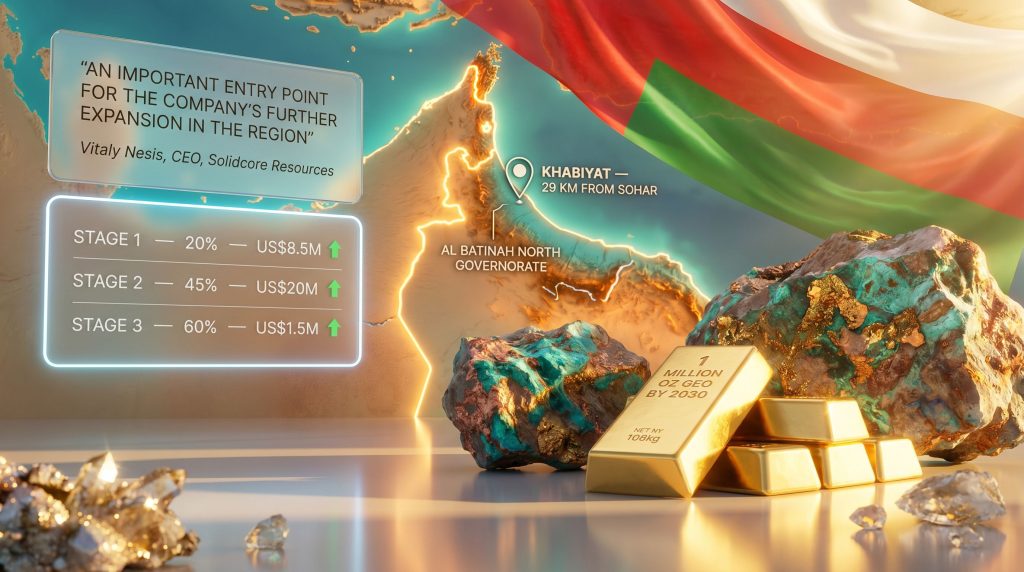
The Khabiyat project sits within the Al Batinah North Governorate in northern Oman, approximately 29 kilometres from Sohar, one of the region's most strategically important industrial port cities. The licence area covers 84.5 square kilometres of terrain interpreted to be prospective for copper-gold VMS mineralisation.
Why Proximity to Sohar Matters More Than It Appears
Sohar is not simply a nearby town. It is home to one of the Middle East's most significant industrial port complexes, with dedicated facilities for bulk mineral handling, refining infrastructure, and direct maritime access to Asian and European markets. For a copper-gold project at the exploration stage, proximity to export infrastructure of this calibre is a material long-term advantage that is often underestimated in early-stage project valuations.
Oman's Mining Investment Fundamentals at a Glance
| Factor | Detail |
|---|---|
| Geological Prospectivity | Semail Ophiolite hosts world-class VMS copper-gold potential |
| Political Environment | Among the most stable governance environments in the Middle East |
| State Partnership Model | Minerals Development Oman (MDO) provides sovereign co-investment capability |
| Infrastructure Access | Sohar Industrial Port enables future direct mineral exports |
| Economic Policy Context | Oman's Vision 2040 identifies mining as a priority economic diversification sector |
How the Solidcore–MDO Joint Venture Is Structured
The Earn-In Mechanism: Risk Management by Design
The joint venture between Solidcore and Minerals Development Oman (MDO) follows a three-stage earn-in structure, a format that has become increasingly common in exploration-stage partnerships because it aligns capital commitment with demonstrated technical progress rather than upfront acquisition risk.
An earn-in agreement allows an incoming party to acquire equity in an exploration asset progressively, by meeting defined expenditure thresholds across sequential stages. Each stage is typically contingent on the completion of the previous one, meaning capital is only deployed when exploration results justify continued investment. Consequently, the risk profile for early investors is considerably more manageable than in traditional outright acquisition deals.
Stage-by-Stage Breakdown:
| Stage | Stake Acquired | Cumulative Ownership | Capital Commitment |
|---|---|---|---|
| Stage 1 | 20% | 20% | US$8.0 million exploration spend + US$500,000 initial cash payment to MDO |
| Stage 2 (Optional) | +25% | 45% | US$20 million additional investment |
| Stage 3 (Optional) | +15% | 60% | US$1.5 million additional payment |
Stage 1 covers a two-year initial exploration program, focused on systematic geological investigation across the licence area. Stage 2 and Stage 3 are optional, only triggered if the outcomes of the preceding stage demonstrate sufficient technical merit to justify further capital commitment.
Upon completion of all three stages, Solidcore and MDO would fund further development activities on a pro-rata basis relative to their respective equity positions.
Structural Features That Matter to Investors
Several characteristics of this deal structure are worth examining from an investment perspective:
- Capital efficiency: The staged deployment model limits early-phase downside exposure while preserving full upside participation if exploration succeeds
- Majority control pathway: A 60% operator stake is at the higher end of what foreign miners typically achieve in sovereign-partnered joint ventures in resource-nationalist jurisdictions
- Sovereign partner alignment: MDO, as a state-owned entity, provides inherent regulatory connectivity and in-country operational support that a purely private co-venturer could not replicate
- Optionality preservation: The optional nature of Stages 2 and 3 means Solidcore retains the right to limit total capital exposure if early-stage results disappoint
- Pro-rata funding post-Stage 3 ensures that long-term development costs are shared in proportion to ownership, eliminating the dilution risk that can arise when one partner disproportionately funds later-stage programs
VMS Copper-Gold Systems: Why This Deposit Style Is Attracting Capital in 2026
Technical Characteristics of VMS Mineralisation
Volcanogenic massive sulfide deposits are among the most economically significant deposit types in the global base metals sector. They form through submarine hydrothermal processes: metal-enriched fluids circulate through fractured volcanic rock sequences and discharge at the seafloor, where rapid cooling causes dense sulfide mineral precipitation.
The resulting ore bodies are characteristically high-grade relative to other copper deposit styles, often exhibiting:
- Massive sulfide zones with copper grades that can exceed typical porphyry copper systems
- Precious metal credits, particularly gold and silver, that materially improve project economics
- Polymetallic character, with zinc and lead sometimes adding further revenue streams
- Relatively compact footprints that can limit mine development capital relative to bulk-tonnage porphyry alternatives
The Copper Supply Deficit and Its Exploration Implications
The broader context for this Solidcore Oman exploration venture cannot be separated from the structural copper supply narrative that has dominated commodity markets over the past several years. The copper supply crunch the global industry faces is well-documented: declining average ore grades at existing mines, a multi-decade decline in major discovery rates, and a permitting environment that has extended the timeline from discovery to production to fifteen years or longer in many jurisdictions.
Against this backdrop, demand projections continue to expand. Electric vehicles require approximately four times the copper content of conventional internal combustion engine vehicles. Power grid infrastructure upgrades, particularly those driven by AI data centre buildout and renewable energy integration, represent additional demand vectors that most pre-2023 supply models failed to adequately capture.
Early-stage VMS copper-gold exploration in geologically prospective but underexplored jurisdictions like Oman's ophiolite belt therefore represents a category of assets that may carry significant option value, even at pre-resource stages, if the broader supply deficit narrative continues to unfold as projected.
It should be noted that exploration-stage projects carry inherent uncertainty, and investors should treat projections regarding future copper demand and supply dynamics as speculative until substantiated by ongoing market developments.
What the Khabiyat Deal Signals About Solidcore's M&A Pipeline
A Template, Not a One-Off
CEO Vitaly Nesis has indicated that Khabiyat represents an important entry point for the company's broader regional expansion ambitions, a characterisation that investors should interpret carefully. Entry points, by definition, precede further moves. The earn-in structure adopted at Khabiyat, with its staged capital commitment and majority-control pathway, is inherently replicable and could serve as a template for additional joint ventures across the region.
In this context, the trend toward mining industry consolidation through joint ventures and sovereign-partnered structures appears to be accelerating across Central Asia and the Middle East, with Solidcore now positioned at the forefront of that movement.
Solidcore's Corporate Transformation in Context
| Year | Event | Strategic Significance |
|---|---|---|
| 2024 | Divested Russian mining operations | Removed sanctions risk; simplified corporate structure for international investors |
| 2024 | Announced 1 million oz GEO target by 2030 | Set growth mandate requiring M&A and geographic diversification |
| 2026 | Signed Khabiyat JV with MDO in Oman | First project outside Kazakhstan; established first Middle East operational footprint |
The post-Russia Solidcore is a materially different investment proposition. The elimination of Russian exposure removes what had become a significant institutional investor constraint, particularly for European and North American capital allocators operating under increasingly stringent ESG and geopolitical risk frameworks. A Kazakhstan-domiciled, Middle East-expanding gold and copper producer presents a profile that is considerably more accessible to global institutional capital than its pre-2024 predecessor.
Is the Middle East an Undervalued Mining Frontier?
Western majors have historically concentrated exploration capital in well-established mining jurisdictions: the Americas, Australia, sub-Saharan Africa, and parts of Southeast Asia. The expansion of Middle East exploration licences has, however, begun attracting growing attention from mid-tier producers seeking less contested geological terrain.
Oman's ophiolite-hosted copper deposits are not unknown to geologists. The ancient Magan copper trade, conducted from Omani sites more than four millennia ago, confirms both the presence of accessible mineralisation and a historical precedent for extraction at scale. What has changed is the commercial and regulatory infrastructure surrounding those geological opportunities, with MDO now providing a structured pathway for foreign capital to participate in Omani resource development under a defined and increasingly standardised partnership framework.
For mid-tier miners like Solidcore, the relative scarcity of international competition in this geographic corridor may represent a first-mover advantage that is difficult to replicate once the region's exploration potential becomes more broadly recognised. Solidcore Resources itself has noted the strategic importance of establishing an early presence in jurisdictions that remain largely uncrowded by Western majors.
The next major ASX story will hit our subscribers first
Frequently Asked Questions: Solidcore Oman Exploration Venture
What is the Solidcore Oman exploration venture?
Solidcore Resources plc has entered a joint venture with Minerals Development Oman to explore and potentially develop the Khabiyat copper-gold project in northern Oman. This is the company's first exploration asset located outside Kazakhstan.
Where exactly is the Khabiyat project?
The project is situated in Oman's Al Batinah North Governorate, approximately 29 kilometres from Sohar's industrial port complex, covering an 84.5 square kilometre licence area targeting copper-gold VMS mineralisation.
What is the total potential investment commitment?
Under the three-stage earn-in structure, Stage 1 requires a US$8.0 million exploration program plus a US$500,000 cash payment to MDO. Stage 2 adds up to US$20 million and Stage 3 a further US$1.5 million. Full completion of all stages would give Solidcore a 60% stake.
Why did Solidcore sell its Russian assets?
The 2024 divestment of Russian operations was executed specifically to eliminate exposure to sanctions-related risks, repositioning the company with a cleaner geopolitical profile for international institutional investors.
What is Solidcore's production growth target?
The company has publicly committed to doubling its gold equivalent output to 1 million ounces per year by 2030, to be achieved through organic growth, M&A activity, and diversification into base metals including copper.
What makes a VMS copper-gold deposit significant?
Volcanogenic massive sulfide deposits are typically high-grade, polymetallic ore bodies formed through submarine hydrothermal processes. They frequently carry copper, gold, silver, and zinc in combinations that can deliver strong project economics, and Oman's ophiolite belt is globally recognised as one of the most prospective terranes for this deposit style.
Key Takeaways for Investors and Industry Observers
The Solidcore Oman exploration venture is best understood not as a singular transaction but as the opening move in a deliberate multi-year geographic repositioning strategy. Several themes emerge from a thorough assessment of the deal:
- The earn-in structure at Khabiyat is capital-efficient, staged, and offers a replicable template for further Middle East exploration ventures
- Oman's ophiolite belt provides geological credentials that are scientifically substantiated and commercially underexplored by international mining capital
- A 60% maximum operator stake, achieved through staged earn-in rather than upfront acquisition, represents an advantageous control outcome relative to typical sovereign-partnered JV frameworks
- The copper-gold focus directly aligns Solidcore's exploration pipeline with the most structurally supported commodity demand themes of the late 2020s
- For the broader sector, this deal signals growing appetite from Central Asian mining companies to establish Middle Eastern exploration footholds, a geographic pairing that remains largely uncrowded by Western majors
This article is intended for informational purposes only and does not constitute financial advice. Exploration-stage mining projects carry significant risk, and statements regarding future production targets, resource potential, and commodity demand trajectories should be considered forward-looking and subject to material uncertainty.
Ready to Capitalise on the Next Major Mineral Discovery Before the Market Catches On?
Discovery Alert's proprietary Discovery IQ model instantly identifies significant ASX mineral discoveries — from copper-gold VMS systems to transformative exploration breakthroughs — delivering real-time, actionable alerts to subscribers ahead of the broader market. Explore historic discoveries and their remarkable returns to understand the opportunity, then begin your 14-day free trial at Discovery Alert to position yourself at the forefront of the next major find.