July 8, 2026
The Grade Advantage That Changes Everything in Copper Mining
Most copper mines operating today extract metal from ore grading somewhere between 0.5% and 0.8% copper. That figure represents decades of grade decline across the industry, as miners have progressively worked through the richest zones of their deposits and moved deeper into lower-quality rock. Against this backdrop, a mine consistently pulling ore grading between 3.0% and 4.5% copper does not simply represent an incremental improvement. It represents a fundamentally different economic and operational reality.
This is the lens through which the Ivanhoe Mines Kamoa-Kakula copper project in the Democratic Republic of Congo demands to be understood. Not as another large mine in a resource-rich country, but as a structural outlier in a global industry increasingly struggling to replace the copper it consumes. The numbers behind this project are not just impressive in isolation — furthermore, they are reshaping what analysts and investors consider achievable at scale.
When big ASX news breaks, our subscribers know first
Why Ore Grade Is the Most Misunderstood Metric in Copper Mining
Before examining performance data, it is worth unpacking why ore grade matters so profoundly to the economics of copper extraction. At 0.6% copper, a mine must process roughly 167 tonnes of rock to yield one tonne of copper metal. At 3.5% copper, that same tonne of metal requires only about 29 tonnes of rock to be drilled, blasted, hauled, crushed, and processed.
The downstream implications cascade across every cost line on an income statement:
- Lower tonnes milled per unit of copper produced
- Reduced energy consumption per tonne of output
- Smaller tailings volumes per tonne of copper recovered
- Higher mill throughput efficiency
- Lower reagent consumption in flotation circuits
This explains why Kamoa-Kakula has earned recognition as having among the lowest carbon intensity per tonne of copper produced of any major copper operation globally. The efficiency is not primarily the result of technology choices, although those matter. It is, however, embedded in the geology itself.
| Metric | Kamoa-Kakula | Global Major Copper Average |
|---|---|---|
| Average Ore Grade | 3.0%–4.5% Cu | ~0.5%–0.8% Cu |
| Indicated Resource | ~34 Mt contained copper | Varies significantly |
| Carbon Intensity | Lowest among major producers | Higher, often diesel-dependent |
| Commercial Production Start | July 2021 | N/A |
| Ore tonnes per tonne of Cu | ~29 (at 3.5%) | ~145 (at 0.69%) |
The Central African Copperbelt: A Geological Setting Unlike Any Other
The Kamoa-Kakula deposits sit within the Central African Copperbelt, a geological province spanning parts of the DRC and Zambia that represents one of the most copper-endowed regions on Earth. The mineralisation style at Kamoa-Kakula is classified as sediment-hosted stratiform copper, meaning the copper occurs in flat-lying, laterally continuous sedimentary layers rather than in the irregular, disseminated patterns typical of porphyry copper deposits common in South America and Southeast Asia.
This geological architecture matters for several practical reasons:
- Predictability — Stratiform deposits tend to be more geometrically consistent, simplifying mine planning and grade control.
- Continuity — The mineralised horizons can be traced over large distances, supporting the delineation of very large resource tonnages.
- Mining method suitability — The flat-lying geometry lends itself to highly efficient room-and-pillar or drift-and-fill underground mining methods, reducing dilution.
- Shallow initial mining depths — Early production zones were accessible at relatively modest depths, keeping development costs manageable during the project ramp-up phase.
The total Indicated Mineral Resource stands at approximately 1.27 billion tonnes of ore grading 2.65% copper, representing around 34 million tonnes of contained copper metal. To contextualise that figure, global copper mine production runs at approximately 22 million tonnes per year, meaning Kamoa-Kakula's resource base alone represents more than 1.5 years of total global supply from a single deposit complex. Consequently, this project sits at the heart of the ongoing global copper supply gap conversation among analysts and policymakers.
Who Controls the Project and How the Joint Venture Operates
The Ivanhoe Mines Kamoa-Kakula copper project operates under a joint venture structure that balances technical leadership with financial depth and political alignment.
Ownership Structure:
- Ivanhoe Mines: 39.6% interest
- Zijin Mining Group: 39.6% interest
- DRC Government and Crystal River Global: remaining minority interests
Zijin Mining, one of China's largest gold and copper producers, brings substantial smelting expertise and offtake connections to the partnership. This relationship has proven strategically relevant given that the Lualaba Copper Smelter, located adjacent to the mine, was partially developed to serve the project's growing concentrate output. The Chinese connection also provides commercial pathways into Asian refined copper markets, which absorb the majority of global refined copper supply.
The DRC government's participation, through its state mining entity Gécamines, reflects a broader trend across African mining jurisdictions where resource nationalism has evolved from outright confrontation to more structured partnership arrangements. Understanding this dynamic is important for investors assessing political risk, as it aligns state interests with project performance rather than placing them in opposition.
Q2 2026 Production Performance: Reading the Numbers Correctly
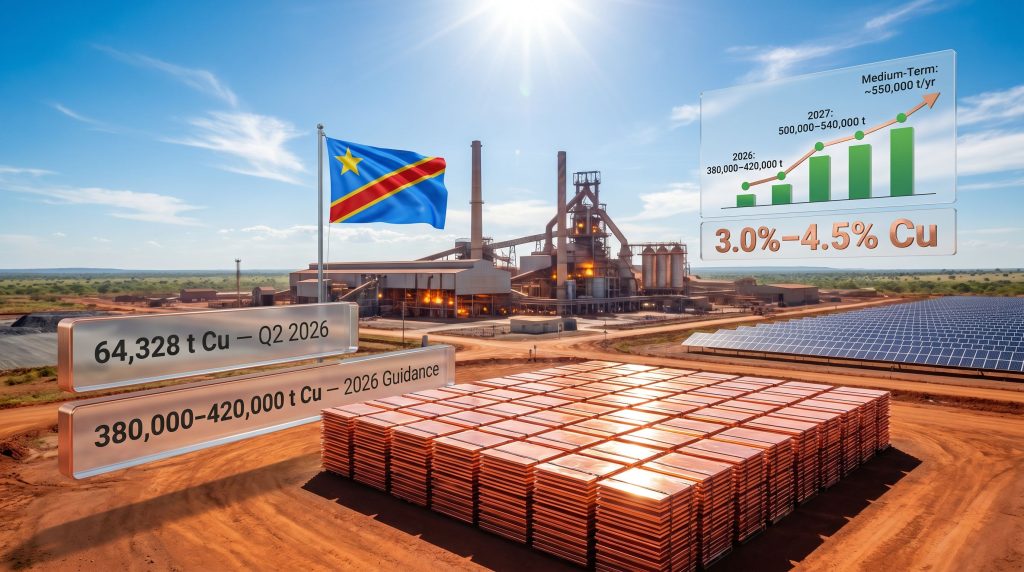
The second quarter of 2026 delivered 64,328 tonnes of copper across concentrate, anode, and blister copper product forms. To understand what that figure means in context, consider that many mid-tier copper producers regard 100,000 tonnes as an annual production target. Kamoa-Kakula achieved nearly two-thirds of that in a single quarter, even while navigating the ongoing recovery from the Kakula mine seismic suspension that began in May 2025.
Q2 2026 Operational Snapshot:
- Total copper produced: 64,328 tonnes
- Ore milled: approximately 3 million tonnes
- Sulphuric acid produced: 112,307 tonnes
- July sulphuric acid contract price: approximately US$840 per tonne
The sulphuric acid figure deserves specific attention. Acid is a co-product of the copper smelting process, generated when sulphur dioxide from smelting is captured and converted rather than released into the atmosphere. At US$840 per tonne on July contracts, sulphuric acid production at this scale generates meaningful supplementary revenue while simultaneously reducing atmospheric emissions, creating a commercial incentive that aligns with environmental outcomes.
What the Temporary Smelter Shutdown Revealed
The Lualaba Copper Smelter experienced a temporary shutdown during Q2 2026 before operations resumed. Rather than treating this as a concern, experienced mine analysts will note that the swift resumption and the maintenance of overall quarterly production targets demonstrated robust operational contingency planning. When a single component of a large, integrated processing chain can be taken offline and brought back online without derailing headline output figures, that speaks to the depth of operational redundancy built into the system.
The Seismic Recovery: Progress, Timeline, and What Comes Next
The May 2025 seismic event that prompted suspension of underground mining operations at the Kakula mine represented the most significant operational disruption in the project's short producing life. Understanding the recovery trajectory is essential for anyone assessing near-term production risk.
Kakula Recovery Progress Tracker:
- Western side dewatering: 70% complete
- Eastern side dewatering: 60% complete
- New eastern ore extraction zone: targeted commencement mid-2026
- Mining rate target post-recovery: 8.5 million tonnes per annum
- Rate increase represented: approximately 30% above current rates
The dewatering process in underground mines following seismic events is methodical by necessity. Water ingress into lower mine levels following ground movement requires systematic pumping campaigns that proceed zone by zone, with rehabilitation and ground support installation occurring only once sections are confirmed safe and dry. The 70%/60% completion rates on western and eastern dewatering respectively suggest the recovery programme is tracking toward full reinstatement of mining access across all production zones.
Critically, the identification and preparation of a new eastern mining area, with ore extraction targeted from mid-2026, indicates that the geological team has not simply been waiting for the existing areas to dewater. Mine planning has advanced alternative production zones in parallel, providing additional feed sources that will contribute to the targeted 8.5 million tonne per annum mining rate.
The next major ASX story will hit our subscribers first
Production Guidance: Building Toward 550,000 Tonnes Per Year
The forward production profile for the Ivanhoe Mines Kamoa-Kakula copper project follows a clear escalating trajectory, underpinned by the parallel ramp-up of three processing concentrator trains and the progressive reinstatement of full underground mining capacity.
| Year | Production Guidance | Primary Driver |
|---|---|---|
| 2026 | 380,000–420,000 t Cu | Seismic recovery progression and smelter ramp-up |
| 2027 | 500,000–540,000 t Cu | All three concentrator phases at steady-state throughput |
| Medium-Term | ~550,000 t Cu/yr | Phase 4 expansion potential leveraging 34 Mt resource |
The 2027 target of 500,000 to 540,000 tonnes would represent a step-change for global copper supply from a single project. To achieve this, the combined throughput of the Phase 1, Phase 2, and Phase 3 concentrators must reach 17 million tonnes of ore per annum. At current grades, that throughput volume generates copper output broadly consistent with guidance, assuming recovery rates remain stable. In addition, the copper supply crunch unfolding across global markets makes this output trajectory all the more significant for long-term supply planning.
The Phase 4 Optionality That Markets May Be Undervaluing
Beyond the confirmed three-phase expansion, the project's resource base of approximately 34 million tonnes of contained copper provides the foundation for a potential Phase 4 expansion. At the scale already established by Phases 1 through 3, a fourth processing train would theoretically push annual production capacity toward or above 600,000 tonnes, placing Kamoa-Kakula in a tier occupied by very few copper operations globally. This expansion optionality is not widely modelled in consensus forecasts, representing a speculative but geologically credible upside scenario worth monitoring. For context, a review of the world's largest copper mines underscores just how rare output at this scale truly is.
Africa's Largest Copper Smelter: Scale, Purity, and Market Position
The Lualaba Copper Smelter represents a deliberate strategic choice to capture more of the value chain domestically rather than exporting copper concentrate for processing elsewhere. With a nameplate capacity of 500,000 tonnes of copper per annum, the smelter is designed to handle not only current production but the expanded output targets through 2027 and beyond.
The copper anode produced achieves a purity standard of 99.7%, which meets the specification required by copper refineries producing London Metal Exchange-grade copper cathode. This positions the project's output firmly within mainstream global trading markets.
Steady-state smelter operations are targeted by the end of 2026. Once achieved, the integrated mine-to-smelter model will allow the project to capture processing margins currently shared with third-party smelters, while simultaneously reducing the logistical costs associated with shipping bulkier concentrate product.
Solar Power Integration and the Carbon Intensity Story
The commissioning of a 60-MW solar power facility, expected to reach full operational capacity by the end of Q3 2026, adds a renewable energy component to a project that already benefits from access to hydroelectric power through the DRC's national grid. The practical significance for an underground copper mine is notable, as mine ventilation, pumping, and processing circuits are among the most energy-intensive operations in the mining industry.
For battery manufacturers, electric vehicle producers, and industrial buyers increasingly subject to scope 3 emissions scrutiny, the origin and carbon intensity of raw material inputs is becoming a commercial consideration rather than simply a reputational one. Copper sourced from operations with demonstrably low carbon intensity per unit of production will increasingly attract attention from procurement teams navigating their own decarbonisation obligations. Furthermore, the copper price growth drivers tied to the energy transition reinforce the strategic importance of low-emission supply sources.
Ivanhoe's Portfolio Context: Three Tier-One Assets Operating Simultaneously
Kamoa-Kakula does not operate in isolation within Ivanhoe Mines' portfolio. The company is simultaneously advancing two other world-class operations that provide both commodity diversification and additional evidence of management's capacity to execute at scale.
| Operation | Commodity | Q2 2026 Highlight | Next Key Milestone |
|---|---|---|---|
| Kamoa-Kakula | Copper | 64,328 t Cu produced | 8.5 Mtpa mining rate reinstatement |
| Kipushi | Zinc | Record 70,177 t zinc concentrate | Sustained high-grade output continuation |
| Platreef | Platinum, Palladium, Nickel | Shaft #3 ramp-up completed | Full expansion by late 2027 |
Kipushi's record quarterly zinc concentrate output of 70,177 tonnes demonstrates that operational excellence at Kamoa-Kakula is not an isolated occurrence. The Platreef project in South Africa's Bushveld Complex, targeting platinum group metals alongside nickel and copper, adds exposure to battery materials and catalytic converter markets through a single integrated operation.
For investors, this multi-commodity structure means that single-commodity price shocks are partially buffered by exposure across copper, zinc, and platinum group elements, all of which have independent demand drivers in the energy transition economy. It is also worth noting that the DRC's role extends beyond copper — DRC cobalt production makes the region one of the most consequential jurisdictions for battery supply chains globally.
Frequently Asked Questions: Ivanhoe Mines Kamoa-Kakula Copper Project
What is the Kamoa-Kakula copper project?
Kamoa-Kakula is a large-scale, high-grade underground copper mining operation located in the DRC's Lualaba Province. It is operated as a joint venture and hosts one of the world's largest undeveloped-to-producing copper resource bases, with approximately 34 million tonnes of contained copper in Indicated Mineral Resources.
Where is Kamoa-Kakula located?
The project is situated in Lualaba Province in the south of the DRC, within the Central African Copperbelt, approximately 25 kilometres west of the town of Kolwezi.
When did Kamoa-Kakula begin commercial production?
The project achieved commercial production in July 2021, transitioning from development to producing status within a remarkably compressed timeline relative to comparable large-scale underground copper mines.
How does Kamoa-Kakula's ore grade compare to global peers?
With ore grades averaging between 3.0% and 4.5% copper, Kamoa-Kakula is consistently four to eight times richer than the global average for large copper mines, which typically operate at grades of 0.5% to 0.8% copper.
What is the current status of the Kakula mine seismic recovery?
As of the Q2 2026 reporting period, western side dewatering is approximately 70% complete and eastern side dewatering is approximately 60% complete. A new eastern mining area is targeting ore extraction from mid-2026, with the broader goal of reaching an 8.5 million tonne per annum mining rate.
What Q2 2026 Results Signal for H2 2026 and Beyond
The Q2 2026 performance data from the Ivanhoe Mines Kamoa-Kakula copper project communicates several things simultaneously to investors assessing the project's execution track record.
First, the maintenance of meaningful copper output during an ongoing mine recovery demonstrates operational resilience that a purely production-focused reading of the numbers might obscure. The project is not simply delivering copper. It is delivering copper while dewatering and rehabilitating a suspended mine section, ramping up a new smelter, and commissioning additional processing capacity.
Second, the forward guidance increase implied by the 2027 target of 500,000 to 540,000 tonnes represents a 25% to 35% step-up from the 2026 guidance midpoint. In most industries, guidance of that magnitude would require significant capital expenditure or transformative acquisitions. At Kamoa-Kakula, however, it is driven by the organic completion of already-installed infrastructure reaching its designed throughput rates.
Third, and perhaps most consequentially for long-term copper market participants, the project's eventual medium-term output of approximately 550,000 tonnes per year from a single operation will represent a material fraction of any credible demand growth scenario tied to electric vehicle adoption and grid infrastructure expansion. In a market where the pipeline of new high-grade copper projects is thin, the scale and quality of what Kamoa-Kakula is building warrants ongoing, close attention.
This article contains forward-looking statements and production guidance figures sourced from publicly available operational reporting. Readers should note that mining projections are subject to geological, operational, regulatory, and commodity price risks. Nothing in this article constitutes financial or investment advice. Investors should conduct their own due diligence before making any investment decisions.
Want to Catch the Next Major Copper Discovery Before the Market Does?
Discovery Alert's proprietary Discovery IQ model delivers real-time alerts on significant ASX mineral discoveries, instantly translating complex mineral data into actionable insights for both short-term traders and long-term investors — explore Discovery Alert's discoveries page to see how historic finds have generated extraordinary returns, and begin your 14-day free trial today to position yourself ahead of the broader market.