August 11, 2026
The Bottleneck No One Talks About: Why Smelting Capacity Determines the Ceiling on Copper Output
In the global conversation about closing the copper supply crunch, the focus almost always lands on mine discovery, ore grades, and drilling results. Yet the less glamorous reality of copper production is that finding and extracting ore is only half the equation. What happens to that ore after it leaves the ground, specifically how efficiently it moves through smelting and refining infrastructure, ultimately determines how much finished copper reaches the market.
For the world's largest mining companies, metallurgical processing capacity has quietly become the binding constraint that no amount of new drilling can solve on its own.
This is precisely the lens through which BHP's recent decision to award a contract valued at over AUD$200 million for the BHP Olympic Dam smelter and refinery expansion deserves to be understood. It is not simply a procurement milestone. It is an architectural decision about where the ceiling on South Australia's copper output will sit for the next two decades.
When big ASX news breaks, our subscribers know first
Understanding Olympic Dam as a Metallurgical Hub, Not Just a Mine
Olympic Dam occupies a category of its own within global copper mining. Unlike standalone open-pit operations that ship concentrate to third-party smelters, Olympic Dam operates as a fully integrated metallurgical complex. Underground ore is mined, processed, smelted, and refined on site, with the end product being finished copper cathode rather than intermediate concentrate.
This integration offers meaningful cost advantages under normal conditions, but it also creates a specific vulnerability: the smelter and refinery become the rate-limiting step for the entire provincial system. As BHP advances its copper expansion strategy across three separate operations, the metallurgical hub at Olympic Dam must be capable of absorbing the increased ore volumes. Without smelter expansion, additional mining investment produces diminishing returns.
The three mines currently feeding the Olympic Dam complex are:
- Olympic Dam — the flagship underground operation and host of the centralised processing facilities
- Prominent Hill — a high-grade underground copper-gold mine approximately 650 kilometres north of Adelaide
- Carrapateena — a sublevel cave operation that entered production in 2019 and continues to ramp up output
A fourth asset, Oak Dam, sits at the exploration stage but is considered a meaningful long-term optionality play within the province. Together, these assets underpin BHP's ambition to transform Copper South Australia into one of the world's most significant copper-producing jurisdictions.
Breaking Down the AUD$200 Million Contract Awarded to China Nerin Engineering
The contract awarded to China Nerin Engineering Co. Ltd covers the design and conditional supply of key processing facilities central to the smelter and refinery expansion at Olympic Dam. The structure of the agreement reflects a disciplined approach to capital commitment ahead of a formal investment decision.
| Contract Element | Detail |
|---|---|
| Total Contract Value | Over AUD$200 million (approx. US$138 million) |
| Contractor | China Nerin Engineering Co. Ltd |
| Primary Scope | Staged design of key smelter and refinery processing facilities |
| Secondary Scope | Conditional supply of equipment and infrastructure |
| Supply Conditionality | Activated only upon BHP's Final Investment Decision |
| Execution Model | Phased delivery aligned with advancing study milestones |
| FID Target | Mid-2027 |
China Nerin Engineering is a specialised metallurgical design institute with a track record that extends well beyond general construction. The firm has been involved in the design or construction of seven large-scale modern copper smelters globally, giving it deep technical familiarity with the pyrometallurgical systems that Olympic Dam's expansion will require.
Pyrometallurgy, the high-temperature processing of metal-bearing ores and concentrates, is a technically demanding field where engineering expertise and prior smelter-specific experience carry significant weight in contractor selection. Furthermore, copper smelting expansion at this scale requires exactly the kind of specialised engineering pedigree that Nerin brings to the table.
How the Phased Contract Structure Manages Capital Risk Before FID
The structure of this agreement deserves particular attention because it illustrates how large mining companies manage capital risk during multi-year study phases. The supply component of the Nerin contract is explicitly conditional on BHP approving the Final Investment Decision.
This means that advanced engineering work can proceed, design specifications can be developed, and procurement lead times can be managed without BHP being legally committed to the full capital expenditure of a construction programme.
This kind of front-end engineering investment, where design work advances on a staged basis while full capital commitment remains contingent on FID approval, is standard practice for mega-projects. It compresses the timeline between FID and first production without requiring premature capital lock-in.
From an investor perspective, the existence of a contracted design programme signals genuine forward momentum. It demonstrates that the project has advanced sufficiently in technical definition to support a structured design engagement with a specialised contractor, while simultaneously maintaining financial optionality.
The Parallel EPCM Contract: Fluor Australia and Hatch
Alongside the Nerin agreement, BHP awarded a separate contract valued at approximately AUD$40 million (approximately US$28 million) to a joint venture formed by Fluor Australia and Hatch, covering Engineering, Procurement, and Construction Management (EPCM) responsibilities for the expansion study programme.
The division of responsibilities between these two agreements reflects an important structural principle in complex project delivery:
- China Nerin Engineering holds the technical design and conditional supply mandate, applying its specialised smelter expertise directly to the metallurgical engineering challenge.
- Fluor Australia / Hatch JV provides independent project management, strategy, planning, and study coordination, ensuring that scope, schedule, and cost remain under structured oversight.
Separating the design and supply function from the management and coordination function is a deliberate risk-mitigation approach. It prevents any single contractor from controlling both the technical definition of scope and its delivery oversight, a common source of cost overruns in large infrastructure projects.
BHP's Copper Production Targets: The Numbers Behind the Ambition
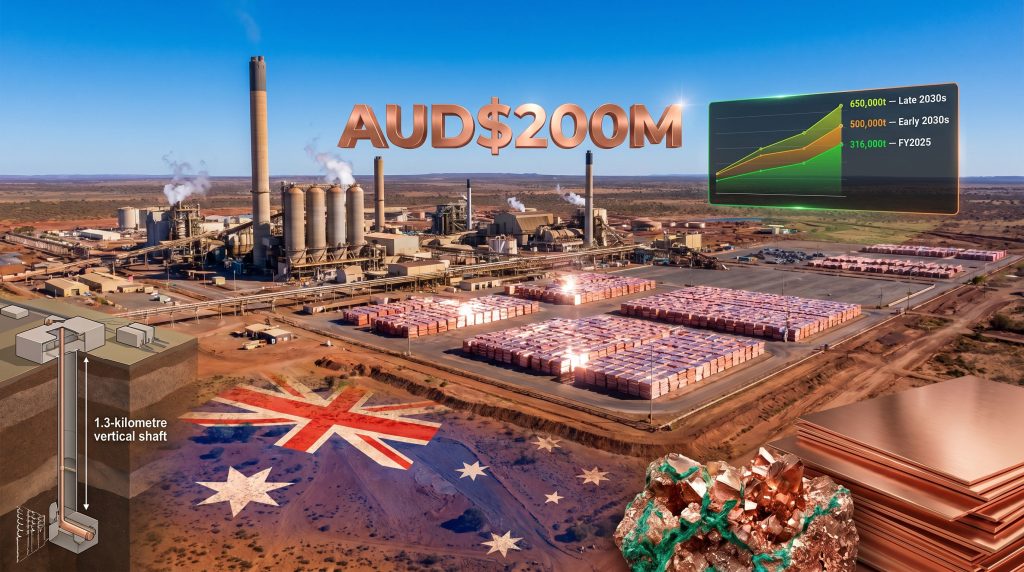
The production trajectory that BHP has outlined for Copper South Australia is among the most ambitious copper growth programmes being pursued by any major mining company globally. During the financial year ending June 2025, the Copper SA platform produced approximately 316,000 tonnes of copper. The expansion programme is designed to more than double that figure within the current decade.
| Production Scenario | Volume (ktpa) | Timeline |
|---|---|---|
| Current Baseline | ~316,000 | FY2025 |
| Primary Expansion Target | >500,000 | Early 2030s |
| Extended Upside Scenario | Up to 650,000 | Late 2030s |
To put this in context, moving from 316,000 tonnes to 500,000 tonnes per annum would represent a production increase of approximately 58% from a single provincial operation. Reaching 650,000 tonnes would effectively double current output. At prevailing copper prices, the revenue implications of such a production increase are substantial.
Why the Smelter Is the Critical Unlock
The production growth outlined above cannot be achieved through underground mining investment alone. The three-mine feeder system currently delivers ore volumes that are approaching the processing ceiling of the existing Olympic Dam metallurgical complex.
Expanding underground capacity at Prominent Hill, Olympic Dam, and eventually Carrapateena without simultaneously expanding smelter and refinery throughput would create a processing queue that limits the system's effective output. Consequently, the BHP Olympic Dam smelter and refinery expansion contract represents a genuinely foundational decision — the infrastructure investment that either enables or constrains every other growth initiative in the portfolio.
The AUD$2 Billion Active Project Pipeline Supporting the Expansion
The smelter design contract does not exist in isolation. BHP currently has over AUD$2 billion in active capital projects underway across the Copper SA platform, all of which are designed to prepare the underground mining system for the volumes that an expanded smelter would need to process.
Key projects currently in execution include:
- A new 1.3-kilometre vertical hoisting shaft at Prominent Hill, designed to dramatically increase underground ore transport capacity and reduce cycle times
- The Southern Mine Area access tunnel at Olympic Dam, which opens up deeper ore zones and extends the mine's productive life
The logic underlying this sequencing is deliberate. Underground infrastructure investment must precede smelter expansion because committing to a significantly enlarged processing facility requires confidence that sufficient ore volumes can be delivered consistently. Without adequate hoisting and haulage capacity in the mines, a larger smelter would operate below its design throughput, undermining the economics that justify the capital expenditure.
BHP's capital sequencing reflects a classic mine planning principle: production capacity is only as strong as its weakest bottleneck. In an integrated system like Copper SA, that bottleneck has historically been, and remains, the metallurgical processing hub.
The next major ASX story will hit our subscribers first
Critical Variables That Will Determine the 2027 Final Investment Decision
The mid-2027 FID target carries significant uncertainty, and several factors will materially influence whether BHP proceeds on schedule, delays, or modifies the scope of the expansion.
Copper Price Trajectory
The economics of a project of this scale are highly sensitive to long-run copper price assumptions. BHP's internal hurdle rate for major capital commitments typically requires confidence in price levels that justify the return on a multi-billion-dollar investment over a project life of several decades. Copper price volatility in the period leading up to 2027 could compress or expand the economic case.
Construction Cost Inflation
The mining construction sector has experienced significant cost escalation since 2021. Labour, materials, and equipment costs have increased substantially across Australia's resources sector, and any further inflationary pressure in the period leading to FID could alter the project's capital cost profile.
Power and Water Infrastructure
An expanded smelter at Olympic Dam would require substantially larger volumes of both electricity and process water. Olympic Dam is located in an arid region of South Australia, and scaling water supply alongside processing capacity is a logistical and capital challenge that forms part of the feasibility study work currently underway.
Regulatory and Environmental Approvals
The expansion will require environmental approvals that address the full scope of the expanded operation. One dimension that is sometimes overlooked is that Olympic Dam's ore body contains meaningful concentrations of rare earth elements as a by-product of copper processing. Any plans to recover or process these materials will require separate regulatory consideration, adding complexity to the approval pathway.
Rare Earth By-Product Optionality
Olympic Dam's ore contains uranium, gold, silver, and rare earth elements alongside copper. The rare earth content is a lesser-discussed but potentially valuable dimension of the deposit. As global interest in rare earth supply chains intensifies, BHP's approach to by-product extraction at an expanded Olympic Dam facility could become a material consideration in how the project's economics are modelled.
What the China Nerin Selection Reveals About Mining's Global Supply Chains
The decision to engage a Chinese engineering firm for a flagship Australian copper expansion project will inevitably attract commentary in an era of heightened scrutiny over supply chain dependencies. China Nerin's selection appears to have been driven primarily by technical capability. With involvement in seven major copper smelter projects globally, the firm possesses a depth of pyrometallurgical engineering expertise that has few equivalents anywhere in the world.
The contract structure, which separates design and study work from supply commitments until FID is reached, also provides BHP with flexibility to manage equipment sourcing decisions closer to the point of commitment. This design-first, supply-conditional approach allows engineering progress to advance on the basis of technical merit while preserving optionality on the ultimate equipment supply chain.
The broader dynamic reflects a tension that is becoming increasingly common in the resources sector: the most technically experienced contractors in certain specialist fields are Chinese-owned firms, while the projects being developed are located in jurisdictions that are increasingly attentive to the geopolitical dimensions of supply chain choices. However, in terms of copper processing methods and metallurgical engineering, technical depth continues to drive contractor selection at the feasibility stage.
South Australia's Position as a Tier-1 Copper Jurisdiction
The scale of BHP's commitment to Copper South Australia reflects the exceptional quality of the resource base underlying the province. South Australia hosts approximately two-thirds of Australia's total copper resources, a concentration of endowment that is rare at the national level for any single commodity.
The Copper SA platform currently employs approximately 8,000 people, making it one of the state's most significant private sector employers. The integrated nature of the operation, combining underground mining, ore processing, smelting, and refining within a connected provincial system, creates operational synergies that standalone operations cannot replicate.
For investors and industry observers, the combination of resource scale, integration advantages, and the capital commitment now flowing into infrastructure positions Copper SA as one of the most credible large-scale copper growth projects globally — provided the economics at FID support a positive investment decision. Indeed, when considering the future of copper mining, integrated provincial systems like Copper SA represent one of the most compelling structural models available to the industry.
BHP's official announcement confirms the contract award and outlines the broader strategic rationale behind the expansion programme. Additionally, South Australia's major project register provides further context on Olympic Dam's place within the state's broader minerals and mining framework.
Frequently Asked Questions: BHP Olympic Dam Smelter and Refinery Expansion
What is the value of the contract BHP awarded for the Olympic Dam smelter expansion?
BHP awarded a contract valued at over AUD$200 million (approximately US$138 million) to China Nerin Engineering for the design and conditional supply of key processing facilities at Olympic Dam.
When is BHP expected to make a Final Investment Decision on the Olympic Dam expansion?
BHP is targeting a Final Investment Decision in mid-2027, subject to completion of study phases, economic evaluation, and regulatory requirements.
What is BHP's copper production target for South Australia?
BHP aims to grow Copper South Australia's output to more than 500,000 tonnes per annum by the early 2030s, with a potential upside scenario of up to 650,000 tonnes per annum by the end of the decade.
Which mines currently feed the Olympic Dam smelter and refinery?
The Olympic Dam complex currently processes ore from three underground operations: Olympic Dam, Prominent Hill, and Carrapateena. Oak Dam is an exploration-stage asset forming part of the long-term growth pipeline.
What is the current production level at Copper South Australia?
Copper SA produced approximately 316,000 tonnes of copper during the 2025 financial year.
Why was the supply portion of the Nerin contract made conditional?
The supply component of the contract is contingent on BHP formally approving the Final Investment Decision. This structure allows engineering work to advance while limiting capital commitment ahead of a confirmed go-forward decision.
What other contracts has BHP awarded in connection with this expansion?
BHP separately awarded an approximately AUD$40 million EPCM contract to a joint venture of Fluor Australia and Hatch, covering strategy, planning, and study coordination for the expansion programme.
Disclaimer: This article contains forward-looking statements and production targets that are subject to material risks and uncertainties. Actual outcomes may differ significantly from those projected. Nothing in this article constitutes financial or investment advice. Readers should conduct their own due diligence and consult qualified advisers before making any investment decisions. For further context on BHP's broader copper strategy, readers may find value in publicly available project disclosures and investor briefings published by BHP Group, as well as industry coverage available through Reporte Minero at reporteminero.cl.
Want to Know When the Next Major Copper Discovery Hits the ASX?
Discovery Alert's proprietary Discovery IQ model scans ASX announcements in real time, instantly identifying significant mineral discoveries — including copper — and delivering actionable alerts before the broader market has time to react. Explore historic examples of major discoveries and their market returns, then start your 14-day free trial at Discovery Alert to position yourself ahead of the next significant find.