June 11, 2026
When Industrial Peace Becomes a Liability: Understanding the Structural Fault Lines in Australian Mining Workforce Relations
Decades of relative calm in Australian resource sector labour relations have produced an unintended consequence: the conditions for a particularly sharp reckoning when grievances finally crystallise into collective action. Large-scale mining operations, built across economic cycles of boom and contraction, routinely employ workers under layered enterprise agreements that reflect the wage pressures of the era in which each cohort was hired. For years, this dynamic has operated beneath the surface of Australia's most productive mining regions. The BHP Pilbara industrial action of 2026 has brought it sharply into view.
When big ASX news breaks, our subscribers know first
The Pay Equity Problem That Structural Agreements Created
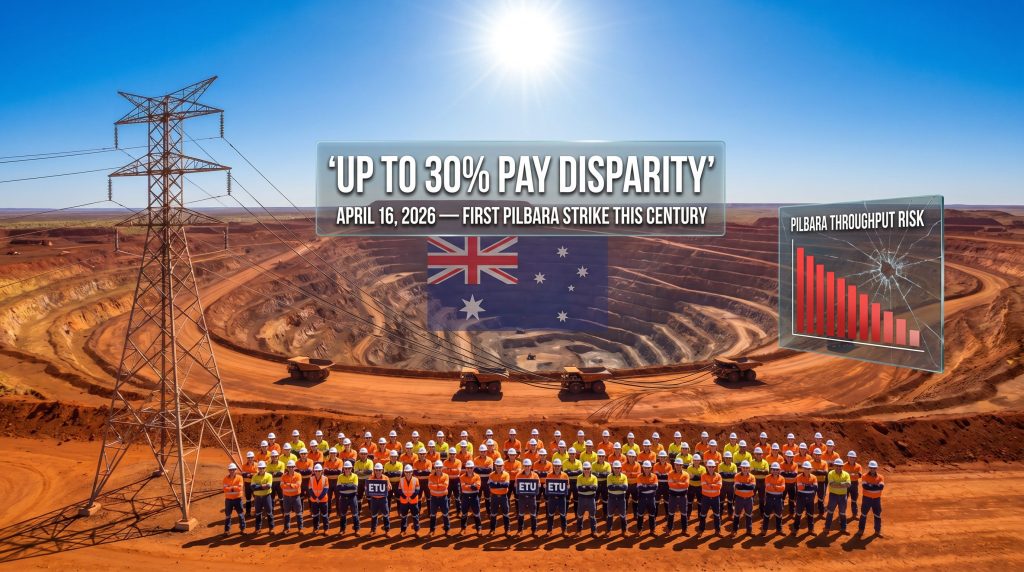
At the core of the BHP Pilbara industrial action is a workforce composition challenge that did not emerge overnight. Approximately 60 high-voltage electrical workers employed across BHP's Pilbara iron ore operations are subject to pay arrangements that vary by as much as 30% for workers performing functionally identical roles. The differentiating factor is not skill, output, or tenure in the conventional sense. It is the economic era during which a worker was hired.
Resource sector enterprise agreements are typically negotiated against the backdrop of prevailing commodity prices, labour market conditions, and the strategic priorities of the operator at that point in time. Workers engaged during the mining boom years entered employment under conditions that reflected intense competition for skilled labour. Those hired during downturns accepted terms that reflected an entirely different set of market pressures. When these two cohorts work side by side performing the same tasks, the legacy of those different negotiating environments becomes a daily lived experience of inequity.
The Electrical Trades Union (ETU) formalised these grievances through Australia's protected industrial action framework under the Fair Work Act 2009, after enterprise bargaining negotiations failed to produce an agreement that addressed the wage disparity. The dispute also extended to rostering arrangements, on-call obligations, and supervisory classifications — issues that in a FIFO (fly-in, fly-out) workforce model carry substantial impact on quality of life and effective remuneration. Furthermore, the WA resources sector impact of such disputes extends well beyond the immediate parties involved.
Why High-Voltage Electrical Workers Hold Disproportionate Leverage
The 60 workers at the centre of this dispute represent a small fraction of BHP's overall Pilbara workforce, yet their operational significance is substantial. High-voltage electrical systems underpin virtually every critical function in large-scale open-cut iron ore operations: autonomous haulage networks, crushing and processing infrastructure, conveyor systems, and port loading facilities all depend on continuous electrical integrity. In BHP's Pilbara operations, which rank among the most automated mining systems anywhere in the world, this dependency is particularly acute.
Australia faces a documented and deepening shortage of qualified high-voltage electrical tradespeople, particularly those willing to work in remote and FIFO environments. This scarcity fundamentally alters the bargaining calculus. What might appear as a numerically small workforce segment becomes, in operational terms, an irreplaceable capability cluster. Union leverage in this context is not simply about solidarity; it is grounded in genuine market scarcity for a specialist skill set that cannot be rapidly substituted.
There is also an important paradox embedded in BHP's operational model. The company has invested heavily in mining automation trends across its Pilbara assets, yet that very investment has not reduced its dependence on specialist electrical workers. In many respects, the increasing sophistication of automated systems has expanded the scope and criticality of high-voltage electrical expertise. The more automated the mine, the more consequential any disruption to the electrical systems that sustain it.
A Timeline of Escalation: How the 2026 Dispute Unfolded
Protected industrial action commenced on 16 April 2026, marking what industry observers have characterised as the first Pilbara mining strike of this century. The progression of action followed a pattern typical of escalating enterprise bargaining disputes under the Fair Work framework: initial targeted bans on overtime and on-call work, restrictions on workers performing supervisory roles, followed by authorised work stoppages ranging from brief rolling actions to 48-hour shutdowns.
The decision by ETU members to extend bans indefinitely represents a significant escalation in both commitment and signal. An indefinite extension moves the dispute from a pressure tactic with a defined horizon to a structural standoff — one in which both parties must assess their capacity to sustain their position over an indeterminate period.
Some industry observers have noted that the April 2026 action represents the most significant labour disruption in the Pilbara in approximately four decades, prompting comparisons to the industrial disputes of the 1980s that WA Premier Roger Cook referenced in his public commentary on the situation.
The 1980s Pilbara disputes occurred in a fundamentally different regulatory environment, prior to the enterprise bargaining framework that now governs Australian workplace relations. The comparison is nonetheless instructive as a gauge of historical significance, and the Premier's invocation of that era served to underscore the potential economic consequences of escalation.
The Competing Positions at the Bargaining Table
The ETU's stated objectives centre on achieving pay parity across workforce cohorts, reforming rostering arrangements that members consider inequitable, and addressing workforce composition concerns. The union's position is reinforced by the operational leverage its members hold and by the signal that an indefinite extension of bans sends about member resolve.
BHP's publicly stated position characterises the union's demands as unworkable within current operational frameworks. The company has proposed pay benchmarking against Western Australian public sector comparators and has activated contingency operational plans intended to maintain iron ore production continuity during the dispute. BHP has not indicated public movement on the core structural issues of pay equity and rostering reform.
| Negotiating Party | Core Position | Primary Leverage |
|---|---|---|
| Electrical Trades Union (ETU) | Pay parity across hire cohorts; roster and composition reform | Operational criticality of ~60 high-voltage specialists; indefinite bans |
| BHP | Demands characterised as unworkable; contingency plans activated | Operational scale; legal framework; financial resources |
| WA State Government | Urges negotiated resolution; warns of employment consequences | Political influence; public positioning; no direct intervention powers under Fair Work Act |
The WA Government's Position and the Limits of State Intervention
WA Premier Roger Cook has taken a public position urging both parties to pursue a negotiated outcome, framing industrial stability as an economic asset with measurable value. His references to the 1980s Pilbara disputes served as a historical warning about the broader consequences of prolonged industrial conflict in a region that is foundational to Western Australia's export revenue base.
It is important to understand, however, that the state government's capacity for direct intervention is constrained by the federal legislative architecture governing this dispute. The Fair Work Act 2009 is federal legislation administered through the Fair Work Commission, meaning the WA government's role is primarily one of public advocacy and political pressure rather than regulatory intervention. Consequently, any formal dispute resolution mechanism — including conciliation, arbitration, or an application to terminate protected action on public interest grounds — falls within the federal jurisdiction of the Fair Work Commission.
This distinction matters for understanding the realistic resolution pathways available and the degree to which state-level political pressure can meaningfully alter the trajectory of bargaining between two parties operating under federal industrial law. The Prime Minister has also warned unions publicly not to abuse their privileges as the Pilbara conflict widens.
Operational and Commercial Risk: What Contingency Plans Can and Cannot Cover
BHP has stated that contingency measures are in place to sustain iron ore production continuity. In practice, the resilience of those contingency measures against a workforce action involving specialist high-voltage electrical workers is time-bound. Contingency arrangements that can absorb days or weeks of disruption may prove inadequate against an indefinite ban, particularly as the technical complexity of Pilbara iron haulage infrastructure limits the pool of qualified personnel who can provide cover.
The commercial stakes are material. While BHP's most recent half-year results confirmed that copper operations contributed more than half of earnings for that period, iron ore remains the company's largest volume business by output. Any sustained disruption to Pilbara throughput carries direct revenue implications, particularly given global iron ore markets' sensitivity to Chinese steel production signals and demand cycles.
Investor consideration: BHP's dual strategic reality means that iron ore operational stability is not merely a legacy concern. Despite the company's well-publicised pivot toward copper, targeting approximately 2.5 million tonnes per annum of copper equivalent production by the mid-2030s, the Pilbara remains the financial engine that funds that transition. Disruption to iron ore throughput today constrains the capital available for copper growth tomorrow.
BHP is simultaneously managing a significant leadership transition, with outgoing CEO Mike Henry stepping down on 1 July 2026 after more than six years in the role. His successor, Brandon Craig, brings particular relevance to this dispute: Craig has direct prior experience leading BHP's WA Iron Ore business, during which he improved operational performance and advanced the company's position as the lowest-cost major iron ore producer. That background positions him as a potentially important figure in any resolution process, though the timing of the transition adds a layer of organisational complexity to an already pressured situation.
The next major ASX story will hit our subscribers first
Broader Sector Implications: A Test Case for Latent Tensions
The BHP Pilbara industrial action is best understood not as an isolated dispute but as a visible manifestation of structural tensions that exist across multiple major resource operations in Western Australia and Queensland. Multi-cohort workforces, built through successive cycles of boom and contraction, are a feature of the Australian resources sector broadly. The Pilbara dispute may function as a test case whose resolution — or lack thereof — signals to unions and operators alike how such systemic pay inequities will be addressed in other enterprise agreements approaching renegotiation.
The intersection of skills shortages, energy transition infrastructure demands, and resource sector competition for the same electrical trade workforce adds further complexity. High-voltage electrical workers are increasingly sought after not only by mining companies but by renewable energy project developers, grid infrastructure operators, and data centre construction programmes. The competition for this talent pool is intensifying at precisely the moment when resource sector operators face the consequences of legacy wage structures that make retention and attraction more difficult.
Furthermore, the Australian iron ore industry more broadly must grapple with how these workforce dynamics affect its long-term global competitiveness, particularly as rival producers seek to capitalise on any perceived instability.
The Automation Paradox and Future Bargaining Dynamics
BHP's Pilbara operations are frequently cited as a global benchmark for mining industry evolution, featuring autonomous haulage fleets, remote operations centres, and advanced processing systems. Yet the dispute underscores a reality that receives less attention in automation narratives: technological sophistication does not eliminate human dependency; it transforms and concentrates it. As mines become more automated, the specialist human expertise required to maintain and operate that automation becomes simultaneously more critical and more scarce.
This dynamic has profound implications for future enterprise bargaining in the resources sector. The workers who remain indispensable in highly automated environments are precisely the specialist tradespeople whose skills are in shortest supply. Their bargaining power relative to headcount will continue to increase, not diminish, as automation investment accelerates.
Resolution Pathways: Three Scenarios and Their Implications
Scenario 1: Negotiated Settlement Through Conciliation
The most constructive resolution pathway involves both parties returning to the Fair Work Commission's conciliation process with revised positions. A workable pay equity framework might involve graduated harmonisation of wages across cohorts over a defined period, rather than immediate parity, which would reduce the immediate financial impact for BHP while providing a credible path to equity for ETU members.
Scenario 2: Fair Work Commission Intervention
BHP could apply to the Fair Work Commission to terminate protected action on public interest grounds, citing impacts on the broader Western Australian economy. Such applications have precedent in the Australian resources sector but are not straightforward and carry reputational costs in a period of heightened scrutiny of major employer conduct in enterprise bargaining.
Scenario 3: Prolonged Stalemate
If neither party moves from its stated position, the dispute risks becoming a protracted standoff. BHP's capacity to sustain contingency operations diminishes over time as fatigue, complexity, and the specialist nature of the work limit substitution options. The longer-term costs of a protracted dispute — including workforce attrition, recruitment damage, and reputational consequences in a tight trade labour market — may ultimately prove more consequential than the direct wage cost of meeting the union's core demands.
Frequently Asked Questions: BHP Pilbara Industrial Action
What triggered the BHP Pilbara industrial action in 2026?
Approximately 60 high-voltage electrical workers, represented by the ETU, initiated protected industrial action in April 2026 following failed enterprise bargaining negotiations. Core grievances included pay discrepancies of up to 30% between workers hired in different economic cycles, as well as rostering and workforce composition disputes.
When did protected industrial action begin?
Action commenced on 16 April 2026. Workers subsequently voted to extend overtime and on-call bans indefinitely, escalating the dispute beyond its initial parameters.
How has BHP responded?
BHP has characterised union demands as unworkable and activated contingency operational plans to maintain production continuity. The company has not publicly indicated movement on the structural pay equity and rostering issues central to the ETU's position.
Is iron ore production currently affected?
BHP has stated contingency measures are in place. However, the specialist nature of high-voltage electrical work means sustained action carries escalating operational risk over time, particularly for infrastructure-dependent production and processing systems.
What is incoming CEO Brandon Craig's relevance to this dispute?
Craig, who succeeds Mike Henry on 1 July 2026, previously led BHP's WA Iron Ore business and has deep familiarity with Pilbara operational dynamics. His background may position him as a key figure in any resolution, though the leadership transition itself adds complexity to the company's negotiating posture in the near term.
Key Takeaways for Industry Observers and Investors
- Pay inequity embedded in legacy enterprise agreements is a sector-wide structural issue, not an isolated BHP challenge, and the Pilbara dispute may accelerate renegotiation pressure at other major operations.
- The first Pilbara strike in decades signals that prolonged industrial peace in Australian mining has not resolved underlying workforce relations tensions; in some cases, it may have allowed them to compound.
- Specialist trade scarcity gives high-voltage electrical workers leverage that is disproportionate to their headcount — a dynamic that will intensify as automation investment increases across the sector.
- Iron ore remains BHP's volume backbone despite the copper earnings growth story; sustained Pilbara disruption carries material revenue and strategic implications.
- The leadership transition from Mike Henry to Brandon Craig, effective 1 July 2026, introduces a variable into the resolution timeline, with Craig's prior WA Iron Ore experience representing both a relevant credential and a potential catalyst for negotiated resolution.
- Federal Fair Work frameworks remain the decisive regulatory architecture governing this dispute; state government commentary, while politically significant, does not translate into direct intervention capacity.
This article is intended for informational purposes only and does not constitute financial or investment advice. Statements regarding BHP's operational performance, earnings composition, production targets, and strategic direction are based on publicly available information and should not be relied upon as a basis for investment decisions. Readers should conduct their own due diligence and consult qualified financial advisers before making investment decisions.
Want to Stay Ahead of Major ASX Resource Sector Developments?
Discovery Alert's proprietary Discovery IQ model delivers real-time alerts on significant ASX mineral discoveries, transforming complex resource data into actionable investment insights the moment they are announced — explore historic discoveries and their market returns to understand the scale of opportunity, then begin your 14-day free trial at Discovery Alert to position yourself ahead of the broader market.