
June 11, 2026
The Regulatory Clock Is Always Running: Why Approval Speed Defines Mining Competitiveness
In capital-intensive industries, time is not simply money. It is market position, investor confidence, and in some cases, project viability. Every day a mining or exploration company waits for regulatory clearance is a day it cannot mobilise equipment, deploy capital, or begin generating returns. For jurisdictions competing to attract global resources investment, the efficiency of their approvals architecture is as important as the geology beneath their soil.
Western Australia has long held a commanding position in the global resources landscape, home to some of the world's most significant deposits of iron ore, lithium, gold, and nickel. Yet even the most mineral-rich jurisdiction can lose competitive ground if its regulatory machinery cannot keep pace with investor expectations. The completion of the third and final release of the Resources Online platform on 9 June 2026 represents a meaningful structural response to that challenge, and the performance data emerging from WA digital mining approvals suggests the shift is already delivering measurable results.
When big ASX news breaks, our subscribers know first
From Paper Trails to Digital Pathways: The End of the EARS Era
For years, Western Australia's mining and petroleum regulatory system relied on the Environmental Assessment and Regulatory System, widely known as EARS. While functional, the legacy platform was increasingly recognised as a structural constraint in an environment where application volumes were growing and industry expectations around turnaround times were rising sharply.
The EARS system required manual lodgement processes, lacked the automated workflow capabilities needed to accelerate assessment, and created friction at multiple points in the approval chain. For exploration companies managing multiple tenements or planning staged drilling programs, delays in one approval could cascade across an entire work schedule.
Resources Online was designed from the ground up to address these limitations. Rather than patching an ageing system, the Department of Mines, Petroleum and Exploration (DEMIRS) pursued a purpose-built digital gateway that centralises lodgement, assessment, and approval workflows within a single secure portal. Furthermore, the new online portal was specifically engineered to streamline these approvals at scale.
The migration occurred across three structured release phases, each progressively moving a category of regulatory interactions from EARS into the new platform. This staged approach allowed industry participants time to adapt their internal processes while limiting disruption to active applications.
What Is Now Fully Digitised: A Complete Breakdown
With the Release 3 completion on 9 June 2026, all core environmental and regulatory submissions for the resources sector are now permanently housed within Resources Online. The table below summarises the migration status across key approval categories:
| Approval Type | Previous System | Current System | Migration Status |
|---|---|---|---|
| Programmes of Work (PoW) | EARS (manual) | Resources Online | Fully migrated |
| Mining Development and Closure Proposals | EARS | Resources Online | Fully migrated |
| Eligible Mining Activity (EMA) applications | EARS | Resources Online | Fully migrated |
| Native Vegetation Clearing Permits | EARS | Resources Online | Migrated – Release 3 |
| Environment Plans | EARS | Resources Online | Migrated – Release 3 |
| Oil Spill Contingency Plans | EARS | Resources Online | Migrated – Release 3 |
The Eligible Mining Activity framework deserves particular attention from junior explorers. EMA classification applies to lower-impact exploration activities that meet specific criteria, allowing them to proceed through a streamlined pathway rather than the full assessment process required for larger or more complex proposals.
This distinction is operationally significant: a junior company planning a targeted drilling program that qualifies as an EMA can now receive a decision in a fraction of the time previously required. In addition, understanding mining permitting fundamentals can help smaller operators identify which pathway best suits their project profile.
The Numbers That Matter: Assessment Timeline Reductions
The performance metrics associated with WA digital mining approvals under Resources Online are striking in their scale:
| Approval Category | Previous Average (Business Days) | New Average (Business Days) | Reduction |
|---|---|---|---|
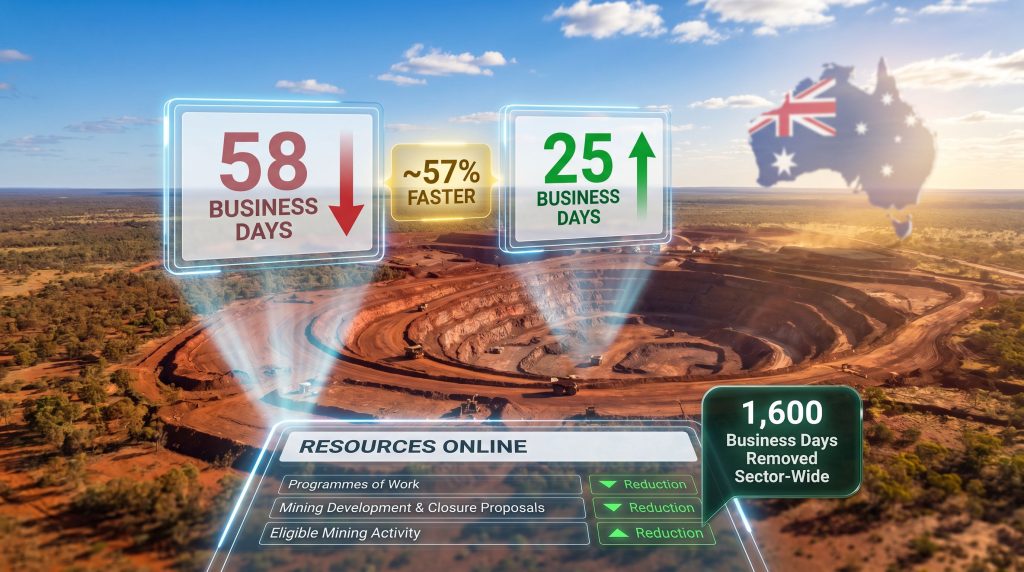
| Mining Development and Closure Proposals | 58 | 25 | ~57% |
| Programmes of Work (PoW) | 16 | 7 | ~56% |
| Eligible Mining Activities lodged | 200+ | Streamlined pathway | ~1,600 business days removed sector-wide |
| Approval Statements issued | Legacy process | ~100 issued | Under new MDP framework |
The reduction of approximately 1,600 business days across the sector is not simply an administrative statistic. It represents drilling seasons recaptured, investor presentations made with greater certainty, and capital allocation decisions that could proceed rather than stall.
To contextualise the significance of a 57% reduction in assessment time for major Mining Development and Closure Proposals: a project that previously waited nearly three months for approval clearance now receives a decision within five weeks. At a project financing level, where drawdown timelines are often tied to regulatory milestones, this compression can directly reduce interest carrying costs and improve project economics.
For Programmes of Work, the reduction from 16 to 7 business days is particularly relevant to active exploration companies. PoW applications govern the physical activities a company can conduct on a tenement, including geophysical surveys, drilling, and sampling. A faster PoW turnaround effectively shortens the gap between identifying a target and being legally authorised to test it.
How Automation Drives Consistency, Not Just Speed
A common concern raised when regulatory processes are accelerated is whether speed comes at the expense of rigour. In the case of Resources Online, the architecture of the system provides a meaningful counterargument to this concern.
Digital workflows introduce a form of structured consistency that manual systems cannot easily replicate. When an application is lodged through Resources Online, it is automatically routed through predefined assessment checkpoints, reducing the risk of critical information being overlooked or assessment steps being skipped under workload pressure.
Automated validation at the point of lodgement also reduces the frequency of incomplete applications entering the assessment queue. In legacy manual systems, incomplete submissions were a significant driver of delay, often requiring back-and-forth correspondence between applicants and assessors before the formal review could even begin. By front-loading compliance checking, the platform reduces rework and accelerates the time from submission to substantive assessment.
WA Mines and Petroleum Minister David Michael has been explicit that accelerated processing will not compromise environmental standards. The minister's position is that the community expectations and the vital interests of Traditional Owners that underpin Western Australia's approvals framework remain embedded within the digital process, not removed from it. Environmental obligations are structurally integrated into the Resources Online workflow rather than treated as an optional layer.
What This Means for Junior Explorers and Capital Allocation
While major producers benefit from faster approval cycles, the asymmetric impact on junior and mid-tier exploration companies is worth examining in depth. For large-cap miners with established regulatory teams and long-term project pipelines, a reduction from 58 to 25 business days is an efficiency gain. For a junior explorer managing a single tenement with limited cash runway, it can be the difference between completing a drilling program within a funding round and missing the window entirely.
Consider the practical implications for a junior company:
- Cash burn management: Every week spent waiting for an approval is a week of administrative overhead, idle contractor relationships, and reduced investor confidence.
- Seasonal drilling windows: Many WA exploration programs are constrained by wet season access restrictions. A faster PoW approval can mean the difference between drilling in a given season or waiting another year.
- Capital raising narratives: Investors in junior explorers respond positively to demonstrated regulatory momentum. A company that can show rapid approvals and active fieldwork programs commands a stronger equity story.
- Tenement management: WA mining tenements carry minimum expenditure obligations. Delays in approvals can create compliance risk if companies cannot demonstrate qualifying expenditure within the required timeframe.
The EMA fast-track pathway compounds these advantages for qualifying activities. By providing a streamlined channel for lower-impact exploration, the framework essentially creates a tiered approval system that allocates assessment resources proportionate to project complexity and risk profile. Consequently, the junior exploration investment landscape in WA is shifting in ways that reward operational agility.
How Does Regulatory Speed Affect Investor Confidence?
Faster approvals translate directly into improved investor narratives. When a junior explorer can demonstrate that its regulatory pipeline is moving efficiently, it reinforces the credibility of its project timeline — a critical factor in capital raising. Furthermore, Australia's 2025 budget support for junior explorers compounds these benefits, creating a more favourable overall funding environment.
The next major ASX story will hit our subscribers first
How WA Compares to Other Australian Jurisdictions
Australia's resource-producing states have each pursued varying degrees of regulatory modernisation over the past decade, but the depth and measurability of WA's transformation under Resources Online is distinctive.
Queensland's mining approval framework has undergone incremental digital reform, with the state's Department of Resources progressively expanding online lodgement capabilities. However, Queensland's system still involves coordination across multiple regulatory bodies depending on project type, which can introduce inter-agency lag that a centralised platform like Resources Online is specifically designed to avoid.
The Northern Territory has focused heavily on attracting exploration investment through incentive programmes and has recently committed record funding toward mineral exploration activity. The NT's approval framework has also undergone reform, but the jurisdiction's relatively smaller administrative infrastructure means digital transformation at the scale WA has achieved presents proportionally greater implementation challenges.
South Australia has made notable progress through its OneStop online system for development approvals, though its application to mining-specific environmental assessments remains more limited in scope compared to Resources Online.
New South Wales operates a more complex multi-agency approvals environment due to the intersection of mining, planning, and environmental legislation, which continues to present challenges for streamlined digital integration.
WA's structured three-phase migration, combined with independently verifiable timeline reductions across multiple approval categories, represents the most quantifiably documented regulatory efficiency gain in Australia's national resources sector to date.
The Broader Policy Architecture: Fast Tracking Mining Approvals Programme
Resources Online does not exist in isolation. It sits within the broader Fast Tracking Mining Approvals programme, which represents a coordinated policy effort to reduce the structural friction between project identification and project execution in WA's resources sector. The Cook Government's approvals reforms have been central to this transformation, establishing a clear legislative and administrative foundation for the programme.
The programme has expanded the spatial and digital capability of DEMIRS, enabling the department to manage growing application volumes without proportional increases in manual assessment resources. This scalability is critical: as WA's critical minerals sector continues to attract investment interest driven by global energy transition demand, application volumes are expected to increase, and the system needs to absorb that growth without reverting to legacy delays.
Key elements of the programme's architecture include:
- Centralised digital lodgement removing the fragmentation of paper-based and email-based submissions.
- Automated workflow routing ensuring applications reach the correct assessment team without manual triage.
- Structured milestone tracking giving applicants visibility into where their submission sits within the assessment process.
- Expanded spatial data integration allowing assessors to reference geographic and environmental datasets without manual consultation across separate systems.
What Industry Can Expect Next
The completion of Release 3 closes the migration chapter but opens the optimisation phase. DEMIRS has indicated that continued improvements to processing efficiency are expected as the platform matures and additional automation capabilities are developed.
The most likely near-term enhancements include deeper integration between Resources Online and spatial environmental databases, which would allow assessors to conduct vegetation, heritage, and hydrological sensitivity checks within the platform rather than through external consultation processes. This kind of embedded environmental intelligence has the potential to further compress assessment timelines while simultaneously improving the consistency and defensibility of approval decisions.
Real-time application tracking features represent another logical development pathway. Giving applicants live visibility into assessment status reduces the administrative burden of follow-up correspondence and allows companies to align their operational planning more precisely with expected decision dates.
The scalability question will become increasingly important as critical minerals exploration in WA intensifies. Lithium, rare earths, cobalt, and nickel tenements across the Pilbara, Goldfields, and South West regions are all likely to generate increasing application volumes over the coming two to three years. A system built for current volumes must be stress-tested against future demand. The broader significance of gold and copper exploration further underscores why processing efficiency at this scale matters so profoundly for the sector.
Frequently Asked Questions: WA Digital Mining Approvals
What is the Resources Online platform used for in Western Australia?
Resources Online is a secure digital portal administered by DEMIRS that centralises the lodgement, assessment, and approval of environmental and regulatory submissions for the mining and petroleum sectors.
How long does it take to get a mining approval in WA under the new system?
Average assessment times vary by approval type. Mining Development and Closure Proposals now average 25 business days, down from 58. Programmes of Work average 7 business days, down from 16.
What is an Eligible Mining Activity and how does it qualify for fast-track processing?
An EMA covers lower-impact exploration activities that meet prescribed criteria under WA mining regulations. Qualifying activities are assessed through a streamlined pathway, significantly reducing wait times for exploration companies planning targeted, limited-footprint programmes.
Has the digital approvals system replaced all functions of the EARS system?
Yes. The final migration of Native Vegetation Clearing Permits, Environment Plans, and Oil Spill Contingency Plans to Resources Online on 9 June 2026 marked the complete retirement of EARS as the submission platform for these categories.
Does the new system affect environmental assessment standards for mining projects?
No. Environmental obligations, community consultation requirements, and Traditional Owner interests remain embedded within the Resources Online assessment workflow. Digital efficiency applies to processing speed and consistency, not to the substantive standards applied during assessment.
Who oversees the Resources Online platform and the approvals process?
The Department of Mines, Petroleum and Exploration (DEMIRS) administers the platform and oversees the assessment and approval process for all lodgements made through Resources Online.
How does WA's digital mining approvals process benefit junior exploration companies?
Junior explorers benefit through faster PoW approvals, which directly shorten the gap between tenement acquisition and active fieldwork. The EMA fast-track pathway further reduces lead times for qualifying lower-impact activities, improving cash runway efficiency and supporting stronger capital raising narratives.
Key Takeaways
- Assessment times for major Mining Development and Closure Proposals have been cut by approximately 57%, from 58 to 25 business days
- Programmes of Work approvals have been halved, from 16 to 7 business days
- More than 1,600 business days of cumulative processing time have been removed across the sector since the platform's rollout began
- All core mining and petroleum environmental lodgements are permanently housed within Resources Online following the Release 3 completion on 9 June 2026
- Junior and mid-tier explorers stand to benefit most from the EMA fast-track pathway and compressed PoW timelines
- Environmental and community obligations remain structurally embedded within the digital workflow
- WA's model provides a replicable framework for regulatory modernisation across Australia's other resource-producing jurisdictions
This article is intended for informational purposes only and does not constitute financial or investment advice. Readers should conduct independent research and seek professional guidance before making investment decisions related to any mining or resources sector activity.
Want To Capitalise On The Next Major ASX Mineral Discovery Before The Market Catches On?
Faster regulatory approvals in WA mean exploration companies can move from tenement to discovery announcement more rapidly than ever — and Discovery Alert's proprietary Discovery IQ model ensures subscribers receive real-time alerts the moment significant ASX mineral discoveries are announced, turning complex data across 30+ commodities into actionable insights. Explore historic discoveries and their extraordinary returns to understand what's at stake, then begin your 14-day free trial at Discovery Alert to position yourself ahead of the broader market.