June 11, 2026
The Hidden Bottleneck Problem That Shapes Every Graphite Processing Plant
Before a single tonne of graphite concentrate reaches a battery manufacturer, it must survive one of the most technically demanding processing sequences in the mining industry. Natural flake graphite requires careful liberation from host rock, precise flotation chemistry, and consistent filtration to produce a concentrate pure enough for downstream anode applications. Getting that sequence right at a commercial scale, consistently and continuously, is the central challenge that separates promising graphite projects from functioning producers. It is within that technical context that the South Star Santa Cruz graphite concentrate production operation in Bahia, Brazil, operated by South Star Battery Metals Corp, is now navigating one of the most consequential phases in its development.
When big ASX news breaks, our subscribers know first
Why Brazilian Flake Graphite Is Attracting Serious Attention
The global graphite shortage has intensified focus on the battery supply chain's concentration problem. China currently accounts for the dominant share of both natural and synthetic graphite anode material production, leaving battery manufacturers in North America, Europe, and Japan exposed to a single-jurisdiction supply risk that has become increasingly difficult to ignore. Natural flake graphite, which serves as the primary precursor for spherical graphite used in lithium-ion anodes, cannot be substituted at scale by synthetic alternatives without significant cost and performance trade-offs.
This makes geographically diversified sources of high-quality natural graphite commercially and strategically important. Furthermore, lithium-ion battery supply risks continue to drive urgency among Western manufacturers seeking alternative sourcing options outside of China.
Brazil's Bahia State has emerged as one of the more credible alternatives within this diversification thesis. The region hosts substantial flake graphite mineralisation within metamorphic schist sequences, with existing road and port infrastructure providing logistical advantages that many African graphite projects lack. Brazil also operates under the regulatory framework of the Agência Nacional de Mineração (ANM), which provides a structured licensing pathway and operational certainty once mining concessions are formally granted.
Where Santa Cruz Fits in the Global Production Landscape
Understanding the scale of the Santa Cruz operation requires placing it within a global context. The phased development model that South Star has adopted reflects a deliberate commercial logic: use Phase 1 to de-risk the processing circuit, generate revenue, and build operational data before committing capital to a substantially larger footprint.
| Operation | Country | Annual Concentrate Output | Stage |
|---|---|---|---|
| Santa Cruz Phase 1 | Brazil | 5,000 tpy (target) | Active ramp-up (2026) |
| Santa Cruz Phase 2 | Brazil | 25,000 tpy | Development pipeline |
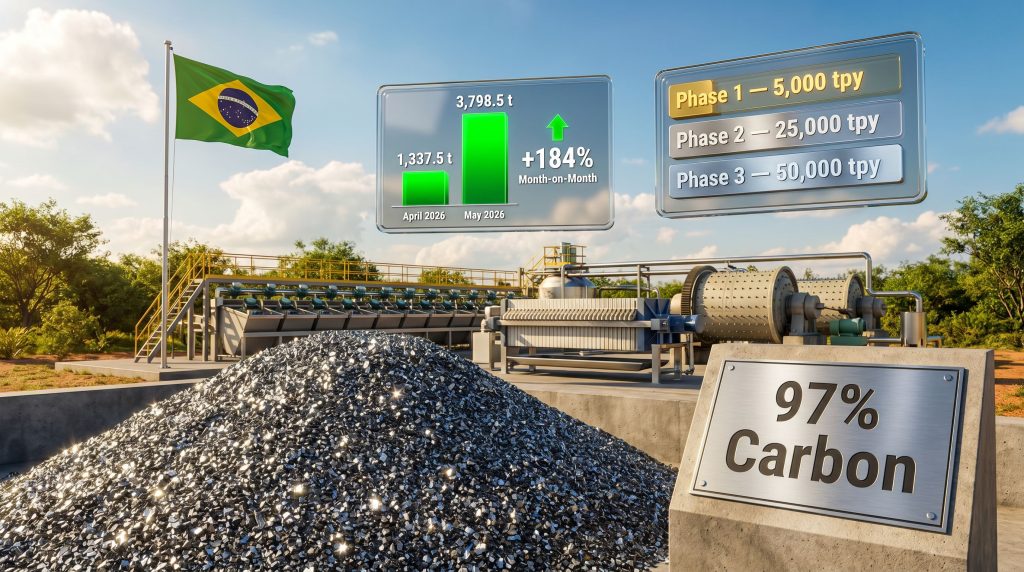
| Santa Cruz Phase 3 | Brazil | 50,000 tpy | Conceptual |
| Major African producers | Mozambique/Tanzania | 50,000–100,000+ tpy | Operating |
| Chinese operations | China | Dominant global share | Operating |
Structural Note: Phase 1 at Santa Cruz is not designed to compete with established large-scale African or Chinese producers on volume. Its role is to validate the processing circuit commercially and generate the operational track record needed to attract capital for Phase 2 and Phase 3 expansion.
What the May 2026 Operational Update Actually Reveals
Commissioning vs. Ramp-Up: Why the Distinction Matters
These two operational phases are frequently conflated by investors but represent fundamentally different challenges. Commissioning involves verifying that equipment functions as designed, testing individual circuits in sequence, and identifying mechanical deficiencies before sustained production begins. Ramp-up, by contrast, requires the entire integrated flowsheet to operate simultaneously under real feed conditions, with a workforce capable of managing process variability across 24-hour cycles.
Santa Cruz completed its commissioning phase during the first week of May 2026. That transition marked the point at which the operation moved from equipment verification into sustained production targeting. The shift from a single nine-hour daily shift to a continuous 24-hour operating cycle is particularly significant because annualised production targets are mathematically unachievable without full-cycle operation.
A plant running nine hours per day can only access roughly 37% of its theoretical annual throughput capacity, meaning the move to 24-hour operations is not merely an operational preference but a structural requirement for hitting the 5,000 tpy target registered with ANM.
ROM Feed Throughput: Reading the Growth Numbers
The most immediately visible indicator of plant progress is run-of-mine (ROM) feed throughput, which measures the volume of ore entering the processing circuit over a given period.
| Period | ROM Feed Processed | Change |
|---|---|---|
| April 2026 | 1,337.5 tonnes | Baseline (restart) |
| May 2026 | 3,798.5 tonnes | +184% month-on-month |
| Cumulative since restart | ~5,136 tonnes | Combined total |
A 184% month-on-month increase in ROM feed is a meaningful signal of circuit stabilisation rather than a routine incremental improvement. It suggests that the modifications made to the feed preparation and primary processing areas successfully resolved what had historically been identified as the plant's primary operational constraint. When an upstream bottleneck is cleared in a processing flowsheet, the effect is multiplicative because every downstream circuit benefits simultaneously.
The cumulative concentrate output of approximately 25 tonnes from roughly 5,136 tonnes of ROM ore reflects the early-stage nature of the ramp-up rather than any deficiency in ore quality. Early ramp-up periods in graphite processing plants are characterised by lower recoveries as grinding media inventories build, flotation reagent dosages are calibrated, and filter circuits are tuned to the specific ore characteristics.
Grade Performance: The 97% Carbon Result in Context
Graphite concentrate purity is typically expressed as a percentage of carbon content (% Cg). The specifications relevant to battery anode applications generally require concentrate purity in the range of 94%–99.9% Cg, with downstream purification processes used to achieve the ultra-high purity levels required for final anode material. Santa Cruz achieving concentrate grades of up to 97% carbon during its first month of production is a technically meaningful result for several reasons:
- It confirms that the flotation circuit is selectively recovering graphite over gangue minerals effectively
- Material at 97% Cg sits comfortably within the range acceptable for further processing into spherical purified graphite (SPG) for anode use
- High-purity concentrate commands premium pricing in the spot market relative to lower-grade material, strengthening the commercial case per tonne shipped
- It generates a marketable data point that supports offtake negotiations with battery material processors
It is worth noting that concentrate grade and final anode-ready purity are distinct. Natural graphite concentrate typically undergoes thermal or chemical purification to achieve the 99.95%+ Cg levels required for direct anode applications. Santa Cruz is producing feedstock for that downstream process, not finished anode material.
How the Plant Is Being Optimised During Ramp-Up
Three Engineering Levers Being Deployed Now
The operational team at Santa Cruz has identified three near-term technical priorities that will determine how quickly the plant closes the gap between current output and annualised targets:
-
Filter press optimisation – The focus is on identifying the ideal filter cloth configuration to maintain consistent, stable filtration of the graphite concentrate slurry. Filter press performance is particularly sensitive to particle size distribution, which changes as the grinding circuit is tuned. An incorrectly specified cloth can result in either excessive moisture in the final product or blocked filtration cycles that interrupt throughput.
-
Grinding circuit enhancement – Grinding media (steel balls and rods) that have already been acquired and received are being installed into the milling circuit. Correct media loading and sizing directly affects graphite liberation from gangue minerals. Under-grinding produces locked particles that report to tailings rather than concentrate, reducing both recovery and grade. Over-grinding damages graphite flake size, which reduces the product's commercial value since larger flake sizes attract premium prices.
-
Production rate stabilisation – Plant parameters are being continuously monitored and adjusted with the goal of achieving consistent output at the 5,000 tpy annual rate formally registered with ANM as the target for Years 1 through 3 of the mining licence.
Why Flake Size Is an Underappreciated Variable
One aspect of graphite processing that receives limited attention in general investment commentary is the relationship between grinding intensity and flake size preservation. Natural flake graphite is classified by particle size, with jumbo flake (+180 mesh), large flake (+100 mesh), medium flake (+80 mesh), and fine flake categories each commanding different market prices. Aggressive grinding that over-reduces particle size permanently destroys flake structure in a way that cannot be reversed downstream.
This means the grinding circuit calibration at Santa Cruz is not merely a recovery optimisation exercise but a direct determinant of product value per tonne. Indeed, understanding cut-off grade economics is equally important here, as the value realised per tonne processed depends critically on both grade and flake characteristics.
Technical Insight: In natural flake graphite processing, the grinding circuit represents a direct trade-off between liberation efficiency and flake size preservation. Operators must find the optimal grind size that maximises both graphite recovery and the proportion of larger, higher-value flake fractions in the final concentrate.
Production Timeline and the Path to 5,000 tpy
Key Operational Milestones
| Date | Milestone |
|---|---|
| June 5, 2025 | First commercial graphite concentrate shipment dispatched |
| April 2026 | Plant restart; 1,337.5 t ROM processed |
| First week of May 2026 | Commissioning phase formally completed |
| May 2026 | 3,798.5 t ROM processed; 24-hour cycle initiated |
| Early June 2026 | First prepared concentrate shipment from current ramp-up cycle |
| Cumulative to June 2026 | ~5,136 t ROM ore; ~25 t graphite concentrate produced |
The presence of a restart event between the June 2025 commercial launch and the 2026 ramp-up is an operational reality common to junior miners commissioning new processing infrastructure. Plant restarts allow engineering teams to implement modifications identified during initial operations that cannot be safely or efficiently performed during live production. The modifications made to the feed preparation area, which were reported as highly effective in stabilising downstream processing, are a direct product of that interruption period.
Benchmarking the Ramp-Up Timeline
Industry experience across graphite processing projects suggests that reaching nameplate capacity from first ore typically requires between six and eighteen months, depending on ore variability, circuit complexity, workforce maturity, and the availability of technical support. Several factors at Santa Cruz are relevant to where within that range the operation is likely to land:
- The newly hired workforce has now completed training and assumed permanent production roles, reducing one of the key human capital risks during ramp-up
- Process engineering and quality control teams are generating reliable data across the full circuit flowsheet, enabling faster identification of inefficiencies
- The primary historical bottleneck in the feed preparation area has been addressed through targeted modifications
- Grinding media installation is ongoing, meaning recovery rates are expected to improve as the circuit reaches its designed operating parameters
Commercial and Investment Implications
What Operational Milestones Signal to the Market
For investors and potential offtake counterparties, the May 2026 update carries commercial information beyond its raw tonnage figures. The preparation of the first concentrate shipment from the current ramp-up cycle functions as a product readiness signal. Concentrate purity data at 97% carbon provides a quality benchmark that can be referenced in commercial negotiations. The shift to 24-hour operations demonstrates organisational capacity to sustain continuous production rather than intermittent batch output.
The relationship between demonstrated operational stability and financing capacity for Phase 2 development is direct. Junior mining companies typically face significantly better terms in both equity and debt financing when they can present auditable production history alongside grade and recovery data. Every consistent month of production at Santa Cruz builds that commercial case. Those exploring the broader battery metals investment landscape will recognise that producer-stage milestones like these are precisely what differentiate investable assets from pure exploration plays.
Key Risk Factors to Monitor
- Filter press performance remains an active optimisation challenge, and any failure to identify the correct cloth configuration could create recurring downstream bottlenecks
- Grinding circuit calibration directly affects both recovery rates and the flake size distribution of the final product, making it one of the highest-value engineering activities currently underway
- The gap between cumulative production of approximately 25 tonnes and an annualised target of 5,000 tpy represents a roughly 200-fold increase in run-rate output still required to reach the Phase 1 target
- Workforce retention and operational continuity in a regional Brazilian mining context introduces human capital risk that is typical but non-trivial for early-stage operations
- Currency exposure between Brazilian real-denominated operating costs and US dollar-denominated graphite pricing creates a financial variable that can move independently of operational performance
Disclaimer: This article contains forward-looking statements and projections related to production targets, development timelines, and commercial outcomes. These are based on currently available information and involve assumptions that may not prove accurate. Readers should conduct their own due diligence and consider independent financial advice before making investment decisions.
The next major ASX story will hit our subscribers first
Frequently Asked Questions: South Star Santa Cruz Graphite Production
What is the current production target for the Santa Cruz plant?
The operation is targeting 5,000 tonnes per year of graphite concentrate, which is the approved output rate registered with ANM for Years 1 through 3 of the mining licence. Since restarting, approximately 25 tonnes of concentrate have been produced from around 5,136 tonnes of ROM ore.
What graphite concentrate grade is the plant achieving?
During the first month of the current production ramp-up, Santa Cruz achieved concentrate grades of up to 97% carbon content, which falls within the range considered suitable as feedstock for battery anode material processing.
When did commissioning officially conclude?
Commissioning was formally completed during the first week of May 2026, after which the plant transitioned into production ramp-up mode targeting stable commercial output at annualised rates.
What are the longer-term expansion plans beyond Phase 1?
South Star's development roadmap envisions Phase 2 at 25,000 tpy and Phase 3 at 50,000 tpy, representing fivefold and tenfold scale-ups respectively from the Phase 1 target. Both phases remain in earlier planning stages and are contingent on Phase 1 demonstrating commercial viability. Furthermore, permitting and grade basics will play a central role in how smoothly those subsequent phases advance through regulatory approval.
Why does Brazil matter as a graphite source?
Brazil's geological endowment of natural flake graphite within its Bahia State schist belts, combined with a structured ANM regulatory framework and existing infrastructure, positions it as one of the more credible non-Chinese graphite supply options available to Western battery manufacturers seeking supply chain diversification. South Star's Santa Cruz mine operations have been widely noted as a significant step toward establishing Brazil as a reliable alternative source.
The Road Ahead: What the Next Twelve Months Will Determine
South Star Santa Cruz graphite concentrate production is advancing through the most operationally intensive phase of its development cycle in 2026. Commissioning is complete, the workforce is in place, the primary historical bottleneck has been addressed, and the plant is operating on a 24-hour cycle for the first time. The 184% increase in ROM feed from April to May 2026 provides measurable evidence of stabilisation progress, and the 97% carbon concentrate grade validates the processing circuit's technical capability.
What remains is the harder and longer work: calibrating the grinding circuit to preserve flake value while maximising recovery, optimising filter press performance for consistent throughput, and sustaining the operational discipline required to compound those monthly improvements into an annualised run rate approaching 5,000 tpy. The first commercial shipment from the current cycle carries significance beyond its physical volume because it initiates the commercial proof-of-product sequence that underpins every subsequent phase of the South Star Santa Cruz graphite concentrate production story.
Forward-Looking Note: The transition to continuous 24-hour operations is the structural prerequisite without which any annualised production target remains theoretical. The operational and commercial outcomes of the next two to three quarters will provide the clearest indication yet of the timeline to Phase 1 nameplate capacity and the credibility of the Phase 2 development thesis.
Want To Stay Ahead of the Next Major Battery Metals Discovery?
Discovery Alert's proprietary Discovery IQ model delivers real-time alerts on significant ASX mineral discoveries — instantly transforming complex mineral data into actionable investment insights for both short-term traders and long-term investors. Explore how historic discoveries have generated substantial returns on Discovery Alert's dedicated discoveries page, and start your 14-day free trial today to secure your market-leading advantage.