June 11, 2026
Why Index Benchmarks Shape Investment Destinies in Precious Metals
The architecture of modern institutional investing is built on benchmarks. When a company crosses from one index tier to another, it does not simply receive a new label. It enters an entirely different capital ecosystem, one governed by algorithmic mandates, passive fund rebalancing rules, and portfolio weight requirements that collectively move billions of dollars with mechanical precision. For precious metals producers navigating a sector defined by volatile commodity cycles and geopolitical risk, ascending to a major benchmark index represents something more durable than a short-term catalyst. It signals a fundamental reclassification of the company's risk profile in the eyes of institutional capital.
This dynamic sits at the core of the Coeur Mining S&P 400 inclusion story, a development that reflects years of deliberate strategic repositioning rather than opportunistic market timing.
When big ASX news breaks, our subscribers know first
The S&P MidCap 400: What Institutional Investors Actually Know That Retail Investors Often Miss
Understanding the Three-Tier Architecture of S&P Benchmarks
Most investors are familiar with the S&P 500 as the dominant US equity benchmark, but the broader S&P Composite 1500 system operates as a three-tier architecture that serves distinct investor categories at each level. The S&P SmallCap 600, MidCap 400, and LargeCap 500 are not simply ranked by size. Each carries specific eligibility criteria including minimum market capitalisation thresholds, liquidity requirements measured by annual dollar value traded, and financial viability filters such as consecutive quarters of positive earnings.
The S&P MidCap 400, which covers companies with market capitalisations broadly in the $3.7 billion to $15.8 billion range, serves as the institutional sweet spot for a specific class of fund manager. These are companies large enough to absorb meaningful position sizes without excessive price impact, yet still positioned for growth trajectories that large-cap peers have typically already exhausted.
| Index | Market Cap Range (Approx.) | Primary Investor Base | Typical Constituents |
|---|---|---|---|
| S&P 600 (SmallCap) | $850M – $3.7B | Growth-focused funds | Emerging sector players |
| S&P 400 (MidCap) | $3.7B – $15.8B | Institutional and passive funds | Established mid-tier operators |
| S&P 500 (LargeCap) | $15.8B+ | Broad market funds | Sector-dominant majors |
The Passive Fund Demand Mechanism: A Structural Buying Event
One of the most consequential and least publicly discussed mechanics of index investing is the mandatory rebalancing requirement triggered by constituent changes. When a company is added to the S&P MidCap 400, every passive fund and exchange-traded fund tracking that benchmark must purchase shares in proportion to the stock's assigned index weight. This is not discretionary. Fund managers cannot defer, reduce, or avoid these purchases without breaching their tracking mandates.
Academic research on index inclusion events has consistently documented a measurable short-term price premium associated with announced additions, driven by anticipated passive fund buying pressure before and at the effective inclusion date.
The effective date for Coeur Mining S&P 400 inclusion is Monday, June 22, 2026, creating a structurally significant trading window for both passive and active market participants. Active managers who anticipate index rebalancing flows often position ahead of the event, compounding the initial demand pressure. However, investors should note that short-term inclusion premiums do not guarantee sustained price appreciation, which ultimately depends on operational execution and commodity market conditions.
How Coeur Mining Engineered a Multi-Year Platform Transformation
From Mid-Tier Producer to North American Senior: A Decade of Strategic Repositioning
Coeur Mining's elevation to the S&P 400 did not occur through a single transaction or a favourable commodity cycle. The company pursued a deliberate multi-year strategy of asset quality improvement, balance sheet strengthening, and production scale expansion that progressively moved it toward senior producer status. The Coeur strategic transformation traded on both the New York Stock Exchange and the Toronto Stock Exchange under the ticker symbol CDE, providing dual-market liquidity that itself reflects its institutional-grade standing.
The pivotal accelerant in this transformation was the US$7.7 billion acquisition of New Gold, completed on March 20, 2026. This single transaction added two producing assets to Coeur's portfolio:
- New Afton (British Columbia, Canada): An underground block cave gold-copper mine with significant by-product copper revenue, which materially changes Coeur's commodity diversification profile
- Rainy River (Ontario, Canada): An open-pit and underground gold operation with meaningful long-term reserve potential
Despite contributing only 11 days of production output to Coeur's first quarter 2026 results following the March 20 close date, management identified both operations as central to the company's full-year production potential. This compressed contribution window makes Q1 2026 technically the weakest quarter of the reporting year by design, with subsequent quarters expected to reflect the full integrated platform.
Building the Only All-North American Senior Precious Metals Platform
What distinguishes Coeur's positioning from virtually every other company at comparable scale is geographic concentration by design rather than by default. All seven of Coeur's operating mines are located within North America, specifically across the United States and Canada. This is not simply a matter of administrative convenience. It represents a deliberate jurisdictional strategy that carries measurable valuation implications.
In an era where sovereign risk, permitting uncertainty, resource nationalism, and infrastructure reliability have become primary screens for institutional capital allocation, operating exclusively within stable, transparent, rule-of-law jurisdictions commands a structural premium. Competing producers with operations spread across Latin America, West Africa, or Southeast Asia face discount factors that Coeur structurally avoids.
The Financial Architecture Behind a Record-Breaking Year
Dissecting the $2.1 Billion Revenue and Tenfold Profit Expansion
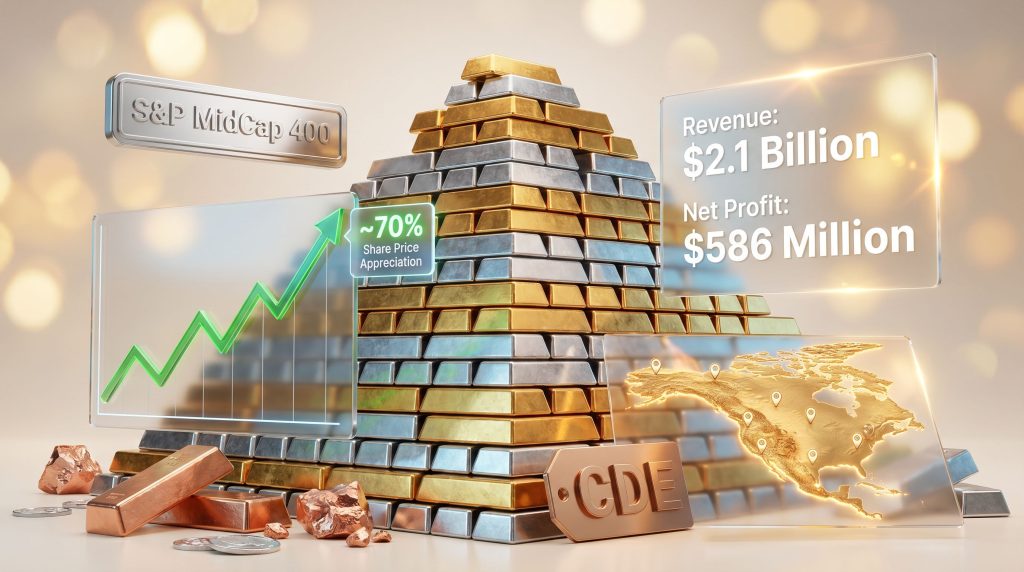
Coeur's 2025 financial results established new company records across every primary metric. Revenue reached $2.1 billion from combined silver, gold, and copper sales, while net profit expanded tenfold to $586 million. The magnitude of the profit increase relative to revenue growth deserves scrutiny, as it reveals operating leverage rather than purely top-line expansion.
A tenfold profit increase against a revenue base that did not increase tenfold implies meaningful improvement in operating cost efficiency, capital allocation discipline, and potentially favourable commodity price realisation across the portfolio. For investors evaluating earnings quality rather than earnings magnitude, this distinction matters considerably. Furthermore, the gold and silver market trends of 2025 undoubtedly provided a supportive pricing environment that amplified these results.
2025 Actual vs. 2026 Guidance Comparison:
| Metric | 2025 Actual | 2026 Guidance |
|---|---|---|
| Gold Production | 419,046 oz | 680,000 – 815,000 oz |
| Silver Production | 17.9 million oz | 18.7 – 21.9 million oz |
| Copper Production | Not separately disclosed | 50 – 65 million lbs |
| Revenue | $2.1 billion | Not guided |
| Net Profit | $586 million | Not guided |
Q1 2026 as a Baseline Floor, Not a Representative Run Rate
Management explicitly flagged that Q1 2026 represented the softest quarter of the year, with more than $200 million in quarter-specific cash outflows related to transaction costs, integration expenses, and timing-related working capital movements. With New Afton and Rainy River contributing only 11 days of production to the March quarter, subsequent periods will reflect materially higher output from the consolidated seven-mine platform.
This structure creates an unusual analytical opportunity. Investors evaluating Coeur on Q1 2026 metrics alone are examining a financial snapshot that systematically understates the company's underlying run-rate capacity. From Q2 2026 onward, the full production contribution from all seven operations becomes visible in reported results for the first time.
Market Capitalisation, Share Price Trajectory, and Institutional Repricing
What the ~70% Share Price Gain Actually Signals
Coeur's approximately 70% share price appreciation over the 12 months preceding its S&P 400 inclusion is frequently cited as evidence of commodity price tailwinds. While elevated gold and silver prices have undoubtedly supported precious metals equities broadly, this explanation alone fails to account for the scale of Coeur's specific re-rating. Indeed, the gold price impact on miners tells only part of the story here.
A more complete interpretation recognises that the market was actively repricing earnings quality rather than simply tracking commodity prices. The transition from a mid-tier producer with concentrated single-asset exposure to a diversified, seven-mine, three-commodity platform materially reduces the risk discount that institutional investors apply to mining equities. This de-risking of the earnings stream, combined with the operational leverage demonstrated through the tenfold profit expansion, supports the view that the share price gain represents genuine multiple expansion rather than commodity-driven inflation.
At a current market capitalisation of approximately $16.6 billion, Coeur sits at the upper boundary of the S&P 400 range and approaches the threshold that would eventually qualify it for S&P 500 consideration, though that remains a longer-term scenario dependent on continued operational delivery and market conditions.
Silver Market Leadership and the Strategic Value of Multi-Commodity Exposure
Coeur's Position as a Top-Five Global Silver Producer
Silver occupies a peculiar dual identity in commodity markets, functioning simultaneously as a monetary metal that tracks gold sentiment and an industrial input with growing demand from solar panel manufacturing, electric vehicle components, and electronics production. This duality creates a more complex demand profile than gold, and silver's dual demand dynamic means industrial silver consumption now accounts for the majority of annual fabrication demand globally.
Coeur's standing as a top-five global silver producer by output volume positions it to capture both dimensions of this demand. At the guided production level of 18.7 to 21.9 million ounces of silver in 2026, the company operates at a scale that few competitors can match, and at which silver revenue contributes meaningfully to total portfolio cash flow.
The Three-Commodity Revenue Mix as a Volatility Dampener
One of the underappreciated structural advantages of Coeur's post-acquisition portfolio is its three-commodity revenue profile. In a period where commodity prices move on different fundamental drivers, diversification across gold, silver, and copper reduces the earnings sensitivity of any single commodity price correction.
- Gold functions as the primary revenue driver, benefiting from elevated spot prices and safe-haven demand
- Silver provides leverage to both monetary conditions and industrial demand cycles, particularly the accelerating deployment of photovoltaic technology
- Copper through the New Afton by-product stream introduces energy-transition demand exposure, with guidance of 50 to 65 million pounds annually representing a meaningful new revenue category
This commodity mix is structurally different from pure-play gold or silver producers and warrants a differentiated valuation framework from institutional portfolio managers.
The next major ASX story will hit our subscribers first
The Seven-Mine Platform: Asset Diversification and Its Operational Logic
Why Operating Across Seven Sites Changes the Risk Calculation
Single-asset mining companies carry a specific category of operational risk that is difficult to diversify away. Equipment failures, geological surprises, labour disputes, tailings incidents, or permitting setbacks at one operation can devastate annual production guidance and trigger severe equity market reactions. A seven-mine platform distributes this risk across multiple independent sites, meaning that underperformance at one operation can be partially offset by outperformance or steady delivery across the remaining portfolio.
This operational diversification is not merely a theoretical risk management concept. It has practical implications for the reliability of production guidance, the predictability of quarterly earnings, and ultimately the earnings multiple that institutional investors are willing to assign to the company's cash flows.
North American Jurisdictional Premium in Practice
Canada and the United States represent two of the highest-ranked mining jurisdictions globally across dimensions including permitting frameworks, contract enforcement, political stability, and access to infrastructure. For institutional investors managing sovereign risk exposure across global equity portfolios, allocating to an exclusively North American precious metals producer eliminates an entire category of risk assessment that applies to peers operating in politically complex environments.
This jurisdictional purity is increasingly recognised within precious metals M&A as a scarcity premium. As the sector consolidates and fewer high-quality North American assets remain independent, the pool of companies offering comparable jurisdictional safety at senior producer scale is genuinely limited. The Coeur silver acquisition of Las Chispas further demonstrated the company's commitment to building a high-quality, strategically focused asset base.
Broader Sector Implications: What Coeur's Elevation Signals for Precious Metals M&A
Scale as a Prerequisite for Index Eligibility Creates Consolidation Incentives
The mechanics of S&P index eligibility create a structural incentive for mid-tier producers to pursue consolidation. Companies that reach index-eligible market capitalisations gain access to permanent passive fund capital, tighter bid-ask spreads, lower cost of equity, and enhanced visibility among generalist institutional investors. These advantages compound over time, creating a widening gap between index-eligible and non-eligible producers in terms of capital access and valuation multiples.
This dynamic is accelerating consolidation across the precious metals sector as management teams recognise that scale is not just operationally beneficial but financially necessary to access the institutional capital markets that determine long-term valuation.
What Competing Producers Must Do to Close the Gap
Mid-tier producers seeking to replicate Coeur's trajectory face a demanding checklist:
- Achieve sufficient market capitalisation through organic growth, commodity price appreciation, or strategic M&A
- Demonstrate consistent positive earnings across multiple reporting periods to satisfy S&P financial viability screens
- Build jurisdictional credibility by concentrating or weighting assets in investment-grade mining regions
- Establish multi-commodity or multi-asset diversification to reduce single-point earnings volatility
- Maintain adequate liquidity measured by daily traded dollar volume to satisfy index float requirements
Coeur's trajectory demonstrates that all five conditions are achievable simultaneously through disciplined M&A strategy, but the execution window for well-timed transactions at reasonable valuations is narrow and competitive.
Frequently Asked Questions: Coeur Mining S&P 400 Inclusion
When Does Coeur Mining's S&P MidCap 400 Inclusion Take Effect?
Coeur Mining (NYSE/TSX: CDE) is scheduled to join the S&P MidCap 400 Index effective before the market opens on Monday, June 22, 2026.
What Triggered Coeur's Elevation to the S&P 400?
The inclusion reflects Coeur's expanded market capitalisation of approximately $16.6 billion, driven by record 2025 financial results and the completion of the US$7.7 billion New Gold acquisition in March 2026.
How Significant Is the 2026 Gold Production Guidance Increase?
Coeur produced 419,046 ounces of gold in 2025 and has guided for 680,000 to 815,000 ounces in 2026, representing a potential increase of more than 60% year-on-year, largely attributable to the New Afton and Rainy River contributions across a full year.
Will S&P 400 Inclusion Cause Coeur's Share Price to Rise?
Index inclusion typically generates measurable short-term buying pressure as passive funds acquire shares to match benchmark weights. However, sustained price performance beyond the initial inclusion window is not guaranteed and remains dependent on operational delivery, commodity prices, and broader market conditions. This does not constitute financial advice.
What Makes Coeur the Only All-North American Senior Precious Metals Producer?
Following the New Gold acquisition, all seven of Coeur's operating mines are located within North America, a distinction from peers with geographically dispersed or higher political-risk international asset portfolios.
Key Takeaways: The Investment Significance of Coeur's S&P 400 Milestone
- Mandatory passive fund buying is triggered by index inclusion, creating structural demand independent of near-term sentiment
- Record 2025 revenues of $2.1 billion and a tenfold increase in net profit to $586 million validate the earnings quality repricing thesis
- 60%+ gold production growth anticipated through 2026 reflects full-year New Afton and Rainy River integration for the first time
- All-North American asset footprint across seven mines reduces sovereign risk discount factors that apply to international peers
- Top-five global silver production scale provides differentiated commodity exposure and captures both monetary and industrial demand dynamics
- Three-commodity revenue mix across gold, silver, and copper reduces single-commodity earnings volatility
Disclaimer: This article is for informational purposes only and does not constitute financial advice or a recommendation to buy or sell securities. Forecasts, production guidance, and financial projections referenced in this article are based on company disclosures and are subject to material risks and uncertainties. Investors should conduct their own due diligence before making investment decisions.
For further industry analysis and precious metals sector coverage, visit miningbeacon.com.
Want to Capitalise on the Next Major ASX Mineral Discovery Before the Broader Market?
Discovery Alert's proprietary Discovery IQ model delivers real-time alerts on significant ASX mineral discoveries, instantly transforming complex mineral data into actionable investment insights for both short-term traders and long-term investors — explore historic discovery returns that demonstrate just how transformative early positioning can be, and begin your 14-day free trial at Discovery Alert to secure your market-leading advantage today.