August 11, 2026
The Hidden Fragility Built Into the World's Iron Ore Supply Chain
Most commodity markets distribute their supply risk across dozens of ports, dozens of producers, and dozens of trade routes. Iron ore does not enjoy that luxury. A significant portion of the world's seaborne iron ore trade passes through a single coastal gateway in the northwest of Australia, and that concentration creates a structural vulnerability that market participants rarely confront until a crisis forces the issue.
That vulnerability came into sharp focus in August 2026, when the BHP Port Hedland iron ore strike saw workers stage coordinated industrial action, marking the first major stoppage at the facility in roughly 25 years. Understanding why this matters requires stepping back from the immediate dispute and examining what Port Hedland actually represents within the global iron ore ecosystem.
When big ASX news breaks, our subscribers know first
Why Port Hedland Is Unlike Any Other Export Terminal
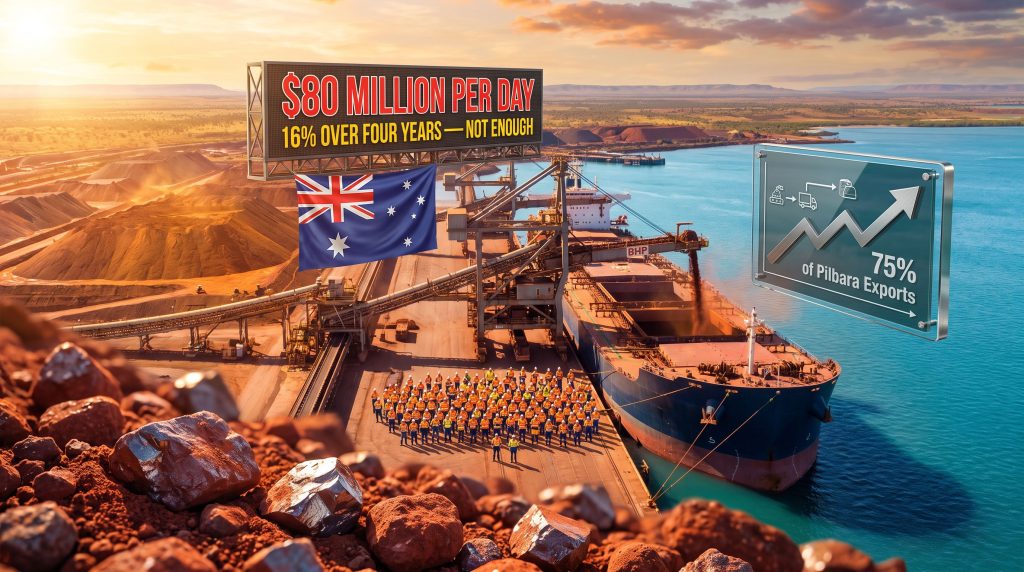
Port Hedland, situated on the coast of Western Australia's Pilbara region, is not simply a large port. It is the dominant exit point for one of the world's most heavily traded bulk commodities, handling approximately 75% of all iron ore exports from the Pilbara, the region that supplies the majority of China's imported ore requirements. Furthermore, the global iron ore market impact of any sustained disruption here is immediately felt across multiple exchanges and procurement chains.
Three of Australia's biggest iron ore producers — BHP, Fortescue, and Hancock Prospecting — all export through this facility. The sheer volume of trade concentrated through a single point means that throughput data from Port Hedland functions as a real-time indicator for global iron ore market sentiment. When volumes shift, futures markets on the Singapore Exchange and the Dalian Commodity Exchange respond accordingly, sometimes before actual tonnage impacts materialise.
BHP alone ships an estimated $80 million worth of iron ore through the port every single day, a figure that immediately reframes any operational disruption as an economic event rather than a routine labour matter. The company employs more than 800 workers at the port across vessel-loading, logistics, and operational functions, and as the world's third-largest iron ore producer, its throughput feeds directly into Chinese blast furnace supply chains.
Port Hedland's role in the seaborne iron ore trade is functionally comparable to a chokepoint in a shipping lane. Traffic can reroute around most bottlenecks, but there is no equivalent alternative for Pilbara iron ore volumes at this scale.
The Enterprise Bargaining Dispute: More Than a Wage Argument
The August 2026 BHP Port Hedland iron ore strike did not emerge suddenly. It was the product of a protracted breakdown in negotiations over a new enterprise bargaining agreement between BHP and the Combined BHP Ports Unions, a coalition of three unions representing a portion of the company's port workforce. Bloomberg's coverage of the strike noted the significant market implications from the outset.
On the surface, the dispute appears straightforward. BHP tabled a 16% pay increase spread across a four-year agreement, representing roughly 4% per annum. The CBPU declined to accept this as sufficient. However, experienced resources sector analysts understand that enterprise bargaining disputes in the Australian mining industry are rarely resolved on headline wage numbers alone.
The real complexity lies beneath the surface — in the structure of allowances, roster classifications, and working condition standardisation that do not appear in any press release but account for a significant portion of a port worker's total compensation. In the fly-in, fly-out model that characterises much of the Pilbara workforce, allowances for accommodation, travel, and shift arrangements can represent a material fraction of annual earnings. When those allowances erode in real terms over years of below-inflation adjustments, the tension builds quietly until it surfaces as formal industrial action.
What Workers Are Actually Seeking
The CBPU's formal demands span three interconnected areas:
- Base pay increases that meaningfully outpace cumulative CPI growth over the agreement period
- Enhanced port-specific allowances reflecting the physical demands and remote nature of port operations
- Standardised working conditions that provide greater consistency across BHP's port workforce classifications
Australia's inflation environment over the years preceding this dispute eroded real wages across the broader resources sector, making a 16% nominal increase over four years insufficient to recover lost purchasing power for many workers. This context is essential to understanding why the union proceeded with industrial action despite reportedly productive mid-week negotiations in the days before the August stoppage.
A Chronological Look at How the Strike Unfolded
The August stoppages were not the first indication that BHP's Port Hedland workforce had reached a breaking point. Workers staged an initial eight-hour stoppage in July 2026 — the first industrial action at the facility since the year 2000 — after preliminary bargaining talks collapsed. As the AFR reported, this historic action was carefully timed to hit BHP at a critical operational moment. That action alone was historically significant, given Port Hedland had not seen comparable industrial action in a quarter-century.
| Date | Development | Workforce Participation |
|---|---|---|
| July 2026 | First strike since 2000, eight-hour stoppage | Partial workforce |
| August 8, 2026 | First 24-hour ship-loading halt commences | Approximately 50 workers |
| August 9, 2026 (5:30 AM AWST) | Second wave joins rolling stoppage | Approximately 100 additional workers |
| August 9, 2026 (peak) | Total participation across both days | Approximately 150 workers |
| August 10, 2026 (5:30 AM AWST) | Workers return to duties | Full resumption |
| August 18, 2026 | Next formal bargaining session scheduled | Both parties confirmed |
One detail that markets noted carefully: BHP confirmed that vessel loading continued on Sunday despite the industrial action. This was possible because the CBPU represents a portion, not the entirety, of BHP's 800-plus port workforce, leaving operational continuity achievable through remaining staff. It also reflects BHP's preparedness with contingency coverage during planned stoppages.
Critically, neither Fortescue nor Hancock Prospecting experienced any disruption to their Port Hedland operations. The dispute is entirely contained within BHP's workforce agreements.
Quantifying the Economic Stakes
With $80 million in iron ore export value flowing through BHP's Port Hedland operations each day, the arithmetic of a prolonged dispute is stark. A theoretically complete two-day halt would represent approximately $160 million in deferred or lost shipment value. The actual impact of the August stoppages was substantially lower given continued loading operations, but the figures illustrate why resolution matters urgently to BHP's revenue profile.
Beyond immediate revenue, there are downstream market dynamics to consider. The iron ore demand outlook adds further pressure to any supply disruption of this nature:
- Chinese steel mills typically carry 30 to 45 days of iron ore inventory buffer at port, but procurement pricing adjusts rapidly when supply signals shift
- Iron ore futures markets are acutely sensitive to Port Hedland throughput data, and strike news can generate price volatility independent of whether actual tonnage is affected
- Pilbara ore grades, particularly the higher-iron-content fines that BHP produces, command specific premiums in Chinese blast furnace procurement, meaning substitution from other origins is not seamless even if alternative supply exists
A lesser-known dynamic in iron ore markets is that Chinese steel mills often adjust their purchasing cadence based on Port Hedland shipping schedules weeks in advance. Even a temporary scheduling disruption can ripple forward into procurement decisions that affect spot pricing across the entire seaborne market.
Why Ore Grade Matters in This Context
Not all iron ore is interchangeable. Pilbara ore — and specifically BHP's Newman blend and Mining Area C products — is characterised by relatively high iron content and consistent mineralogy that suits large-scale blast furnace operations. China steel and iron ore procurement strategies have been optimised around these specific grade profiles over decades of trade. Disruptions to supply of these specific ore types cannot be instantly offset by sourcing from Brazilian or West African origins without operational and cost adjustments at the mill level.
The Negotiating Positions: Where the Gap Actually Lies
| Dimension | CBPU Position | BHP's Offer |
|---|---|---|
| Agreement term | Four-year EBA | Four-year term |
| Wage increase | Above-inflation multi-year increases | 16% over four years |
| Allowances | Enhanced port-specific allowances | Undisclosed specifics |
| Working conditions | Standardised conditions across workforce | Under active negotiation |
| Next session | August 18, 2026 | Confirmed participation |
The alignment on a four-year agreement term suggests the parties are not fundamentally divided on structure. The friction, however, centres on the real value of the package and the non-wage provisions that matter deeply to workers operating in demanding, remote conditions but rarely appear in corporate communications about the dispute.
The next major ASX story will hit our subscribers first
The Broader Labour Market Context: A Sector Recalibrating
The BHP Port Hedland iron ore strike sits within a wider pattern of workforce recalibration across Australian resources. Following years of elevated commodity prices and record corporate profitability, workers across the Pilbara have grown increasingly willing to pursue enterprise bargaining action to close the gap between company earnings and real wage growth.
Australia's iron ore dominance has historically been underpinned by stable labour relations, making the current dispute a notable departure from the sector's established norms. Furthermore, the resources sector's dependence on fly-in, fly-out workforce models introduces specific bargaining complexities. FIFO workers face unique pressures around roster fatigue, time away from families, and the psychological toll of remote operations. These factors generate grievances that extend well beyond base pay.
The CBPU's structure as a three-union coalition also matters here. Multi-union coordination in enterprise bargaining typically produces more unified worker positions, reducing BHP's ability to negotiate separately with individual union representatives and strengthening the collective bargaining leverage available to the workforce.
What the Last 25 Years Tell Us
The fact that Port Hedland had not seen comparable industrial action since the year 2000 is worth examining carefully. In 2000, China's steel industry was producing roughly 128 million tonnes of crude steel annually. By the mid-2020s, that figure had grown to well over 1 billion tonnes per year. The Pilbara iron logistics network had transformed from a significant regional supply corridor into an indispensable link in the global industrial supply chain. Workers at Port Hedland today occupy roles of far greater economic consequence than their counterparts did a quarter-century ago, and the labour relations framework has been slow to reflect that shift.
Scenario Pathways: Resolution, Escalation, or Mediation
Scenario A: Negotiated Settlement
BHP enhances its offer on allowances and condition clauses without materially moving on the headline wage figure. The CBPU accepts a revised package with improved non-wage provisions. Industrial action ceases before further planned stoppages occur.
Scenario B: Rolling Stoppages Escalate
The August 18 session fails to bridge the conditions gap. The CBPU authorises additional 24-hour or 48-hour stoppages at escalating frequency. Market impact becomes material once stoppages begin disrupting vessel scheduling at scale, shifting the dispute from a news event to a genuine supply concern for Chinese steel procurement.
Scenario C: Fair Work Commission Intervention
If extended stoppages threaten significant economic harm, BHP applies to the Fair Work Commission to terminate protected industrial action. The dispute consequently moves into legally mediated arbitration, producing an outcome neither party fully controls but one that provides contractual certainty.
BHP's operational continuity during the August stoppages reduced the union's immediate leverage but did not eliminate it. Sustained rolling action across multiple weeks would eventually stress vessel scheduling, port logistics, and customer supply commitments in ways that a single weekend stoppage cannot replicate.
Frequently Asked Questions: BHP Port Hedland Iron Ore Strike
How many workers participated in the August 2026 strike?
Approximately 150 workers participated across the two planned days of industrial action. Around 50 joined the first day's stoppage on August 8, with a further 100 joining from 5:30 AM on August 9, bringing the total to roughly 150 out of BHP's 800-plus port workforce.
Did vessel loading stop completely during the strike?
No. BHP confirmed that vessel loading continued on Sunday, August 9, indicating that the stoppage did not achieve a full operational halt. The CBPU represents a portion, not all, of the port workforce, allowing continued operations.
When was the last comparable strike at Port Hedland?
The last major industrial action at Port Hedland occurred in the year 2000, making the 2026 dispute the first of its kind in approximately 25 years.
What pay increase has BHP offered?
BHP's publicly stated offer is a 16% wage increase over a four-year enterprise agreement, equivalent to roughly 4% per annum. The union has not accepted this as sufficient, with ongoing disagreement over allowances and working condition provisions.
Are Fortescue and Hancock Prospecting affected?
No. The industrial action is specific to BHP's workforce agreements at Port Hedland. Both Fortescue and Hancock Prospecting, which also use the port, continue to operate without disruption.
When do negotiations resume?
The Combined BHP Ports Unions and BHP are scheduled to return to formal bargaining on August 18, 2026.
Key Takeaways for Iron Ore Market Observers
- Port Hedland's 75% share of Pilbara iron ore exports makes it the most concentrated commodity export point of its scale on Earth, and any sustained disruption carries systemic supply risk
- The $80 million daily export value flowing through BHP's Port Hedland operations quantifies the economic exposure of an unresolved dispute with precision
- BHP's 16% four-year wage offer has not resolved a dispute rooted as much in allowance structures and working conditions as in base pay arithmetic
- The grade-specificity of Pilbara iron ore means supply disruptions cannot be seamlessly offset by alternative origins, adding a hidden layer of real supply risk beyond headline tonnage
- The August 18 bargaining session is the critical near-term inflection point, with failure to reach agreement potentially triggering further escalation toward rolling or extended stoppages
- This dispute reflects a sector-wide labour market recalibration across Australian resources, driven by the widening gap between record corporate earnings and real wage growth for the workforce that makes those earnings possible
This article is intended for informational purposes only and does not constitute financial advice. Forecasts, scenario analyses, and projections involve inherent uncertainty and should not be relied upon as predictions of actual outcomes. Readers should conduct their own independent research before making any investment decisions related to iron ore markets, BHP, or the broader resources sector.
Want To Stay Ahead of ASX Mineral Discoveries That Move Markets?
Discovery Alert's proprietary Discovery IQ model delivers real-time alerts on significant ASX mineral discoveries, transforming complex resource data into actionable investment insights for both short-term traders and long-term investors. Explore Discovery Alert's discoveries page to understand how historic mineral finds have generated substantial market returns, and begin your 14-day free trial today to position yourself ahead of the broader market.