August 10, 2026
The Hidden Mechanics Behind Calls to Trump Restrict U.S. Oil Exports
Every major energy policy debate eventually collides with a fundamental tension: the gap between what sounds politically intuitive and what is structurally possible. Few issues illustrate this collision more sharply than the recurring push to Trump restrict U.S. oil exports and limit petroleum product flows abroad. When fuel prices climb, the instinct to keep domestic energy at home feels obvious. However, the mechanics of how U.S. crude is produced, transported, refined, and sold internationally tell a far more complicated story, one that politicians on both sides of the debate rarely acknowledge in full.
When big ASX news breaks, our subscribers know first
The Legal Framework That Makes This Debate Possible
Understanding whether the Trump administration could restrict U.S. oil exports requires first understanding the legal architecture governing those exports. For four decades following the 1970s energy crisis, a blanket federal prohibition on crude oil exports remained in place under the Energy Policy and Conservation Act of 1975. That restriction was lifted by a 2015 omnibus spending bill, which opened American crude to global markets for the first time in a generation.
Critically, however, the removal of that prohibition did not eliminate all presidential authority over export flows. Statutory carve-outs preserved emergency powers allowing a president to reimpose restrictions under formally declared national emergency conditions. Refined petroleum products such as gasoline and diesel carry a separate legal treatment from crude oil, meaning any comprehensive intervention would require navigating two distinct regulatory pathways simultaneously.
Is the Legal Door Fully Closed?
"The legal door to restricting U.S. oil exports was narrowed in 2015, not closed. Emergency declaration authority remains intact, which is precisely why the debate resurfaces whenever domestic fuel prices spike or global supply chains fracture."
The procedural threshold for invoking those emergency powers is meaningful. A formal declaration would need to satisfy specific legal conditions, and in the current geopolitical environment, Iran's ongoing disruption of Strait of Hormuz shipping represents the kind of supply shock that analysts believe could satisfy that threshold. Whether any administration chooses to invoke it is an entirely different question, shaped far more by political economy than by legal feasibility. Furthermore, the trade war impact on oil markets adds another layer of complexity to these already difficult decisions.
How U.S. Export Volumes Reached Their Current Scale
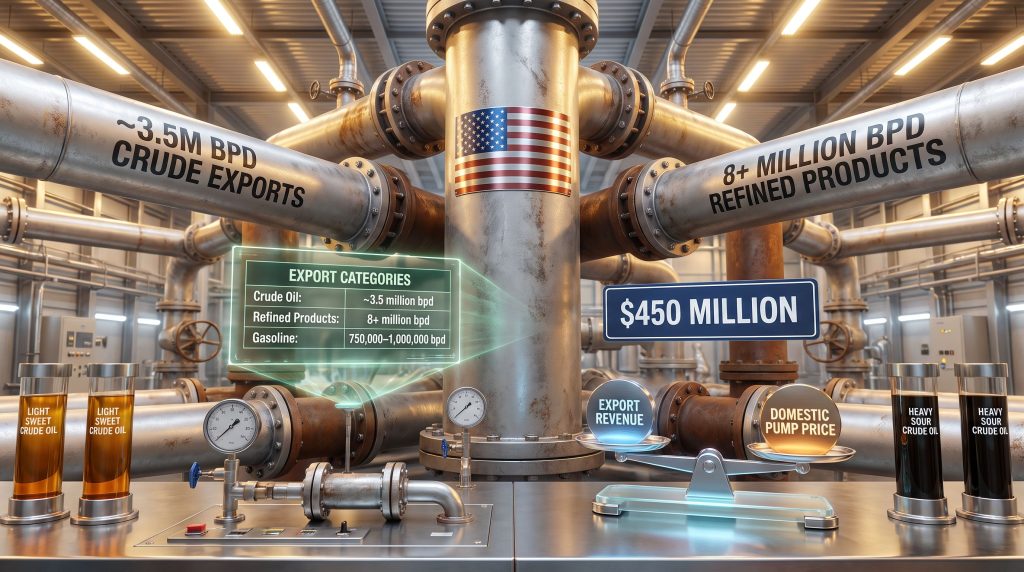
The scale of American petroleum exports makes any restriction a decision with global consequences. The shale revolution fundamentally transformed the United States from a net crude importer into one of the world's most significant exporters in the span of roughly fifteen years. As of mid-2026, U.S. crude oil exports sit at approximately 3.5 million barrels per day, while total refined petroleum product exports exceed 8 million barrels per day.
Distillate fuel exports, which include diesel and fuel oil, have reached record weekly volumes according to U.S. Energy Information Administration data. Gasoline exports have been running between approximately 750,000 and 1 million barrels per day, representing a meaningful share of Atlantic Basin refined product trade.
| Export Category | Recent Volume | Market Significance |
|---|---|---|
| Crude Oil | ~3.5 million bpd | Among the world's largest export streams |
| Refined Products (total) | 8+ million bpd | Exceeds many OPEC members' total output |
| Gasoline | ~750,000–1,000,000 bpd | Significant swing factor in Atlantic Basin pricing |
| Distillate Fuels (diesel/fuel oil) | Record weekly highs | Critical for European and Latin American supply chains |
These figures carry enormous geopolitical weight. Many U.S. trading partners, particularly in Europe and Latin America, have structured their fuel supply chains around consistent access to American petroleum products. Any interruption, even a partial or temporary one, would send immediate price signals through global refined product markets. In addition, understanding crude oil price geopolitics helps explain why allied nations monitor these debates so closely.
Why Crude Grade Chemistry Undermines the Simple Export Ban Logic
Perhaps the least understood dimension of this debate involves the physical characteristics of American crude production itself. This is where the politics diverge sharply from the engineering reality.
U.S. shale production is overwhelmingly weighted toward light sweet crude, a grade defined by its relatively low density and low sulfur content. The term sweet refers specifically to crude with sulfur levels below approximately 0.5%, which makes it easier and cheaper to refine into transportation fuels. In contrast, sour crude carries higher sulfur concentrations that require additional processing steps, most notably hydrotreating or hydrodesulfurization, to meet fuel quality standards.
The critical problem is that the majority of American refinery infrastructure was designed and built decades ago to process heavy sour grades, not the light sweet crude now flooding out of shale formations in the Permian Basin and elsewhere. This creates a structural mismatch that fundamentally limits what a crude-only export restriction could achieve.
- Retaining more light sweet crude domestically does not automatically increase gasoline or diesel output if refinery units cannot efficiently process it.
- The U.S. simultaneously exports light crude and imports heavy crude, a trade pattern driven entirely by refinery configuration economics rather than policy failure.
- Forcing surplus light crude to accumulate domestically would suppress wellhead prices for producers without delivering meaningful consumer relief at the pump.
- Achieving meaningful consumer price relief through export restrictions would require either including refined products in the ban or mandating expensive refinery retooling, neither of which is politically straightforward.
"Restricting crude exports without addressing the refinery configuration mismatch would likely create a domestic crude surplus that processing facilities cannot fully absorb, potentially harming producers while doing little for consumers."
This dynamic is rarely communicated clearly in public debate. The intuitive logic of keeping American oil at home for American consumers breaks down the moment you examine what kind of oil American refineries actually need versus what American wells actually produce. Analysts examining OPEC's influence on oil markets note a similar structural disconnect between political instinct and physical market reality.
The Political Economy: Industry Investment and Its Consequences
Any honest analysis of why proposals to Trump restrict U.S. oil exports face such steep political barriers must reckon with the financial relationship between the energy industry and the current administration. By one estimate, the U.S. oil and gas sector directed approximately $450 million toward campaign contributions, lobbying activity, and political advertising in support of the 2024 election cycle, spanning both candidate campaigns and broader Republican political infrastructure.
That level of financial engagement creates significant institutional inertia against any policy that would directly reduce producer revenues. Industry groups have consistently argued that American energy producers deserve the same right to access global markets as manufacturers, agricultural exporters, or technology companies, a principle embedded in the 2015 crude export liberalisation.
The stakeholder landscape is more fragmented than the industry's unified public messaging suggests, however:
| Stakeholder Group | Position on Export Restrictions | Primary Concern |
|---|---|---|
| Upstream Producers | Strongly opposed | Loss of premium global pricing |
| Refiners | Mixed/cautious | Feedstock access and margin impacts |
| Fuel Retailers | Potentially supportive | Domestic supply availability |
| U.S. Consumers | Broadly supportive | Pump price relief |
| International Buyers | Strongly opposed | Supply disruption and contract risk |
| Energy Secretary Chris Wright | Publicly opposed | Market distortion and investment deterrence |
Energy Secretary Chris Wright has publicly rejected proposals to restrict diesel exports and broader energy export flows. The White House has similarly stated that no plans exist to restrict crude oil or natural gas exports. Analysts note, however, that the speed and specificity with which the administration moved to deny these reports itself signals the intensity of industry lobbying pressure operating behind the scenes.
The Strait of Hormuz Variable: When Emergency Powers Become Viable
The geopolitical context surrounding this debate matters enormously. Iran's disruption of Strait of Hormuz shipping has already elevated international crude benchmarks and tightened global refined product availability. The Strait is the single most critical maritime chokepoint for global oil flows, with roughly 20% of worldwide petroleum trade passing through its waters under normal conditions.
A sustained, formal closure of the Strait represents one of the few scenarios where the legal threshold for a presidential emergency declaration on export controls becomes genuinely accessible. Historical precedent exists for such intervention: the U.S. managed energy commodity flows during declared emergencies in the post-1973 period, and the original 1975 crude export ban was itself a direct policy response to the disruption of that era.
The diplomatic complication is significant. Imposing export restrictions during a geopolitical crisis would simultaneously strain relationships with allied nations that depend on American crude and refined product supply, including several European countries that have reorganised import strategies following the Russia-Ukraine conflict. Consequently, the U.S.-China trade war oil prices dynamic adds yet another dimension to these geopolitical calculations.
"If distillate and gasoline prices remain elevated for a sustained period extending three to six months beyond current levels, the political calculus around export restrictions could shift materially, particularly if opposition lawmakers begin leveraging consumer price pain as a legislative pressure point."
The next major ASX story will hit our subscribers first
Three Policy Design Options and Their Real Trade-Offs
If restrictions were ever to proceed, the design of the policy would determine its actual impact far more than the headline decision itself. Three broad approaches are analytically distinct:
- Crude-only restriction: Limits unrefined crude exports while allowing refined product exports to continue. This addresses producer pricing dynamics but delivers minimal consumer benefit given the refinery configuration constraints described above. It is also the least legally complicated pathway.
- Refined products restriction: Targets gasoline and diesel exports directly, which would have a more direct connection to domestic pump prices. This option carries significant trade relationship risks and could trigger retaliatory measures from affected import-dependent nations. It would also disrupt long-standing commercial contracts.
- Comprehensive ban covering both crude and refined products: The maximum intervention scenario, requiring a formal emergency declaration and carrying the highest potential consumer impact alongside the greatest market disruption, legal complexity, and geopolitical cost.
Each scenario carries distinct consequences for domestic inventory levels, refinery utilisation rates, and international benchmark pricing. Furthermore, trade wars and oil prices research consistently shows that export uncertainty of any kind tends to suppress future drilling investment and capital allocation decisions among domestic producers.
A Longer-Term Question: Strategic Asset or Market Commodity?
Beneath the immediate price politics lies a deeper policy question that the U.S. has never formally resolved: should domestic energy be treated primarily as a strategic national asset or as a market commodity subject to normal export economics?
Other major energy-exporting nations have developed more explicit frameworks for managing this tension. Norway's sovereign wealth model captures export revenues for long-term national benefit while maintaining open market participation. Several Gulf producers maintain domestic pricing structures that differ materially from export market pricing.
The United States, by contrast, relies on a patchwork of emergency authorities and market mechanisms without a coherent framework for prioritising domestic energy security during periods of global supply stress. Energy policy researchers have argued that whether Congress should revisit the 2015 crude export liberalisation to build in clearer, pre-defined emergency response mechanisms, rather than relying on ad hoc presidential authority, is a question this debate may eventually force into the legislative agenda.
FAQ: U.S. Oil Export Restrictions Explained
Can the U.S. President Legally Restrict Oil Exports Without Congress?
Under existing law, the president retains emergency authority to restrict crude oil exports under specific national security and supply emergency conditions. Refined product exports carry separate legal treatment and may require distinct authorisation pathways.
Would Restricting Crude Oil Exports Lower Gasoline Prices?
Not necessarily, and possibly not at all. Because most U.S. refineries are configured for heavy crude grades rather than the light sweet crude that dominates domestic shale production, restricting crude exports alone would not automatically increase refined fuel output or reduce consumer prices.
What Would Actually Trigger a Formal Export Restriction?
A formal emergency declaration linked to a major geopolitical supply disruption, such as a sustained Strait of Hormuz closure, represents the most legally viable and politically defensible pathway to implementing export controls.
Has the U.S. Restricted Oil Exports Before?
Yes. A federal crude oil export ban was in effect from 1975 until 2015, originally enacted in response to the 1970s energy crisis. The 2015 legislative change removed the blanket prohibition but preserved emergency authority for future use.
What Is the Difference Between Light Sweet and Heavy Sour Crude?
Light sweet crude has low density and low sulfur content, making it cheaper and simpler to refine. Heavy sour crude is denser and contains more sulfur, requiring additional processing steps. U.S. shale production is dominated by the former, while most legacy American refinery infrastructure was designed for the latter, creating the structural mismatch at the centre of this debate.
Disclaimer: This article is for informational and educational purposes only and does not constitute financial, investment, or legal advice. Energy market dynamics, regulatory frameworks, and geopolitical conditions referenced are subject to rapid change. Readers should conduct independent research before making any financial decisions.
Want to Stay Ahead of the Next Major Resource Discovery Before the Market Moves?
While energy policy debates reshape global commodity landscapes, Discovery Alert's proprietary Discovery IQ model scans ASX announcements in real time, instantly identifying significant mineral discoveries and turning complex data into actionable opportunities — explore historic discoveries and their returns to see what's possible, then begin your 14-day free trial at Discovery Alert to position yourself ahead of the broader market.