August 10, 2026
The Architecture of Restriction: Understanding Europe's Transformed Steel Import Landscape
Trade policy rarely announces itself as a structural break in real time. More often, regulatory change accumulates quietly until a threshold is crossed and entire market architectures must be rebuilt from the ground up. The EU steel import regime that took effect on 1 July 2026 represents precisely this kind of inflection point. It is not an extension of the safeguard arrangement that preceded it, nor a calibrated adjustment to existing mechanisms. It is a wholesale redesign of how steel enters the European market, who can access it, on what terms, and at what cost.
For procurement teams, trading desks, and international exporters, the practical implications are still materialising. However, the regulatory mechanics are already clear enough to map the terrain.
When big ASX news breaks, our subscribers know first
From Transitional Safeguard to Permanent Trade Architecture
The original EU steel safeguard, introduced in 2018 as a provisional response to the global overcapacity shock triggered partly by US steel tariffs diverting supply, carried an embedded expiry logic. It was designed to give European steelmakers breathing room, not permanent shelter. Its sunset date of 30 June 2026 was always visible on the horizon, and the expectation in many quarters was that the EU would either allow it to lapse or replace it with a lighter-touch renewal.
What emerged instead was categorically different. The new EU steel import regime retains the structural form of a quota-based safeguard but transforms virtually every operational parameter within it. The EU steel action plan that preceded this framework signalled the direction of travel well in advance.
| Feature | Previous Safeguard (Pre-2026) | New Import Regime (Post-2026) |
|---|---|---|
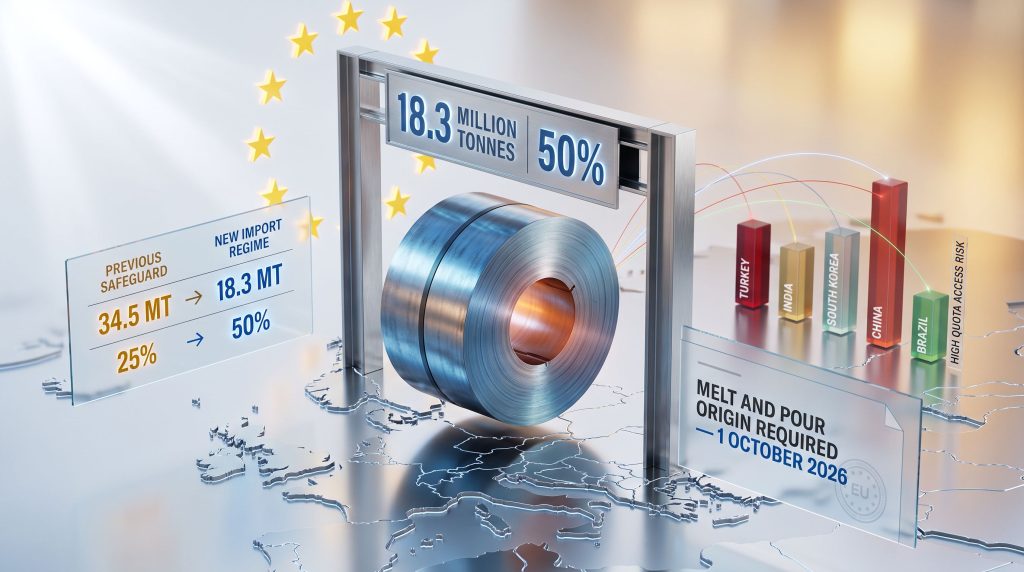
| Annual duty-free quota | ~34.5 million tonnes | 18.3 million tonnes |
| Out-of-quota tariff rate | 25% | 50% |
| Product category coverage | 26 categories | 30 categories |
| Quota management cycle | Annual allocation | Quarterly administration |
| Traceability requirement | Not mandated | Melt and pour origin required |
| Regime type | Temporary safeguard | Structural import framework |
The contraction from approximately 34.5 million tonnes of duty-free access to just 18.3 million tonnes annually represents a reduction of roughly 47% in available import headroom. When combined with a doubling of the out-of-quota tariff rate from 25% to 50%, the effective cost of exceeding the quota ceiling has moved from inconvenient to prohibitive for most commercial transactions.
This is not incremental policy refinement. It is a deliberate architectural redesign with a long-term orientation, reflecting the EU's broader industrial strategy goals around maintaining a viable domestic steel base capable of supporting the green energy transition. Furthermore, the Council has formally greenlighted these new rules to protect the EU steel market from global overcapacity.
How Quarterly Quota Administration Changes Market Behaviour
One of the least discussed but most operationally significant changes within the new EU steel import regime is the shift from annual to quarterly quota administration. Under the previous safeguard, importers could plan across the full calendar year, adjusting import timing to manage allocation drawdown. Early-quarter surges were possible; so were late-year corrections.
Under the new framework, the 18.3 million tonne annual ceiling is segmented into quarterly tranches. Once a given quarter's allocation is exhausted across a product category, the 50% out-of-quota tariff applies for the remainder of that period regardless of remaining annual headroom.
This creates several distinct market effects:
- Front-loading pressure: Importers face incentives to secure quota access early in each quarter, creating potential for rapid early-period exhaustion in high-demand categories
- Planning complexity: Contract timing must now align with quarterly quota windows rather than annual import plans
- Cliff-edge pricing risk: Price dislocations can emerge at quarter boundaries, particularly when quotas approach exhaustion in flat product categories like hot-rolled coil (HRC)
- Information asymmetry: Traders with better real-time visibility into quota utilisation rates hold a significant competitive advantage over those relying on lagging data
Analytical Note: The quarterly administration mechanism effectively transforms the EU steel market into a series of discrete access windows rather than a continuous open market. This fundamentally changes the risk profile of import-dependent supply chains and rewards early-mover positioning within each quarter.
The Melt and Pour Standard: Origin Traceability as a Trade Defence Tool
Perhaps the most technically sophisticated element of the new EU steel import regime is the mandatory melt and pour origin traceability requirement, which applies to all imports from 1 October 2026 onwards.
What Melt and Pour Actually Means
In conventional trade law, country of origin is typically determined by the location of the most substantial transformation, which in steel can mean the country where final rolling or processing occurred. This created a well-documented vulnerability: steel produced in high-volume, low-cost environments could be routed through third-country processing facilities and re-exported under a different origin classification, gaining more favourable quota access in the process.
The melt and pour standard closes this route by anchoring origin determination to the point of primary steelmaking. Specifically:
- Melt refers to the country where raw materials were converted into liquid steel in an electric arc furnace or basic oxygen furnace
- Pour refers to the country where that liquid steel was cast into a semi-finished solid form, typically slab, billet, or bloom
- Final processing and rolling country is no longer sufficient for origin determination under this standard
This is a more rigorous standard than almost any other major steel-importing jurisdiction currently applies, and it directly targets the transshipment and origin-washing practices that have complicated quota enforcement under every previous EU safeguard iteration.
Compliance Documentation Requirements
The October 2026 compliance deadline creates a three-month preparation window from the July implementation date. However, for supply chains where steel passes through multiple intermediate processors, assembling compliant documentation is non-trivial.
Importers should expect requirements to include mill certificates identifying the original steelmaking facility, declarations of origin signed by the primary producer, and potentially third-party verification for complex supply chains where documentation continuity is difficult to establish. In addition, importers facing the new safeguard regulation should act swiftly to assess their existing documentation frameworks.
Compliance Warning: Companies that have structured their sourcing arrangements around third-country processing to manage origin classification should treat the October 2026 deadline as urgent. Existing supplier contracts may need to be reviewed, amended, or replaced to ensure documentary compliance with the melt and pour standard before enforcement begins.
EEA Treatment Under the Traceability Framework
Norway, Iceland, and Liechtenstein occupy a distinct position within the new framework. As members of the European Economic Area, these countries benefit from deep integration with the EU single market for goods and are treated differently in key provisions of the quota architecture. In practical terms, this means EEA-origin steel may qualify for different treatment than material sourced from third-country exporters, though the specific application of traceability requirements to EEA-origin material warrants verification against the final regulatory text as implementation details are clarified.
Price Dynamics and Domestic Production Response
Two months into the new regime's operation, the most analytically meaningful early signal is the rate at which quarterly quotas are being consumed across key product categories. Rapid early-quarter exhaustion in flat products, particularly HRC, would confirm that the 18.3 million tonne annual ceiling is genuinely binding rather than theoretically restrictive.
The price implications follow directly from quota constraint intensity:
- When quarterly allocations approach exhaustion, European HRC and long product benchmarks are expected to reflect a scarcity premium relative to export-market equivalents
- Capacity restarts among European producers, incentivised by improved margin visibility under the more protective import regime, represent a partial supply-side offset
- However, the speed and scale of domestic capacity responses is constrained by the capital requirements of restarting idled blast furnace or electric arc furnace capacity
European steel demand in 2026 operates against a mixed macroeconomic backdrop. Construction sector activity remains subdued across several key EU markets following the prolonged effect of elevated interest rates on development pipelines. Automotive production faces structural headwinds from the electric vehicle transition, which changes both the volume and specification profile of steel requirements. Against these demand headwinds, the regime's price support mechanism is most effective in categories where import substitution by domestic production is technically and economically feasible in the near term.
Which Global Exporters Face the Greatest Exposure
The new EU steel import regime does not affect all exporting nations equally. Exposure is a function of both product mix and existing compliance infrastructure. Consequently, understanding the broader global steel outlook is essential for contextualising how various exporters are positioned to respond.
| Exporting Region | Primary Product Exposure | Quota Access Risk | Melt and Pour Compliance Complexity |
|---|---|---|---|
| Turkey | Long products (rebar, billet, wire rod) | High | Moderate |
| India | Flat products (HRC, cold-rolled) | Moderate to High | Moderate |
| South Korea | Flat products, coated steel | Moderate | Lower |
| China | Semi-finished, flat products | High | High |
| Ukraine | Semi-finished, flat products | Variable | Moderate |
| Brazil | Semi-finished (slab), flat products | Moderate | Lower |
Turkey has historically been among the EU's most significant external steel suppliers, particularly in long products. The combination of reduced duty-free quota access and the melt and pour documentation burden creates both volume and administrative challenges for Turkish exporters, who must weigh pricing concessions to remain competitive within quota against the strategic cost of redirecting surplus volumes to alternative markets in the Middle East or North Africa.
India's steel export trajectory toward Europe has been building momentum, with flat products representing a key growth category. The quarterly quota management system and the 50% out-of-quota tariff create a more compressed and competitive access environment. Indian producers with established European customer relationships and strong documentation infrastructure are better positioned to maintain market share than newer entrants, for whom the compliance learning curve is steeper.
Furthermore, the China steel market faces particularly elevated exposure, given the high complexity of melt and pour compliance for Chinese semi-finished and flat product exports into Europe.
The next major ASX story will hit our subscribers first
The CBAM Intersection: A Dual-Barrier Architecture
Operating in parallel with the new import quota regime is the EU's Carbon Border Adjustment Mechanism, which applies a carbon cost to imported steel calculated against the embedded greenhouse gas emissions of the production process and referenced to the EU Emissions Trading System carbon price.
The interaction between these two instruments creates a compounding effect for high-emission steel imports. A tonne of coal-intensive steel from an economy without equivalent carbon pricing that also exceeds its quarterly quota faces both the 50% ad valorem tariff and a CBAM carbon levy on its embedded emissions, which for coal-based steelmaking are substantially higher than for EAF-produced steel.
Analytical Insight: The convergence of the quota regime and CBAM represents a comprehensive restructuring of EU steel trade defence across three simultaneous dimensions: volume restriction, price penalties, and carbon cost internalization. Market participants modeling total landed cost economics must account for both mechanisms together, as analysing either in isolation produces a materially incomplete picture of import competitiveness.
This dual-barrier architecture also functions as an indirect industrial policy instrument. By making high-emission imported steel increasingly costly to access, it improves the relative economics of domestic EU production, particularly electric arc furnace steelmaking, which carries significantly lower embedded carbon intensity than blast furnace routes. EAF expansion is central to the EU's green steel transition, and the new import regime improves the business case for that investment by structurally supporting the domestic price premiums that make such capital expenditure viable. For context on how these cost dynamics are evolving, green steel pricing trends in 2025 offer a useful forward-looking perspective.
Comparing the EU and U.S. Steel Trade Defence Approaches
The United States has maintained Section 232 steel tariffs at 25% on most origins since 2018, creating a broadly comparable trade defence environment. However, the structural mechanics differ in ways that produce distinct market dynamics.
| Trade Measure | United States (Section 232) | EU New Import Regime |
|---|---|---|
| Instrument type | Universal tariff | Quota with out-of-quota tariff |
| Standard tariff rate | 25% | 50% above quota |
| Duty-free access | Limited country exemptions | 18.3 million tonnes annually |
| Origin traceability | Standard customs rules | Melt and pour requirement |
| Product coverage | Broad steel categories | 30 specific categories |
| Administration | Continuous | Quarterly quota management |
The U.S. approach applies a consistent cost uplift across all import volumes regardless of total quantity. The EU approach creates a cliff-edge effect: imports within the quarterly quota are essentially duty-free, while those above it face a 50% tariff. This cliff-edge structure generates different exporter behaviour, with volume discipline and quota monitoring becoming as strategically important as price competitiveness.
When both markets simultaneously restrict import access, the global steel exporters who historically relied on one or both blocs as primary destinations face concentrated pressure. Southeast Asian markets, the Middle East, and emerging economies in Sub-Saharan Africa and Latin America are likely absorption points for redirected volumes, with the potential to suppress prices in those regions as additional supply enters markets that previously received less.
Procurement Strategy Recalibration for European Buyers
For European steel consumers across automotive, construction, and industrial manufacturing, the new EU steel import regime necessitates a fundamental rethink of sourcing strategy. The market access dynamics that underpinned previous procurement models, including reliable availability of competitively priced third-country material, no longer hold in the same form.
Key strategic adaptations already emerging include:
- Accelerated domestic contracting: Securing volume commitments with EU-based mills ahead of anticipated quarterly quota exhaustion periods
- Diversification of import origin exposure: Shifting allocation toward countries with more favourable quota access and stronger melt and pour documentation capabilities
- Strategic inventory positioning: Building buffer stocks in advance of quarters expected to see rapid quota consumption in key product categories
- Contract structure modernisation: Incorporating quota-contingency pricing clauses and origin-documentation warranties into import purchase agreements
- Supplier qualification audits: Proactively assessing existing supplier documentation frameworks against the October 2026 melt and pour compliance requirements
The buyers who adapt fastest to the new quota mechanics, specifically those who invest in real-time quota utilisation monitoring and build quota-contingent flexibility into their sourcing contracts, are likely to maintain supply continuity and price stability even in periods of constrained access. Those who continue to operate on the assumption that import availability will remain broadly consistent with pre-2026 norms face material supply and cost risk in tight-quota quarters.
Disclaimer: This article is intended for informational and analytical purposes only. It does not constitute financial, legal, or procurement advice. Regulatory details are subject to change as the EU's implementation guidance evolves, and readers should consult primary regulatory sources and qualified advisers before making commercial or compliance decisions based on this content.
Want to Stay Ahead of the Next Major Mineral Discovery on the ASX?
While Europe's steel import architecture is being fundamentally redrawn, commodity markets globally remain dynamic — and significant mineral discoveries can emerge at any time. Discovery Alert's proprietary Discovery IQ model instantly identifies high-potential ASX mineral announcements across 30+ commodities, translating complex data into actionable insights for both traders and long-term investors. Explore historic discovery returns on Discovery Alert's dedicated discoveries page and begin your 14-day free trial to position yourself ahead of the market.