August 5, 2026
When a Single Port Holds the World's Steel Industry to Ransom
Global bulk commodity markets are built on an assumption that rarely gets tested: that the infrastructure connecting mines to markets will function without interruption. Most of the time, that assumption holds. But when it breaks down at a node as concentrated as Port Hedland, the consequences ripple across blast furnaces from Zhanjiang to Pohang within days.
Port Hedland sits at the intersection of geology and geography in a way that few export terminals can claim. The Pilbara region of Western Australia contains some of the world's most accessible, high-grade iron ore deposits, and Port Hedland is the single gateway through which virtually all of that material reaches global markets. That structural concentration is precisely what makes the BHP Port Hedland iron ore strike of August 2026 worth examining not just as an industrial relations event, but as a stress test of the entire seaborne iron ore supply system.
When big ASX news breaks, our subscribers know first
Port Hedland: The Arithmetic of Concentration Risk
One Terminal, One Company, One Chokepoint
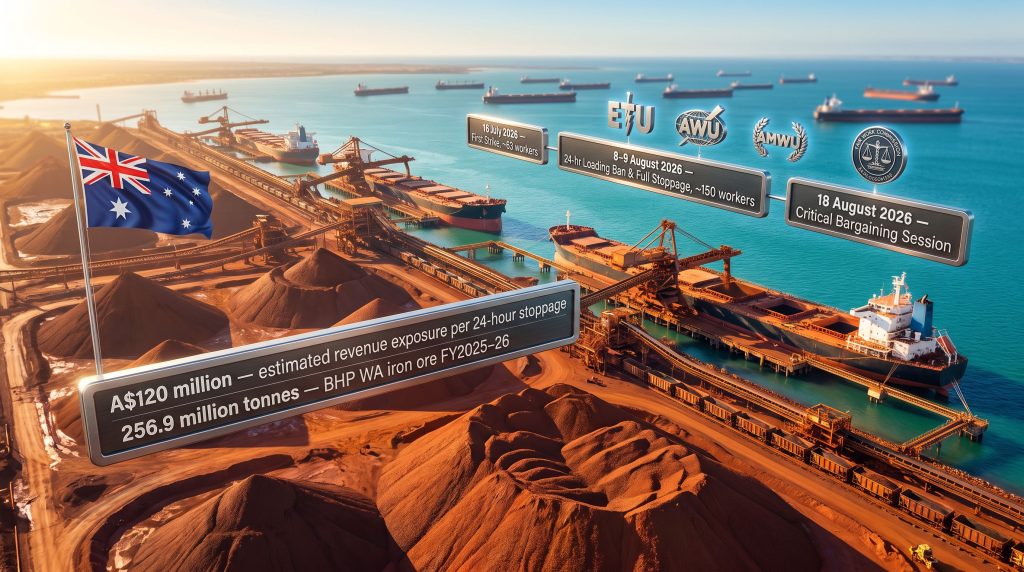
Port Hedland handles more bulk iron ore than any other export terminal on earth. For BHP, it is not merely a logistics asset but the terminal node of an entire production system. During the July 2025 to June 2026 fiscal year, BHP exported 256.9 million tonnes of iron ore from its Western Australian operations, with every tonne channelled through Port Hedland's infrastructure. There is no backup gateway, no alternative export corridor, and no partial rerouting capability at meaningful scale.
This degree of concentration distinguishes Port Hedland from other major bulk export terminals. Brazil's Ponta da Madeira, operated by Vale, handles comparable iron ore volumes but is part of a broader export network that includes Tubarão and Guaíba Island. Port Hedland operates without equivalent redundancy for BHP's Pilbara system. Furthermore, WA iron ore logistics constraints mean any disruption at this single node cannot easily be absorbed elsewhere in the supply chain.
The Revenue Calculus Behind Every Hour of Downtime
The financial exposure attached to any disruption at Port Hedland is not abstract. The Chamber of Minerals and Energy WA has assessed the cost of a single 24-hour work stoppage at approximately A$120 million (roughly US$83 million) in foregone iron ore export revenue for BHP. That figure reflects the loaded value of iron ore volumes that cannot be shipped, received, or priced during the stoppage window.
To contextualise that number: BHP's iron ore division consistently accounts for the majority of the company's underlying earnings before interest and tax. A two-day disruption of the kind structured for 8 and 9 August 2026 therefore represents not a rounding error but a material earnings event, particularly if vessel queuing effects extend the operational recovery window beyond the stoppage itself.
Key Insight: At A$120 million per day in estimated revenue exposure, Port Hedland represents one of the most financially concentrated single-day supply disruption risks in the global bulk commodities market. No weather event at a Brazilian port or vessel delay in the Strait of Malacca produces a comparable revenue-per-hour exposure profile for a single operator.
The Dispute Architecture: What the Workers Are Actually Demanding
Enterprise Bargaining and the Coalition Behind It
Enterprise agreement negotiations between BHP and its Port Hedland maritime workforce began in October 2025, covering approximately 450 employees excluding contractors. The bargaining is being pursued by a coalition of three unions operating under the Combined Ports Unions banner: the Electrical Trades Union (ETU), the Australian Workers Union (AWU), and the Australian Manufacturing Workers' Union (AMWU).
The multi-union structure is significant. Rather than a single-employer, single-union dynamic that can often be resolved bilaterally, the coalition structure means BHP must satisfy the threshold positions of three organisations with different membership priorities and different internal political pressures. This architecture inherently slows resolution and increases the risk of any individual union holding out even after the others have reached provisional agreement.
The four core demands of the Combined Ports Unions centre on:
- Fair and equitable pay structures that reflect the operational demands of the role
- Equal pay for workers performing equivalent functions across the port
- Clearer occupational classifications that reduce ambiguity around grade and pay band boundaries
- Improved working conditions addressing shift structures, rostering, and safety provisions
Protected Action: Who Can Strike and Why It Matters
Under Australia's Fair Work Act framework, not all employees covered by an enterprise agreement are automatically eligible to participate in protected industrial action. Fair Work Commission records indicate that up to 236 of the approximately 450 EA-covered workers at Port Hedland are legally eligible to take protected action. Port Hedland's total workforce, including roles not covered by this EA, stands at approximately 1,200 workers.
This eligibility gap matters strategically. The July 2026 action involved only around 63 workers, a fraction of the eligible cohort, which was insufficient to halt operations. BHP successfully maintained vessel departures, with a loaded ship leaving port on 17 July. The August action, with an estimated 150 participants, represents a materially larger mobilisation, though it still falls well short of the full eligible workforce.
Escalation Timeline: From First Strike to Structured Disruption
| Date | Event | Workers Involved | Operational Impact |
|---|---|---|---|
| October 2025 | EA negotiations commence | ~450 covered workers | No disruption |
| 16 July 2026 | First protected industrial action (8 hours) | ~63 workers | Minimal; loaded vessel departed 17 July |
| 4 August 2026 | FWC-mediated bargaining session | All parties | No resolution on substantive issues |
| 8 August 2026 | 24-hour ship-loading ban (from 05:30 AWST) | ~150 workers | Ship-loading operations suspended |
| 9 August 2026 | 24-hour full work stoppage (from 05:30 AWST) | ~150 workers | Full port operations suspended |
| 18 August 2026 | Next scheduled bargaining meeting | All parties | BHP to table revised EA proposal |
Why the August Structure Is Tactically More Sophisticated
The two-phase design of the August action reflects a more sophisticated operational disruption strategy than the July stoppage. By opening with a 24-hour ship-loading ban on 8 August, the unions create immediate vessel queue build-up without triggering the full operational response that a work stoppage would demand. Day two, the complete work stoppage on 9 August, then compounds the congestion that Day One created.
This sequencing is not accidental. A ship-loading ban immobilises vessels at berth and in the outer anchorage without requiring all port functions to cease, which makes it harder for management to redeploy contingency labour across all functions simultaneously. The follow-on full stoppage then freezes a port already congested from the preceding day, extending the effective disruption window well beyond the formal 48-hour action period.
How a Port Hedland Stoppage Moves Iron Ore Markets
The Mechanism From Disruption to Price Signal
Short-duration stoppages at Port Hedland do not automatically translate into immediate spot price movements. BHP maintains pre-positioned stockpile inventory that can partially buffer a 24 to 48 hour window, and traders and mills with existing cargo in transit are not immediately affected. However, the market impact mechanism operates through two distinct channels:
- Near-term vessel scheduling disruption: A loading ban creates an anchorage backlog that extends delivery windows for contracted cargoes, forcing mills to draw down buffer stocks faster than planned and potentially triggering spot purchase requirements.
- Forward risk premium: If the dispute remains unresolved after the 18 August bargaining meeting, markets begin pricing a sustained supply uncertainty premium into forward curve structures, even before physical shortfalls materialise.
China's Steel Cycle as the Amplifier Variable
The price sensitivity of a Port Hedland disruption is not constant. It varies significantly depending on where Chinese steel mills sit in their restocking cycle at the time of the stoppage. When mill-side iron ore port inventories are lean, which tends to occur during peak construction season restocking periods, even a 48-hour supply interruption can tighten the spot market enough to move prices by several dollars per tonne. Consequently, monitoring iron ore demand prospects alongside industrial relations developments is essential for procurement teams.
BHP's Pilbara iron ore grades, primarily high-iron fines and lump products, occupy a specific role in blast furnace blending strategies across China, Japan, and South Korea. Pilbara fines typically carry iron grades in the 61 to 62 percent Fe range, while Pilbara lump, which commands a significant premium due to its ability to be charged directly into the blast furnace without sintering, runs at comparable grade levels. The substitutability of these products in a disruption scenario is limited in the short term because blend ratios are optimised for the specific chemistry of available supply.
Market Watch: Iron ore price sensitivity to Port Hedland disruptions is highest when Chinese steel mill port inventories are lean and restocking demand is active. Procurement teams should monitor inventory data alongside industrial relations developments throughout Q3 2026.
The Broader Commodity Volatility Context
The BHP Port Hedland iron ore strike is unfolding within a broader market environment characterised by elevated commodity price volatility. Glencore reported in August 2026 that its value-at-risk measure peaked at $456 million during the first half of 2026, compared to an average of $72 million in the comparable prior period, reflecting a market environment where disruption events are carrying outsized pricing consequences. This is the backdrop against which any supply interruption at a node as significant as Port Hedland must be assessed.
In addition, China steel and iron ore market pressures in 2025 and 2026 have already placed buyers in a structurally cautious position, making any further supply-side uncertainty particularly unwelcome for downstream mills.
The Fair Work Framework: Legal Architecture of the Dispute
What Protected Industrial Action Actually Means
Australia's enterprise bargaining system under the Fair Work Act creates a structured pathway for industrial disputes that includes specific legal protections for workers taking protected action and specific limitations on employer responses. BHP cannot unilaterally terminate the protected action, cannot stand down workers without pay during stoppage periods in most circumstances, and cannot take adverse action against union members for participating.
The Fair Work Commission's role is dual-function: it acts as mediator in bargaining sessions, as it did at the 4 August meeting, and it retains reserve powers to suspend or terminate protected action if it determines the action poses a significant threat to the welfare of the economy. This second power is rarely exercised but provides a backstop in escalation scenarios.
BHP's Strategic Tension
BHP's negotiating position reflects a tension that is common to large mining operators in enterprise bargaining: the financial incentive to resolve the dispute quickly is in direct conflict with the precedent-setting risk of making concessions that flow through to other EA negotiations across its broader workforce. With multiple enterprise agreements active or approaching renewal across BHP's Australian operations, any settlement at Port Hedland becomes a reference point for subsequent negotiations.
This precedent dynamic is partly why the 4 August meeting, while described by both parties as productive, failed to resolve substantive issues. Movement on pay classification structures at Port Hedland could create upward pressure on equivalent classifications at BHP's mine-site operations, multiplying the actual cost of any concession. Furthermore, iron ore trade risks already weighing on the sector make any prolonged dispute particularly damaging to investor confidence.
The next major ASX story will hit our subscribers first
Is This Dispute a Harbinger of Broader Industrial Pressure?
Labour Relations in the Pilbara: A Generational Shift
The July 2026 action at Port Hedland was characterised as historic, representing the first industrial action in the Pilbara resources sector in decades. That characterisation, if accurate, is itself significant. It suggests that the post-boom labour relations equilibrium that held across Pilbara operations through the 2010s has been disrupted by a combination of cost-of-living pressures, a structurally tight Western Australian labour market, and a broader reassertion of union bargaining power in the Australian resources sector.
The conditions driving union assertiveness at Port Hedland are not unique to BHP. Labour market tightness across the Pilbara has reduced the threat value of replacement labour strategies. Post-pandemic wage expectations have reset the floor below which workers are willing to accept nominal pay increases. And the political environment around industrial relations legislation in Australia has shifted in ways that have strengthened the procedural rights of unions in enterprise bargaining.
Similarly, Onslow iron operations elsewhere in Western Australia have demonstrated that operational disruptions in the Pilbara can carry broader safety and commercial consequences, reinforcing the urgency of swift resolution at Port Hedland.
Scenario Analysis: What Happens After 18 August?
The 18 August bargaining meeting is the near-term decision point for this dispute. Four realistic pathways exist:
- Scenario A: Negotiated resolution. BHP tables an acceptable EA proposal on 18 August and unions suspend further action pending member ratification. Probability: Moderate. Requires BHP to make meaningful movement on pay classification structures.
- Scenario B: Rolling stoppages. Talks stall and unions escalate to recurring protected action through September and October. Probability: Moderate to high if substantive gaps persist. Market impact: sustained supply uncertainty premium and potential spot price support.
- Scenario C: FWC arbitration. Parties agree to refer unresolved matters to binding arbitration by the Fair Work Commission. Probability: Low to moderate. Resolution within 60 to 90 days but removes union leverage over timing.
- Scenario D: Full-scale port shutdown. The unlikely but not impossible scenario in which union membership broadens to include the full 450-worker coverage group. Revenue exposure would exceed A$120 million per day and operational impact would be severe.
Strategic Note for Iron Ore Buyers: Procurement teams sourcing BHP Pilbara fines and lump should treat the 18 August bargaining outcome as a key supply chain contingency planning trigger for Q3 and Q4 2026. The asymmetric risk profile favours building modest buffer inventory ahead of that date.
Frequently Asked Questions: BHP Port Hedland Iron Ore Strike
How much revenue does BHP lose per day of port disruption?
The Chamber of Minerals and Energy WA estimates a 24-hour stoppage costs BHP approximately A$120 million (around US$83 million) in foregone iron ore export revenue.
How many workers are involved in the August 2026 action?
Approximately 150 workers are expected to participate across the two-day action. Up to 236 of the approximately 450 EA-covered employees are legally eligible to take protected industrial action under Fair Work Commission records.
When did enterprise bargaining begin?
Negotiations for a new enterprise agreement commenced in October 2025, covering approximately 450 maritime workers at the port, excluding contractors.
Will the strike affect iron ore prices?
A two-day stoppage is unlikely to produce a sustained spot price shift given BHP's contingency planning and existing stockpiles. However, if the dispute escalates into recurring actions through Q3 2026, markets may begin pricing in a forward supply disruption premium, particularly if Chinese mill inventory levels are lean at the time.
What role does the Fair Work Commission play?
The FWC has served as mediator in bargaining sessions, including the 4 August meeting. If negotiations fail to progress, the FWC retains powers to suspend protected action or refer unresolved matters to binding arbitration under the Fair Work Act.
Key Takeaways for Market Participants
- Port Hedland's status as the world's largest bulk iron ore export terminal means labour disruptions at this single facility carry supply chain consequences that no comparable terminal can generate
- The August 2026 action marks a structural escalation from the July stoppage, with a larger participating workforce, a two-phase tactical design, and a clear signal that the unions are prepared to sustain pressure beyond a single-day demonstration
- At an estimated A$120 million per day in revenue exposure, BHP's financial incentive to resolve the dispute is substantial, but the precedent risk of making concessions moderates the urgency of settlement
- The 18 August bargaining meeting represents the most important near-term decision point; failure to resolve core classification and pay equity issues will likely trigger further escalation into Q3 2026
- Iron ore buyers, steel mills, and commodity traders should treat the BHP Port Hedland iron ore strike situation as an active supply chain risk variable, with particular attention to Chinese port inventory levels as the demand-side amplifier of any supply disruption impact
This article contains forward-looking analysis and scenario projections based on publicly available information as of early August 2026. It is intended for informational purposes only and does not constitute financial or investment advice. Market outcomes will depend on factors including, but not limited to, the outcome of bargaining sessions, union membership decisions, and Chinese steel market conditions.
Want to Stay Ahead of ASX Mineral Discoveries Before the Broader Market Moves?
While supply disruptions at Port Hedland dominate headlines, significant mineral discoveries continue to emerge across the ASX — and timing is everything. Discovery Alert's proprietary Discovery IQ model delivers real-time alerts on major ASX mineral discoveries, transforming complex geological and market data into actionable insights for both traders and long-term investors. Explore Discovery Alert's discoveries page to see how historic finds have generated substantial returns, and start your 14-day free trial today to ensure you're positioned ahead of the market.