August 5, 2026
When Sovereign Policy Becomes the Marginal Cost Setter
Commodity markets have historically priced metals through the interaction of supply, demand, and input costs. Extraction technology improves, energy prices fluctuate, labour agreements shift, and the market absorbs these changes through price discovery. But a structurally different dynamic emerges when a government holding 65% of global mine supply uses regulatory architecture to set the minimum price at which ore changes hands, regardless of what the spot market is doing. That scenario is no longer theoretical. It is the operating reality of nickel in 2026, and understanding the Indonesia nickel cost floor is essential for anyone evaluating battery metal supply chains.
When big ASX news breaks, our subscribers know first
What the Indonesia Nickel Cost Floor Actually Means
The concept of a cost floor is familiar to mining analysts, but most cost floors are market-derived, reflecting the blended production cost of the highest-cost producer whose output is required to meet demand. Indonesia's situation is categorically different. Its cost floor is policy-derived, set through the Harga Patokan Mineral (HPM) benchmark pricing formula, which determines the minimum price that smelters must pay miners for ore feedstock. Indonesian nickel price trends have consequently diverged from conventional market dynamics in ways that require careful analysis.
The April 2026 revision to this formula introduced two structural changes that permanently elevated production costs:
- The correction factor applied to 1.6% nickel ore was raised from 17% to 30%, directly increasing the minimum ore valuation
- Cobalt, iron, and chromium concentrations above threshold levels are now incorporated into the ore valuation, adding further uplift to feedstock costs
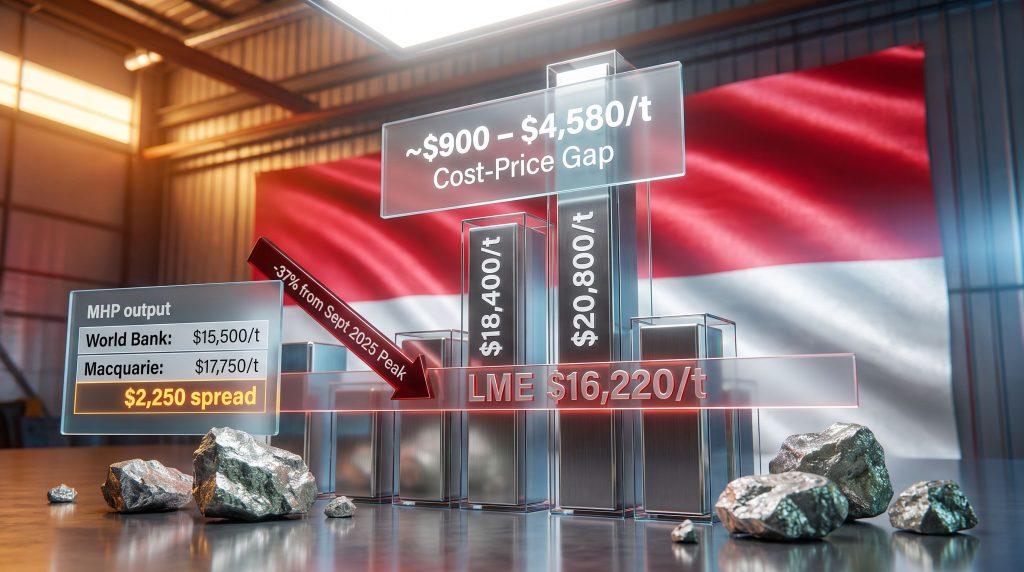
The combined effect of these changes added approximately $500 per tonne to nickel pig iron (NPI) production costs. For High Pressure Acid Leach (HPAL) operations, which have a different cost structure and higher sensitivity to input pricing, the impact was materially larger. UBS Global Research places Indonesian break-even costs at $18,400 per tonne for pyrometallurgical routes and $20,800 per tonne for hydrometallurgical operations.
Against those benchmarks, LME nickel fell to a 2026 year-to-date low of $16,220 per tonne on July 2, 2026 before recovering to roughly $17,500 per tonne later that month. The arithmetic is unambiguous: even after the partial recovery, pyrometallurgical producers in Indonesia were operating approximately $900 per tonne below their estimated break-even.
A government-set ore benchmark does not automatically decline when metal prices fall. This creates a structural mismatch between production costs and realised revenues that can only resolve through price recovery or supply contraction, not efficiency gains alone.
The RKAB Quota System: How Annual Limits Bind the Market
From 379 Million to 260-270 Million WMT: The Scale of the Cut
Indonesia's Ministry of Energy and Mineral Resources (ESDM) administers ore production through the Rencana Kerja dan Anggaran Biaya (RKAB) system, which sets annual quotas for each licensed operation. For 2026, the approved quota was set at 260 to 270 million wet metric tonnes (wmt), representing a reduction of approximately 109 to 119 million wmt from the 379 million wmt approved for 2025.
This cut is not occurring in a vacuum. Domestic smelter consumption requirements for 2026 are estimated at approximately 330 million wmt, meaning the quota is structurally below what processors need to run at capacity. Furthermore, the gap between supply permission and consumption requirement must be bridged through one of three routes:
- Imported ore, which carries a higher delivered cost than domestic feedstock
- Stockpile drawdowns, which are finite and cannot be replenished without additional quota
- Reduced throughput, which contracts output and, by extension, supply
Between January and June 2026, domestic smelters consumed 120.6 million wmt of ore, equivalent to 46.2% of the annual quota. This pace suggests the binding constraint had not yet fully materialised in the first half of the year, but the second half arithmetic becomes increasingly difficult as remaining quota is absorbed.
Adding a further layer of supply uncertainty, the RKAB validity period was shortened from three years to one year as of mid-2026. This annual reset mechanism gives ESDM the ability to adjust production ceilings each year without the buffer of a multi-year permit, increasing regulatory unpredictability for capital-intensive investment decisions. The Indonesian nickel industry challenges stemming from this regulatory shift are considerable.
Export Clearance Delays: An Underappreciated Complication
Beyond quota volumes, approximately 120 surveyor reports required to clear nickel exports from operations across Sulawesi, West Kalimantan, and Bangka Belitung remained outstanding as of late July 2026, following new customs screening requirements for rare-earth content in exported material. Indonesian NPI containing 10% nickel was priced at $145.60 per tonne FOB Indonesia on July 29, 2026, unchanged week-over-week, suggesting the physical market had not yet priced in the backlog. If clearance delays persist or expand, they could amplify supply constraints beyond what quota volumes alone imply.
Processing Route as the Primary Competitive Variable
The Sulfur Dependency Problem in HPAL Operations
One of the less widely understood aspects of the Indonesia nickel cost floor is how unevenly it distributes across different processing technologies. HPAL treatment of laterite ore consumes approximately 10 tonnes of sulfur for every tonne of contained nickel in the resulting mixed hydroxide precipitate (MHP). Sulfuric acid is therefore the dominant variable input cost for these operations, not labour or energy.
Indonesia imports elemental sulfur rather than finished acid for domestic HPAL processing, and a particularly concentrated supply risk sits within this input chain: four of the five largest sulfur suppliers to Indonesian operations route shipments through the Strait of Hormuz. Any disruption to that corridor adds geopolitical supply risk on top of an already elevated cost base.
Rotary kiln electric furnace (RKEF) pyrometallurgical routes, by contrast, have no sulfuric acid dependency, insulating them from this specific cost pressure. The divergence between these two processing pathways in the post-HPM-revision environment is now measurable in output data: Indonesian MHP production has fallen approximately 37% from its September 2025 peak through mid-2026. This contraction represents the first concrete evidence that revised benchmark pricing is already curtailing output at the most cost-exposed operations, well before any visible tightening appears in LME warehouse stocks.
Why Sulfide Mineralogy Commands a New Premium
The sulfide versus laterite distinction has always mattered in nickel project evaluation, but the revised HPM framework has sharpened the cost differential significantly. Sulfide deposits processed through conventional flotation and smelting do not require sulfuric acid inputs, immediately sidestepping the HPAL cost escalation. Projects that can demonstrate competitive all-in costs below the Indonesian pyrometallurgical break-even of approximately $18,400 per tonne occupy a structurally advantaged position that did not exist at the same magnitude before the April 2026 formula revision.
The Two-Layer Inventory Problem: Why Warehouse Stocks Are a Lagging Signal
Understanding the Disconnect Between Ore Markets and Exchange Inventories
Combined LME registered and off-warrant refined nickel stocks rose approximately 58% in 2025 to exceed 367,000 tonnes, with additional unregistered material held in Singapore and Kaohsiung. For observers focused solely on exchange inventories, the bullish supply thesis appears contradicted by ample refined metal availability.
The analytical error in this framing is treating ore markets and refined metal inventories as a single system that responds simultaneously to the same signals. They do not. The table below illustrates the structural difference in response speed:
| Market Layer | Governing Mechanism | Response Speed to Policy Change |
|---|---|---|
| Ore supply | RKAB quota + HPM benchmark | Immediate (quota-constrained) |
| Intermediate products (NPI, MHP) | Processing economics + input costs | Medium-term (weeks to months) |
| Refined metal inventories | Exchange stocks + off-warrant material | Lagging (months to years) |
Refined inventories reflect the cumulative surplus accumulated during Indonesia's 2020 to 2024 expansion cycle. Cost pressure at the ore and intermediate level reduces producer margins and output first, manifesting in NPI pricing and MHP output declines before it ever reaches exchange warehouse data. The 37% decline in Indonesian MHP output from its September 2025 peak is precisely the kind of leading signal that precedes, rather than coincides with, inventory drawdowns.
The International Nickel Study Group (INSG) forecasts a 32,000-tonne primary nickel deficit for 2026. Elevated inventories are expected to absorb much of this deficit before it translates into spot price movement, but the deficit itself signals that the supply-demand balance is tightening at the structural level even if prices remain subdued near-term. Consequently, the prospects for nickel market recovery hinge significantly on how quickly this structural tightening flows through to exchange-level pricing.
The $2,250 Forecast Spread: Not a Demand Disagreement
The World Bank projects nickel prices near US$15,500 per tonne for 2026, while Macquarie Group forecasts US$17,750 per tonne. The $2,250 per tonne spread between two credible institutional forecasters is not a disagreement about nickel demand trajectories. It is, essentially, a difference in assumptions about ESDM enforcement discipline.
If the 260 to 270 million wmt quota ceiling holds firmly and supplementary RKAB applications are denied or substantially limited, higher-cost Indonesian production cannot expand to relieve tightness. If, on the other hand, supplementary approvals post-July 31 allow the effective quota to rise above 300 million wmt, the projected supply deficit narrows materially and price recovery potential weakens.
This regulatory enforcement uncertainty creates a premium for projects whose economics are independent of Indonesian quota decisions. A lower-cost project outside the Indonesian quota system benefits from the supply floor scenario without bearing the downside risk if enforcement proves less stringent than assumed. The broader battery metals investment landscape is increasingly shaped by precisely this kind of jurisdictional risk differentiation.
The next major ASX story will hit our subscribers first
The China-Indonesia Policy Nexus and Its Strategic Implications
Indonesia's role as the dominant ore producer is structurally intertwined with China's dominance in downstream refining. The leading refining country accounted for an average of 72% of global critical mineral refining capacity (excluding rare earths) in 2025, up from 70% in 2023. China's Ministry of Industry and Information Technology published a critical minerals refining roadmap on July 31, 2026, reinforcing this downstream concentration.
The practical consequence is that battery metal production costs across the supply chain are increasingly determined by sovereign policy decisions made in Jakarta and Beijing rather than by market-driven efficiency gains. For project developers and offtake buyers seeking supply chain diversification, this creates a jurisdictional premium for assets that sit outside this policy nexus and can demonstrate competitive cost structures independently. The Indonesia's 2026 policy tightening has, in effect, repriced the entire nickel cost map.
Lithium's Parallel Supply Compression: Capital Rather Than Quota
While nickel's supply constraint is driven by regulatory architecture, lithium is following a structurally similar path through a different mechanism: the withdrawal of development capital. The lithium market downturn has intensified as capital retreats from the sector at precisely the moment when long-term demand signals remain strong.
Lithium carbonate fell to 140,000 CNY per tonne on August 3, 2026, down 15.28% over the prior month but still 96.22% above the year-ago level. The IEA recorded critical minerals investment declining 9% in 2025, the first material contraction since 2020. Battery materials companies reduced capital expenditure by approximately 20%, while lithium specialists implemented cuts of approximately 40%.
The table below captures the structural tension embedded in these numbers:
| Metric | Value |
|---|---|
| IEA critical minerals investment decline (2025) | -9% (first decline since 2020) |
| Lithium specialist capex reduction | ~40% |
| Battery materials company capex reduction | ~20% |
| Lithium demand growth (prior 2-year average) | ~25% per year |
| Global lithium production growth target (2026) | +26% year-over-year |
| Lithium carbonate price (August 3, 2026) | 140,000 CNY/tonne |
| Month-over-month price change | -15.28% |
| Year-over-year price change | +96.22% |
Near-term prices remain capped by restart supply, including production resumption at CATL's Jianxiawo operation. The 26% production growth target for 2026 reflects projects already in execution, not new capital commitments. When capital spending contracts by 40% while demand grows at 25% annually, the mines that should replace depleting assets in 2028 to 2030 are simply not being developed. The supply gap is not visible in current prices. It is being constructed in the absence of investment decisions being made today.
Supply models in the lithium sector have consistently overestimated future production because they assume projects with promising economics will actually receive funding and reach construction. When capital dries up, projects that look good on paper never reach production, and those projections fall away. Industry observers tracking project-level construction commencement data note that the gap between projected supply and actual commissioning timelines has widened materially since 2024.
The New Project Screening Framework: Cost-Curve Position Above All Else
The revised HPM benchmark and tightening RKAB quota regime have fundamentally altered how battery metal projects should be evaluated. The old framework prioritised total contained metal and ore grade. The new framework, shaped by the Indonesia nickel cost floor, demands a more nuanced analytical lens.
Old Evaluation Framework:
- Total contained nickel (resource size)
- Ore grade
- Geographic proximity to existing infrastructure
New Evaluation Framework (Post-April 2026 HPM Revision):
- Cost-curve position relative to the Indonesian break-even (~$18,400/t pyrometallurgical; ~$20,800/t HPAL)
- Processing route and sulfur dependency, with sulfide projects holding a structural cost advantage
- Jurisdictional independence from Indonesian quota policy and Chinese refining concentration
- Treasury strength and funding runway, since capital access determines whether low-cost assets reach production
- Permitting progress, as established regulatory pathways reduce time-to-production and increase present value
- Execution track record, including metallurgical recovery certainty and capital cost control history
The processing route comparison below illustrates why mineralogy type now carries as much analytical weight as resource grade:
| Processing Route | Sulfur Dependency | HPM Benchmark Exposure | Relative Cost Position (Post-April 2026) |
|---|---|---|---|
| Sulfide (conventional flotation) | None | Indirect | Competitive advantage |
| HPAL (laterite) | ~10t sulfur/t Ni in MHP | Direct and material | Cost-disadvantaged |
| RKEF Pyrometallurgical (NPI) | None | Direct (ore benchmark) | Moderate, quota-constrained |
| Hydromet (alternative technology) | Low | Indirect | Potentially competitive |
Key Monitoring Signals: What to Watch and Why
Leading Indicators That Will Confirm or Challenge the Thesis
Because refined inventories are a lagging signal, the most actionable monitoring framework focuses on upstream and intermediate market data:
Leading indicators (respond first to policy changes):
- Indonesian NPI prices (FOB Indonesia) currently at $145.60/tonne for 10% Ni NPI as of July 29, 2026
- Indonesian MHP output volumes, currently approximately 37% below the September 2025 peak
- ESDM supplementary RKAB approval decisions following the July 31 submission window
- Sulfur supply chain conditions through the Strait of Hormuz
Lagging indicators (confirm tightening after the fact):
- LME registered nickel warehouse stocks (currently above 367,000 tonnes)
- LME spot nickel price movements
- Off-warrant inventory levels in Singapore and Kaohsiung
Conditions that would weaken the supply tightening thesis:
- ESDM raises the 2026 ore quota above 300 million wmt through supplementary RKAB approvals
- Indonesian producers sustain operations materially below UBS break-even estimates without measurable output cuts, suggesting modelled costs are overstated
- Sulfur supply normalises and HPAL margins recover, reducing pressure on laterite processing economics
- Lithium production growth exceeds the 26% target while demand decelerates below 25% annually
Frequently Asked Questions: Indonesia Nickel Cost Floor
What exactly is the Indonesia nickel cost floor?
The Indonesia nickel cost floor refers to the minimum economically viable production cost established by government-set ore benchmark pricing through the HPM formula and production quota restrictions through the RKAB system. Under UBS Global Research estimates, this floor sits at approximately $18,400 per tonne for pyrometallurgical routes and $20,800 per tonne for HPAL operations, both well above current LME spot prices.
Why did Indonesia revise its HPM benchmark pricing formula in April 2026?
The revision raised the correction factor for 1.6% nickel ore from 17% to 30% and incorporated cobalt, iron, and chromium into the valuation formula when threshold concentrations are met. The combined effect added approximately $500 per tonne to NPI production costs and a larger increment to HPAL operations.
Does the 367,000-tonne refined nickel inventory overhang eliminate the supply tightening risk?
No. Refined inventories and ore or intermediate supply operate on different timescales and are governed by different mechanisms. The primary signals of physical tightening appear first in NPI pricing and MHP output volumes, both of which are already showing measurable stress. Inventory drawdowns are a lagging confirmation, not a leading signal.
Why does processing route matter more than ore grade in the current environment?
The revised HPM formula has elevated the cost of ore feedstock for all Indonesian producers, but HPAL operations face additional pressure through sulfuric acid input costs. Sulfide projects processed through non-acid-dependent methods avoid this cost exposure entirely, creating a competitive cost gap that did not exist at the same scale before the April 2026 revision. In an environment where the Indonesia nickel cost floor sits above spot prices, processing route determines whether a project can generate positive margins at all.
Disclaimer: This article is provided for informational purposes only and does not constitute financial or investment advice. Forecasts, price projections, and production estimates referenced herein are drawn from third-party institutional sources and involve significant uncertainty. Battery metal markets are subject to regulatory, geopolitical, and commodity price risks that can materially alter outcomes. Readers should conduct their own due diligence before making any investment decisions.
Want to Invest Before the Next Major Battery Metal Discovery Hits the Market?
Discovery Alert's proprietary Discovery IQ model delivers real-time alerts on significant ASX mineral discoveries — cutting through the complexity of shifting cost floors, quota regimes, and processing route economics to surface actionable opportunities the moment they are announced. Start your 14-day free trial today and explore how historic mineral discoveries have generated exceptional returns for investors who positioned early.