August 5, 2026
The Hidden Mechanics Behind Crude Oil's Sensitivity to Diplomatic Signals
Few forces reshape energy markets as rapidly or as profoundly as the shift from armed conflict to negotiating table. When geopolitical tensions spike, oil traders don't wait for tankers to stop sailing before bidding prices higher. They price in the probability of disruption, weeks or months before any physical supply change materialises. And when the diplomatic mood lifts, that probability-weighted premium collapses just as swiftly, regardless of whether a single barrel of crude has changed hands differently. This is the foundational dynamic driving the current situation in which oil declines as investors await outcome of US-Iran talks, with both major benchmarks posting their sharpest weekly losses in months.
Understanding why markets behave this way requires looking beyond headlines and into the structural mechanics of how geopolitical risk gets priced into commodity markets in the first place. Furthermore, the interplay between crude oil geopolitics and price sensitivity has never been more evident than during active diplomatic cycles involving major producing nations.
When big ASX news breaks, our subscribers know first
How Geopolitical Risk Gets Embedded Into Crude Prices
Oil markets operate on two simultaneous pricing layers. The first is the fundamental layer: supply volumes, inventory levels, refinery demand, and OPEC+ production quotas. The second is the risk premium layer, an additional price component that traders attach to crude benchmarks whenever there is a credible threat to physical supply. This premium can range from a few dollars per barrel during minor regional tensions to $15 or more per barrel during major chokepoint disruption scenarios.
The risk premium is not arbitrary. Institutional traders and algorithmic systems assign probability-weighted values to various disruption scenarios, multiplying the expected price impact of each scenario by its estimated likelihood. When a conflict emerges near a critical transit corridor, that probability calculation shifts dramatically, pushing the premium higher almost instantly.
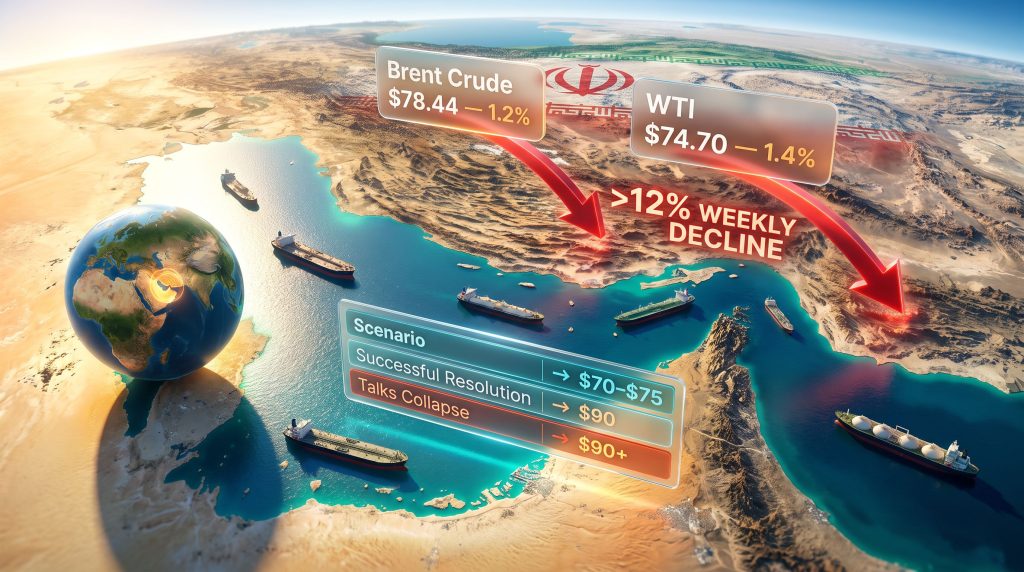
The inverse is equally true. When credible diplomatic progress signals emerge, those probability assessments are revised downward in real time. This is why crude benchmarks can fall more than 12% in a single week without any actual change to physical oil flows, as is currently the case with Brent crude. Markets are not responding to what has happened to supply. They are responding to what is now less likely to happen.
Markets reprice geopolitical risk within hours. Physical supply normalisation, by contrast, takes weeks to months. This lag is one of the most misunderstood dynamics in commodity investing, and it creates both risks and opportunities for traders operating across different time horizons.
Why the Trade War and Oil Markets Connection Adds Further Complexity
The relationship between the trade war and oil markets adds yet another layer of complexity to geopolitical risk modelling. Traders must simultaneously account for tariff-related demand slowdowns alongside traditional supply-shock premiums. Consequently, the pricing environment during periods of overlapping diplomatic and trade tensions becomes significantly more volatile than either factor alone would produce.
The Strait of Hormuz: More Than an Oil Transit Route
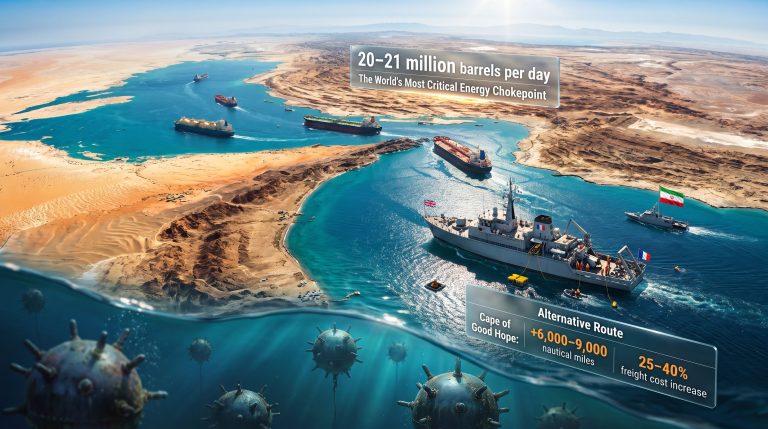
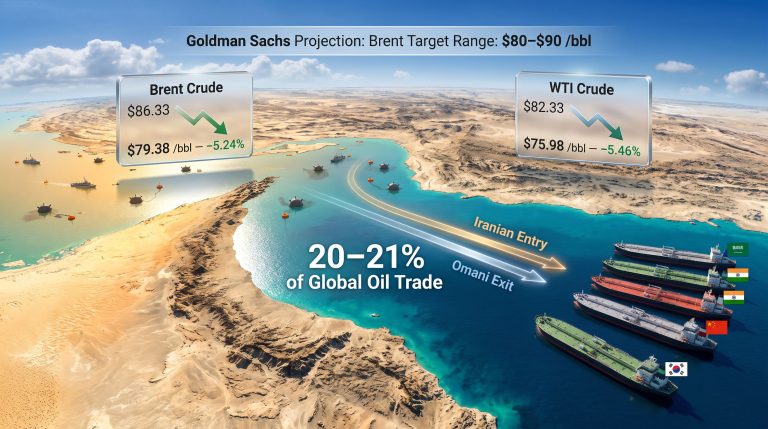
The Strait of Hormuz occupies a unique position in global energy infrastructure. Situated between Iran to the north and Oman and the United Arab Emirates to the south, this narrow waterway is the only maritime passage connecting the Persian Gulf to the open ocean. Before the current conflict disrupted traffic through the strait, the waterway handled approximately 20% of the world's combined oil and liquefied natural gas supply on a daily basis.
This figure deserves emphasis because it is frequently underappreciated in crude-focused media coverage. The Strait of Hormuz is not merely an oil transit corridor. It is simultaneously a critical artery for global LNG supply chains, meaning any diplomatic resolution that restores shipping through the waterway would ease pricing pressures across two major commodity classes at once. In addition, the LNG supply outlook for Asian importers remains particularly sensitive to any development involving Hormuz transit.
The nations most exposed to Hormuz disruption include:
- Japan and South Korea, which rely on Persian Gulf LNG imports for a substantial portion of their energy mix
- India, which imports significant volumes of both crude oil and LNG from Gulf producers
- European importers, who are exposed indirectly through global LNG spot price dynamics
- China, which sources a large proportion of its crude oil through Persian Gulf shipping lanes
The scale of the price impact seen since the conflict began illustrates the waterway's leverage over global benchmarks. In March alone, crude prices climbed approximately 50% following the onset of the conflict and the effective blockade of the strait. That single-month move represents one of the fastest and most severe supply-shock repricing events in recent commodity market history, comparable in pace to the early phases of the 1973 Arab oil embargo, though different in its structural cause.
Benchmark Performance Snapshot: A Week of Sustained Pressure
The current price decline has unfolded across three consecutive trading sessions, with selling pressure building as diplomatic signals from Qatar intensified. As of the latest available data:
| Benchmark | Price Level | Session Change | Weekly Decline |
|---|---|---|---|
| Brent Crude Futures | $78.44/barrel | -$0.92 (-1.2%) | More than 12% |
| WTI Futures | $74.70/barrel | -$1.07 (-1.4%) | More than 11% |
Brent's breach below $80 per barrel is particularly significant from a technical standpoint. This level had held as support since mid-July, and its loss signals a potential shift in the medium-term trend structure. Monitoring current crude oil prices closely is therefore essential for anyone navigating this period of heightened volatility.
For WTI, trading near $74.70 per barrel places the benchmark close to the breakeven thresholds that several mid-tier US shale producers require to maintain current drilling activity, a dynamic that could start to influence rig count decisions if sustained.
The weekly decline of more than 11% for WTI and more than 12% for Brent represents a textbook example of risk-premium unwinding rather than demand destruction. The distinction matters enormously for positioning. Demand destruction implies a structural reduction in consumption that persists even after geopolitical factors resolve. Risk-premium unwinding is a valuation correction that can reverse sharply and suddenly if the diplomatic environment deteriorates.
Qatar's Mediation Role and the Conflicting Signals Complicating Markets
Qatar's emergence as the primary diplomatic intermediary between Washington and Tehran adds a layer of strategic complexity that oil markets are actively trying to price. Qatar's Emir Sheikh Tamim bin Hamad Al Thani held direct discussions with US President Donald Trump regarding efforts to narrow differences between the two governments and improve the prospects for a durable settlement, according to Qatar's Emiri office.
Qatar's willingness to facilitate these negotiations is not purely altruistic. As one of the world's largest LNG exporters, Qatar has a direct commercial interest in restoring safe passage through the Strait of Hormuz. A closed or militarily contested strait imposes operational costs and insurance premiums on Qatar's own export shipping, creating a powerful alignment of incentives that makes Doha a genuinely motivated mediator rather than a passive facilitator.
However, the market-complicating factor is the contradictory public messaging coming from Tehran. While Qatar's mediators have indicated measurable progress, Iran publicly denied that formal negotiations are underway. This divergence between back-channel diplomatic activity and public political messaging is a well-documented feature of Iran-US diplomatic cycles, stretching back through multiple rounds of nuclear talks. According to Reuters, oil markets pulled back sharply as traders assessed the credibility of diplomatic progress claims.
IG market analysts highlighted the central sticking point: whether Iran will maintain its position that it retains some degree of navigational authority over the Strait of Hormuz, and whether the United States will firmly reject any such jurisdictional framing. This specific disagreement has the potential to derail talks entirely, which is why analysts are urging caution despite the recent price pullback.
Scenario Modelling: What Happens Next to Oil Prices?
The current price trajectory could diverge sharply depending on how the diplomatic process unfolds over the coming weeks. The following framework outlines the three most plausible scenarios:
| Scenario | Probable Brent Direction | Key Trigger | Likely Timeline |
|---|---|---|---|
| Successful diplomatic resolution | Further downside toward $70-$75 range | Hormuz reopening confirmed | Weeks to months |
| Talks collapse or renewed conflict | Sharp reversal toward $90+ | Physical supply disruption | Immediate |
| Partial or ambiguous agreement | Range-bound volatility | Unresolved jurisdictional dispute | Extended |
The third scenario is arguably the most underappreciated by retail market participants. A partial agreement that leaves the jurisdictional question unresolved would likely produce a prolonged period of elevated volatility, with prices oscillating between risk-on optimism and risk-off fear. This environment tends to benefit options traders and volatility-focused strategies while creating difficult conditions for directional positioning.
Priyanka Sachdeva, Head of Market Insights at Phillip Nova, has noted that the unwinding of the immediate geopolitical premium does not eliminate underlying supply risk, and that if diplomatic efforts fail and physical supply is ultimately affected, the current pullback could prove short-lived, with tighter inventories amplifying the impact of any future supply shock.
How an Oil Price Shock Could Rapidly Reverse Current Trends
The prospect of an oil price shock scenario remains firmly on the table should talks break down. Canadian energy executives and other industry leaders have already modelled contingency strategies for a renewed supply disruption, reinforcing the view that the diplomatic pathway remains fragile and that market participants should not interpret the current decline as a definitive resolution signal.
The next major ASX story will hit our subscribers first
The Inventory Wildcard and Why Distillate Data Complicates the Picture
Adding a secondary layer of downward pressure to crude prices this week is the inventory data released by the American Petroleum Institute. Crude stocks in the United States rose by approximately 2.7 million barrels in the week ending July 31, a figure that, in isolation, would typically be read as moderately bearish for prices. Combined with the geopolitical risk-premium unwinding, the inventory build has compounded selling pressure.
However, the distillate component of the same report complicates a purely bearish interpretation. Distillate stocks fell during the same period, a signal that demand for diesel and heating oil remains firm. Distillate consumption is closely correlated with industrial activity and freight transportation, meaning the drawdown suggests the underlying demand environment is not deteriorating.
This is an important nuance: oil declines as investors await outcome of US-Iran talks, yet the current crude price movement is being driven by geopolitical repricing and inventory positioning, not by weakening fundamental demand. Official figures from the US Energy Information Administration are due to be released, and any divergence from the API's preliminary data could act as a near-term catalyst in either direction.
How Historical Diplomatic Cycles Have Shaped Crude Volatility
The current episode is not without historical precedent. When the JCPOA nuclear agreement was concluded in 2015, crude markets anticipated the return of Iranian barrels to global supply well in advance of the actual lifting of sanctions. Brent futures declined progressively during the negotiation phase, pricing in the increased probability of supply normalisation.
Critically, the financial market repricing happened months before physical Iranian crude volumes materially increased. This temporal gap between agreement and actual supply normalisation is a structural feature of geopolitical commodity cycles. Even if a diplomatic resolution is reached, restoring Hormuz shipping traffic to pre-conflict volumes would require:
- Formal cessation of hostilities and verification mechanisms
- Clearance of any navigational hazards in the strait
- Restoration of shipping insurance coverage by major underwriters
- Rebuilding of port infrastructure where damage has occurred
- Reconnection of supply chain logistics across affected Gulf exporters
Each of these steps introduces additional lead time, meaning the financial market will very likely overshoot to the downside before physical reality catches up.
The Broader Strategic Implications: LNG, OPEC+, and Energy Security
A successful diplomatic resolution would carry implications well beyond crude oil benchmarks. Asian LNG import costs, particularly for Japan, South Korea, and India, would likely ease as Persian Gulf cargoes regain unrestricted access to open ocean shipping routes. This could have meaningful downstream effects on petrochemical feedstock pricing and refining margins across Asia-Pacific markets.
For OPEC+, a normalising Hormuz corridor changes the production management calculus significantly. Member nations that had curtailed output or diverted shipments due to the conflict would need to reassess their volume strategies in the context of potentially lower prices. Saudi Arabia's fiscal breakeven oil price, widely estimated in the range of $70 to $80 per barrel depending on the analytical source, would come under pressure if Brent were to settle sustainably below $75 following a resolution.
Perhaps most consequentially for long-term energy markets, the Hormuz episode has accelerated investor and government attention toward energy supply chain diversification. As reported by the Wall Street Journal, oil declines as investors await outcome of US-Iran talks have prompted fresh scrutiny of infrastructure investment strategies. Furthermore, new LNG terminal developments, alternative pipeline routes, and strategic petroleum reserve expansions may prove structurally supportive of certain energy sub-sectors regardless of how the diplomatic situation resolves.
Disclaimer: This article is intended for informational purposes only and does not constitute financial or investment advice. Commodity markets involve significant risk, and past price behaviour is not indicative of future performance. Readers should conduct independent research and consult a qualified financial professional before making investment decisions.
Further coverage of global oil market dynamics and geopolitical risk pricing is available through ET EnergyWorld at energy.economictimes.indiatimes.com, which provides ongoing analysis of oil and gas market developments from an industry perspective.
Want to Stay Ahead of the Next Major Commodity Market Move?
Discovery Alert's proprietary Discovery IQ model scans ASX announcements in real time, instantly identifying significant mineral discoveries across more than 30 commodities — including those directly influenced by shifting energy and geopolitical dynamics — and delivers actionable alerts before the broader market catches on. Explore Discovery Alert's discoveries page to see how historic mineral discoveries have generated substantial returns, and begin your 14-day free trial today to secure a market-leading edge.