August 5, 2026
The Geopolitics of a 21-Mile Bottleneck: Why Every Oil Trader Is Watching Hormuz
Global energy markets have long operated with a quiet awareness of a single geographic fact: the world's most important oil artery passes through a stretch of water barely 21 miles wide at its narrowest point. The Strait of Hormuz, tucked between the southern coast of Iran and the northern tip of Oman, is not merely a shipping lane. It is a pressure valve for the entire global energy system, and right now, the question of whether a Strait of Hormuz reopening deal with Iran can hold is driving some of the most dramatic single-session price movements crude markets have seen in years.
Understanding why this corridor commands such outsized attention requires looking beyond the raw tonnage figures. Market participants have always known that physical disruption and perceived risk of disruption are two entirely different forces, and both can move prices with equal intensity.
When big ASX news breaks, our subscribers know first
The Architecture of Global Energy Vulnerability
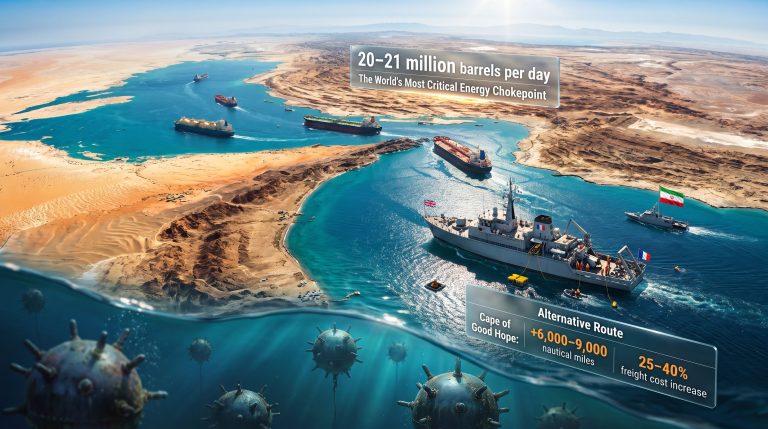
Roughly 20 to 21 percent of the world's traded oil transits the Strait of Hormuz on any given day. Persian Gulf LNG exports bound for East Asia and Europe move through the same corridor. When this waterway functions normally, it is largely invisible to most energy consumers. When it does not, or when credible threats emerge, the ripple effects extend to petrol stations, airline fuel contracts, fertiliser costs, and manufacturing input prices across dozens of countries simultaneously.
What makes the strait uniquely dangerous from a market psychology perspective is the concept of asymmetric leverage. Iran does not need to physically close the waterway to impose costs on global markets. The credible threat of closure, the deployment of mines, the targeting of commercial vessels, or the mere signalling of hostile intent is sufficient to inject a substantial risk premium into forward crude pricing. Analysts refer to this as the geopolitical risk premium, an additional cost per barrel that reflects uncertainty rather than any actual reduction in physical supply.
This premium can persist for extended periods even when physical flows remain largely intact, which is precisely what has made the current conflict period so consequential for energy importers worldwide. Furthermore, understanding geopolitical oil price factors helps illustrate why this dynamic carries such weight across global commodity markets.
What the Reported Hormuz Deal Actually Involves
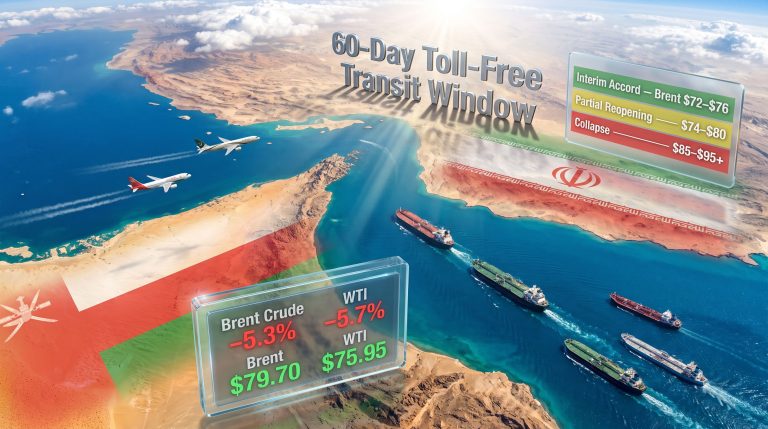
The framework currently under discussion is best understood as an interim access arrangement rather than a comprehensive peace settlement. The Strait of Hormuz reopening deal with Iran, as reported by regional officials and confirmed through diplomatic commentary, outlines a pragmatic, if fragile, structure:
| Element | Reported Detail |
|---|---|
| Iran's obligations | Mine removal and permission for commercial vessel passage |
| U.S. obligations | Lift naval blockade on Iranian ports |
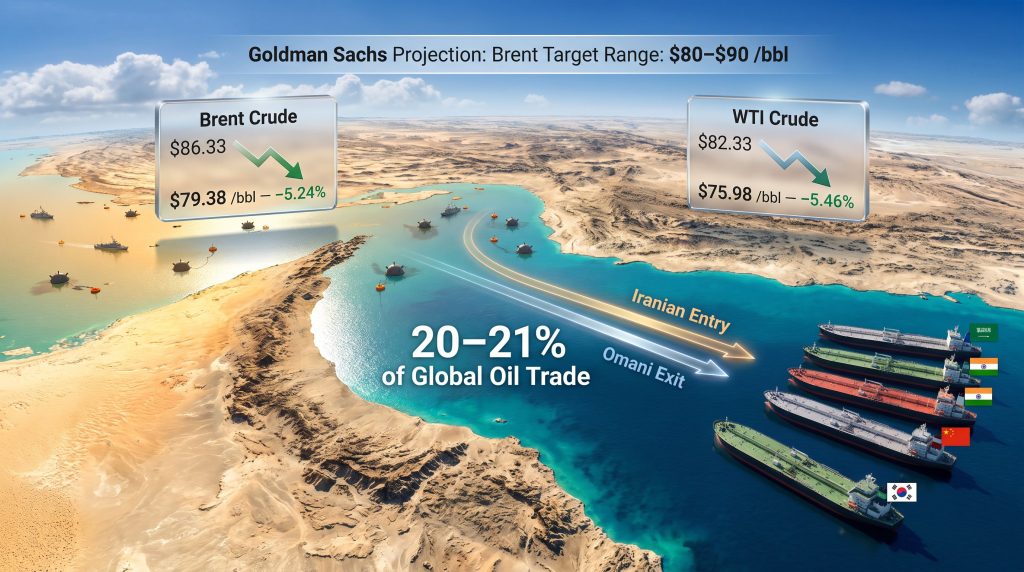
| Corridor structure | Iranian-controlled entry / Omani-controlled exit |
| Transit fees | Security and maritime environment service charges |
| Timeline to full reopening | Up to 30 days post-signing |
| Ceasefire window | Approximately 60 days for broader negotiations |
| Deal status | Described as fragile and provisional |
One of the less-discussed nuances in the reported framework is the distinction between tolled access and freedom of movement. A tolled model, in which Iran and Oman levy service charges on transiting vessels for security and environmental management, carries meaningful implications for global shipping economics. It would effectively institutionalise Iranian revenue generation from the strait in a way that creates both an incentive structure for compliance and a precedent for maritime governance that extends well beyond the current conflict.
The question of whether the final arrangement would adopt a fee-based model or guarantee unimpeded freedom of movement carries significant weight for war-risk insurance markets and long-term tanker routing decisions.
Key Insight: The difference between a tolled corridor model and a freedom-of-movement guarantee is not merely semantic. For shipping operators and cargo insurers, these two structures imply fundamentally different risk assessments, cost projections, and compliance frameworks over a multi-year horizon.
How Oil Markets Responded to Diplomatic Signals Alone
The market reaction to diplomatic commentary on August 5, 2026 offered a revealing case study in how heavily geopolitical risk premiums had been built into crude benchmarks during the conflict period. Indeed, oil price movements of this scale in response to diplomatic signals alone underscore just how much uncertainty had accumulated in forward pricing.
| Benchmark | Session High | Post-Signal Price | Single-Session Decline |
|---|---|---|---|
| Brent Crude (Front-Month) | $86.33/bbl | $79.38/bbl | -5.24% |
| WTI Crude | $82.33/bbl | $75.98/bbl | -5.46% |
Brent front-month futures fell 5.24 percent to $79.38 per barrel, having touched a session high of $86.33 earlier that same day. WTI crude dropped 5.46 percent to $75.98 per barrel from an intraday peak of $82.33. These are not modest adjustments. A movement of this scale on the back of diplomatic statements, without any confirmed agreement or physical change to supply conditions, reveals something important about the structure of the current market.
It tells us that the geopolitical risk premium embedded in crude prices during this period has been substantial and that market participants were pricing in a meaningful probability of sustained or escalating disruption. A single credible signal of de-escalation was sufficient to unwind months of accumulated risk pricing in a matter of hours.
Market Context: The speed and magnitude of this price response illustrates a widely underappreciated dynamic in commodities investing. The market does not wait for physical confirmation. It reprices probability distributions in real time, meaning diplomatic language carries almost as much market force as operational reality in highly uncertain geopolitical environments.
The Mediator Network: Qatar, Oman, and Pakistan
The diplomatic architecture facilitating these negotiations is itself significant. Qatar, Oman, and Pakistan have been coordinating closely to exchange draft proposals between Washington and Tehran, each bringing distinct and complementary leverage to the process.
Qatar has established itself over recent decades as a uniquely capable intermediary between Western governments and Iranian-aligned actors. Its willingness to maintain open channels with parties in active conflict with Western interests gives it credibility that larger powers cannot replicate.
Oman brings something even more structurally important: geographic positioning. Oman's coastline forms the southern boundary of the strait's exit corridor, meaning any dual-corridor arrangement operationally depends on Omani cooperation and administrative capacity. Oman has also maintained backchannel diplomatic relationships with Iran and the United States across multiple administrations, making it the most naturally positioned broker for an arrangement of this kind.
Pakistan's inclusion signals that the regional coalition being assembled around this framework extends beyond the immediate Gulf neighbourhood, suggesting an attempt to build broader legitimacy for the arrangement across the wider Muslim world and among major Asian energy importers.
Mediator credibility matters not just diplomatically but as a market signal. Markets are not simply asking whether a deal exists. They are assessing whether the parties guaranteeing it have sufficient credibility and leverage to enforce compliance over the critical 60-day window.
Goldman Sachs and the Binary Scenario Framework
Goldman Sachs has outlined a Brent price holding range of $80 to $90 per barrel, characterising this band as the likely equilibrium until one of two catalysts resolves the current uncertainty: a confirmed US-Iran agreement or a significant escalation involving broader target sets and intensified military activity.
This binary framing reflects a broader shift in how institutional energy desks are approaching the current environment. Rather than issuing point forecasts, major banks are constructing outcome probability distributions, effectively treating the geopolitical situation as a discrete event risk rather than a continuous fundamental variable.
The practical implication for investors is significant. Energy equities, tanker operators, and commodity-linked instruments are all being priced with embedded optionality that reflects this binary uncertainty. A confirmed deal compresses that optionality value sharply. A confirmed escalation expands it, likely pushing prices well above the upper bound of Goldman's current range.
There is also a specific risk that sophisticated market participants are beginning to model: the sell-the-news dynamic. If a deal is announced and markets have already partially priced in de-escalation, the subsequent price movement may be more muted than anticipated, or even temporarily reverse, if questions emerge about the deal's durability or implementation timeline. Monitoring crude oil price trends in real time remains essential for navigating this environment effectively.
The next major ASX story will hit our subscribers first
Why the Deal Remains Fragile: The Structural Issues Left Unaddressed
The provisional nature of this arrangement cannot be overstated. Several interconnected structural issues sit entirely outside the scope of the interim maritime framework:
- Iran's nuclear programme and the broader non-proliferation architecture remain unresolved
- The existing multi-layered sanctions regime imposed on Iran by the United States and its allies is not addressed in the maritime corridor arrangement
- Regional proxy conflicts and the dynamics driving them are not part of the 60-day negotiation window
- Domestic political pressures within Iran create meaningful risk that any agreement could be repudiated by hardline factions opposed to engagement
- Historical precedent from previous Iran-related diplomatic breakthroughs, including the original JCPOA negotiations and subsequent unravelling, demonstrates that structural spoiler risks are significant
The distinction between a ceasefire-linked corridor reopening and genuine normalisation of maritime access is critical for anyone attempting to model the medium-term energy supply picture. The former is a temporary pressure release. The latter would represent a structural transformation of Persian Gulf shipping economics that could take years to negotiate and ratify.
Ongoing Threats: Why Hormuz Remains Dangerous Right Now
Even as diplomatic activity intensifies, the physical environment in and around the strait remains hazardous. The UK Maritime Trade Operations agency flagged an incident on August 5, 2026, involving a cargo vessel struck by an unknown projectile approximately 20 nautical miles northeast of Oman's Al Khasab area. This is a direct reminder that the operational risks have not paused pending diplomatic progress.
Broader regional rerouting behaviour tells a similar story. Six Saudi-flagged supertankers recently altered course in the Gulf of Aden, redirecting toward southern Africa rather than continuing on their planned routes. Two separate Saudi oil-laden tankers did successfully transit the Bab el-Mandeb Strait, suggesting partial route normalisation is occurring, but the broader pattern remains one of caution and contingency planning among major tanker operators.
Mine-clearing operations, which would be a prerequisite for any formal reopening, are technically complex and time-consuming. Depending on the density and type of mines deployed, the 30-day timeline to full traffic restoration cited in reporting may prove optimistic. Naval mine clearance in active or recently active conflict zones requires specialised assets, careful coordination, and systematic verification protocols that cannot be rushed without creating significant residual risk for commercial shipping.
The Downstream Impact: Who Benefits Most From a Reopening?
A durable Strait of Hormuz reopening deal with Iran would generate benefits that are not evenly distributed across the global economy. The asymmetric gains would flow most strongly toward a specific group of economies:
- India currently imports substantial volumes of Persian Gulf crude and has faced elevated freight costs and insurance premiums throughout the conflict period
- China, as the world's largest crude oil importer, has significant exposure to Persian Gulf supply disruption and has been absorbing elevated spot LNG premiums
- Japan and South Korea, both heavily dependent on Middle Eastern crude for their refining sectors, would see meaningful relief in delivered crude costs
- European buyers of Persian Gulf LNG would benefit from restored supply competition, placing downward pressure on elevated spot gas prices
For shipping operators and war-risk insurers, a confirmed and sustained reopening would progressively compress the elevated premiums that have been layered into tanker voyage costs since the conflict intensified. Freight rate normalisation would follow, though likely with a lag as operators rebuild confidence in route safety.
Strategic Implication: A durable reopening would function as one of the most powerful near-term deflationary forces available to the global energy complex, capable of compressing the accumulated geopolitical risk premium across oil, LNG, and freight markets simultaneously.
Scenario Modelling: Three Pathways and Their Market Consequences
Scenario 1: Deal Confirmed and Holds
Brent crude would likely retreat toward or below the lower bound of Goldman's $80 to $90 per barrel range. Tanker rerouting via southern Africa would progressively reverse as route safety is confirmed, normalising freight rates and compressing war-risk insurance premiums. Broader diplomatic momentum could create conditions for more substantive sanctions discussions, though these would unfold over a much longer timeframe.
Scenario 2: Deal Announced but Collapses Within the 60-Day Window
An initial price decline would partially reverse as market participants reprice deal durability risk. Shipping operators would maintain alternative routing contingencies rather than fully committing to Hormuz passage. The diplomatic credibility of Qatar, Oman, and Pakistan as effective mediators would face scrutiny, potentially complicating future negotiation efforts.
Scenario 3: No Deal, Escalation Continues
Goldman's upper bound of $90 per barrel or above becomes the working base case. Southern Africa rerouting becomes entrenched, adding an estimated 10 to 14 days to voyage times and meaningfully increasing delivered crude costs for Asian importers. Asian LNG spot markets face sustained tightness, with potential knock-on effects for industrial energy costs across the region's major manufacturing economies. In addition, the trade war impact on oil could compound these pressures further, amplifying downside risks for global supply chains.
Frequently Asked Questions: Strait of Hormuz Deal With Iran
What is the Strait of Hormuz and why does it matter so much to energy markets?
The Strait of Hormuz is a narrow maritime passage connecting the Persian Gulf to the Gulf of Oman and the broader Arabian Sea, bordered by Iran to the north and Oman to the south. Approximately 20 percent of the world's traded oil and a substantial share of global LNG moves through this corridor daily, making it the single most consequential energy chokepoint in existence.
What does the reported Hormuz deal actually involve?
The reported interim framework involves Iran removing mines and permitting commercial shipping to transit, while the United States lifts its naval blockade on Iranian ports. According to Courthouse News, Iran would also be permitted to sell oil freely under the terms of the arrangement. A dual-corridor system with Iranian-controlled entry and Omani-controlled exit routes is under discussion, along with service charges for maritime security and environmental management.
How long would full reopening realistically take after a deal is signed?
Reporting indicates full traffic restoration could require up to 30 days following any formal agreement, primarily due to the time required for mine-clearing operations and the establishment of verifiable security protocols along agreed transit corridors.
Is this arrangement permanent?
No. The deal is widely characterised as provisional and fragile, embedded within a reported 60-day ceasefire or negotiation window. Core structural issues including Iran's nuclear programme, the sanctions architecture, and broader regional conflicts remain entirely outside the interim framework's scope.
What happens to oil prices if the deal is confirmed and holds?
Based on Goldman Sachs projections, a confirmed and credible arrangement would likely push Brent crude toward or below the lower bound of the $80 to $90 per barrel range as the accumulated geopolitical risk premium compresses. The speed and magnitude of that compression would depend heavily on market assessment of deal durability. An oil price rally of meaningful scale, however, could still occur in alternative escalation scenarios.
What the Hormuz Situation Reveals About Modern Energy Risk
The events unfolding around the Strait of Hormuz serve as a high-definition case study in how geopolitical risk functions within contemporary energy markets. Several broader lessons emerge that extend well beyond this specific episode:
- Diplomatic commentary without confirmed agreements can move crude prices by more than five percent in a single session, illustrating the scale of embedded geopolitical risk premiums during conflict periods
- The architecture of mediation matters as much as its content. Who is guaranteeing an arrangement and through what mechanisms shapes market confidence as much as the terms themselves
- Provisional arrangements linked to ceasefire windows carry intrinsic instability. Markets that rally on such arrangements must then continuously re-assess deal survival probability across the negotiation window
- Asian energy importers hold the greatest economic stake in Hormuz normalisation and will be the primary beneficiaries of any durable resolution
- Mine-clearing timelines and residual threat actors mean that even a signed deal does not translate immediately into safe commercial passage, creating a gap between diplomatic and operational realities that markets must price carefully
For anyone tracking the evolving situation, Scripps News' coverage of the Iran-Hormuz negotiations provides ongoing reporting on the reported terms and broader West Asia energy landscape.
Disclaimer: This article contains forward-looking analysis, scenario projections, and references to institutional forecasts. None of the content constitutes financial or investment advice. Oil price projections cited from Goldman Sachs represent institutional range estimates and are subject to revision. Readers should conduct independent research before making any investment or commercial decisions related to the topics discussed.
Want to Stay Ahead of the Next Major Commodity Shift?
Geopolitical events like the Strait of Hormuz crisis demonstrate how quickly commodity markets can reprice — and Discovery Alert's proprietary Discovery IQ model ensures subscribers receive real-time alerts on significant ASX mineral discoveries the moment they're announced, turning complex market signals into actionable investment opportunities. Explore how major discoveries have historically generated substantial returns on Discovery Alert's dedicated discoveries page, and begin your 14-day free trial today to position yourself ahead of the market.