August 5, 2026
The World's Most Dangerous 33 Kilometres: How Mine Clearance Became the Key to Global Energy Stability
Geopolitical risk rarely concentrates itself into a single geographic bottleneck with the same ferocity as it does in the Strait of Hormuz. Stretching just 33 kilometres at its narrowest navigable point, this sliver of water between the Arabian Peninsula and Iran accounts for a volume of energy trade that no other maritime corridor comes close to matching. When military conflict introduces naval mines into that corridor, the consequences ripple outward across every oil-importing economy on the planet. The question now dominating diplomatic back-channels is whether Iran allowing Europe to clear mines in the Strait of Hormuz could represent the pivotal step toward restoring one of the arteries on which the modern global economy depends.
When big ASX news breaks, our subscribers know first
Why the Strait of Hormuz Is Irreplaceable in Global Energy Architecture
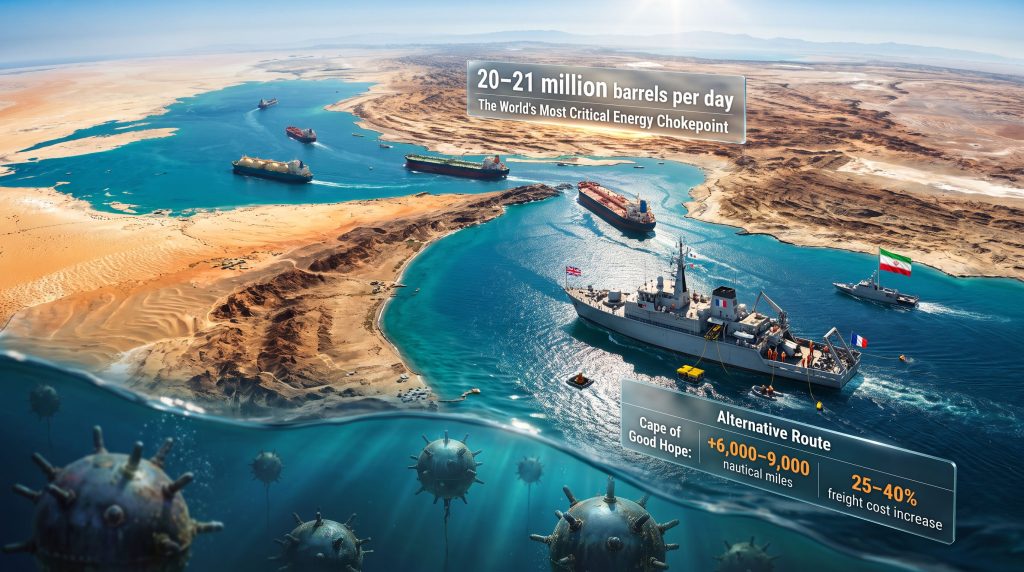
Approximately 20 to 21 million barrels of oil equivalent transit the Strait of Hormuz every single day, a figure that encompasses both crude oil and liquefied natural gas shipments. By most estimates, that represents somewhere between 20 and 25 percent of global petroleum liquids trade and a substantial share of global LNG supply, particularly for buyers in Northeast and South Asia.
The nations most exposed to Strait disruption are not Western economies with diversified supply networks. They are Japan, South Korea, India, and China, all of which depend heavily on Persian Gulf crude and LNG to power industry, electricity generation, and transportation. Japan, for example, has no meaningful domestic hydrocarbon production. South Korea sources the overwhelming majority of its crude from Gulf producers.
India's energy import dependency has grown sharply over the past decade as domestic production has lagged consumption growth. Furthermore, OPEC's market influence over Persian Gulf supply decisions means that any strait disruption interacts directly with broader production policy, compounding the impact on global buyers.
When those flows are interrupted, the impact is not linear — it is exponential. Tanker insurance markets reprice instantly, spot freight rates surge, and sovereign governments begin drawing down strategic petroleum reserves while simultaneously competing for alternative supply. This is the environment that more than five months of military conflict in and around the strait has already begun to create.
Alternative Routes and Why They Cannot Replace the Strait
A common misconception is that alternative routing options provide adequate relief. In practice, the economics and logistics tell a very different story.
| Alternative Route | Additional Transit Distance | Estimated Cost Premium | Key Constraints |
|---|---|---|---|
| Cape of Good Hope (Africa) | +6,000 to 9,000 nautical miles | 25 to 40% freight cost increase | Severe delivery delays for Asian buyers |
| Saudi East-West Pipeline | Not applicable | Partial volume relief only | Hard capacity ceiling near 5 million bpd |
| UAE Fujairah Pipeline | Not applicable | Moderate cost relief | UAE crude only; zero LNG alternative |
The Saudi East-West Pipeline, which connects Abqaiq to Yanbu on the Red Sea, has a throughput ceiling of roughly 5 million barrels per day. Global demand runs more than four times that volume through the strait alone. The UAE's Habshan-Fujairah pipeline provides some relief for Abu Dhabi crude, but again, it carries no LNG and cannot absorb anything close to total strait volumes.
Routing tankers around the Cape of Good Hope adds weeks to voyage times and dramatically increases fuel and crew costs, with the freight cost premium ultimately passed on to end consumers and energy-intensive industries. These geopolitical oil price factors are not temporary inconveniences — sustained strait closure at scale would constitute the most severe supply disruption in the recorded history of global energy markets.
The price implications would dwarf those of the 1973 oil embargo or the 1979 Iranian Revolution shock. Consequently, the pressure on diplomatic channels to resolve the situation is immense.
Iran's Dual Posture: Public Defiance and Private Flexibility
Iran's official position has been consistently unambiguous: demining the Strait of Hormuz is a sovereign Iranian responsibility, and no foreign naval presence will be permitted to participate. That declaration has been repeated through official channels across multiple weeks of the conflict's aftermath.
Yet diplomatic sources speaking on condition of anonymity have described a materially different conversation taking place in private. According to those sources, Tehran has in recent weeks signalled conditional openness to a European-led or multinational demining operation, framing it as a component of broader peace negotiations rather than a standalone concession.
The divergence between Iran's public declarations and its private diplomatic signals is not a contradiction born of confusion. It is a deliberate negotiating posture, one that preserves domestic political credibility while simultaneously testing whether European and American interlocutors are willing to offer the guarantees Tehran would require before any foreign naval vessels enter its operational sphere.
This is a well-established pattern in Iranian diplomatic behaviour. Public hardline positions create leverage, while private flexibility creates room for deal-making. Neither should be treated as the definitive outcome until formal commitments are made.
Which European Nations Are at the Centre of Demining Discussions?
Reports have identified the United Kingdom and France as the European nations most actively engaged in operational-level planning for a potential mine-clearing mission. Both maintain significant naval mine countermeasures capabilities, including dedicated minehunter vessels, remotely operated underwater vehicles, and trained hydrographic survey teams.
Notably, the UK will lead a Hormuz coalition to reopen the strait following Iran's deployment of deadly sea mines. No formal mandate has been publicly confirmed, however the operational planning discussions themselves are significant. They suggest that the diplomatic conversation has moved beyond the conceptual stage and into the realm of practical logistics, even if the political preconditions remain unresolved.
What Iran Would Reportedly Require Before Approving Foreign Operations
Based on diplomatic source reporting, Iran's conditional openness — including Iran allowing Europe to clear mines in the Strait of Hormuz — carries a set of firm prerequisites:
- Formal security guarantees covering all European naval assets operating within the operational zone
- A ceasefire framework demonstrably stable enough to eliminate the risk of resumed hostilities during active demining
- Islamic Revolutionary Guard Corps approval of all operational parameters, including geographic scope and vessel identification protocols
- Clearly defined limits on the geographic range of foreign mine-clearing activity, preventing mission creep into waters Iran considers exclusively sovereign
The IRGC dimension is particularly consequential. The Revolutionary Guard maintains operational authority over Iranian naval activities throughout the Persian Gulf and the strait. Any agreement reached at the diplomatic level that does not carry IRGC endorsement would be operationally meaningless, making internal Iranian military politics as important a variable as the diplomatic negotiations themselves.
How Maritime Demining Actually Works at Scale
Public understanding of mine clearance operations tends to be shaped by wartime imagery rather than the precise, methodical reality of modern naval mine countermeasures. The actual process is far more technically demanding than commonly understood.
The Four-Phase Operational Framework
A Strait-scale demining operation would progress through distinct phases, each with its own timeline and dependencies:
| Operational Phase | Estimated Duration | Key Dependencies |
|---|---|---|
| Hydrographic survey and mine mapping | 2 to 6 weeks | Ceasefire stability, Iranian cooperation on access |
| Controlled neutralisation of confirmed mines | 4 to 12 weeks | Naval asset availability, seasonal weather conditions |
| Verification sweeps and safety certification | 2 to 4 weeks | Agreement on third-party observer framework |
| Insurance industry re-rating of transit risk | Post-certification | Lloyd's of London and P&I club risk assessments |
Modern navies deploy a layered toolkit for mine countermeasures. Influence minesweepers generate electromagnetic and acoustic signatures to trigger mines at a safe distance. Minehunter vessels use high-resolution sonar to identify mine-like contacts on the seabed. Remotely operated vehicles (ROVs) then approach detected objects for visual confirmation and neutralisation, typically by placing explosive charges and retreating to a safe distance before detonation.
The specific challenge in the Strait of Hormuz relates to mine variety. Reports suggest both moored contact mines (anchored at a set depth, detonating on direct contact) and potentially more sophisticated pressure-activated or influence-triggered variants have been deployed. For a detailed visual breakdown of how minesweeping works in the strait, Al Jazeera has published a comprehensive guide covering the technical process in depth.
The latter mine variants respond to changes in water pressure, magnetic field, or acoustic signature generated by passing vessels, making them significantly harder to detect and neutralise safely. Their precise locations and total quantities have not been independently verified.
Why Third-Party Verification Changes Everything for Shipping
The shipping and insurance industries will not normalise operations on the basis of political announcements alone. Lloyd's of London and the Protection and Indemnity (P&I) clubs that underwrite the overwhelming majority of global cargo insurance operate on risk assessments grounded in verified data, not diplomatic statements.
War risk surcharges applied to Hormuz-transiting voyages throughout the conflict period will only be lifted when independent technical observers certify that mine clearance operations have been completed to an accepted standard. This certification requirement is non-negotiable for institutional underwriters, and it provides a strong structural argument for European involvement: European naval participation brings with it the credibility that inspires third-party certification confidence in a way that unilateral Iranian demining simply cannot.
The Geopolitical Logic Behind Iran's Conditional Openness
Understanding why Tehran would consider European involvement requires looking beyond the immediate operational question and into the broader diplomatic architecture being constructed around the US-Iran relationship.
European powers occupy a unique diplomatic position in this context. They are not parties to the military conflict, they have maintained functioning diplomatic channels with Tehran throughout the nuclear negotiation era, and they carry sufficient institutional credibility to serve as genuine guarantors of operational agreements.
For Iran, accepting European demining assistance is not a concession to a hostile party — it is a strategic delegation to a neutral one, structured in a way that allows Tehran to extract diplomatic value from the arrangement while maintaining plausible deniability on any perception of yielding to American pressure.
The broader US-Iran negotiating architecture amplifies this logic. Demining the strait serves Iranian economic interests directly, as a functioning strait restores Iranian oil export capacity. In turn, this dynamic is already feeding into the oil price rally that markets have been tracking as diplomatic signals shift. Framing European involvement as a confidence-building measure within broader peace negotiations allows Iran to characterise the decision as a diplomatic achievement rather than a capitulation.
The next major ASX story will hit our subscribers first
Scenario Pathways for the Coming Months
The situation remains genuinely fluid. Three distinct scenarios are now being tracked by energy markets, governments, and the insurance industry simultaneously.
Scenario A: Iran formally endorses a European-led demining framework. This would represent the most constructive outcome. It unlocks third-party certification, accelerates insurance normalisation, and provides a confidence boost to broader peace negotiations. Oil and LNG spot markets would likely price in reduced risk premium meaningfully within days of a credible announcement.
Scenario B: Iran proceeds with unilateral demining while permitting international observers. A middle-ground outcome that partially satisfies the certification requirements of the insurance industry but maintains Iranian sovereignty optics. Progress would be slower, insurance repricing more cautious, and shipping resumption more incremental.
Scenario C: Negotiations collapse and the strait remains contested. This is the most severe scenario for global energy markets, and represents a significant oil market disruption risk that commodity traders are currently pricing as a non-trivial tail event. Sustained closure would trigger emergency reserve releases, accelerate alternative routing costs, and introduce structural inflation into energy-intensive manufacturing across Asia.
Markets, insurers, and governments are consequently watching a specific set of lead indicators: ceasefire duration and violation frequency, IRGC public statements on foreign naval access, and any movement toward formalised Iranian engagement with European diplomatic delegations at the foreign minister level.
Key Analytical Takeaways
- Iran allowing Europe to clear mines in the Strait of Hormuz remains unconfirmed and subject to rapid reversal given the multi-track nature of the diplomatic process
- IRGC internal politics represent an underappreciated variable that could override diplomatic-level agreements at the operational stage
- The insurance industry's certification requirements create a structural incentive for European involvement that goes beyond political optics
- Alternative routing options are economically viable only at moderate disruption levels; full strait closure eliminates all viable substitutes at scale
- The gap between Iran's public and private positions is best understood as a negotiating instrument, not as institutional incoherence
- Any operational timeline for full demining and insurance normalisation spans a minimum of three to five months from the commencement of active mine-clearing work, even under ideal conditions
This article contains forward-looking analysis and scenario projections based on anonymous diplomatic source reporting and publicly available data as of early August 2026. Geopolitical situations of this nature are subject to rapid and material change. Nothing in this article constitutes financial or investment advice.
Want to Capitalise on the Commodity Market Shifts Driven by Global Energy Disruptions?
Discovery Alert's proprietary Discovery IQ model delivers real-time alerts on significant ASX mineral discoveries, instantly translating complex market signals — including those triggered by geopolitical energy disruptions like the Strait of Hormuz crisis — into actionable investment opportunities; explore historic examples of exceptional discovery returns and begin your 14-day free trial to position yourself ahead of the market.