August 5, 2026
The Hidden Mechanics Behind Aluminium's Most Volatile Price Swings
When commodity markets flash sudden price signals, the instinct of most participants is to look at demand. But aluminium tells a different story. The metal's price architecture is overwhelmingly shaped by supply-side fragility, and nowhere is that fragility more concentrated than at the intersection of energy dependency, geographic exposure, and production concentration. Understanding why LME aluminium prices amid China flooding concerns move the way they do requires pulling apart a supply chain that spans hydropower reservoirs in southwest China, alumina refineries in Western Australia, and smelter operating rooms across the Middle East.
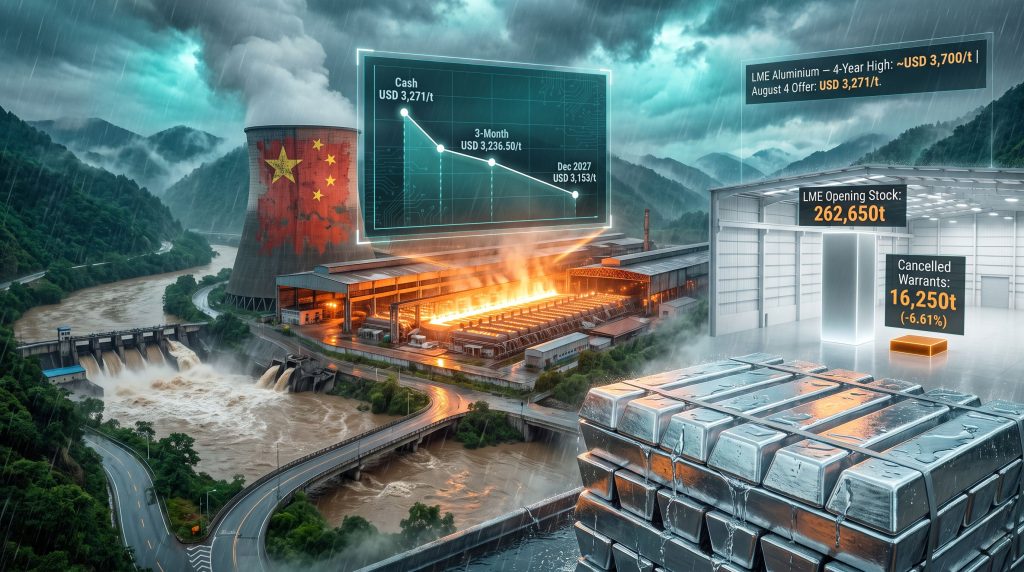
The events of early August 2026 offer a masterclass in how these forces compound. On August 4, LME aluminium cash offer prices climbed to USD 3,271 per tonne, a 0.34% single-session gain that extended a broader recovery from mid-year lows. However, the story behind that number involves far more than a single weather event.
When big ASX news breaks, our subscribers know first
Why Hydropower Makes Aluminium Uniquely Vulnerable to Weather Events
Aluminium smelting is one of the most electricity-intensive industrial processes on earth. Producing one tonne of primary aluminium consumes roughly 13,000 to 15,000 kilowatt-hours of electricity, making access to cheap, reliable power the single most important input cost in the entire value chain. This is precisely why China's Sichuan province became such a strategically significant smelting location: its extensive hydroelectric infrastructure offered some of the lowest electricity costs in the country.
That same advantage, however, becomes a structural liability when water systems behave unpredictably. Flooding creates a compounding supply shock that conventional industrial disruptions do not replicate, because it strikes three critical systems at once:
- Power generation: Excess water flows can damage turbines, require emergency shutdowns of hydroelectric stations, or disrupt grid stability across the regional network.
- Smelter operations: Direct flooding of facility infrastructure, combined with power instability, can force partial or full curtailments at short notice.
- Inland logistics: Road and rail damage impairs the movement of aluminium ingots and billets from inland production centres to coastal ports, creating inventory backlogs.
This triple-impact dynamic is what makes flood-related supply disruptions particularly powerful price catalysts. Unlike a labour strike or a planned maintenance shutdown, a flood-driven curtailment can materially tighten near-term physical availability before the broader market has time to adjust positioning.
One of the lesser-understood dynamics in aluminium market analysis is that Sichuan's hydropower-dependent smelters are vulnerable to both drought and flood conditions. During summer droughts, reservoir levels fall and power output declines. During severe rainfall events, flooding disrupts infrastructure and operations. This means the province represents a year-round weather-sensitive supply risk, not just a seasonal one.
Mapping the 2026 LME Aluminium Price Trajectory
To appreciate the context of early August's price action, it helps to trace the full arc of aluminium prices across 2026. The metal's journey from a four-year high to a mid-year correction and back toward recovery encapsulates the push-and-pull between supply concerns and demand headwinds. Furthermore, LME aluminium prices amid China flooding concerns have repeatedly demonstrated how quickly sentiment can shift when hydropower-dependent supply nodes come under pressure.
| Period | LME Price Level | Primary Driver |
|---|---|---|
| Early June 2026 | ~USD 3,700/tonne (4-year high) | Supply disruption fears, tariff risk |
| 1 July 2026 | ~USD 3,060/tonne | Export normalisation, demand softness |
| Late July 2026 | ~USD 3,170/tonne | Mixed signals, inventory drawdowns |
| 4 August 2026 | USD 3,271/tonne (cash offer) | Flooding concerns, falling LME stocks |
The mid-year correction from approximately USD 3,700/tonne to USD 3,060/tonne reflected the moderating influence of China's record export volumes, which effectively rebalanced overseas physical markets faster than many traders anticipated. The partial recovery through July and into August suggests the market is recalibrating around a new set of supply-side variables, with flooding risk layered on top of structural ex-China curtailments.
The Full Forward Curve: What August 4 Pricing Reveals
The shape of the LME forward curve provides a critical lens for understanding how market participants are pricing the duration and severity of current supply disruptions.
| Contract | Bid (USD/t) | Offer (USD/t) | Day-on-Day Change |
|---|---|---|---|
| Cash | 3,270 | 3,271 | +0.34% |
| 3-Month | 3,236 | 3,236.50 | +0.76-0.81% |
| December 2027 | 3,148 | 3,153 | +0.48% |
| Asian Reference Price | 3,223 | N/A | N/A |
| LME Alumina (Platts) | N/A | 343.10 | N/A |
A key structural observation here is that cash prices are trading above three-month and December 2027 prices. This condition, known as backwardation, is a classic signal of near-term physical tightness. When immediate delivery commands a premium over forward delivery, it indicates that buyers are willing to pay more to secure metal now rather than wait, typically because warehouse stocks are falling and spot availability is constrained.
Importantly, the fact that December 2027 prices remain well below spot levels suggests the market does not interpret current disruptions as structurally permanent. The backwardation structure is pricing in a temporary supply squeeze, not a fundamental rewiring of long-term aluminium supply capacity. For a broader view of how aluminium tariff impacts are shaping the wider pricing environment, it is worth considering these trade-policy pressures alongside the weather-related supply signals.
LME Inventory Data: Decoding the Warehouse Signals
Physical inventory movements on the LME provide some of the most reliable real-time signals of genuine supply tightness, as opposed to sentiment-driven price speculation.
On August 4, 2026, LME aluminium warehouse data confirmed broad-based inventory erosion:
- Opening stock: Declined to 262,650 tonnes from 264,400 tonnes, a 0.66% fall
- Live warrants: Slipped to 244,650 tonnes, down 0.24% day-on-day
- Cancelled warrants: Dropped sharply to 16,250 tonnes, a 6.61% single-session decline
The cancelled warrants figure deserves particular attention. In LME market mechanics, a cancelled warrant represents aluminium that a warehouse holder has formally designated for physical removal from exchange-registered storage. Typically, a rising cancelled warrant count signals strong physical demand pulling metal out of the exchange system.
The sharp 6.61% drop in cancelled warrants on August 4, occurring simultaneously with overall inventory declines, reflects a nuanced and often misunderstood dynamic: physical removal commitments are easing even as total stocks continue to fall, pointing to a market where inventory tightening is being driven by supply constraints rather than a surge in physical off-take demand. Complementing this picture, aluminium stocks held at major Japanese port facilities declined 7.8% month-on-month, confirming that physical tightness is not isolated to LME-registered warehouses but is visible across key regional storage infrastructure in Asia.
China's Output Paradox: Record Production Meets Localised Vulnerability
One of the more analytically challenging aspects of the current market is reconciling China's macro-level production dominance with its localised smelter vulnerability.
At the national level, the data is unambiguous. China's primary aluminium output reached 3.98 million tonnes in June 2026, representing a 4.7% year-on-year increase. Unwrought aluminium and related product exports hit a record 711,000 tonnes in the same period, underscoring the sheer scale of China's outbound supply capacity.
Yet this national-level strength masks a critical geographic concentration risk. China's aluminium industry has been progressively relocating smelting capacity toward hydropower-rich provinces like Sichuan and Yunnan as part of a broader push to decarbonise energy-intensive industries. This shift has improved the carbon profile of Chinese aluminium production but has simultaneously concentrated supply risk in regions where weather variability, particularly rainfall extremes, can translate rapidly into output disruptions. In addition, the China steel demand outlook provides useful context for understanding how broader industrial demand trends in the region influence metals pricing across the board.
The aluminium industry's shift toward hydropower-dependent production in southwest China is, in effect, a trade-off between carbon credentials and weather resilience. The cleaner the energy source, the more vulnerable the supply chain becomes to hydrological variability.
Adding complexity to this picture, China's manufacturing PMI unexpectedly contracted in July 2026, raising questions about whether domestic consumption can absorb continued production growth. This demand softness provides a natural moderating force on prices, counterbalancing the supply-side tightening signals.
The next major ASX story will hit our subscribers first
Ex-China Supply Pressures: The Structural Floor Beneath LME Prices
While flooding-related concerns in Sichuan command attention as an immediate catalyst, the structural support beneath LME aluminium prices amid China flooding concerns is being built by a set of ex-China supply pressures that are largely independent of Chinese weather patterns.
Outside China, primary aluminium production fell 6.7% year-on-year in July 2026, driven in part by operating rate reductions across several Middle Eastern smelter facilities. At the global level, primary aluminium output declined 1.5% year-on-year in June 2026, confirming that production weakness outside China is broad-based rather than isolated.
Layered on top of these smelter-level curtailments is a significant upstream constraint in the form of Alcoa alumina disruption following operational issues at its Pinjarra refinery in Western Australia. Consequently, Alcoa reduced its full-year alumina output target by 200,000 to 300,000 tonnes, setting a revised guidance range of 9.5 to 9.6 million tonnes.
This matters because alumina is the direct precursor to primary aluminium. Every tonne of aluminium produced requires approximately 1.9 to 2.0 tonnes of alumina as feedstock. A reduction of 200,000 to 300,000 tonnes in alumina supply therefore has the potential to constrain primary aluminium smelting capacity by roughly 100,000 to 160,000 tonnes, depending on where in the supply chain the shortfall is absorbed. The upstream tightness is already registering in pricing, with the LME alumina Platts price of USD 343.10 per tonne as of August 4 reflecting a raw material market adjusting to reduced refinery output.
| Disruption Event | Direct Impact | Secondary Market Effect |
|---|---|---|
| Sichuan flooding (China) | Smelter and power curtailment risk | Near-term LME price support |
| Middle East smelter cuts | Ex-China output reduction | Structural supply floor |
| Alcoa Pinjarra outage | Reduced alumina supply | Upstream cost pressure on smelters |
| Falling LME inventories | Physical tightness signal | Cash price premium vs. forward curve |
Scenario Analysis: Three Price Pathways Through Q3 2026
Given the multi-layered nature of current supply pressures, market participants need to stress-test outcomes across a range of scenarios rather than anchoring to a single price forecast. Major aluminium producers and traders alike are closely monitoring these intersecting risks as the second half of 2026 unfolds.
Scenario 1: Flooding escalates and disrupts major smelter clusters
Should heavy rainfall extend across multiple hydropower-dependent smelting locations in Sichuan and neighbouring Yunnan province, the combined power and production curtailments could remove significant tonnage from near-term supply. In this environment, LME cash prices could test the USD 3,400 to USD 3,500/tonne range, inventory drawdowns would accelerate, and the backwardation structure of the forward curve would steepen further.
Scenario 2: Flooding proves localised and China's exports compensate
If the disruption remains geographically contained and short-lived, China's record export capacity would likely rebalance overseas physical markets within weeks. Under this scenario, LME prices would probably consolidate in the USD 3,150 to USD 3,300/tonne range as supply concerns moderate, with market attention shifting back toward Chinese manufacturing activity and global demand signals.
Scenario 3: Compounding multi-vector supply shocks
The most significant risk scenario involves simultaneous pressure from Middle Eastern curtailments, reduced alumina availability following the Pinjarra disruption, and sustained Chinese flooding. This combination would create a supply shock that no single geographic rebalancing mechanism could quickly offset, potentially sustaining elevated LME prices through Q3 and into Q4 2026. For context on how US aluminium tariffs could amplify this scenario, trade-policy constraints on non-Chinese supply remain an important background variable.
Frequently Asked Questions: LME Aluminium and China Flooding
What makes Sichuan province so critical to global aluminium supply?
Sichuan hosts a large concentration of aluminium smelters that rely on hydroelectric power rather than coal-fired generation. This makes the province's output both cost-competitive and environmentally preferable, but it also makes production highly sensitive to water availability. Both drought conditions and flood events can curtail output, meaning the province represents a persistent, year-round weather-sensitive supply variable for global aluminium markets.
Why did LME aluminium reach a four-year high in early June 2026?
The approximately USD 3,700/tonne peak in early June reflected a convergence of tariff-related supply disruption fears, ex-China production curtailments, and tightening LME inventories. The subsequent correction toward USD 3,060/tonne by July 1 was driven by China's record export volumes effectively rebalancing overseas markets faster than the price implied, combined with softening demand indicators from Chinese manufacturing data. For further detail on this rally, live aluminium price data provides a useful reference for tracking these movements in real time.
How does Alcoa's reduced alumina guidance affect LME aluminium prices?
Alumina is the essential feedstock for primary aluminium smelting. Alcoa's decision to lower its 2026 alumina production guidance to 9.5 to 9.6 million tonnes following disruptions at its Pinjarra facility in Western Australia reduces the raw material pool available to smelters globally. This creates upstream cost pressure that flows through to primary aluminium production costs, providing a structural support layer beneath LME prices independent of any demand-side signals.
What do falling LME cancelled warrants indicate about physical demand?
Cancelled warrants represent aluminium formally earmarked for physical removal from LME-registered warehouses. The sharp 6.61% decline in cancelled warrants recorded on August 4 suggests that immediate physical delivery commitments have reduced even as overall inventory levels continue to fall. This combination points to supply-side tightening as the primary driver of inventory erosion, rather than a demand-led pull of metal out of the exchange system. Furthermore, analysis of aluminium market dynamics through 2026 highlights how these structural tightening signals are being interpreted by institutional traders.
Key Takeaways for Market Participants
The August 2026 environment for LME aluminium prices amid China flooding concerns crystallises a set of dynamics that reward multi-framework analysis over single-factor thinking:
- Flooding in Sichuan acts as an immediate price catalyst by simultaneously threatening hydropower generation, smelter operations, and inland logistics networks.
- Ex-China production declines of 6.7% year-on-year in July 2026 and Alcoa's revised alumina guidance of 9.5 to 9.6 million tonnes provide a structural supply floor that exists independently of Chinese weather events.
- China's record exports of 711,000 tonnes and its continued output growth create a pressure-relief valve that can moderate the scale and duration of flood-driven price spikes.
- LME inventory declines across opening stocks, live warrants, and cancelled warrants confirm that physical tightening is real and not purely a sentiment-driven phenomenon.
- The forward curve's backwardation structure signals that the market interprets current disruptions as temporary, with December 2027 prices remaining materially below spot levels.
The current price environment is best understood as a tension between genuine near-term supply compression and China's substantial export capacity. Neither force is dominant enough to set a clear directional trend in isolation, which is precisely why scenario-based thinking matters more than point forecasts for anyone navigating aluminium exposure through the second half of 2026.
This article contains forward-looking scenarios and price trajectory analysis based on market data available as of early August 2026. Commodity prices are inherently volatile and subject to rapid change. Nothing in this article constitutes financial or investment advice. Readers should conduct independent research and consult qualified advisors before making any investment or procurement decisions based on commodity price expectations.
Want to Capitalise on the Next Major Mineral Discovery Before the Market Moves?
Discovery Alert's proprietary Discovery IQ model delivers real-time alerts on significant ASX mineral discoveries, transforming complex geological and market data into actionable investment insights for traders and investors at every experience level — start your 14-day free trial today and see why major discoveries have historically generated extraordinary returns.