June 12, 2026
The World's Most Exposed Commodity Bottleneck
Global commodity markets contain a small number of infrastructure nodes so strategically concentrated that a single operational disruption can reverberate across international supply chains within hours. These chokepoints rarely attract attention until they become flashpoints, at which point the structural vulnerabilities that have always existed suddenly become visible to everyone from spot traders to steel mill procurement managers. The BHP workers strike at Port Hedland iron ore export hub has placed one of the most consequential export terminals in the world under a spotlight it cannot easily escape.
Understanding why this matters requires moving beyond the immediate dispute and examining the layered dynamics of iron ore logistics, enterprise bargaining mechanics, global steel supply chain dependencies, and the broader wage pressures reshaping Australia's resource sector workforce.
When big ASX news breaks, our subscribers know first
Why Port Hedland Is the Nerve Centre of Global Iron Ore Trade
The Scale of Operations at the World's Largest Bulk Export Terminal
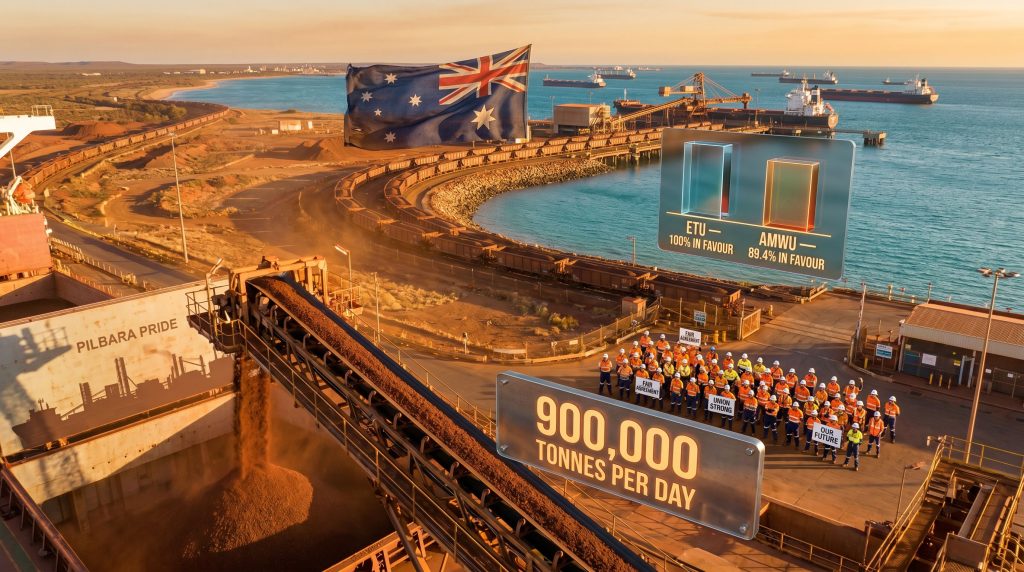
Port Hedland occupies a position in global commodity infrastructure that has no real equivalent in any other bulk mineral export system. The facility handles an extraordinary concentration of iron ore throughput, processing in the vicinity of 900,000 tonnes per day, making it the largest bulk iron ore export terminal on the planet and the dominant logistics gateway for BHP's entire Western Australian iron ore business.
To contextualise that figure: the daily throughput volume of Port Hedland alone exceeds the total annual iron ore production of most mid-tier mining nations. At current prevailing spot prices, the value of ore flowing through the facility on a single average trading day is measured in hundreds of millions of dollars. Furthermore, this concentration of commodity value at a single geographic point represents an unusually acute form of supply chain risk that neither markets nor major steel producers can fully hedge against.
All of BHP's Western Australian iron ore exports are routed through this facility. There is no parallel pathway, no backup terminal capable of absorbing meaningful diversion volumes in the short term. This operational structure creates what supply chain analysts would classify as a critical single-point-of-failure, where disruption at the terminal does not merely affect export volumes but creates upstream congestion pressure across the entire Pilbara production network.
How the Pilbara Network Feeds into Port Hedland
The port functions as the downstream terminus for a dense rail and mining network extending deep into the Pilbara region. Iron ore extracted from BHP's Pilbara mine sites travels via dedicated heavy haul rail corridors directly to Port Hedland, where it is stockpiled, blended, and loaded onto bulk carriers for export.
The customers at the end of this supply chain are primarily Asian steel mills, with Chinese integrated steelmakers representing by far the dominant demand source for Pilbara-origin ore. Consequently, Chinese steel producers have historically built their procurement strategies around a reliable, high-volume supply of Australian iron ore, meaning any disruption to Port Hedland's operational continuity has implications that extend well beyond BHP's quarterly revenue figures.
A 24-hour work stoppage at Port Hedland would theoretically remove close to 900,000 tonnes of iron ore from global seaborne supply in a single day, enough to create measurable tightness in spot market availability, particularly for buyers with lean port inventory positions.
The interdependency between the rail network, mine sites, and port infrastructure means disruptions do not stay contained at the terminal. When ore cannot move off the stockpiles onto vessels, the entire upstream system begins to back up, with mines facing the choice of either curtailing production or stockpiling ore at inland locations with limited holding capacity. This cascading effect amplifies the market impact of any sustained industrial action well beyond the direct throughput loss at the port itself.
What Triggered the BHP Port Hedland Strike Vote?
Seven Months of Stalled Enterprise Bargaining
The dispute that has now escalated to a formal strike ballot did not emerge suddenly. Workers and their union representatives have been engaged in enterprise bargaining with BHP for a period spanning roughly six to seven months, with workers at Port Hedland voting in favour of strike action after negotiations stalled across two unions offering slightly different characterisations of the timeline.
The Electrical Trades Union described the negotiation period as exceeding six months, while the Australian Manufacturing Workers' Union placed the figure at seven months. Both unions characterised the outcome of those negotiations as fundamentally unsuccessful, with no meaningful progress toward resolution despite extended engagement.
The core substance of the dispute centres on pay parity and conditions for approximately 450 port workers covered under the enterprise bargaining framework. The specific grievance is structurally significant: workers in equivalent roles, with comparable skills and experience, were engaged on divergent individual contracts that created substantial pay inequity within the same operational environment.
This is not simply a dispute about the level of wages. It is a dispute about whether workers performing identical functions under identical conditions should be paid differently based on the individual contract terms under which they were originally engaged. The ETU characterised the resulting pay disparities as wildly divergent, a framing that signals deep workforce frustration with outcomes that cannot be justified by reference to skills, experience, or operational contribution.
The Ballot Results: Near-Unanimous Support Across Two Unions
The formal strike ballot produced results that leave little ambiguity about the depth of workforce sentiment. Both unions conducted separate ballots under the procedural requirements of Australian industrial relations law, and both returned decisive majorities in favour of protected industrial action.
| Union | Participating Members | Support for Strike Action |
|---|---|---|
| Electrical Trades Union (ETU) | Approximately 100 | 100% in favour |
| Australian Manufacturing Workers' Union (AMWU) | More than 100 | 89.4% in favour |
The ETU result is particularly striking. A unanimous vote in a secret ballot involving approximately 100 workers is an extraordinarily strong signal of unified grievance that goes beyond ordinary bargaining posturing. In Australian industrial relations practice, ballot results of this character typically indicate that workers perceive the underlying dispute as a matter of principle rather than a negotiating position subject to incremental compromise.
The AMWU result, at 89.4% in favour, reinforces this reading. In enterprise bargaining contexts, any ballot result above 75% is generally interpreted as a strong mandate. Results approaching 90% indicate that dissatisfaction has moved beyond the core activist membership and penetrated the broader workforce.
The Cost-of-Living Dimension: Why Wage Disputes Hit Differently in 2026
The timing of this dispute intersects with an important macroeconomic backdrop. Australia has experienced sustained inflationary pressure over recent years, and the impact of cost-of-living increases has been particularly pronounced in regional resource communities like the Pilbara, where housing costs, consumer goods prices, and essential services carry significant premiums relative to capital city benchmarks.
The AMWU framed its members' vote explicitly within this context, characterising the action as workers demanding recognition during a period of acute financial pressure on household budgets. This framing is significant because it transforms the dispute from a conventional wage negotiation into something more resonant for public audiences: a story about whether workers in essential export industries are fairly compensated relative to the cost of their lives in the communities where they are required to live.
In enterprise bargaining disputes involving regional workforces, the cost-of-living argument carries particular weight because workers in these locations have limited ability to offset stagnant real wages through lifestyle adjustments that are available to urban workers with more flexible residential and consumption choices.
What Are the Proposed Forms of Industrial Action?
A Graduated Escalation Framework Built for Maximum Leverage
The structure of proposed industrial action is itself analytically revealing. Rather than moving immediately to full work stoppages, the unions have proposed a graduated framework ranging from 30-minute rolling work bans through to full 24-hour shutdowns. This escalation architecture is a deliberate strategic choice with important implications for how the dispute is likely to unfold.
Under Australian industrial relations law, workers who have successfully completed a formal protected action ballot may commence industrial action after providing five days' written notice to the employer. This mandatory notice period creates a structured interval during which renewed negotiations can occur before action actually begins, giving both parties a final opportunity to resolve the dispute without operational disruption.
The proposed escalation framework functions as follows:
- Stage 1: Partial Stoppages (30 minutes to 4 hours) – These are primarily signalling mechanisms designed to demonstrate workforce cohesion and serious intent without immediately triggering full operational disruption. At this level, direct throughput impact is minimal, but the message to BHP's logistics and commercial teams is unambiguous.
- Stage 2: Extended Stoppages (4 to 12 hours) – At this duration, operational impact becomes measurable. Vessel loading schedules begin to compress, buffer stockpile drawdowns accelerate, and shipping counterparties receive notification of potential delays. This stage increases the financial and reputational pressure on BHP to return to the bargaining table with substantive offers.
- Stage 3: Full 24-Hour Shutdowns – Maximum disruption scenario. At this level, the daily throughput loss approaches the full operational capacity of the terminal, placing direct financial pressure on BHP's revenue recognition and creating potential spot market price responses in iron ore futures.
The graduated structure of proposed industrial action is consistent with sophisticated enterprise bargaining strategy rather than reflexive industrial militancy. It preserves union optionality while escalating pressure incrementally, giving BHP clear off-ramps to negotiate a resolution at each stage.
How Is BHP Responding to the Strike Threat?
The Dual-Track Response: Engagement and Contingency in Parallel
BHP's publicly stated position has two components that operate simultaneously, reflecting the company's awareness that the dispute carries both operational and reputational dimensions. BHP's Australia president Geraldine Slattery has not ruled out a Port Hedland shutdown amid the industrial strife, adding further weight to the seriousness of the situation.
On the operational side, BHP confirmed that strong contingency plans are in place to maintain export operations in the event of union-led disruptions. Industry practice in similar circumstances typically involves a combination of:
- Pre-positioning of stockpiled ore at the terminal to buffer against loading delays
- Deployment of supervisory or management personnel to maintain critical port functions during partial stoppages
- Active communication with vessel operators and steel mill customers about potential scheduling adjustments
- Coordination with shipping charterers to manage vessel queuing and berth allocation around anticipated disruption windows
On the negotiating side, BHP characterised its approach as focused on achieving an outcome that maintains industry-leading pay and conditions while supporting safe and productive operations. This framing presents a constructive posture while simultaneously establishing conditions on the outcome, reflecting the company's stated position that it believes its existing pay and conditions framework is already competitive.
The Disputed Narrative: Constructive Engagement vs. Obstructive Conduct
The most significant tension in the public characterisations of this dispute lies between BHP's description of constructive engagement and the ETU's characterisation of BHP's bargaining conduct as obstructive. The ETU's state secretary for Western Australia stated publicly that the union had been attempting to negotiate a resolution for more than six months, but that BHP's conduct had effectively meant there was no meaningful negotiating counterpart at the table.
This direct contradiction between the two parties' accounts of the same bargaining process is itself an important analytical data point. When both parties in an enterprise bargaining dispute offer such diametrically opposed characterisations of the process, it typically indicates a genuine and substantive disagreement about what constitutes adequate bargaining participation, or one or both parties are managing their public narrative for strategic purposes ahead of potential Fair Work Commission intervention.
In either case, the divergence between these narratives reduces the probability of rapid voluntary resolution and increases the likelihood that the dispute will either escalate to actual industrial action or require external facilitation through the Fair Work Commission.
What Are the Broader Market Implications of a Port Hedland Disruption?
Iron Ore Price Mechanics: How Supply Shocks Transmit to Futures Markets
Iron ore price trends are highly sensitive to supply signals from dominant export terminals, and disruptions at Port Hedland transmit to price through multiple channels simultaneously, which is why even the announcement of a strike ballot can influence futures market sentiment.
The transmission mechanism works approximately as follows:
- Strike ballot results become publicly known, signalling credible disruption risk
- Traders with short-dated iron ore exposure begin adjusting positions to account for potential near-term supply tightness
- Steel mills with low port inventory levels begin assessing whether to accelerate procurement ahead of potential supply interruption
- Spot market premiums for prompt-delivery cargoes begin to reflect scarcity risk
- If actual stoppages commence, daily supply removal creates measurable inventory drawdown pressure at destination ports
- Extended disruptions force mills to seek alternative supply from Brazilian or other non-Australian origins, which typically carry higher freight costs and sometimes different ore specifications
Port Hedland's disproportionate share of global seaborne iron ore supply means that even relatively short-duration disruptions can produce non-trivial price responses, particularly in a market environment where Chinese steel mill inventory buffers are already lean.
Quantifying BHP's Revenue Exposure
The financial stakes for BHP in this dispute are substantial. At approximately 900,000 tonnes of daily export capacity and prevailing iron ore spot prices, a single full day of halted exports represents hundreds of millions of dollars in deferred revenue. Even partial stoppages of several hours per day, sustained over a period of weeks, would generate cumulative financial impact that rapidly exceeds the cost of the wage improvements being sought by union members.
This creates an interesting asymmetry in the negotiating calculus: the cost to BHP of sustained industrial action almost certainly exceeds the annualised cost of meeting worker pay parity demands. The complicating factor is the precedent dimension: any settlement reached at Port Hedland that addresses structural pay parity concerns will be visible to the broader Pilbara workforce and may influence enterprise bargaining expectations across BHP's other operational sites.
Downstream Effects on Asian Steel Supply Chains
The China steel and iron ore market is the most directly exposed in the event of a sustained Port Hedland disruption. China's steel industry has historically maintained relatively modest iron ore port inventories relative to its consumption rate, preferring to minimise working capital tied up in raw material stockpiles. This structural characteristic means that supply disruptions at source translate to consumption constraint pressure more rapidly than in markets with higher inventory buffer practices.
Extended disruption at Port Hedland could force Chinese mills to draw down port stocks at an accelerated rate, seek premium-priced spot cargoes from alternative suppliers, or adjust production scheduling to manage ore consumption against depleted inventory. Each of these responses carries cost implications that ultimately affect steel production economics and, by extension, the cost of steel-intensive construction and manufacturing globally.
Brazilian producer Vale represents the most significant alternative supply source in the event of an Australian supply disruption, though Brazilian ore requires substantially longer transit times to reach Chinese ports, meaning substitution is never perfectly seamless.
The next major ASX story will hit our subscribers first
How Does This Dispute Fit Into Australia's Broader Industrial Relations Landscape?
Enterprise Bargaining Cycles as Recurring Flashpoints in the Resources Sector
Australia's resource sector has a well-documented history of periodic industrial action at major export infrastructure facilities. Enterprise agreement cycles, which typically run for three to four years before requiring renegotiation, create recurring windows during which accumulated workforce grievances can surface and escalate to formal dispute processes.
Australia's iron ore leadership in global seaborne supply means that when these disputes occur, the consequences extend far beyond domestic industrial relations. The Fair Work Act framework that governs protected industrial action in Australia establishes specific procedural requirements, including formal balloting processes, before workers can commence protected action.
Pay Parity as a Systemic Issue Beyond a Single Dispute
The specific grievance at the centre of the Port Hedland dispute — the use of divergent individual contracts for workers performing equivalent roles within the same operational environment — represents a broader structural tension in how Australian resource sector employers have managed workforce costs during periods of labour market fluctuation.
During periods of labour scarcity, mining companies have sometimes engaged workers on individually negotiated contracts that reflect prevailing market rates at the time of hire. As market conditions change and new workers join under different contract terms, pay divergence can emerge between workers performing identical functions. Enterprise bargaining agreements that address this structural divergence have the effect of standardising pay outcomes, which workers view as a matter of fairness but which employers sometimes resist.
Recent Australian Resource Sector Industrial Actions: A Comparative View
| Facility | Company | Core Issue | Outcome |
|---|---|---|---|
| Port Hedland (2026) | BHP | Pay parity, individual contract divergence | Unresolved, strike vote passed |
| LNG export facilities (various, 2023) | Multiple operators | Wage growth, conditions | Resolved after extended negotiations and FWC facilitation |
| Coal export terminals (various) | Various | Pay disputes, rostering | Mixed outcomes, some escalated to commission |
Resolution of the Port Hedland dispute on terms that address the structural pay parity issue could establish a precedent that influences enterprise bargaining across other Pilbara operators. The global iron ore tariff impact on market dynamics adds further complexity, making supply reliability from Australia even more strategically significant for downstream buyers navigating an already uncertain trade environment.
Frequently Asked Questions: BHP Port Hedland Strike Action
How long could the Port Hedland strike last?
Industrial action could range from 30-minute partial stoppages to full 24-hour work shutdowns, depending on the escalation path chosen by the ETU and AMWU. Duration ultimately depends on the pace at which BHP and the unions can reach agreement on the pay parity and conditions issues at the core of the dispute.
How many workers are involved in the Port Hedland strike vote?
Approximately 200 or more workers participated in the formal ballots across the two unions, with the broader enterprise bargaining coverage extending to around 450 port workers in total.
Will the BHP strike affect iron ore prices?
Short-duration partial stoppages are unlikely to produce sustained price movements. However, extended or escalating action could create measurable near-term tightness in seaborne iron ore supply and generate upward pressure in futures markets, particularly given Port Hedland's dominant role in global exports.
What is BHP doing to prevent disruption to iron ore shipments?
BHP has confirmed that contingency plans are in place to maintain operations during any union-led disruptions. The specific nature of those arrangements has not been publicly detailed.
When could strike action begin at Port Hedland?
Under Australian industrial relations law, workers must provide five days' written notice before commencing protected industrial action following a successful ballot. This means stoppages could begin within days of formal notification being lodged with BHP.
What is the core demand driving the Port Hedland strike vote?
Workers are primarily seeking pay parity, meaning equal compensation for employees performing equivalent roles with comparable skills and experience who were engaged on divergent individual contracts. Broader improvements to pay and conditions also form part of the unions' bargaining agenda.
Key Takeaways for Market Participants and Industry Observers
The BHP workers strike at Port Hedland iron ore export hub represents a confluence of factors that extends well beyond a standard enterprise bargaining negotiation. Furthermore, the iron ore market tariff risks layered on top of this supply disruption scenario underscore why market participants are watching this dispute with unusual attention. Several dimensions warrant particular attention:
- The dual-union ballot outcome, with the ETU recording unanimous support and the AMWU returning 89.4% in favour, signals deep and broadly held workforce dissatisfaction rather than a campaign driven by a minority activist group
- Port Hedland's status as the world's largest bulk iron ore export terminal, channelling all of BHP's Western Australian exports, means the market consequences of sustained industrial action are disproportionate to the size of the workforce involved
- The graduated escalation structure of proposed action reflects strategic sophistication from the unions, preserving significant leverage while giving BHP multiple opportunities to negotiate a resolution before maximum disruption is applied
- The structural pay parity issue at the heart of the dispute, arising from divergent individual contracts across an equivalent workforce, creates precedent risk that extends beyond Port Hedland to BHP's broader Pilbara operations and potentially to other resource sector operators
- BHP's simultaneous contingency readiness and constructive engagement posture reflects the company's awareness that the reputational, commercial, and supply chain costs of prolonged disruption are substantial
- The cost-of-living context in which this dispute is occurring amplifies worker sensitivity to pay outcomes in ways that make conventional incremental bargaining responses less likely to achieve rapid resolution
This article is intended for informational purposes only and does not constitute financial advice, investment recommendations, or an endorsement of any particular trading position. Iron ore market dynamics and industrial relations outcomes are subject to rapid change. Readers with financial exposure to relevant commodities or equities should conduct independent research and seek qualified professional advice before making investment decisions.
Want to Stay Ahead of ASX Mineral Discoveries That Could Move Markets?
Discovery Alert's proprietary Discovery IQ model delivers real-time alerts on significant ASX mineral discoveries, transforming complex mineral data into actionable insights for both short-term traders and long-term investors — explore the historic returns major discoveries have generated to understand the opportunity, then begin your 14-day free trial at Discovery Alert to position yourself ahead of the broader market.