
July 14, 2026
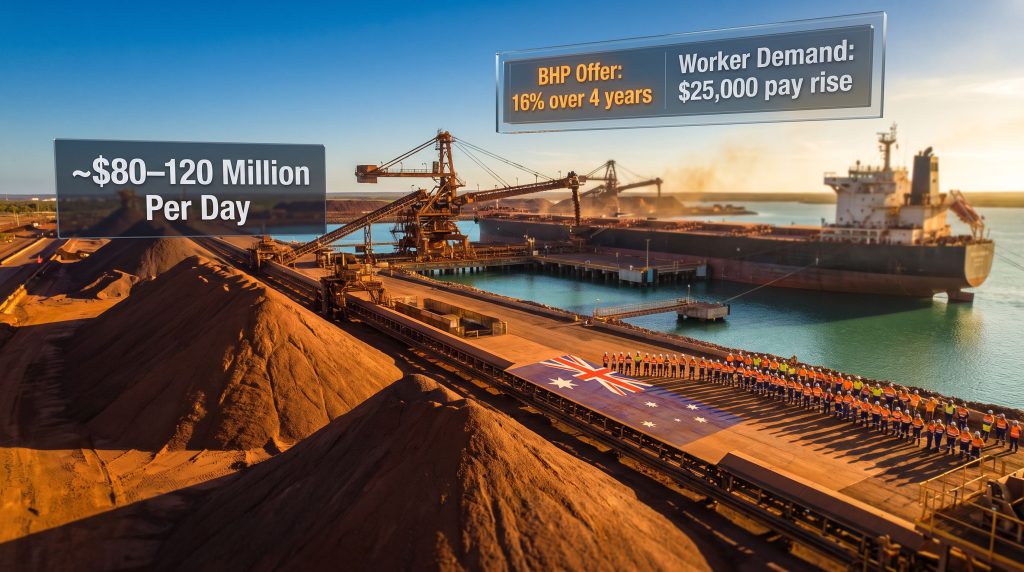
The Infrastructure Behind the Dispute: Why Port Hedland Is Unlike Any Other Bulk Port
Most industrial disputes are contained within the boundaries of a single employer's risk profile. The BHP Port Hedland strike is something fundamentally different. To understand why the stoppage scheduled for July 16, 2026 carries weight far beyond the immediate wage negotiation, it helps to start with the physical and economic architecture of Port Hedland itself.
Port Hedland is not merely Australia's largest iron ore export terminal. It is one of the highest-volume bulk commodity ports on the planet, a purpose-built logistics node through which a significant share of the world's seaborne iron ore supply flows on any given day. The rail networks, stockpile systems, and ship-loading infrastructure that converge at this single location represent decades of capital investment calibrated to run at near-continuous capacity.
When that system slows, even partially, the disruption propagates across shipping schedules, steel mill procurement calendars, and spot market pricing in ways that a revenue-per-hour calculation cannot fully capture. It is within this context that the BHP Port Hedland strike must be assessed, not simply as a labour dispute, but as a stress test of one of the most consequential nodes in the global commodities supply chain.
When big ASX news breaks, our subscribers know first
Six Months of Deadlock: How the Bargaining Process Collapsed
A Timeline of Failed Negotiations
The path to the July 16 work stoppage was neither sudden nor unexpected. Formal enterprise bargaining between BHP and the Combined BHP Ports Union, representing members from the Electrical Trades Union (ETU), the Australian Manufacturing Workers' Union (AMWU), and the Western Mine Workers Alliance, stretched across approximately six to seven months and encompassed at least eight documented formal bargaining sessions.
The final attempt to avert the action took place on July 14, 2026, when a five-hour bargaining session concluded without resolution. Following that meeting, the Combined BHP Ports Union confirmed its intention to proceed with protected industrial action. A subsequent session on July 15 was characterised by BHP as showing positive progress, yet the union coalition chose not to halt the planned stoppage.
This decision reflects how deeply entrenched the structural disagreements had become. Both parties agreed to resume formal negotiations on Tuesday, July 21, regardless of whether the strike proceeded, indicating that neither side viewed the industrial action as a terminal breakdown, but rather as a pressure tactic within a continuing process.
The $25,000 Demand and the $40,000 Gap
At the centre of the dispute sit two interconnected but distinct issues. The headline wage demand is a $25,000 pay rise for workers covered by the proposed four-year enterprise agreement. BHP's formal counter-offer is a 16% increase spread across the four-year term, which the company described as a meaningful and competitive offer given conditions across the sector.
The deeper and arguably more intractable issue is the existence of pay disparities of up to $40,000 between workers performing functionally identical roles under different contract structures. This two-tier employment framework, where two tradespeople working side by side may earn vastly different wages solely because of the contract arrangement under which they were originally hired, is what unions have described as structurally inequitable.
Addressing this is not a matter of adjusting a percentage point. It requires dismantling and rebuilding the employment framework itself, which is why the dispute resists the kind of straightforward numerical compromise that resolves most wage bargaining standoffs.
Unions have framed this dispute not simply as a wage negotiation but as a challenge to the legitimacy of differentiated employment frameworks operating within a single worksite, a structural argument that is considerably harder for management to concede without setting a precedent across its broader Australian operations.
Historical Significance: Breaking Nearly Two Decades of Industrial Peace
The Last Comparable Action: 2008
The BHP Port Hedland strike represents the first major industrial action at the facility since 2008, making it the most significant disruption at the site in approximately 18 years. Industry observers have positioned this as potentially the largest industrial action in Western Australia's mining sector in roughly 25 years, a framing that underscores just how unusual this moment is within the longer arc of Pilbara labour relations.
For context, BHP recently concluded enterprise agreement negotiations at its South Flank and Mining Area C operations without industrial action, making Port Hedland's breakdown a notable outlier within BHP's own industrial relations portfolio. The fact that the multi-union coalition spans three distinct trade groups — the ETU, AMWU, and Western Mine Workers Alliance — signals that the grievance is cross-trade and structural rather than isolated to a single occupational category.
Comparative Industrial Action at Port Hedland
| Metric | Port Hedland 2026 | Previous Comparable Actions |
|---|---|---|
| Last major strike at site | 2008 | N/A |
| Estimated years of industrial peace broken | ~18 years | Various smaller stoppages |
| Sector significance | Largest in WA mining in ~25 years | Typically isolated to individual trades |
| Workforce involved | ~150-200 of ~450 total port workers | Typically smaller cohorts |
| Duration of initial stoppage | 8 hours (2 PM to 10 PM, July 16) | Variable |
| Union parties involved | ETU, AMWU, Western Mine Workers Alliance | Usually single-union |
The cross-trade solidarity evident in this dispute is itself an indicator of something more systemic. When electricians, manufacturing workers, and mine workers align under a single bargaining umbrella, it typically signals that the underlying grievance is perceived as shared across occupational lines rather than specific to one group's conditions.
The Economic Scale: What a Disruption at Port Hedland Actually Costs
Revenue Exposure and Royalty Risk
Under normal operating conditions, BHP routes approximately $80 million worth of iron ore per day through Port Hedland. When modelling for full operational disruption, some estimates extend that daily revenue exposure to as high as $120 million, reflecting the full value of throughput that cannot be processed or shipped.
The Western Australian government's royalty income from Port Hedland operations is estimated at $6.8 to $7 million per day. This fiscal dimension gives the state government a latent but real interest in the speed of resolution, though no formal intervention has been confirmed.
Modelling the Financial Impact Across Scenarios
| Scenario | Duration | Estimated BHP Revenue Exposure | Estimated WA Royalty Exposure |
|---|---|---|---|
| Single 8-hour stoppage | 1 day (partial shift) | ~$40-60 million | ~$3-3.5 million |
| Multi-day escalation | 3-5 days | $240-600 million | $20-35 million |
| Extended dispute | 14+ days | $1.1-1.7 billion+ | $95-98 million+ |
Even an 8-hour stoppage across a single shift cycle creates cascading disruptions to vessel scheduling, stockpile logistics, and rail sequencing that extend the effective financial impact well beyond what the direct revenue figure suggests.
Why Contingency Plans Have Structural Limits
BHP confirmed activation of contingency plans designed to sustain safe operations during the stoppage window. For a single shift cycle running from 2:00 PM to 10:00 PM, the immediate operational damage is containable. However, Port Hedland's operational architecture — which integrates rail delivery from Pilbara mine sites, automated stockpiling systems, and coordinated ship-loading sequences — is not amenable to large-scale substitution by non-specialist personnel.
Maintenance roles in particular represent a category where operational continuity cannot be easily replicated by supervisory or management staff. Furthermore, extended stoppages would progressively erode the buffer that contingency planning creates, moving the disruption from a manageable scheduling issue to a material throughput reduction. Notably, Pilbara haul road operations form a critical upstream link in this supply chain, meaning any compounding disruption across the region could amplify the impact further.
The Workforce Structure and the Contract Equity Problem
Who Is Striking and Why It Matters
Approximately 150 to 200 workers out of a total port workforce of around 450 are participating in the protected industrial action. These workers occupy port operations and maintenance roles, the technical layer of the export terminal responsible for ensuring that ore moves from stockpile to ship on schedule and to specification.
The structural divide underpinning the dispute is worth examining closely. The $40,000 pay gap between workers on different contract arrangements is not a product of differing skill levels or seniority. It reflects the historical accumulation of successive contracting arrangements that emerged from the outsourcing models of the 1990s and 2000s.
Over time, as workforce structures were renegotiated, rolled over, and restructured, differentiated pay scales became embedded within single worksites. Two tradespeople with equivalent qualifications performing equivalent tasks can find themselves on materially different pay rates simply because of the contract vintage under which they were originally engaged. This is a problem that cannot be resolved through a wage percentage adjustment alone, as it requires structural harmonisation of employment frameworks — a process that mining companies have historically resisted because it sets precedent across a broader portfolio of contracting arrangements.
Iron Ore Market Implications: What Traders and Steel Mills Are Watching
Price Sensitivity to Port Hedland Throughput
Port Hedland accounts for a disproportionate share of Australia's seaborne iron ore exports, and iron ore price trends are particularly sensitive to throughput disruptions at this scale. China's steel sector, which absorbs the majority of Pilbara production, uses Port Hedland throughput data as a leading supply indicator.
Short-duration stoppages typically produce modest spot price movements in the range of 1 to 3% in iron ore futures markets, as traders factor in the high probability of rapid resolution and the buffering capacity of stockpiled inventory at destination ports. Extended disruptions lasting more than five trading days, however, historically produce more significant price adjustments as steel mills begin activating secondary procurement channels, typically sourcing from Brazilian suppliers such as Vale, whose freight cost disadvantage to Asian buyers becomes less relevant when Pilbara supply is constrained.
The Broader Commodity Market Context
The dispute arrives at a moment of heightened global commodity market complexity. The China steel and iron ore market is already navigating the cross-currents of demand uncertainty and shifting infrastructure spending cycles, meaning supply-side disruption at a facility of Port Hedland's scale introduces an asymmetric risk premium into forward pricing.
Institutional investors with BHP exposure will be watching the July 17 quarterly results release with particular attention. The simultaneous occurrence of a major industrial action and a scheduled operational results disclosure is an uncommon confluence that places the dispute under immediate market scrutiny. Analysts will assess whether BHP quantifies any operational impact in its disclosures and how management characterises the timeline toward resolution.
In addition, iron ore market risks stemming from global trade tensions further complicate the pricing environment, potentially amplifying the downstream effects of any prolonged stoppage.
The next major ASX story will hit our subscribers first
Escalation Pathways: What Happens After July 16
Three Scenarios for Resolution
Scenario A: Rapid Resolution
- July 21 talks produce a framework agreement bridging the contract equity gap
- BHP improves its offer beyond the 16% four-year baseline
- Industrial action does not escalate beyond the initial 8-hour stoppage
- Operations return to full capacity within 48 to 72 hours of resolution
Scenario B: Protracted Dispute
- July 21 talks fail to produce meaningful movement
- Unions escalate to rolling stoppages or structured work bans
- BHP activates extended contingency operations, reducing throughput progressively
- Iron ore spot price responds to sustained supply uncertainty in Asian markets
Scenario C: Regulatory Intervention
- The Fair Work Commission is called upon to arbitrate or suspend protected action
- A mediated outcome is reached under structured conditions
- Resolution sets formal precedent for contract equity standards across the Pilbara
The involvement of three distinct unions, each representing different trade categories, means any resolution must simultaneously satisfy multiple bargaining units. This structural complexity elevates the risk of prolonged negotiations even when both parties nominally agree on a headline wage number.
The Broader Pilbara Labour Relations Landscape
A Precedent-Setting Dispute in a Stable Region
The Pilbara iron ore region has historically operated under broadly stable enterprise agreement frameworks, with major producers including Rio Tinto and Fortescue maintaining cooperative industrial relations. The BHP Port Hedland strike disrupts this pattern in a way that will be closely studied by labour movements and producers alike.
Unions have framed this action as part of a longer-term strategy to establish a meaningful organising presence across Australia's iron ore regions. A successful campaign at Port Hedland would represent both a tangible wage and conditions victory for participating workers and a strategic foothold for future enterprise agreement negotiations at other Pilbara operations. Consequently, Australia's iron ore dominance in global markets makes the stakes of such precedent-setting particularly significant.
Wage Inflation Pressures Across the Resources Sector
Wage inflation across the Australian resources sector has been building for several years, driven by persistent labour shortages in specialised technical roles, rising cost-of-living pressures in remote and regional areas, and the increased bargaining leverage that tight labour markets provide. The BHP Port Hedland dispute may represent the first formal crystallisation of these accumulated pressures into protected industrial action at a major iron ore export facility.
If the union coalition achieves its core objectives, the resolution terms will effectively establish a new floor for wage expectations across comparable Pilbara operations, influencing not only BHP's other enterprise agreements but also those of Rio Tinto and Fortescue in forthcoming bargaining cycles. According to reporting by the ABC, the action has attracted significant national attention precisely because of these far-reaching implications.
Key Takeaways for Investors and Industry Observers
The BHP Port Hedland strike is a multi-dimensional event that extends well beyond a single shift's lost production. For investors, analysts, and industry observers, the following dimensions warrant close attention:
- Historical rarity: The first major industrial action at the facility since 2008, breaking nearly two decades of Pilbara industrial peace
- Structural complexity: The dispute centres on contract equity, not simply wage percentages, making resolution more architecturally complex than a standard enterprise bargaining outcome
- Financial exposure: Daily revenue at risk ranges from $80 million to $120 million for BHP, with the WA government facing $6.8 to $7 million in daily royalty exposure
- Market sensitivity: China's steel sector monitors Port Hedland throughput as a leading indicator; extended disruption could trigger secondary procurement activity and spot price adjustments
- Precedent implications: Resolution terms will establish a benchmark for labour negotiations across the broader Pilbara region
- Quarterly results timing: The simultaneous occurrence of the strike and BHP's scheduled July 17 quarterly results places the dispute under immediate institutional investor scrutiny
- Multi-union solidarity: The cross-trade alliance of ETU, AMWU, and Western Mine Workers Alliance signals that the grievance transcends occupational boundaries, complicating resolution dynamics
Furthermore, analysis from The West Australian highlights that union members remain defiant even as BHP has sought intervention from the Fair Work Commission, suggesting that the path to resolution remains genuinely uncertain.
For ongoing coverage of Australian mining labour relations and iron ore market developments, Mining.com provides continuous reporting on the BHP Port Hedland strike and related resources sector news.
Want to Stay Ahead of Major Shifts in the Australian Resources Sector?
Discovery Alert's proprietary Discovery IQ model scans ASX announcements in real time, delivering actionable alerts on significant mineral discoveries the moment they are made — explore historic discoveries and the returns they generated to understand what early positioning can mean, then begin your 14-day free trial at Discovery Alert to ensure supply chain disruptions and market-moving events never catch your portfolio off guard.