July 31, 2026
When Labour Meets Logistics: The Systemic Risks Behind the BHP Port Hedland Strike
Global commodity markets are built on assumptions of continuity. Iron ore vessels depart on schedule, steelmakers receive their feedstock, and the industrial machine keeps turning. Yet beneath this apparent reliability sits a network of human agreements, wage structures, and workforce relationships that, when they fracture, expose just how fragile the entire system can be. The BHP Port Hedland strike of 2026 is precisely this kind of fracture point, one that reaches far beyond a single payroll dispute and into the mechanics of global steel supply.
Understanding why this matters requires stepping back from the immediate headlines and examining the architecture of dependence that has grown up around one specific patch of Western Australian coastline.
When big ASX news breaks, our subscribers know first
Port Hedland: The Artery That Cannot Be Blocked
Port Hedland holds a distinction that few industrial facilities anywhere in the world can claim. It is the single largest bulk export terminal on Earth by annual throughput tonnage, processing hundreds of millions of tonnes of iron ore each year and dispatching them primarily toward Chinese and East Asian steel mills. For context, China's steel industry, which produces more than half of the world's total steel output, is structurally dependent on Pilbara iron ore to feed its blast furnaces and electric arc operations.
This concentration of export capacity in one geographic location creates what risk analysts call a single-point-of-failure dynamic. When operations run smoothly, the efficiency gains are enormous. When they do not, however, the consequences radiate outward with surprising speed.
BHP's iron ore strategy at Port Hedland involves multiple berths capable of loading Capesize vessels, the largest dry bulk carriers in commercial operation, at rates that can exceed 10,000 tonnes per hour per berth under optimal conditions. Any sustained reduction in loading rates, whether through mechanical failure, weather events, or industrial action, creates a ripple effect across vessel scheduling, charter rates, and ultimately the spot price of iron ore on the Singapore Exchange and the Dalian Commodity Exchange.
Why Capesize Freight Markets Respond Instantly
One aspect of port disruptions that is rarely explained to non-specialist observers is how quickly freight markets react to throughput signals. Capesize vessels, typically carrying 170,000 to 210,000 deadweight tonnes of iron ore per voyage, are scheduled months in advance under time-charter or voyage-charter arrangements. When a loading port experiences delays, vessels begin queuing at anchor, burning fuel and accruing off-hire costs.
Charter rates tighten as available tonnage is absorbed into extended voyages, creating a secondary price signal in freight markets that can itself influence steel production economics in China. This is why even a short-duration BHP Port Hedland strike carries market significance that appears disproportionate to its immediate operational scale.
Unpacking the 2026 Dispute: More Than a Pay Argument
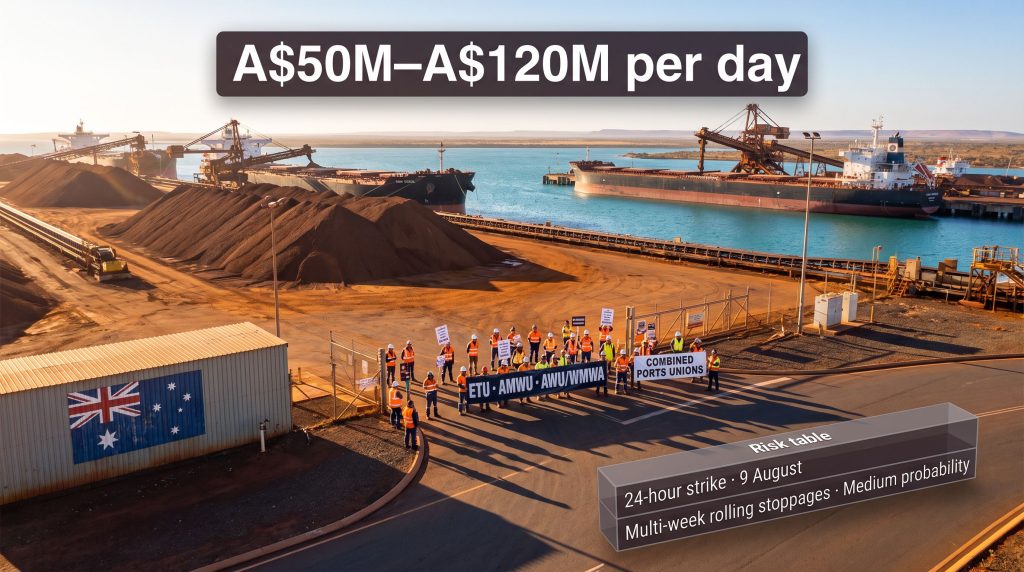
The workforce grievances driving the current industrial action are layered and should not be reduced to a simple wage demand narrative. While pay increases form part of the discussion, workers represented by the Combined Ports Unions coalition — comprising the Electrical Trades Union (ETU), the Australian Manufacturing Workers' Union (AMWU), and the Australian Workers' Union / Workforce Management Workers' Association (AWU/WMWA) — have raised concerns spanning several distinct categories.
Key worker grievances include:
- Real wage erosion driven by sustained inflation during 2023 to 2025, which compressed purchasing power even as nominal wages remained relatively static under existing enterprise agreements
- Roster intensification, a practice in which FIFO (fly-in, fly-out) workers are required to perform the same or greater workloads within compressed shift patterns, effectively increasing productivity demands without commensurate compensation
- Contract transparency, particularly around the terms under which labour hire and contracting arrangements operate alongside direct BHP employment, creating what unions describe as a two-tier workforce structure
- Long-term employment security, reflecting broader anxiety about automation investment at major Pilbara operations, where autonomous haulage systems and remote operating centres have progressively reduced headcount requirements over the past decade
The combination of these issues explains why the Fair Work Commission (FWC) mediation process, which has been active for several months, has failed to produce an agreed outcome. These are not disputes that yield easily to split-the-difference wage negotiations.
A Timeline of Escalating Industrial Action
| Date | Event |
|---|---|
| June 2026 | Workers vote to authorise protected industrial action |
| 16 July 2026 | First stoppage, an 8-hour work halt at the Port Hedland terminal |
| 31 July 2026 | Formal notification to BHP of further planned strike action |
| 9 August 2026 | 24-hour strike lodged pending outcome of negotiations |
The progression from an initial eight-hour stoppage to a full 24-hour notice within approximately three weeks reflects a pattern that industrial relations practitioners recognise as escalating pressure sequencing. Unions typically begin with short-duration actions to demonstrate resolve and test contingency responses, then escalate duration as leverage accumulates. The fact that BHP's contingency arrangements were sufficiently robust to maintain partial loading during the July stoppage likely emboldened union negotiators to push toward longer actions.
The Financial Architecture of Disruption
Estimating Revenue Exposure Per Stoppage Day
Quantifying the financial impact of the BHP Port Hedland strike requires careful framing. Industry estimates and media reporting place potential revenue exposure in the range of A$50 million to A$120 million per day of full operational curtailment. This wide band reflects genuine uncertainty across several variables:
- The degree to which BHP's contingency workforce can sustain partial loading operations during a stoppage
- Whether vessels in queue can be redirected to alternative berths or must remain at anchor
- The prevailing iron ore spot price at the time of the disruption, which directly determines per-tonne revenue loss
- The duration of any throughput deficit, since some cargo can be deferred rather than lost entirely
During the initial 16 July stoppage, BHP confirmed that vessels continued loading and that operations were maintained at a reduced but functional level. This outcome suggests the company's contingency planning is sophisticated and reflects lessons learned from previous industrial disputes at resource infrastructure facilities across Australia.
However, a critical distinction must be drawn between an eight-hour partial disruption and a 24-hour or multi-day rolling stoppage. At a certain threshold of duration, vessel scheduling breaks down in ways that cannot be absorbed through queue management. Ships chartered under tight delivery windows may face demurrage penalties, and steelmill operators in China may begin activating alternative supply arrangements with Brazilian exporters such as Vale.
Medium-Term Risk Scenario Analysis
| Risk Scenario | Probability | Operational Impact | Market Impact |
|---|---|---|---|
| Negotiated settlement before 9 August | Moderate | Minimal throughput loss | Neutral to positive |
| 24-hour strike proceeds, limited rolling action | High (absent deal) | Manageable with contingency | Short-term spot price sensitivity |
| Multi-week rolling stoppages | Medium | Significant throughput deficit | Iron ore price uplift; freight tightening |
| Federal intervention via FWC or government | Low to medium | Action suspended | Political and union friction |
| Permanent workforce restructuring post-dispute | Low to medium | Long-term productivity risk | ESG rating implications |
Iron Ore Markets and the China Connection
How Pilbara Disruptions Travel to Tangshan
Steel production in China's key hub cities, including Tangshan in Hebei Province, is calibrated around predictable feedstock delivery from Australian Pilbara operations. Chinese steelmakers typically maintain port-side iron ore inventory buffers of between 25 and 35 days of consumption equivalent, a figure that the China Iron and Steel Association publishes periodically. When this buffer is adequate, short disruptions at origin ports can be absorbed without production changes.
When disruptions extend beyond the buffer threshold, or when multiple supply disruptions occur simultaneously, steelmill operators begin competing for spot cargo from alternative origins, primarily Brazil, South Africa, and Canada. Furthermore, this competition drives up spot iron ore prices in ways that benefit producers like Fortescue and Rio Tinto even as BHP faces its own operational challenges. Iron ore price trends therefore become closely linked to how long any given disruption persists.
There is an often-overlooked asymmetry in disruption economics: a strike at Port Hedland that reduces BHP's revenue also, paradoxically, tends to support the iron ore price that would apply to BHP's subsequent shipments once operations normalise. This creates a complex calculus in which prolonged disruptions are not entirely without financial offset for the disrupted producer.
Short-Term Market Dynamics to Watch
- Iron ore futures on the Dalian Commodity Exchange and the Singapore Exchange will likely show elevated volatility during any confirmed strike period
- Speculative positioning by commodity trading advisers and hedge funds tends to amplify initial price moves beyond what physical supply fundamentals justify
- The China steel and iron ore market may see procurement managers accelerate term purchase negotiations with Brazilian suppliers as a precautionary measure, particularly if the 9 August stoppage proceeds without resolution
The Fair Work Commission and the Limits of Mediation
How Australian Industrial Law Governs This Dispute
The Fair Work Act 2009 provides the regulatory architecture within which the BHP Port Hedland strike is unfolding. Under this framework, workers who have properly registered protected industrial action are legally entitled to take that action, and employers cannot unilaterally terminate it without FWC intervention.
The FWC can suspend or terminate protected action under specific conditions:
- The action is causing, or threatens to cause, significant harm to a third party or the broader economy
- The action is endangering the life, personal safety, or health of the population
- The action is threatening to cause significant damage to the Australian economy or an important part of it
Given that Port Hedland iron ore exports represent a material proportion of Australia's national export revenue, any escalation to multi-week stoppages would almost certainly meet the threshold required for a formal public interest application. Historical precedent from the 2011 Qantas grounding and the 2023 Gorgon LNG dispute demonstrates that federal intervention, while politically costly, is an available and exercised mechanism.
What distinguishes the current situation is that FWC mediation has already been engaged without producing resolution, which compresses the available pathway to voluntary settlement and makes formal arbitration or intervention a more proximate risk than it would be in early-stage disputes.
The next major ASX story will hit our subscribers first
BHP's Leadership Transition: An Added Complexity
New Chief Executive, Immediate Test
The timing of the BHP Port Hedland strike carries particular significance given that Brandon Craig assumed the chief executive role at BHP on 1 July 2026, barely weeks before the first industrial action. This is not merely a scheduling coincidence. Leadership transitions at major resource companies create genuine uncertainty in management decision-making hierarchies, particularly around industrial relations strategy where personal relationships between senior HR executives and union officials often matter as much as formal negotiating positions.
New chief executives typically face pressure to demonstrate authority through decisive action whilst simultaneously avoiding early missteps that could define their tenure. In an industrial relations context, this tension can manifest as either a willingness to settle quickly to remove the distraction, or a determination to hold firm to establish precedent for future negotiations.
The choice BHP makes in this dispute will likely influence enterprise bargaining dynamics at its other Australian operations for years. A settlement perceived as overly generous may encourage pattern bargaining by unions at Olympic Dam, Nickel West, and BHP's Queensland coal operations. A settlement perceived as punitive toward workers may inflame relations across the broader Pilbara workforce.
ESG Dimensions and Investor Scrutiny
Institutional investors are increasingly applying workforce relations metrics as part of ESG governance assessments. A prolonged and publicly visible industrial dispute at BHP's most critical export terminal carries reputational dimensions that extend beyond the immediate financial impact. In addition, the global iron ore market is already navigating significant headwinds from trade policy uncertainty, making sustained operational disruptions particularly ill-timed.
Proxy advisory firms monitor industrial disputes for evidence of systemic workforce management failures, and a dispute that drags into multiple strike rounds without resolution would likely attract commentary in pre-AGM research notes. BHP's social licence considerations in the Pilbara, already complex given its relationships with Traditional Owners and broader community stakeholders, are further complicated by workforce discord.
Is This Dispute Symptomatic of Something Bigger?
The Structural Shift in Australian Mining Labour Relations
The BHP Port Hedland strike does not exist in a vacuum. Across Western Australia's resources sector in 2025 and 2026, enterprise bargaining has become substantially more contested than it was during the post-COVID period when labour shortages gave employers leverage to set terms.
Several structural forces are reshaping the balance of power:
- Automation anxiety: The accelerating deployment of autonomous haulage trucks, remotely operated drilling equipment, and AI-assisted processing plant management is generating genuine job security concerns among operational workforces. Workers are increasingly using enterprise bargaining as the only available mechanism to negotiate protections against displacement.
- Real wage recovery: The inflationary period of 2022 to 2025 eroded purchasing power across the FIFO workforce. Workers who accepted modest nominal wage increases during that period are now seeking catch-up compensation at the bargaining table.
- Union coalition building: The involvement of multiple unions in a single dispute, as seen at Port Hedland, reflects a deliberate strategy of coalition formation to increase bargaining leverage. Individual unions are aware that their power is amplified when employers cannot isolate and negotiate with a single representative body.
Consequently, the WA iron ore logistics network more broadly faces pressure not only from infrastructure constraints but from this evolving industrial relations landscape.
Comparing Recent WA Resources Disputes
| Operation | Unions Involved | Core Issues | Resolution Status |
|---|---|---|---|
| BHP Port Hedland (2026) | ETU, AMWU, AWU/WMWA | Pay, conditions, contract transparency | Ongoing |
| Gorgon LNG (2023) | Various offshore unions | Pay, roster conditions | Resolved via FWC conciliation |
| WA construction sector (ongoing) | Various | Rates, safety, subcontracting | Sector-wide continuation |
Three Scenarios for Resolution
Pathway One: Settlement Before 9 August
If BHP moves materially on wages and agrees to enhanced transparency provisions around contract structures, the 24-hour strike notice could be withdrawn and operations could return to full capacity without further disruption. This outcome would be positive for near-term operational stability and would remove an overhang from BHP's investor communications ahead of its annual results reporting cycle.
Pathway Two: Strike Proceeds, Dispute Continues
The 9 August stoppage proceeds as notified. BHP activates contingency arrangements to partially sustain operations, and further rolling stoppages are filed as unions maintain pressure. FWC mediation intensifies and a formal conciliation conference is convened. This scenario likely persists for several weeks before either a negotiated settlement or formal arbitration referral terminates the cycle.
Pathway Three: Federal Intervention
If throughput disruption becomes sufficiently material to affect Australia's trade data or trigger formal complaints from trading partners, the federal government may request the FWC to exercise its public interest termination powers. This outcome would likely produce a short-term operational resolution but generate significant political friction, union backlash, and potentially harder-line positions in the next round of enterprise bargaining.
Disclaimer: This article contains analysis, projections, and scenario assessments based on publicly available information as at the date of publication. It does not constitute financial advice. Readers should conduct their own due diligence before making investment or commercial decisions related to any of the companies or sectors discussed.
Frequently Asked Questions: BHP Port Hedland Strike 2026
What is the BHP Port Hedland strike about?
Workers at BHP's Port Hedland iron ore terminal initiated protected industrial action following a breakdown in enterprise bargaining negotiations. The core issues cover wage increases to offset real wage erosion, improved FIFO conditions and roster structures, greater transparency in contract and labour hire arrangements, and long-term employment security amid ongoing automation investment.
Which unions are involved in the BHP Port Hedland strike?
The dispute involves the Combined Ports Unions coalition, which includes the Electrical Trades Union (ETU), the Australian Manufacturing Workers' Union (AMWU), and the Australian Workers' Union / Workforce Management Workers' Association (AWU/WMWA).
How much could BHP lose per day from the strike?
Industry estimates place potential revenue exposure at between A$50 million and A$120 million per day of full disruption, depending on the extent of curtailment and whether contingency arrangements can sustain partial loading operations.
Can the Fair Work Commission stop the strike?
Yes. Under the Fair Work Act 2009, the FWC has the authority to suspend or terminate protected industrial action if it poses a credible threat of significant economic harm. Given Port Hedland's role in national export revenue, sustained multi-day stoppages would likely satisfy the threshold for a formal public interest application.
What is the next key date in the BHP Port Hedland dispute?
Workers filed a 24-hour strike notice for 9 August 2026, making this the next critical inflection point. Whether BHP and the unions reach a negotiated resolution before that date will determine the trajectory of the dispute.
Want To Stay Ahead of Major ASX Resource Disruptions and Discoveries?
When industrial action at a critical export terminal like Port Hedland ripples through iron ore markets, timing and information become decisive advantages — Discovery Alert's proprietary Discovery IQ model delivers real-time alerts on significant ASX mineral discoveries directly to subscribers, ensuring they can act on emerging opportunities before the broader market reacts. Explore historic examples of major mineral discoveries and their market returns, then begin a 14-day free trial at Discovery Alert to secure a market-leading edge.