
July 31, 2026
The Strategic Logic of Keeping Critical Minerals at Home
For decades, the dominant assumption in U.S. resource policy was that mineral security meant mining more. Build new mines, open new deposits, expand domestic extraction. Yet the most immediate vulnerability in America's critical minerals supply chain has nothing to do with untapped geology. It has everything to do with materials already inside the country, already refined to a recoverable state, being systematically shipped overseas every single month.
This is the structural reality that Trump restrictions on critical minerals scrap exports are now directly targeting. The policy pivot is not about finding new resources. It is about stopping the quiet outflow of resources the U.S. already possesses. Furthermore, understanding the critical minerals tariff landscape is essential context for grasping why this moment matters so much.
When big ASX news breaks, our subscribers know first
What Is Black Mass and Why Is It Leaving the Country?
Before understanding the policy, it helps to understand the material at the centre of it. When lithium-ion batteries reach the end of their usable life, they are typically shredded or processed into a dark, granular mixture commonly known in the recycling industry as black mass. This material contains recoverable concentrations of lithium, cobalt, nickel, manganese, and other critical minerals essential for manufacturing new battery cells.
The key characteristic of black mass that makes it strategically significant is that it represents a pre-processed form of critical mineral content. It is not raw ore requiring years of beneficiation. It is an intermediate product sitting closer to the finished supply chain than virtually anything that could be extracted from a greenfield mine today.
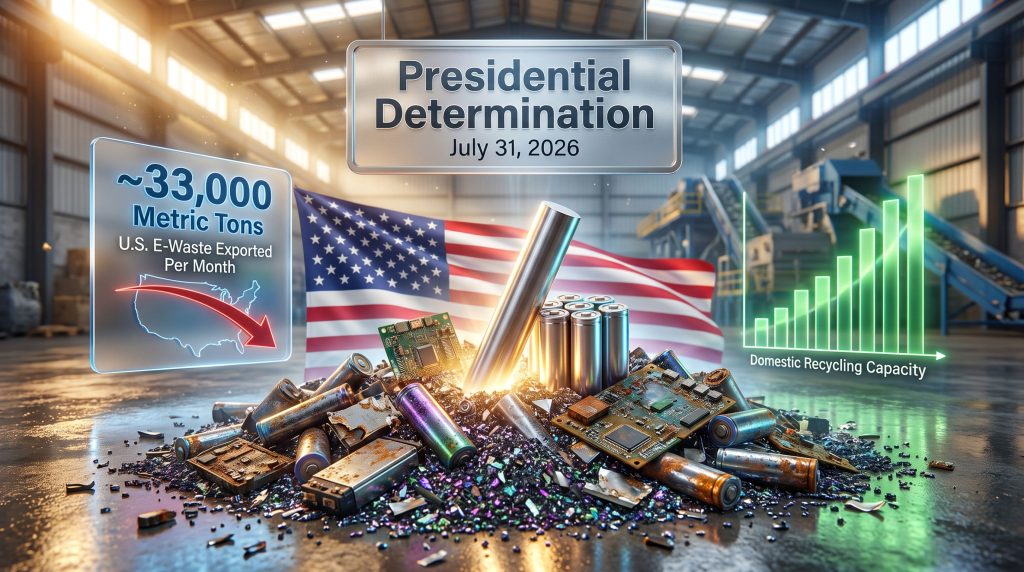
Yet despite this, the U.S. has been exporting approximately 33,000 metric tons of electronic waste per month, according to tracking data from the Basel Action Network. A substantial portion of that e-waste stream contains black mass and other mineral-bearing scrap materials. Once exported, these recoverable minerals are processed by foreign facilities, most of which are located in China or in countries within China's supply chain orbit. The Chinese battery scrap market has been a primary destination for much of this exported material.
The Presidential Determination: What Was Actually Signed
On July 31, 2026, President Trump signed a Presidential Determination that grants the U.S. Commerce Department the legal authority to restrict exports of e-waste and mineral-bearing scrap, including old batteries and black mass. This authority is derived from the Defense Production Act, a statute that allows the executive branch to take measures protecting industries and materials deemed essential to national security.
It is important to be precise about what this determination does and does not do.
| Scope Element | Covered Under This Order |
|---|---|
| End-of-life lithium-ion batteries | Yes |
| Black mass (shredded battery material) | Yes |
| Tungsten-bearing scrap | Yes |
| Raw mined mineral exports | No |
| Processed critical mineral products | No (separate actions apply) |
The determination itself does not immediately halt all e-waste exports. Rather, it empowers the Commerce Department to develop and implement export licensing rules for the covered material categories. Rulemaking, industry consultation, and enforcement framework development will follow. The practical effect on export volumes will therefore depend heavily on how quickly and aggressively the Commerce Department moves through that regulatory process.
Tungsten: The Most Acute Vulnerability This Policy Addresses
Among all the minerals covered under Trump restrictions on critical minerals scrap exports, tungsten represents the most strategically urgent case. The reasons are stark:
- The U.S. has not commercially mined tungsten since 2015, leaving the country with no active domestic primary production
- Global tungsten supply is overwhelmingly dominated by Chinese producers and Chinese export controls
- Tungsten is a critical input for munitions, armour-piercing projectiles, cutting tools, and high-temperature industrial applications
- With no domestic mine production and limited allied supplier alternatives, scrap recovery has become one of the only viable pathways to domestic tungsten supply
Amermin, a privately held recycler, submitted a letter to Commerce Secretary Howard Lutnick in March 2026 arguing that uncontrolled tungsten scrap exports represented an unacceptable risk to American industrial and military readiness. That framing reflects a growing consensus within the defence critical minerals procurement community that secondary mineral sources, including scrap and recycled material, must be treated with the same strategic seriousness as primary mine output.
The U.S. defence industrial base is approaching a January 1, 2027 federal deadline requiring manufacturers to cease sourcing critical minerals from Chinese suppliers. With no domestic tungsten mine and Chinese producers controlling global output, tungsten scrap is not a secondary option. For many manufacturers, it is the only option currently available at scale.
Why Domestic Recyclers Have Been Losing the Feedstock Battle
Understanding why this policy was necessary requires understanding the competitive economics that have driven e-waste exports in the first place. Domestic recyclers competing for mineral-bearing scrap have consistently been outbid by foreign buyers, particularly buyers from China and Southeast Asia, who have paid above-market rates for the material.
The economic logic behind foreign overbidding is not difficult to reconstruct. For a Chinese processor with vertically integrated downstream manufacturing capacity, paying a premium for U.S. scrap feedstock makes rational sense. The value extracted from processing that material within a fully integrated supply chain exceeds what a standalone U.S. recycler with limited downstream offtake agreements can generate.
This structural disadvantage has had severe consequences for North American battery recyclers:
- Li-Cycle, once considered a flagship North American battery recycling company, filed for bankruptcy within the past 18 months
- Ascend Elements, another significant player in the domestic recycling space, entered bankruptcy proceedings during the same period
- Both cases illustrate that feedstock scarcity, driven partly by export competition, contributed to financially unviable operating conditions
New projects are emerging despite these headwinds. In Oklahoma, Blue Whale Materials and two additional firms are currently constructing battery recycling facilities, representing one of the most concentrated clusters of new domestic recycling infrastructure in the country. These operations stand to benefit materially if export restrictions tighten the domestic scrap supply and redirect feedstock to U.S.-based processors.
The Broader Policy Timeline: Three Actions, One Strategic Direction
The July 31 Presidential Determination did not arrive in isolation. It is the third in a sequence of escalating policy actions the Trump administration has taken since January 2026 to address critical mineral supply chain vulnerabilities.
| Date | Policy Action |
|---|---|
| January 2026 | Presidential proclamation following Section 232 investigation finding that processed critical mineral imports threaten U.S. national security |
| July 20, 2026 | Executive order making it harder for defence contractors to secure waivers permitting mineral purchases from prohibited foreign suppliers |
| July 31, 2026 | Presidential Determination authorising Commerce Department authority to restrict e-waste and mineral scrap exports |
| January 1, 2027 | Federal deadline for defence manufacturers to stop purchasing critical minerals from Chinese suppliers |
Each action tightens a different pressure point in the supply chain. The Section 232 proclamation targets inbound mineral imports. The July 20 executive order closes loopholes in defence procurement waivers. The July 31 determination targets the outbound flow of recoverable domestic minerals. Together, they form a multi-vector strategy aimed at reducing the leverage China holds over U.S. industrial and defence supply chains.
The next major ASX story will hit our subscribers first
Urban Mining vs. Greenfield Development: Why Recycling Is the Fastest Fix
One of the most underappreciated dimensions of Trump restrictions on critical minerals scrap exports is the implicit acknowledgment that urban mining can deliver mineral supply far faster than any new mine.
| Pathway | Typical Lead Time | Capital Intensity | Community Opposition Risk |
|---|---|---|---|
| Greenfield mine development | 7 to 15+ years | Very High | High |
| Processing facility construction | 3 to 7 years | High | Moderate |
| Domestic recycling scale-up | 1 to 3 years | Moderate | Low |
| E-waste export restriction (policy lever) | Immediate to 12 months | Low | Very Low |
The comparison is striking. While a new lithium or tungsten mine in the U.S. might take a decade or more to move from discovery to production, a domestic recycling facility operating on redirected scrap feedstock could begin recovering critical minerals within months. The fixed costs are lower, the permitting timeline is shorter, and community opposition to recycling facilities is typically far less intense than opposition to new extractive operations.
The U.S. Geological Survey has confirmed that the country holds substantial quantities of critical minerals locked inside finished goods already within its borders, including consumer electronics, lithium-ion battery packs, and rare earth-containing magnets. This embedded mineral stock represents what analysts increasingly refer to as an urban ore body: a distributed, recoverable resource that requires no new geological discovery, no new permitting process, and no new environmental impact assessment to access. What it has required, until now, is a policy framework that keeps it in the country.
Public Attitudes and the Recycling Behaviour Gap
The policy debate around e-waste exports has a dimension that rarely surfaces in trade or national security discussions: what ordinary Americans actually think about electronics recycling when the supply chain framing is made explicit.
A 2026 study conducted by Ohio-based recycler Cirba Solutions found that approximately 84% of Americans reported they would be more inclined to recycle aging electronics if they understood that doing so would directly reduce U.S. reliance on foreign mineral suppliers. This figure is remarkably high and suggests that public willingness to support domestic mineral recovery through personal behaviour change is far stronger than actual recycling rates would imply.
The gap between stated willingness and actual recycling behaviour reflects a classic information and convenience problem rather than a values problem. Most consumers who own end-of-life electronics are unaware that their old devices contain recoverable strategic materials. Bridging this gap through public communication campaigns, coupled with export restrictions that ensure domestically collected scrap actually reaches domestic processors, could meaningfully increase the volume of recoverable minerals entering the U.S. recycling stream.
Risks, Unintended Consequences, and Implementation Challenges
No export restriction operates without creating friction elsewhere in the system. Several risks merit consideration:
- Feedstock concentration without processing capacity: If export restrictions redirect large scrap volumes to domestic recyclers before those recyclers have scaled their processing infrastructure, temporary scrap stockpiling and price distortions could emerge
- Trade retaliation dynamics: Countries that currently import U.S. e-waste for processing may view export restrictions as a trade barrier, potentially triggering retaliatory measures in other sectors
- Enforcement complexity: E-waste streams are diffuse, multi-jurisdictional, and often move through intermediaries, making compliance monitoring genuinely difficult for regulators
- Allied supplier relationships: The policy, if applied broadly, could affect exports to allied nations that also process scrap for legitimate purposes outside of Chinese supply chains
The bankruptcies of Li-Cycle and Ascend Elements serve as a reminder that domestic recycling capacity is not automatically sufficient to absorb a sudden increase in available feedstock. Capital investment in processing infrastructure must accompany, or ideally precede, the full implementation of export controls. Consequently, the policy must achieve its intended mineral recovery outcomes rather than simply displacing the scrap problem from export terminals to warehouse floors. The Council on Foreign Relations has similarly highlighted this implementation gap as a key challenge in U.S. critical minerals strategy.
Frequently Asked Questions
What minerals are covered under the new export restrictions?
The Presidential Determination specifically references old batteries, black mass, and tungsten-bearing scrap as priority materials. The Commerce Department will determine the precise scope of covered categories through its rulemaking process.
Does this order immediately stop all e-waste exports?
No. The determination grants the Commerce Department authority to restrict exports. Actual restrictions require separate rulemaking, which involves regulatory drafting, public comment periods, and implementation timelines.
What is black mass and why does it matter strategically?
Black mass is the granular mixture produced when lithium-ion batteries are mechanically processed at end of life. It contains recoverable concentrations of lithium, cobalt, nickel, and manganese, making it a valuable feedstock for battery material production. Its strategic importance lies in the fact that it represents a domestic, near-ready mineral source that requires no new mining.
How does this interact with existing tariffs on Chinese mineral imports?
The export restriction and import tariffs operate on opposite ends of the supply chain but serve a complementary strategic purpose. Tariffs on Chinese mineral imports increase the cost of foreign supply, while export restrictions on domestic scrap increase the availability of alternative domestic supply. Together, they are intended to shift the economic calculus toward domestic mineral sourcing.
What is the January 2027 deadline?
Federal regulations require defence manufacturers and contractors to cease purchasing critical minerals from Chinese suppliers by January 1, 2027. This deadline is driving urgency across the defence supply chain and is a key reason why tungsten scrap recovery has become a priority rather than a peripheral concern.
This article is intended for informational purposes only and does not constitute financial or investment advice. Policy timelines, regulatory outcomes, and market impacts remain subject to change as rulemaking processes develop. Readers should conduct independent analysis before making investment decisions based on U.S. critical minerals policy developments.
Want to Invest in the Minerals Driving the Next Wave of Strategic Supply Chains?
Discovery Alert's proprietary Discovery IQ model delivers real-time alerts the moment significant ASX mineral discoveries are announced, instantly translating complex data across more than 30 commodities into clear, actionable insights for both traders and long-term investors. Explore Discovery Alert's dedicated discoveries page to understand how historic mineral discoveries have generated substantial returns, and begin your 14-day free trial today to position yourself ahead of the market.