July 31, 2026
Resource Diplomacy in the Energy Transition Era: Why Mineral Partnerships Are Reshaping Global Trade
The modern global economy has quietly entered an era where geological endowment has become as strategically consequential as military capacity. For decades, bilateral trade agreements were measured in manufactured goods, agricultural commodities, and financial services. Today, a nation's access to lithium, copper, and other critical minerals increasingly determines its ability to compete in semiconductors, electric vehicles, and grid-scale energy storage.
This structural shift explains why the July 2026 summit between South Korean President Lee Jae Myung and Chilean President Jose Antonio Kast produced not just a diplomatic handshake, but five formal memorandums of understanding anchored by a mineral resources partnership elevated to the ministerial level.
Understanding the full significance of South Korea Chile lithium and copper cooperation requires looking beyond the headline agreements toward the deeper economic complementarity, supply chain vulnerabilities, and industrial ambitions that are driving both nations toward a long-term structural relationship.
When big ASX news breaks, our subscribers know first
Chile's Dual-Commodity Strategic Position: A Geological Lottery With Geopolitical Consequences
Why Chile Holds Unmatched Leverage in the Critical Minerals Landscape
Chile's position in global mineral markets is genuinely exceptional and not easily replicated. The country simultaneously holds the world's largest copper reserves and the world's largest lithium reserves, concentrated in two entirely different geological environments. Chile's lithium reserves are sourced from brine systems in high-altitude salt flats, particularly the Salar de Atacama, while copper is predominantly extracted from porphyry deposits in the northern Atacama region.
This geological distinction matters operationally. Brine-based lithium extraction, which dominates Chilean production, requires evaporation ponds spanning thousands of hectares at elevations above 2,300 metres. The brine is pumped to the surface and allowed to concentrate through solar evaporation across a multi-month process before chemical processing yields battery-grade lithium carbonate or lithium hydroxide.
The Atacama brine is among the richest in the world in terms of lithium concentration, typically ranging between 1,500 and 2,200 milligrams per litre of lithium, which is significantly higher than many competing brine operations globally. This grade advantage translates directly into lower per-tonne extraction costs, giving Chilean lithium a structural cost competitiveness that is difficult for higher-cost hard-rock or lower-grade brine producers to match.
| Commodity | Chile's Global Ranking | Primary Geological Source | Primary Use Case |
|---|---|---|---|
| Copper | No. 1 Producer and Largest Reserves | Porphyry deposits, northern Chile | EV wiring, grid infrastructure, semiconductors |
| Lithium | Largest Global Reserves | Salar de Atacama brine systems | Battery cathodes, energy storage, portable electronics |
Codelco's Structural Output Constraints and What They Mean for Copper Markets
Copper prices reached approximately $5.64 per pound in late July 2026, a level that reflects mounting structural supply pressure rather than a temporary demand spike. A significant factor is the production trajectory of Codelco, the Chilean state copper company and historically the world's largest single copper producer. The Codelco copper strategy has been shaped by its new chairman publicly acknowledging that the company faces structural constraints making a return to historical peak output levels unrealistic, according to reporting from Mining.com.
Codelco's challenge stems from a combination of ageing mine infrastructure, declining ore grades at mature operations such as El Teniente and Chuquicamata, and capital-intensive transition programmes required to extend mine life through underground expansion. These dynamics are not short-term operational issues but multi-decade structural realities.
Consequently, South Korea's decision to formalise copper supply security through ministerial-level agreements is strategically rational rather than merely symbolic.
Market Context: When nearby copper futures trade at a premium over later delivery contracts, a condition known as backwardation, it typically signals tight near-term physical supply. Copper markets were showing this rare structure in mid-2026, reinforcing the urgency of securing long-term supply agreements outside spot market exposure.
The Five MOUs: Unpacking What Was Actually Agreed in Santiago
A Multi-Domain Framework, Not Just a Mining Deal
The July 2026 Santiago summit produced agreements spanning five distinct domains, which is worth noting because it signals that both governments view this relationship as genuinely strategic rather than narrowly transactional:
- Mineral Resources Partnership — the centrepiece agreement, structured to elevate cooperation to the ministerial level across the full minerals value chain
- Police Cooperation — law enforcement coordination between the two nations
- Antarctic Research — joint scientific engagement in southern polar territories, relevant given Chile's geographic proximity to Antarctica
- Maritime Safety and Security — cooperative protocols across Pacific shipping corridors critical to minerals trade logistics
- Investment Promotion — a formal framework linking KOTRA, South Korea's trade promotion agency, with InvestChile to channel Korean corporate investment into Chilean industries
The Mineral Resources Partnership in Operational Detail
The centrepiece MOU is structured across four operational dimensions that collectively span the minerals value chain from geological intelligence to refined materials:
- Information sharing on resource development trends, market pricing intelligence, and geological survey data
- Technology cooperation covering extraction methodologies, processing techniques, and refining innovations
- Human capital exchanges between Korean and Chilean technical specialists, including engineers, geologists, and metallurgists
- Focus commodities: lithium and copper as the primary targets, with room for the framework to expand to additional critical minerals over time
The elevation to ministerial level is operationally significant. Ministerial-level frameworks create formal accountability structures, mandated review cycles, joint working groups with defined deliverables, and mechanisms for escalation that survive changes in corporate leadership or individual government administrations.
The $2.1 Billion Baseline and Its Implications
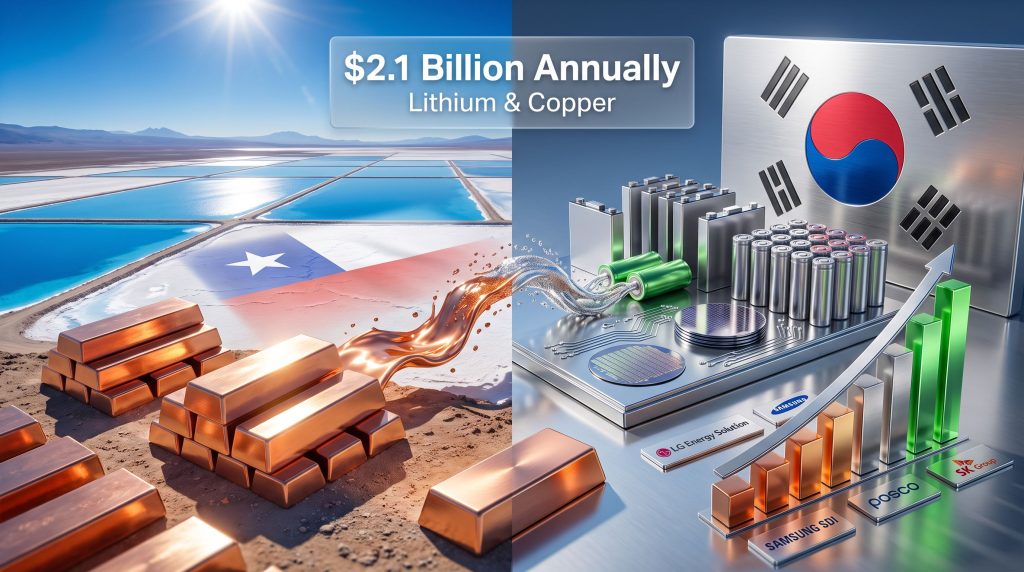
South Korea's presidential office confirmed that Chilean critical minerals currently contribute approximately $2.1 billion annually to the Korean economy. This figure represents existing trade flows before the new agreements take effect. The MOUs are specifically designed to expand this baseline, improve supply security, and create conditions for Korean corporate investment to deepen within Chile's mining and processing sectors.
For context, $2.1 billion in annual mineral imports places Chile among South Korea's most significant resource suppliers, yet the relationship had been operating largely through commercial channels without the structural security of a ministerial-level partnership. The 2026 agreements correct that asymmetry. Furthermore, as critical minerals demand continues to accelerate globally, formalising these arrangements becomes increasingly urgent for both parties.
South Korea's Industrial Dependency: Understanding the Strategic Imperative
The Resource-Technology Structural Gap
South Korea's economic identity rests on three technology-intensive industries that collectively require enormous volumes of critical minerals to function:
- Semiconductor fabrication — South Korean firms including Samsung Electronics and SK Hynix are global leaders in memory and logic chip production, requiring copper for interconnects and various specialty metals for advanced process nodes
- Battery cell manufacturing — LG Energy Solution, Samsung SDI, and SK On collectively rank among the world's largest lithium-ion battery producers, supplying cells to major automotive and grid storage customers globally
- Advanced materials processing — POSCO, originally a steel company, has invested heavily in lithium processing infrastructure and is now a significant player in battery materials production
The structural problem is straightforward: South Korea has virtually no domestic endowment of the raw materials that underpin these industries. This is not a solvable problem through domestic policy. It is a permanent geographical reality that makes international resource partnerships existential rather than merely advantageous.
| Korean Company | Sector | Chilean Mineral Interest |
|---|---|---|
| LG Energy Solution | Battery Manufacturing | Lithium carbonate feedstock |
| Samsung SDI | Battery Manufacturing | Lithium carbonate feedstock |
| POSCO Holdings | Steel and Materials | Lithium processing investments |
| SK Group | Energy and Chemicals | Lithium supply chain participation |
The FTA Modernisation Imperative: A Twenty-Year-Old Framework in a New World
The original South Korea-Chile Free Trade Agreement was signed in 2004, making it one of Korea's earliest bilateral FTAs and a landmark at the time. However, 2004 predates the commercial electric vehicle industry, the proliferation of grid-scale battery storage, and the emergence of lithium as a geopolitically significant commodity. The trade architecture of 2004 was not designed with critical mineral supply chain security in mind.
The FTA joint committee had not convened for approximately ten years before the 2026 summit. Both presidents agreed to restart this committee with a mandate to modernise the pact, with particular emphasis on:
- Strengthening raw materials trade provisions to reflect current commodity realities
- Adding a dedicated critical minerals chapter that creates legally binding supply and investment frameworks
- Improving bilateral investment protections to encourage Korean corporate capital deployment in Chilean mining and processing assets
Structural Significance: Embedding critical mineral supply chain commitments into a modernised free trade agreement is qualitatively different from a voluntary MOU. FTA provisions create enforceable obligations, dispute resolution mechanisms, and tariff frameworks that provide long-term commercial certainty for corporate investment decisions running into the billions of dollars.
The Full Value Chain Approach: From Ore to Recycling
Why This Partnership Goes Beyond Raw Material Purchases
One of the most analytically interesting dimensions of the Korea-Chile framework is its explicit scope across the entire minerals value chain, including end-of-life recycling. This signals a level of strategic sophistication that distinguishes it from simpler offtake agreements. In addition, direct lithium extraction technology features prominently in the framework's eco-friendly extraction dimension, eliminating traditional evaporation pond processing from Atacama brine operations and reducing water consumption by up to 90% compared to conventional methods.
Further value chain dimensions include:
- Processing and refining technology transfer — Korean expertise in producing battery-grade lithium hydroxide and cathode active materials applied to Chilean upstream operations
- Smelter modernisation — upgrading Chilean copper processing infrastructure with Korean industrial technology to increase the proportion of value-added processing occurring within Chile
- Tailings recycling programmes — recovering residual lithium and copper from historical mine waste streams, with some estimates suggesting hundreds of millions of tonnes of tailings containing economically interesting copper concentrations
This tailings recovery dimension is particularly noteworthy from an investment and sustainability perspective. Processing historical tailings does not require new land disturbance, dramatically reduces permitting risk, and in some cases can leverage existing infrastructure. For Korean firms seeking ESG-compliant supply chains demanded by downstream automotive and electronics customers in Europe, tailings-derived minerals carry a compelling provenance story.
The May 2024 Precedent and the Working-Level Foundation
The 2026 ministerial agreements did not emerge from a standing start. In May 2024, South Korea and Chile held their 5th Korea-Chile Resource Cooperation Committee meeting in Santiago, with an agenda focused specifically on tightening lithium supply chain integration. That working-level meeting addressed recycling frameworks, cleaner extraction technologies, and supply chain mapping, establishing the technical groundwork that the 2026 summit agreements have now elevated to ministerial authority.
| Year | Milestone |
|---|---|
| 2004 | Original Korea-Chile FTA signed |
| 2024 (May) | 5th Korea-Chile Resource Cooperation Committee convenes in Santiago |
| 2026 (July) | Five MOUs signed at Santiago summit; mineral partnership elevated to ministerial level; FTA modernisation restarted |
Comparative Framework: Where Does Korea-Chile Fit in Global Resource Diplomacy?
Benchmarking Against Peer Partnerships
| Partnership | Minerals Focus | Agreement Type | Value Chain Scope |
|---|---|---|---|
| Korea-Chile (2026) | Lithium, Copper | Five MOUs plus FTA modernisation | Full value chain including recycling |
| US-Australia Critical Minerals Agreement | Lithium, Cobalt, Rare Earths | Bilateral framework | Processing and offtake |
| EU Critical Raw Materials Act partnerships | Multiple commodities | Regulatory plus bilateral | Strategic stockpiling and supply diversification |
| Japan-Canada mineral agreements | Lithium, Nickel | Government-to-government | Investment and supply security |
What Sets the Korea-Chile Architecture Apart
Two features distinguish the Korea-Chile framework from most peer arrangements. First, the simultaneous pursuit of both a ministerial MOU and FTA modernisation creates a dual-track architecture combining regulatory and commercial instruments.
Second, the explicit inclusion of recycling and eco-friendly extraction methodologies positions the partnership for alignment with increasingly strict ESG requirements from downstream customers in the European and North American EV markets, where Korean battery makers are competing aggressively for long-term supply contracts. Battery raw materials sourced under such frameworks are increasingly valued for their traceable, lower-impact provenance as automakers face greater regulatory scrutiny over supply chain transparency.
According to analysis from the Baker Institute, Chile's dual copper and lithium endowment positions it as uniquely capable of supporting multiple dimensions of the energy transition simultaneously, a characteristic no other single nation can fully replicate.
The next major ASX story will hit our subscribers first
Chile's Strategic Calculus: Why This Is Not Simply a Resource Sale
Moving Up the Value Chain
Chile's motivations extend well beyond commodity export revenue. Korean industrial investment and technology transfer offer Chile a pathway toward developing domestic processing and refining capacity, which has been a stated policy priority for successive Chilean governments.
Moving from raw ore exporter to processed materials supplier means capturing substantially more economic value per tonne of mineral produced, creating domestic employment in higher-skill technical roles and reducing the country's exposure to raw commodity price volatility. Korean investment capital from firms such as POSCO, which has already established lithium processing operations in Chile, and SK and LG-affiliated entities creates a structural incentive for Korean companies to succeed in Chile's long-term industrial development, not merely to extract and export.
As noted in research published by the SWP Berlin, Chile increasingly positions itself as a strategic partner rather than a passive supplier, seeking co-investment and technology agreements that build domestic industrial capacity alongside raw material exports. This alignment of interests is what elevates the South Korea Chile lithium and copper cooperation above a conventional buyer-seller arrangement.
Geopolitical Dimension: The Korea-Chile agreements sit within a broader accelerating pattern of resource diplomacy where nations with advanced industrial manufacturing capacity are systematically locking in long-term mineral supply arrangements with resource-rich partners. This pattern is visible across US, European, Japanese, and Korean strategies simultaneously, creating competitive pressure to formalise agreements before available supply windows narrow further.
Forward Outlook: What the Next Phase of Korea-Chile Cooperation Could Deliver
Near-Term Operational Priorities
- Establishment of joint ministerial working groups to operationalise the Mineral Resources Partnership MOU with defined deliverables and timelines
- Commencement of FTA modernisation negotiations, with a critical minerals chapter as the lead agenda item
- Expanded Korean corporate investment in Chilean lithium processing infrastructure, building on POSCO's existing operational footprint
Medium-Term Scenarios Worth Monitoring
- Development of battery-grade lithium hydroxide processing facilities in Chile using Korean cathode material production technology, representing a significant shift in where value-add processing occurs
- Scaling of tailings recovery programmes to extract copper and lithium from historical mine waste, reducing environmental liability while creating economically viable additional supply streams
- Broader application of direct lithium extraction technology across Atacama operations, potentially accelerating production timelines and reducing the multi-year evaporation pond cycles that currently constrain lithium supply response to demand growth
Long-Term Market Implications
A successfully implemented Korea-Chile mineral axis could function as a replicable template for other technology-manufacturing nations seeking durable Latin American resource supply agreements. For Korean battery producers, successful execution reduces spot market exposure and single-source concentration risk at precisely the moment when European and North American automotive customers are demanding supply chain transparency and geographic diversification as contract conditions.
For Chile, it advances the long-term goal of becoming a value-added materials exporter rather than a raw commodity supplier — a distinction worth billions of dollars annually. The South Korea Chile lithium and copper cooperation framework, if fully realised, stands as one of the more thoughtfully constructed bilateral mineral agreements of the current resource diplomacy era.
This article contains forward-looking analysis and scenario projections that involve assumptions about future policy implementation, corporate investment decisions, and commodity market dynamics. These projections are not guarantees of outcomes and investors should conduct independent research before making any financial decisions based on critical mineral market developments.
Want to Track the Next Major ASX Mineral Discovery Before the Market Does?
Discovery Alert's proprietary Discovery IQ model delivers real-time alerts on significant ASX mineral discoveries — instantly translating complex geological data into actionable investment insights for both short-term traders and long-term investors. Explore historic examples of exceptional discovery returns and begin your 14-day free trial today to position yourself ahead of the broader market.