July 31, 2026
How Commodity Trading Giants Are Quietly Reshaping European Refining Infrastructure
The business of physical energy trading has always rewarded those who control the bottlenecks. In refined fuels markets, the bottleneck is refinery access, and across Europe, the race to secure it is intensifying. Rather than committing billions to outright asset acquisitions, the world's largest commodity trading houses have pivoted toward a more capital-efficient tool: the processing agreement. This structural shift is redefining who controls European fuel supply chains, and the Glencore processing contract for the Wilhelmshaven oil refinery in Germany is one of the clearest expressions of that trend yet.
When big ASX news breaks, our subscribers know first
The Commercial Logic Behind Processing Agreements
Understanding why trading houses pursue tolling arrangements rather than direct ownership requires looking at the economics from both sides of the table.
For a commodity trader, outright refinery ownership brings full operational liability, environmental exposure, maintenance capital requirements, and workforce obligations. A processing agreement strips away most of that burden while preserving the commercial upside: the trader supplies the crude feedstock, pays the refinery operator a throughput fee, and then sells the refined output into the market, capturing the difference between crude input costs and refined product revenues.
For the refinery owner, the arrangement provides a guaranteed revenue stream tied to throughput volume rather than commodity price fluctuations. It reduces the operational complexity of running a trading book while keeping the physical infrastructure active.
The processing agreement model represents a deliberate separation of physical infrastructure ownership from commodity trading risk, allowing each party to focus on its core competency while sharing the economic value of the refining process.
The comparison across deal structures illustrates the trade-offs clearly:
| Contract Type | Capital Exposure | Operational Control | Margin Capture | Flexibility |
|---|---|---|---|---|
| Outright Acquisition | High | Full | Maximum | Low |
| Tolling / Processing Agreement | Low to Medium | Partial | Moderate | High |
| Supply-Only Agreement | Minimal | None | Limited | Very High |
| Joint Venture | Medium | Shared | Shared | Medium |
The tolling model has become increasingly attractive in the post-2022 European energy environment, where commodity market volatility, regulatory complexity, and shifting demand patterns have made long-term refinery ownership a more difficult business proposition for pure-play operators.
Wilhelmshaven: A Strategically Positioned but Underutilised Asset
The Facility's Operational History and Current Configuration
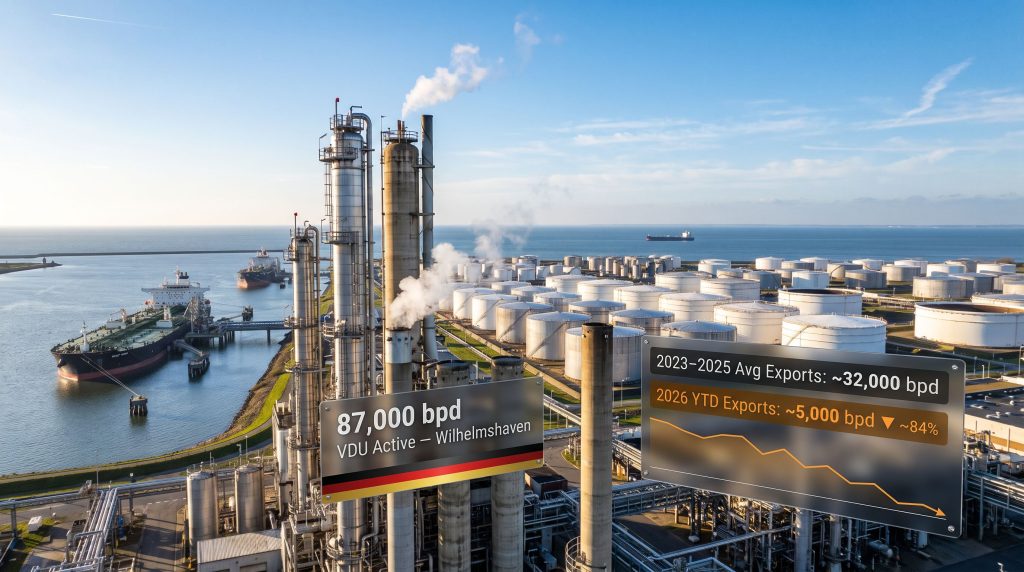
The Wilhelmshaven refinery sits on Germany's northwestern coastline within the North Sea crude import corridor, a location that gives it direct deep-water port access to Atlantic Basin crude supplies. Before being mothballed, the facility operated at a nameplate processing capacity of 260,000 barrels per day (bpd), making it one of the larger refining assets on the German coast.
HES International acquired the site from ConocoPhillips in 2011 and converted it into a large-scale tank terminal operation. A partial operational restart followed in 2019, centred on recommissioning an 87,000 bpd vacuum distillation unit (VDU). The timing of that restart was commercially deliberate: the International Maritime Organization's global sulphur cap, which took effect in 2020, created a surge in demand for low-sulphur marine fuels, and the VDU's configuration was well-suited to meet it.
The facility also operates a 16,000 bpd hydrotreating unit, which removes sulphur compounds from fuel streams to ensure compliance with clean fuel specifications.
Understanding the Technical Configuration
The VDU-to-hydrotreater pairing defines what Wilhelmshaven can and cannot produce. The vacuum distillation unit processes heavy, low-sulphur crude oil and residual fuel oil into higher-value refined fractions. The hydrotreater then cleans those fractions to meet sulphur content thresholds for marine and road fuels. This configuration makes Wilhelmshaven a marine fuel-oriented processing facility rather than a full-conversion refinery capable of producing a broad slate of petroleum products.
That specialisation is both a strength and a constraint. The facility is well-positioned to serve demand from Northern European shipping lanes where IMO-compliant low-sulphur bunker fuels remain a priority purchase. However, it lacks the cracking and coking units that would allow it to maximise yields of higher-margin transportation fuels like gasoline and diesel.
Throughput Reality: A Significant Production Gap
The operational picture at Wilhelmshaven in 2026 reveals a facility running well below its potential capacity:
| Metric | 2023 to 2025 Average | 2026 Year-to-Date | Change |
|---|---|---|---|
| Crude Oil Imports (bpd) | approximately 34,000 | 0 (last import December 2025) | Suspended |
| Refined Product Exports (bpd) | approximately 32,000 | approximately 5,000 | Down approximately 84% |
| Primary Export Products | Fuel oil, gasoil | Fuel oil, gasoil | Unchanged |
| Primary Crude Feedstock | Chadian Doba | To be confirmed under Glencore | Transitioning |
The facility has not imported crude oil since December 2025, based on vessel tracking and cargo flow data from analytics firm Kpler. Refined product exports have contracted sharply to approximately 5,000 bpd in 2026, compared with an average of 32,000 bpd across the prior three-year period. That 84% decline in export volumes underscores the scale of the operational gap that Glencore is now positioned to address.
Glencore's Processing Contract: What the Transition Means
From Hartree to Glencore: A Change in Counterparty Scale
The processing agreement at Wilhelmshaven was previously held by Hartree Partners, a London-based commodity trading firm with a meaningful but comparatively modest footprint relative to Glencore. The transition to Glencore as processing counterparty, reported by Reuters on 30 July 2026 based on four European trading sources familiar with the matter, represents a substantial upgrade in the scale of commercial infrastructure available to the facility.
Neither Glencore, Hartree Partners, nor HES International has publicly confirmed the full terms or timeline of the contract transition. The changeover is understood to have occurred recently as of mid-2026, based on the same trading sources, though the arrangement has not been formally disclosed by any party.
The Crude Feedstock Synergy: Why Chadian Doba Matters
One of the less obvious but commercially significant dimensions of Glencore's involvement is its established position in West African crude markets. The Wilhelmshaven VDU has historically processed Chadian Doba crude, which accounted for the majority of the facility's approximately 34,000 bpd average crude intake across 2023 to 2025.
Chadian Doba is a heavy, low-sulphur crude grade with physical characteristics that align well with the VDU's processing parameters. Glencore is a well-established and active trader of Doba crude, according to West African crude trading sources cited by Reuters. This creates a natural feedstock synergy: Glencore's existing crude trading relationships in the Chad basin can be directed toward a European processing facility that has already demonstrated its ability to handle the grade efficiently.
The alignment between Glencore's West African crude trading book and Wilhelmshaven's proven feedstock preferences reduces one of the key execution risks in restarting meaningful throughput at the facility.
This is not a coincidental overlap. Large commodity traders routinely evaluate processing agreement opportunities specifically by mapping available feedstock against refinery configuration. When the two align, as they do here, the commercial case for the tolling arrangement strengthens considerably.
Glencore's Broader European Strategy: Building Integrated Supply Chains
A Multi-Asset Approach to Northern European Fuels
The Glencore processing contract for the Wilhelmshaven oil refinery does not exist in isolation. It forms part of a deliberate and accelerating strategy to construct vertically integrated fuel supply chains across Northern Europe. Commodity trading giants have increasingly pursued this kind of multi-asset positioning as a means of locking in margin across the value chain.
In the same month the Wilhelmshaven processing agreement transitioned to Glencore, the company also completed the acquisition of a majority stake in FincoEnergies, a Dutch fuel distribution and supply business. The combination of refinery processing access and downstream distribution infrastructure within a single operational corridor creates a structure that is significantly more defensible than either element would be independently.
- Glencore sources and trades West African crude, including Chadian Doba
- That crude is directed to the Wilhelmshaven VDU under the processing agreement with HES International
- Refined fuel oil and gasoil outputs are then marketed and sold by Glencore
- FincoEnergies provides downstream distribution infrastructure in the Netherlands and broader Northern European markets
The resulting value chain captures margin at multiple points: crude acquisition, refinery throughput, and downstream fuel distribution.
Filling the Lindsey Gap
Glencore's European refinery relationships have not been without setbacks. The company held a supply agreement with Prax Group for the UK's Lindsey oil refinery, a 113,000 bpd facility, until that arrangement ended abruptly in mid-2025 when Prax Group entered insolvency proceedings and the refinery ceased operations.
The Lindsey closure removed a significant European processing outlet from Glencore's physical trading infrastructure at a time when the company was actively expanding its continental presence. Wilhelmshaven, while smaller and more specialised in its current configuration, partially restores that lost European processing capacity.
Glencore's Global Refinery Portfolio in Context
| Facility | Location | Structure | Active Capacity |
|---|---|---|---|
| Wilhelmshaven Refinery | Germany | Processing Agreement with HES International | 87,000 bpd VDU active |
| Singapore Refinery | Singapore | Joint Venture with Chandra Asri | Undisclosed |
| Cape Town Refinery (Astron Energy) | South Africa | Wholly-owned subsidiary | approximately 100,000 bpd |
| Lindsey Oil Refinery | United Kingdom | Former supply agreement | Closed mid-2025 |
The geographic diversity of this portfolio reflects a calculated approach to physical market presence. In South Africa, the Astron Energy model provides Glencore with the fullest form of vertical integration, combining crude supply, refinery operations, and downstream retail fuel sales. The Wilhelmshaven arrangement replicates elements of that model in a European context, albeit through a more capital-light structure.
Market Dynamics: Why European Refining Access Is a Strategic Priority
Supply Tightening and Structural Demand Shifts
European refining capacity has been contracting for over a decade. A combination of ageing infrastructure, elevated operating costs, carbon pricing pressures, and shifting product demand has driven a wave of refinery closures and capacity reductions across the continent. Fewer operational refineries means that access to remaining processing capacity becomes more commercially valuable for traders who need physical outlets for crude barrels.
Furthermore, European refining pressures from the IMO 2020 sulphur cap created a specific demand driver for facilities like Wilhelmshaven that can process heavy, low-sulphur crude into compliant marine fuels. That regulatory tailwind has not disappeared; the global shipping fleet continues to require IMO-compliant bunker fuels, and Northern European ports remain among the highest-volume bunkering locations in the world.
The Competitive Landscape Among Trading Houses
Glencore is not alone in pursuing refinery access through processing agreements. The strategy has become a defining feature of how the largest commodity trading houses compete for physical market positioning. Consequently, supply chain disruption risks and industrial decarbonisation trends are further accelerating the race to lock in processing capacity:
- Vitol has maintained long-standing refinery supply and offtake relationships across multiple European markets, leveraging its scale in Atlantic Basin crude to secure processing outlets
- Trafigura has pursued direct refinery equity stakes in several jurisdictions, accepting higher capital intensity in exchange for greater operational control
- Gunvor has operated refinery assets directly in Europe, including the Ingolstadt refinery in Germany, giving it a different risk and reward profile compared with tolling counterparties
Glencore's hybrid approach, combining tolling contracts with downstream distribution acquisitions, sits between the pure tolling model and direct ownership. It minimises balance sheet exposure while building a more integrated physical market presence than a supply-only arrangement would provide.
The next major ASX story will hit our subscribers first
Key Questions: Understanding the Wilhelmshaven Processing Agreement
What does Glencore actually do under the processing contract?
Under the tolling arrangement with HES International, Glencore is responsible for supplying crude feedstock to the Wilhelmshaven facility and for marketing and selling the refined output. HES International retains ownership of the physical infrastructure and earns a throughput processing fee. Glencore captures the commercial margin between crude input costs and refined product sale prices.
Why does the Chadian Doba crude connection matter for throughput recovery?
Restarting meaningful crude import activity at Wilhelmshaven requires a reliable feedstock supply that is technically compatible with the VDU's operating parameters. Chadian Doba's heavy, low-sulphur characteristics are proven to work within the facility's configuration. Because Glencore already trades Doba crude actively, the logistical and commercial pathway to resuming imports is more straightforward than it would be for a counterparty without an established West African crude presence.
What is the realistic throughput ceiling under Glencore's stewardship?
The active VDU has a rated capacity of 87,000 bpd, but the facility operated at an average of approximately 34,000 bpd of crude intake across 2023 to 2025 before suspending imports entirely. Restoring throughput to that prior average would represent an 84% increase from current 2026 levels. Whether Glencore pushes toward the VDU's full rated capacity will depend on crude economics, refined product demand in Northern European markets, and the pace at which the processing relationship with HES International matures.
Disclaimer: This article is based on publicly reported information and industry analysis. It does not constitute financial or investment advice. Forward-looking assessments regarding throughput recovery, commercial strategy, and market positioning are speculative in nature and subject to change based on market conditions, contractual arrangements, and operational factors that have not been publicly disclosed.
Want to Stay Ahead of the Next Major Resource Discovery?
While commodity trading giants quietly reshape European refining infrastructure, savvy investors know that the biggest returns often come from identifying significant mineral discoveries the moment they're announced — Discovery Alert's proprietary Discovery IQ model delivers real-time ASX alerts, turning complex resource data into actionable opportunities, just as historic discoveries by De Grey Mining and WA1 Resources once rewarded those who moved early. Explore Discovery Alert's discoveries page to understand how major mineral finds have generated substantial returns, and begin your 14-day free trial today to position yourself ahead of the broader market.