July 31, 2026
When a Shipping Lane Becomes a Battlefield: The Hidden Mechanics of Hormuz Disruption
Energy markets have always priced geography, but rarely as viscerally as they do today. The Strait of Hormuz, a narrow body of water measuring roughly 21 miles at its tightest navigable point, is not simply a passage between the Persian Gulf and the Gulf of Oman. It is the single most consequential bottleneck in the architecture of global energy supply, a physical constraint so structurally embedded in trade flows that its partial impairment has cascading consequences across refinery margins, diesel pricing, freight insurance, and sovereign economic planning.
Understanding why Gulf oil exports and Strait of Hormuz traffic are diverging, and what that divergence signals about the true state of global supply, requires moving beyond headline barrel counts and into the mechanics of how conflict-era shipping actually functions. Furthermore, the role of trade and geopolitics in oil cannot be overstated when assessing the depth of this disruption.
When big ASX news breaks, our subscribers know first
The Strait as an Inelastic Transit Constraint
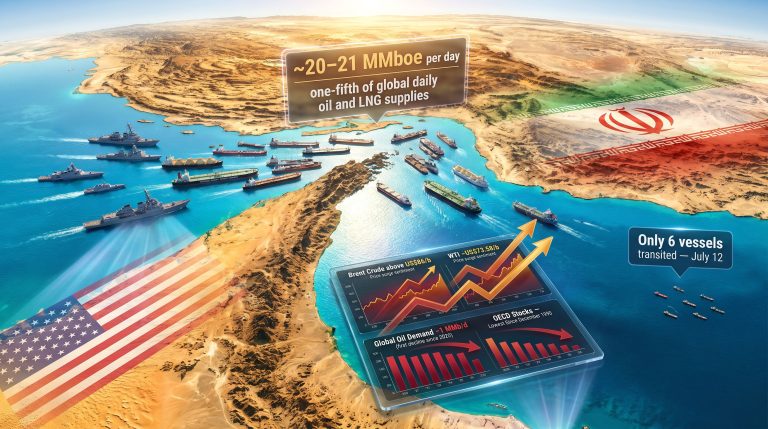
Under pre-conflict operating conditions, the strait facilitated the transit of approximately 20 to 21 million barrels per day of crude oil, condensate, liquefied natural gas, and refined petroleum products — a figure representing roughly one-fifth of total global petroleum liquids consumption according to the U.S. Energy Information Administration. Normal operating rhythms produced more than 100 vessel crossings per day, encompassing the full spectrum of hydrocarbon cargo types.
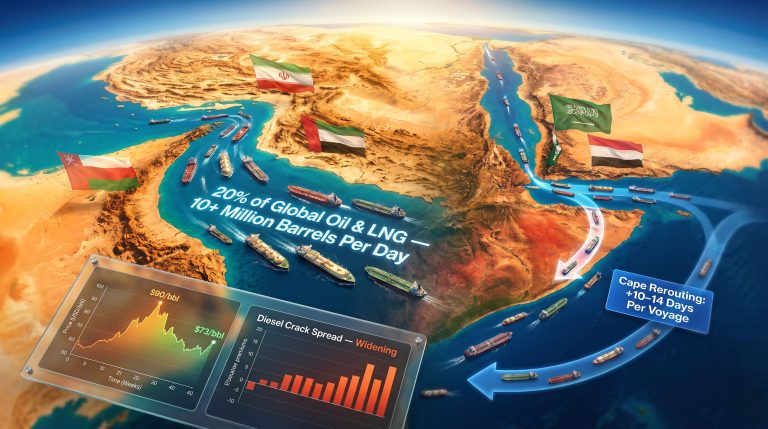
What makes Hormuz uniquely vulnerable is its inelastic character as a transit constraint. Unlike pipeline infrastructure, where rerouting is theoretically possible through investment and interconnection, maritime chokepoints cannot be bypassed instantaneously. Vessel diversions around the Arabian Peninsula or via the Cape of Good Hope add days to weeks of transit time and impose substantial additional freight costs.
The key regional exporters whose crude must transit the strait — including Saudi Arabia, the UAE, Kuwait, Iraq, and Qatar — collectively account for the vast majority of OPEC+ production capacity. None possess sufficient bypass infrastructure to offset a full Hormuz closure at current export volumes. In addition, OPEC's market influence over pricing decisions adds another layer of complexity to how supply disruptions ripple outward.
This inelastic character transforms the strait from a passive geographic feature into an active cost variable embedded in every barrel of Gulf crude. War risk insurance premiums, Iranian interdiction threats, and military escort requirements have all been repriced upward during the current conflict period, compressing refinery margins globally as logistics costs cascade downstream.
The VLCC Pricing Signal
One of the clearest market signals of Hormuz disruption severity is the Very Large Crude Carrier day rate. Under normal conditions, VLCC fixtures for Persian Gulf cargo loadings operate in a competitive freight market. However, under conflict conditions, provisional fixtures have reached nearly $500,000 per day, with the supertanker Jamaica Prosperity provisionally fixed by the shipping unit of a Chinese charterer to load a Persian Gulf cargo at 465 Worldscale points, according to Bloomberg reporting drawing on Kpler tanker-tracking data. That single data point encapsulates the extraordinary risk premium now embedded in Gulf crude logistics.
Vessel Counts, Export Volumes, and the Paradox of Diverging Metrics
Tanker-tracking data reveals an important analytical distinction that most energy market commentary fails to draw clearly. Kpler data cited by Bloomberg showed that fourteen commodity vessels transited the Hormuz chokepoint in both directions on a recent Wednesday, up from single digits the prior week. This sounds like a recovery. In isolation, however, it is not.
Pre-conflict, the strait recorded more than 100 daily crossings. A rise from single digits to fourteen represents only a marginal restoration of transit capacity, not a normalisation of throughput. The weekly volatility compounds this picture further:
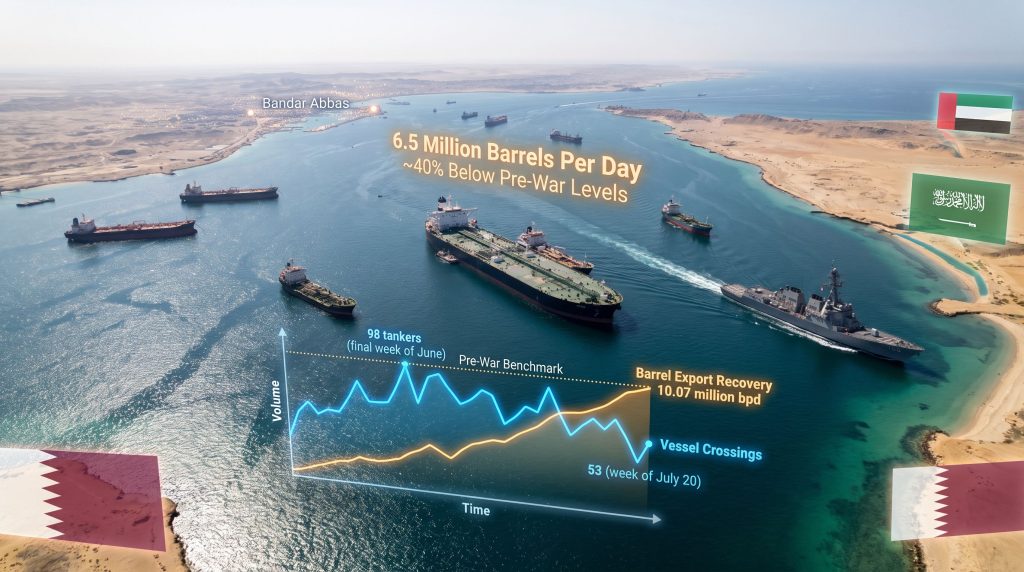
- Crossings surged to approximately 98 tankers in the final week of June, the highest since the conflict began
- The week through July 20 recorded only 53 vessel transits, down sharply from 157 the prior week
- This week-on-week swing of more than 100 vessels illustrates that episodic surges in traffic do not reflect durable recovery
Simultaneously, June Gulf exports recovered to approximately 10.07 million barrels per day, representing an increase of more than 3.5 million bpd compared to May. This figure sounds substantial. Yet it remains approximately 40% below pre-war export levels, meaning the recovery, while operationally real, is both incomplete and fragile.
A critical analytical distinction: export volume recovery and vessel traffic recovery are not interchangeable metrics. Larger vessels carrying heavier cargoes move more barrels per crossing, meaning that a smaller number of transits can still deliver a higher aggregate volume. A market observer tracking only barrel counts may conclude supply is normalising, while a shipping analyst tracking vessel frequency would see persistent structural disruption. Both signals are necessary for an accurate assessment.
Consequently, oil price movements have reflected this uncertainty, with benchmarks swinging sharply in response to each new data point. The UAE exemplifies this dynamic — crude and condensate exports reached a record 3.7 to 3.8 million bpd in June, enabled in part by the Abu Dhabi Crude Oil Pipeline to Fujairah, which bypasses Hormuz entirely.
The Crude Backlog That Migrated Rather Than Cleared
One of the least-reported but most consequential dynamics of the current disruption is the behaviour of stranded crude inventory. Kpler's analysis noted that the crude backlog that accumulated during peak disruption has not actually dissipated. Instead, it has migrated geographically, shifting between the Persian Gulf and the Gulf of Oman as diplomatic and military conditions fluctuate.
Offshore ship-to-ship (STS) transfers have emerged as the primary mechanism for managing this floating inventory. STS operations allow producers to consolidate cargo between vessels in international waters, effectively creating repositionable floating storage. However, as Kpler explicitly noted, STS transfers do not expand export capacity — they redistribute existing barrels within a constrained system rather than adding new supply to global markets.
This distinction matters enormously for price formation. A latent supply overhang sitting in the Gulf of Oman could exert significant downward pressure on crude prices if transit conditions normalise rapidly and all backlogged barrels enter the market simultaneously, creating a supply surge that overwhelms refinery intake capacity.
US Military Escort Operations and Their Structural Limitations
U.S. Energy Secretary Chris Wright confirmed in a Bloomberg Radio interview that approximately 6.5 million barrels of oil per day moved through the Strait of Hormuz over a recent week with active US military support. Against the historical baseline of 20 to 21 million bpd, this figure implies that US-escorted flows represent roughly 30% of normal throughput, confirming the depth of the ongoing supply suppression despite military intervention.
Three structural barriers continue to govern whether commercial operators will attempt a Hormuz transit, independent of diplomatic signals:
- War risk insurance costs: Premiums have escalated to levels that render many voyages economically marginal for operators without state support or military escort
- Iranian interdiction risk: Two Iran-linked Suezmaxes, the Chloe and Kariz, were observed sailing into the strait and idling off Iran's Bandar Abbas, maintaining a visible threat posture
- Operator risk appetite: Shipping companies and charterers are making independent commercial decisions to delay, divert, or avoid transits regardless of headline diplomatic developments
A four-day pause in US strikes on Iran produced minimal improvement in confirmed export clearance rates — a finding that underscores a critical market insight: diplomatic pauses reduce headline risk but do not reduce structural insurance costs, operator risk frameworks, or Iran's capacity to reassert an interdiction posture at short notice.
Alternative Corridors Under Simultaneous Pressure
The overflow from Hormuz disruption has placed adjacent shipping corridors under exceptional stress, and both face their own independent threat dynamics.
Southern Red Sea: The Bab el-Mandeb Bottleneck
| Metric | Recent Observation |
|---|---|
| Daily crossings (Bab el-Mandeb) | ~21 vessels (versus 38 the prior day) |
| Primary cargo type | Russian crude (~3.5 million barrels) |
| Vessel tracking anomalies | Multiple vessels going dark (transponders off) |
| Saudi loading activity | Provisional bookings from Yanbu for August |
Houthi threats in the southern Red Sea have simultaneously constrained this alternative route. Saudi Arabia's Yanbu terminal on the Red Sea coast offers an alternative pathway for crude that would otherwise transit Hormuz, but throughput capacity is limited relative to the Gulf coast export volumes it would need to absorb.
The transponder-off phenomenon is particularly significant from a market intelligence perspective. When vessels disable AIS transponders, they disappear from commercial tanker-tracking databases, creating information gaps that make real-time supply assessment unreliable.
Northern Red Sea and Mediterranean Diversion
Egypt's Sidi Kerir terminal on the Mediterranean coast has become a secondary diversion point. Multiple supertankers — including the Japanese-flagged VLCC Takamatsu Maru and the vessels Bidbid and VL Prosperity — have redirected from previously declared Asian destinations to Sidi Kerir. Three additional VLCCs are currently idling off Sidi Kerir with no confirmed onward destination, compounding the complexity for operators seeking alternative routing.
The next major ASX story will hit our subscribers first
Individual Exporter Responses: Asymmetric Resilience
The conflict has exposed significant differences in the structural resilience of individual Gulf exporters.
Qatar achieved a meaningful milestone when the LNG carrier Al Areesh exited the Persian Gulf carrying the country's first LNG shipment in three weeks. However, Qatar has subsequently begun exploring American LNG as an alternative supply source for contracted buyers — a structural shift with long-term implications for global LNG supply trade architecture.
Saudi Arabia faces dual exposure across two simultaneously threatened corridors. A Houthi strike forced the shutdown of a 400,000 bpd Saudi Aramco refinery, compounding export disruption with a domestic refining capacity constraint. Saudi Arabia is also weighing higher official selling prices for Asian crude buyers to reflect elevated shipping costs.
The UAE has demonstrated the strongest operational resilience, with ADNOC continuing LNG export operations and June export volumes reaching record levels. The Abu Dhabi Crude Oil Pipeline's Fujairah terminus provides a structural bypass advantage that no other major Gulf exporter possesses at equivalent scale.
Downstream Consequences: Why Diesel Markets Face the Acutest Risk
Goldman Sachs has identified the diesel market as the most significant near-term threat in global oil markets, assessing that middle distillate supply chains are disproportionately exposed to Gulf refinery disruptions and shipping cost escalation. Gulf refineries process a substantial share of the crude that ultimately becomes diesel for European and Asian industrial users, and refinery shutdowns combined with export suppression create a compounding effect on refined product availability.
Record US refinery utilisation rates have partially offset Gulf supply losses but have proven insufficient to eliminate the global fuel crunch. In a conflict-era supply disruption, refined product markets — particularly diesel — frequently experience more acute and less reversible supply shocks than crude oil markets, because refinery capacity cannot be rapidly relocated or substituted.
Scenario Analysis: Three Trajectories for Gulf Oil Exports and Strait of Hormuz Traffic Recovery
| Scenario | Probability | Key Conditions | Crude Price Impact |
|---|---|---|---|
| Diplomatic resolution and rapid normalisation | Low | Comprehensive US-Iran agreement within 60 days | Significant correction as backlog clears |
| Managed instability with partial military escort | Base case | US escort operations continue; 60-70% export recovery | Persistent $8-15/barrel geopolitical risk premium |
| Escalation and extended closure | Low but catastrophic | Iranian interdiction of escorted vessels | Spike toward $120-150/barrel; recession risk elevated |
The base case scenario implies that the relationship between Gulf oil exports and Strait of Hormuz traffic will remain structurally abnormal for an extended period, with periodic traffic surges masking a persistent underlying suppression of export capacity relative to pre-conflict norms.
The Long-Term Infrastructure Response: Repricing Chokepoint Risk
The conflict has accelerated capital reallocation toward energy infrastructure that bypasses geopolitically vulnerable maritime chokepoints. A US-Saudi consortium has announced plans for a $5 billion refinery project to be located outside the Hormuz zone, representing a direct long-term capital response to the strategic vulnerability exposed by the current disruption.
Japan has backed overseas oil pipeline investment specifically to reduce structural dependence on Hormuz-routed crude. Australia has separately evaluated a new domestic refinery to reduce reliance on imported refined products. These are not marginal adjustments — they represent a structural repricing of geopolitical transit risk that the current conflict has compressed from a decade-long trend into a multi-year emergency response.
For energy market participants tracking WTI and Brent futures, the most durable insight from the current disruption may be this: physical shipping data — including vessel counts, confirmed export clearances, and freight rates — have proven to be more reliable indicators of actual supply conditions than geopolitical headlines. A single Trump administration threat against Iran triggered a 7% single-session surge in crude prices, while simultaneously, physical export clearance rates remained close to recent lows. According to real-time monitoring of Hormuz vessel activity, the gap between financial market sentiment and physical market reality is itself an information signal — and historically, physical data has ultimately prevailed.
Disclaimer: This article is intended for informational and educational purposes only and does not constitute financial, investment, or trading advice. Forecasts, scenario projections, and market price estimates discussed herein involve inherent uncertainty and should not be relied upon as predictions of actual outcomes. Readers should conduct their own due diligence and consult qualified professional advisers before making any investment decisions. All statistics and figures referenced are drawn from publicly available reporting as cited, and readers are encouraged to verify data independently through primary sources including the U.S. Energy Information Administration, International Energy Agency, Bloomberg, Kpler, and OilPrice.com.
Want to Stay Ahead of the Next Major Resource Discovery Driven by Shifting Energy Markets?
Discovery Alert's proprietary Discovery IQ model delivers real-time alerts on significant ASX mineral discoveries, instantly translating complex resource data into actionable investment insights — particularly valuable as geopolitical disruptions continue to reshape commodity markets and capital flows. Explore historic discoveries and their market returns to understand the opportunity, then begin your 14-day free trial at Discovery Alert to position yourself ahead of the broader market.