July 31, 2026
When Two Chokepoints Fail at Once: The New Geometry of Global Energy Risk
Energy security planners have long operated on a single-point-of-failure assumption: protect the most critical corridor, and the system holds. That model is being stress-tested in real time. The simultaneous disruption of the Strait of Hormuz and the Red Sea's Bab el-Mandeb corridor has exposed a structural blind spot in how governments, traders, and logistics operators think about maritime energy flows. These two waterways are not merely important — they are, for many supply chains, irreplaceable.
When both activate as disruption events concurrently, the compounding effect on global fuel markets is far greater than any simple sum of the parts. This analysis examines the mechanics of the Strait of Hormuz blockage and Red Sea diesel supply crisis, the cascading consequences across sectors, and what market signals are telling participants about the road ahead.
When big ASX news breaks, our subscribers know first
Understanding the Dual-Disruption Framework
The conceptual architecture here matters. The Hormuz disruption is an upstream supply constraint — it restricts the flow of raw crude oil and liquefied natural gas out of the Persian Gulf before those molecules even reach a refinery. The Red Sea crisis, by contrast, is a downstream distribution bottleneck — it disrupts the movement of already-refined products, particularly diesel and gasoil, toward end markets in Europe, East Africa, and the Mediterranean.
When only one of these mechanisms is active, the market can often compensate. Refiners source crude from alternative origins; traders reroute product cargoes. However, when both activate simultaneously, the system loses its redundancy. Upstream tightness inflates crude input costs, while downstream rerouting extends supply timelines and adds freight costs to an already-stressed product market.
The crude oil geopolitical factors at play interact across three interconnected layers:
- Crude oil pricing — driven primarily by Hormuz-related supply anxiety and inventory depletion among Gulf exporters
- Refined product availability — affected by both the reduced crude throughput at Middle Eastern refineries and the inability to ship finished diesel through the Red Sea corridor efficiently
- Freight economics — amplified by war-risk insurance withdrawal, tanker rerouting costs, and the shadow fleet dynamics that have emerged as a partial and imperfect substitute
| Chokepoint | Primary Products Affected | Normal Daily Flow Volume | Disruption Type |
|---|---|---|---|
| Strait of Hormuz | Crude oil, LNG, petrochemicals | ~10+ million bbl/day | Blockage / military conflict |
| Bab el-Mandeb / Red Sea–Suez | Diesel, gasoil, refined products | Significant share of Europe/Africa flows | Attacks, rerouting, insurance withdrawal |
The Strait of Hormuz Blockage: Geography Is Destiny
Why There Is No Real Substitute
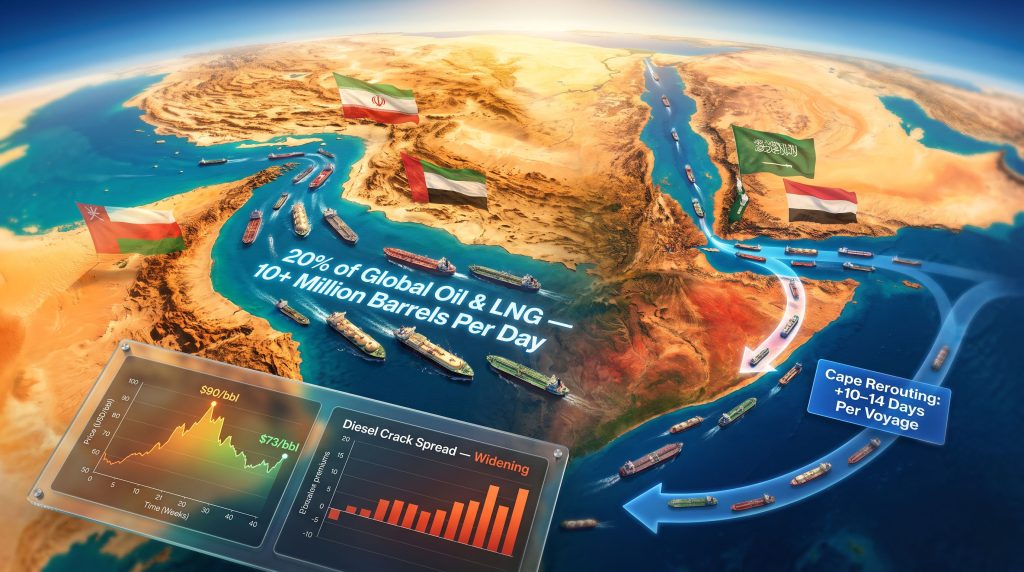
At its narrowest navigable passage, the Strait of Hormuz is approximately 33 kilometres wide, flanked on one side by Iran and on the other by Oman. Through this corridor passes roughly 20% of global oil and LNG supply — more than 10 million barrels per day under normal operating conditions, making it the single most consequential maritime energy chokepoint on the planet. According to UNCTAD's analysis of Hormuz disruptions, the implications for global trade and development are far-reaching and multi-dimensional.
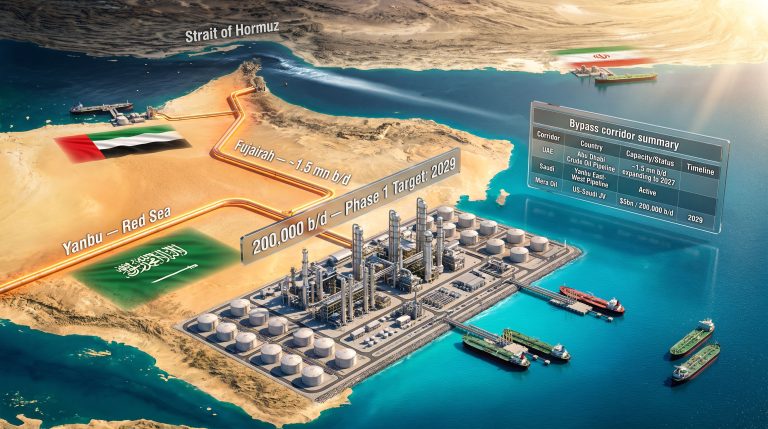
The oft-cited pipeline alternatives provide only partial relief. The Abu Dhabi Crude Oil Pipeline (ADCOP) carries approximately 1.5 million barrels per day, and the Saudi East-West Pipeline (Petroline) adds a further 5 million barrels per day at full operational capacity. Combined, these bypass routes cover perhaps 3–4 million barrels per day of actual, usable capacity — a significant shortfall against the 10+ million that normally transit Hormuz.
More critically, neither pipeline carries LNG. There is zero bypass infrastructure for liquefied natural gas volumes transiting Hormuz, making gas-importing nations in Asia and Europe uniquely exposed to any prolonged disruption. This asymmetry — partial crude bypass capacity, zero LNG bypass capacity — is rarely emphasised in mainstream coverage but represents one of the most consequential structural vulnerabilities in global energy infrastructure. Furthermore, the LNG supply outlook for 2025 and beyond makes this exposure even more critical to understand.
| Bypass Option | Products Covered | Capacity vs. Strait Volume | Operational Status |
|---|---|---|---|
| Abu Dhabi Crude Oil Pipeline (ADCOP) | Crude oil only | ~1.5 million bbl/day | Operational |
| Saudi East-West Pipeline (Petroline) | Crude oil only | ~5 million bbl/day | Operational (partial) |
| No equivalent LNG bypass | LNG | Zero | No infrastructure exists |
| No equivalent refined product bypass | Diesel, gasoil | Zero | No infrastructure exists |
The Iran Conflict Dynamic and Brent's Price Arc
The blockage escalated through a deteriorating Iran-U.S. and Gulf State conflict dynamic that intensified through 2025 and into 2026. At the peak of disruption fears, Brent crude climbed above $90 per barrel as market participants priced in the possibility of a sustained closure. Following an interim diplomatic engagement between the U.S. and Iran, prices retreated toward $73 per barrel — a meaningful decline that nonetheless should not be read as a return to normalcy.
"Price retreat after a diplomatic agreement does not mean the underlying supply-chain damage has been reversed. Insurance market withdrawal, depleted inventories, and tanker scheduling disruptions persist well beyond the political event that caused them. Markets have historically underpriced this lag effect."
Forward curves remaining in backwardation — where near-term prices trade above longer-dated prices — confirm that the market has not fully priced out ongoing supply uncertainty. This structural signal is worth watching closely as a real-time indicator of residual risk premium. The oil price trade war impact compounds these dynamics further, adding another layer of complexity to an already fragile pricing environment.
Oman's Gulf State Oversight Proposal
One of the more structurally novel developments to emerge from this crisis is a proposal by Oman for joint Gulf State oversight of Hormuz transit rights. The logic is geographically grounded: Oman is the only country with territory physically bordering both sides of the strait, giving it a unique standing as a potential neutral broker.
The proposal envisions a multilateral governance framework that could reduce the risk of unilateral Iranian interdiction of commercial shipping. Even setting aside the considerable challenge of securing Iranian participation, the proposal signals a meaningful shift in Gulf State strategic thinking. Whether or not it progresses, it represents the first formal attempt to institutionalise multi-party governance of the world's most critical energy corridor.
The Red Sea Diesel Supply Crisis: A Separate but Compounding Shock
Diesel's Disproportionate Exposure
The Red Sea–Suez route functions as the primary artery for refined diesel and gasoil flows from Middle Eastern and Asian refineries into European, East African, and Mediterranean markets. The disruption to this corridor — driven by shipping attacks associated with the broader regional conflict — has forced a dramatic rerouting away from the Suez Canal entirely. Reporting from The Guardian on Asia's energy crisis highlights the acute pressure this is placing on regional economies heavily dependent on stable fuel imports.
Analysis indicates that approximately 50% of diesel flows that previously transited this corridor have been diverted to the Cape of Good Hope route. This rerouting adds roughly 10 to 14 days to typical Middle East-to-Europe voyages, with corresponding increases in fuel consumption, charter costs, and insurance premiums on a per-cargo basis. The effective supply pipeline lengthens even when physical production volumes remain constant.
Diesel faces a structurally harder squeeze than other refined products for several reasons:
- Diesel demand is relatively inelastic in the short term — it powers freight transport, agricultural machinery, and industrial operations with few substitution options available on any near-term timeline
- Strategic storage buffers for diesel are thinner in most importing regions compared to crude oil strategic reserves, which are subject to IEA release mechanisms
- Russian refinery capacity disruptions — from both drone attacks and maintenance backlogs — have simultaneously removed a key alternative supply source that European buyers previously relied upon
The Triple Constraint on European Diesel Markets
The convergence of three simultaneous pressures on European diesel markets represents an analytically distinct situation from any prior supply disruption:
- Red Sea rerouting costs adding structural freight premiums to every Middle Eastern and Asian cargo destined for European buyers
- Russian supply constraints removing the backstop source that historically absorbed European demand during Middle Eastern disruptions
- Depleted European diesel inventories providing a thinner buffer against supply shortfalls than would normally exist entering a period of geopolitical stress
No single one of these factors would constitute a crisis. Their simultaneous activation creates a compounding dynamic that has widened diesel crack spreads materially — signalling a product-specific supply squeeze that exceeds the general crude oil price shock in its downstream severity.
Sector-by-Sector Consequences: Who Bears the Cost?
The transmission of the Strait of Hormuz blockage and Red Sea diesel supply crisis across the broader economy operates through several distinct channels:
| Sector | Transmission Mechanism | Expected Impact Severity |
|---|---|---|
| Road freight and logistics | Higher diesel input costs passed through to transport rates | High — near-term |
| Agriculture and food supply | Fertilizer feedstock disruption + higher farm diesel costs | High — medium-term |
| Industrial manufacturing | Energy cost inflation + petrochemical feedstock tightening | Moderate-High |
| Plastics and polymers | Reduced Gulf petrochemical exports via Hormuz | Moderate |
| Power generation (diesel-dependent markets) | Direct fuel cost escalation in Africa, South Asia | High — immediate |
The Fertilizer Supply Chain: An Overlooked Downstream Risk
The fertilizer supply chain deserves particular attention because Gulf producers — including major urea and ammonia exporters — depend on Hormuz for outbound shipments. A sustained blockage threatens agricultural input availability across South Asia, East Africa, and parts of Latin America. Consequently, the broader fertilizer import reliance that many nations carry amplifies this vulnerability significantly. Food price consequences from this channel could outlast the energy market shock itself.
War-Risk Insurance and the Shadow Fleet Problem
War-risk insurance premiums for Gulf and Red Sea transits have spiked sharply, creating a secondary cost layer that sits above the commodity price itself. This premium is often invisible in headline crude or diesel price reporting but is fully visible to shipping operators and cargo buyers negotiating freight terms.
In response, a segment of the market has turned to shadow fleet operations — vessels with reduced or non-standard insurance coverage maintaining cargo flows outside conventional risk frameworks. This introduces new counterparty risk, environmental liability, and data opacity into market flows. Notably, product tanker freight rates have shown greater volatility than VLCC (Very Large Crude Carrier) rates during the Red Sea crisis phase, consistent with the disproportionate diesel exposure thesis.
Scenario Modelling: Three Resolution Pathways
Scenario A — Rapid Diplomatic Resolution (3–6 months)
Full U.S.-Iran agreement restores Hormuz transit; Red Sea attacks cease following a broader regional ceasefire. Diesel prices normalise within 2–3 months of route reopening, with freight premiums compressing quickly. However, inventory rebuild across European and Asian markets would require an additional 3–6 months of uninterrupted supply.
Scenario B — Partial Normalisation with Persistent Risk Premium (6–18 months)
Hormuz partially reopens but war-risk insurance remains elevated; Cape rerouting persists for risk-averse operators. Diesel crack spreads remain structurally wider than pre-crisis levels. European buyers accelerate long-term diversification programmes away from Middle Eastern diesel dependence.
Scenario C — Prolonged Disruption with Structural Market Realignment (18+ months)
No diplomatic resolution. Global oil markets reprice to a new equilibrium above $90 per barrel. Diesel supply chains permanently restructure, with accelerated investment in U.S. Gulf Coast, West African, and Indian refining capacity to serve Atlantic Basin demand.
Key Signals to Monitor
- War-risk insurance premium trajectory — the earliest leading indicator of corridor reopening confidence, moving ahead of commodity benchmarks
- IEA strategic reserve release announcements — signals the severity of supply stress as assessed by consuming-nation governments
- Diesel crack spread normalisation — confirms that refined product flows have rebalanced, not just crude oil prices
- Oman diplomatic engagement activity — progress on the Gulf State oversight proposal as a proxy for regional de-escalation momentum
The next major ASX story will hit our subscribers first
Why Single-Chokepoint Risk Models Are No Longer Adequate
The simultaneous activation of Hormuz and Bab el-Mandeb as disruption events has exposed the inadequacy of energy security frameworks built around single-point-of-failure analysis. For decades, scenario planning in consuming nations focused on the risk of one corridor failing at a time, with the implicit assumption that alternative routes or sources could compensate. The current crisis invalidates that assumption entirely.
The market volatility reset that has accompanied the Strait of Hormuz blockage and Red Sea diesel supply crisis underscores how rapidly these events can cascade into broader financial instability. Several structural market architecture changes appear likely to emerge:
- Refinery diversification investment: Consuming regions are expected to accelerate domestic or near-shore refining capacity
- Tanker fleet reconfiguration: Demand for larger, more fuel-efficient product tankers capable of economical Cape routing is likely to increase
- Strategic diesel reserve requirements: Policy conversations in the EU, India, Japan, and South Korea have begun moving toward formal diesel reserve requirements
- Insurance market reform: The war-risk insurance market may develop new corridor-specific instruments to price disruption risk more efficiently
The crisis has also renewed debate about whether a formal international maritime governance body for critical energy chokepoints is now a geopolitical necessity rather than an academic proposal.
Frequently Asked Questions
What percentage of global oil supply passes through the Strait of Hormuz?
Approximately 20% of global oil and LNG transits the Strait of Hormuz under normal conditions, representing more than 10 million barrels per day. No other single maritime chokepoint carries a comparable share of global energy trade.
Why is diesel more affected than crude oil by the Red Sea crisis?
The Red Sea–Suez corridor is the primary routing for refined product flows from Middle Eastern and Asian refineries to European and African markets. Unlike crude oil, which has partial pipeline bypass options, diesel has no alternative pipeline infrastructure. Combined with concurrent Russian supply constraints and thin European inventory buffers, this creates a tighter supply environment for diesel specifically.
What is the Omani proposal for Gulf State oversight of Hormuz?
Oman has proposed a framework for joint Gulf State oversight of Hormuz transit rights, leveraging its unique position as the only country with territory on both sides of the strait. The proposal aims to create a multilateral governance structure that reduces the risk of unilateral Iranian interdiction. Its viability depends significantly on Iranian participation, which remains uncertain.
What does Cape of Good Hope rerouting mean for diesel supply timelines?
Rerouting tankers around the Cape of Good Hope adds approximately 10 to 14 days to typical Middle East-to-Europe voyages. This extends the effective supply pipeline, reduces cargo arrival frequency, and increases per-cargo costs — creating a structural tightening of diesel availability even when physical production volumes are unchanged.
Could a prolonged Hormuz blockage trigger a global recession?
A sustained, unresolved closure would constitute one of the most severe supply shocks in modern energy market history. The cascading effects on crude prices, LNG availability, fertilizer supply chains, freight economics, and industrial energy costs would transmit significant inflationary pressure globally. The depth of any recessionary impact would depend heavily on diplomatic timelines, strategic reserve releases, and how quickly supply chains can structurally adapt.
Disclaimer: This article contains forward-looking analysis, scenario projections, and market commentary that reflect publicly available information and analytical frameworks as of the date of publication. It does not constitute financial or investment advice. Commodity markets are subject to rapid change, and all projections involve uncertainty. Readers should conduct independent research before making any investment or commercial decisions.
Want to Stay Ahead of the Resource Opportunities Emerging From Global Energy Disruptions?
When geopolitical shocks reshape commodity markets this rapidly, identifying actionable investment opportunities demands real-time intelligence — Discovery Alert's proprietary Discovery IQ model instantly alerts subscribers to significant ASX mineral discoveries across more than 30 commodities, turning complex market signals into clear, timely insights. Explore historic examples of exceptional discovery returns or begin your 14-day free trial today to position yourself ahead of the broader market.