July 31, 2026
The Chokepoint Calculus: Why Energy Infrastructure Is Being Rebuilt Around a Single Waterway
Energy markets have operated for decades under a quietly accepted paradox: the global economy's dependence on a handful of geographic chokepoints is well understood, extensively documented, and yet structurally unresolved. The Strait of Hormuz sits at the apex of this vulnerability, a waterway so narrow that its disruption transforms from theoretical risk to operational emergency with startling speed. What geopolitical analysts spent years modelling as a tail-risk scenario has, in 2026, become the defining logistical reality of global oil markets, and the response is reshaping where and how a Hormuz bypass export hub gets built.
When big ASX news breaks, our subscribers know first
The Strait of Hormuz: Anatomy of a Systemic Vulnerability
Fewer than 40 kilometres separate the coastlines of Iran and Oman at the strait's narrowest navigable point, yet this compressed corridor carries approximately 20% of global petroleum trade, including crude oil, liquefied natural gas, and refined products destined for Asia, Europe, and beyond. No other single geographic feature concentrates as much global energy throughput in as constrained a space.
The 2026 US-Iran conflict transformed this long-recognised vulnerability into active disruption. Vessel transit data from tracking service Windward recorded as few as one outbound crossing on 25 July 2026, while daily totals through late July hovered in single digits. The UK Trade Maritime Organization confirmed that Hormuz traffic continued at reduced levels, with no sustained increase along the southern Omani corridor.
Against this backdrop, the front-month Ice Brent crude contract surged to $88.13 per barrel in early Asian trading on 29 July 2026, following Iran's surprise attack against US military positions across the Middle East. Understanding crude oil price trends helps contextualise how swiftly geopolitical events can translate into market-moving price action.
The cascading consequences extend beyond price. Insurance premiums on Hormuz-transiting vessels have escalated sharply. Freight routing strategies have been upended. Furthermore, projects once considered marginal from a capital-return perspective have suddenly become commercially urgent.
"When a latent geopolitical risk converts into sustained operational disruption, the return profile of bypass infrastructure shifts fundamentally. Assets that appeared marginal at $65 per barrel crude look strategically essential at $88."
What Defines a Hormuz Bypass Export Hub and Why the Distinction Matters
Pipeline Bypass Versus Integrated Refinery-Export Hubs
Not all bypass solutions are equivalent. A critical distinction separates the two dominant infrastructure models currently being accelerated across the region:
- Pipeline-only bypass routes reroute crude oil overland or along alternative maritime corridors, allowing producers to load tankers outside the strait without adding any downstream processing capacity.
- Integrated refinery-export hubs combine refining capacity with bypass-positioned export infrastructure, producing finished petroleum products at the bypass point before loading. This model collapses multiple supply chain steps into a single facility.
The significance of this distinction is commercially substantial. Pipeline bypass routes solve a logistics problem but leave downstream value on the table. An integrated approach captures refining margin at the point of export, reducing the number of logistics steps required before product reaches end consumers, and allowing sellers to offer finished ULSD or jet fuel rather than crude requiring further processing.
The Four Active Bypass Corridors
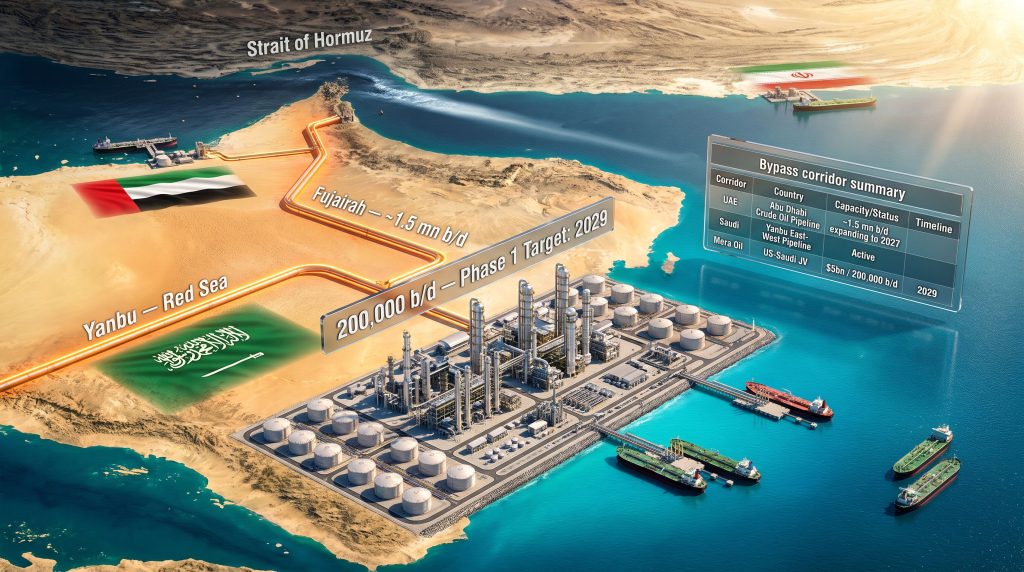
| Bypass Corridor | Country | Key Infrastructure | Status and Capacity |
|---|---|---|---|
| Gulf of Oman (Fujairah) | UAE | Abu Dhabi Crude Oil Pipeline | Operational; ~1.5 mn b/d; expanding toward 2027 |
| Red Sea (Yanbu) | Saudi Arabia | East-West Pipeline | Active; volumes being accelerated |
| Gulf of Oman (Jask) | Iran | Jask export terminal | Operational |
| Gulf of Oman (TBD) | US-Saudi JV (Mera Oil) | Integrated refinery and export hub | $5bn; 200,000 b/d; Phase 1 target: 2029 |
The UAE's Fujairah Hub: The Region's Most Developed Bypass Artery
Abu Dhabi Crude Oil Pipeline Architecture
Fujairah's geographic position on the Gulf of Oman coastline places it entirely outside the Strait of Hormuz, with direct tanker access to Indian Ocean shipping lanes serving Asia, Europe, and East African markets. The Abu Dhabi Crude Oil Pipeline, which delivers crude from Abu Dhabi's producing fields to Fujairah's loading terminals, has operated as the UAE's primary contingency export route for over a decade with a reported throughput capacity of approximately 1.5 million barrels per day.
Fujairah is already recognised as the world's third-largest bunkering hub, an infrastructure-dense port environment with large-scale above-ground tank farms capable of storing millions of barrels of crude and products simultaneously. This existing capacity density is precisely what makes Fujairah functionally superior to greenfield bypass alternatives that would require years of foundational civil works before a single tanker could load. For a broader view of how oil geopolitics analysis frames these developments, the UAE's strategic positioning becomes even more significant.
Planned 2027 Capacity Expansion
The UAE's active investment in additional bypass pipeline capacity, with expanded throughput targeted for 2027, signals something more strategically significant than a wartime contingency measure. It reflects a deliberate policy to permanently reduce Hormuz dependency as a structural feature of UAE export architecture, not merely a temporary response to current hostilities.
"The Fujairah expansion functions as a dual-purpose investment: it addresses near-term crisis logistics while simultaneously repositioning the UAE as a supplier capable of offering guaranteed chokepoint-free delivery, a procurement attribute that buyers are increasingly willing to pay a premium to secure."
The commercial logic is reinforcing. A more capable Fujairah corridor reduces insurance and freight cost burdens for buyers, increases the UAE's negotiating leverage in long-term supply agreements, and provides a competitive differentiator against producers whose entire export profile remains Hormuz-dependent. Bloomberg has reported that the UAE aims to complete its new Hormuz bypass oil pipeline by 2027, underscoring the urgency behind this infrastructure acceleration.
Saudi Arabia's Red Sea Strategy: Acceleration and Complication
The East-West Pipeline and Yanbu's Export Role
Saudi Arabia's East-West Pipeline traverses the breadth of the Arabian Peninsula, delivering crude to the Red Sea port of Yanbu. The route allows Saudi exports to reach European, African, and Atlantic Basin buyers without any Hormuz exposure, and Saudi Aramco has been prioritising Yanbu loadings for key customers since the strait's disruption intensified.
Yanbu's port infrastructure combines crude export terminals with refining capacity and product loading berths, making it a credible multi-product bypass alternative rather than a crude-only loading point. This versatility matters in a disrupted environment where buyers increasingly want product flexibility. OPEC market influence on production decisions also plays a role in how aggressively member states prioritise bypass capacity utilisation.
Is the Red Sea Without Its Own Risks?
A strategically significant and underappreciated complexity surrounds the Yanbu bypass narrative. Yemen's Houthi militant group has resumed targeting Saudi oil shipping in the Red Sea, according to reporting from Argus Media, introducing a secondary layer of transit risk that partially undermines the bypass value proposition.
This creates a dual-corridor risk management challenge for Saudi Arabia: balancing Yanbu and Fujairah routing to diversify exposure across two distinct threat environments simultaneously. For energy procurement professionals, this dual-threat scenario represents a genuinely novel supply security challenge. Historical risk models typically treat Hormuz disruption and Red Sea disruption as low-probability independent events. The 2026 environment has made both simultaneously active, forcing buyers to re-examine the depth and geographic diversification of their supply chain assumptions.
Iran's Jask Terminal: The Geopolitical Paradox of a Self-Bypass Strategy
Iran's development of the Jask export terminal on the Gulf of Oman predates the current conflict, and its strategic logic is rarely fully appreciated outside specialist energy circles. Tehran recognised that its own threat to close the Strait of Hormuz was a double-edged instrument: it constrained Iranian export capability at least as much as it threatened other producers and transit users.
Jask resolves this self-harm problem. By allowing Iranian crude exports to bypass the strait entirely, the terminal decouples Iran's export revenue from the viability of its own Hormuz closure threat. The geopolitical implication is significant: a credible bypass export capability makes the Hormuz closure threat more sustainable over a longer conflict horizon, because Iran can maintain export income while simultaneously threatening to deny transit to others.
This creates an asymmetric escalation dynamic that standard energy security frameworks tend to underweight. Consequently, the more developed Iran's bypass infrastructure becomes, the more it can afford to keep the strait disrupted without suffering proportionate economic consequences. CNBC has analysed the alternative routes and pipeline options that have emerged as the strait's closure risk has intensified.
The next major ASX story will hit our subscribers first
The Mera Oil Project: A $5 Billion Integrated Refinery and Export Hub
Consortium Architecture and Capital Structure
The Mera Oil consortium brings together three institutionally distinct participants, each contributing a different form of capital or capability:
- MWG Enterprises (Texas, USA): An energy development firm providing operational expertise and project development capability.
- Patel Family Office (USA): A capital vehicle built through the hospitality sector, contributing investment capital and financial structuring experience.
- PWS: An associate company of Saudi industrial group AHQ, providing regional industrial relationships and Gulf-based site-access advantages.
This cross-border consortium composition is not accidental. It deliberately aligns US project development expertise with Gulf-region industrial networks, a structure designed to navigate both the technical complexity of a greenfield Hormuz bypass export hub and the regulatory and site-access environment of Gulf Cooperation Council countries. Initial funding is expected to be sourced through external investment and debt financing, with equity structure to be confirmed upon site selection.
Project Specifications and Phase One Milestones
The Mera Oil project's core parameters establish it as a mid-scale but commercially significant operation:
- Refinery throughput capacity: 200,000 barrels per day
- Product slate: High-specification middle distillates, specifically ultra-low sulphur diesel (ULSD) and jet fuel
- Target markets: United States, Atlantic Basin, Mideast Gulf, and other international buyers
- Supporting infrastructure: Deepwater port facilities, large-scale crude and product storage, dedicated marine export berths
- Phase One mechanical completion target: 2029
Projected development timeline:
| Milestone | Target Period |
|---|---|
| Site confirmed from three-location shortlist | Before end of 2026 |
| Final site diligence and engineering design | 2026 to 2027 |
| Construction and mechanical completion (Phase 1) | 2027 to 2029 |
| Commissioning and commercial operations | Post-2029 |
Why Middle Distillates Are the Strategically Correct Product Focus
The decision to orient Mera Oil's refinery output toward ULSD and jet fuel rather than crude or fuel oil deserves closer analysis. Middle distillates occupy a structurally advantaged position in the petroleum product hierarchy for several reasons:
- Demand stability: Road freight, aviation, and industrial users maintain consistent middle distillate demand regardless of broader crude market cycles. These are not discretionary consumption categories.
- Premium pricing: ULSD and jet fuel command higher per-barrel margins than fuel oil or crude, improving the project's return profile even under scenarios of moderate oil prices.
- Regulatory tailwinds: International Marine Organization (IMO) sulphur regulations and global aviation fuel specifications require ultra-low sulphur content, meaning ULSD and compliant jet fuel face structural demand from buyers who cannot substitute lower-specification alternatives.
- US and Atlantic Basin procurement fit: Receiving finished products rather than crude eliminates the need for domestic refinery processing of Middle Eastern crude grades, a procurement advantage that matters particularly for buyers with constrained domestic refinery capacity.
Site Selection: The Decision Framework Driving a Pre-2026 Year-End Choice
Evaluating the Three-Location Shortlist
Mera Oil has confirmed its site selection has been narrowed to three undisclosed locations outside the Strait of Hormuz, with a final decision expected before the end of 2026. The three stated selection criteria provide a useful analytical framework:
- Route resilience requires the chosen site to remain operationally accessible even under scenarios of regional escalation beyond the current conflict. This criterion likely rules out locations with secondary exposure to Houthi-controlled sea lanes or Iran-adjacent territorial waters.
- Infrastructure requirements point toward sites with existing deepwater port access, sufficient land area for refinery and large-scale storage construction, and proximity to construction supply chains capable of supporting the 2029 Phase One target.
- Development timetable compatibility effectively eliminates pure greenfield locations requiring multi-year permitting and foundational civil infrastructure before construction can commence.
What Is the Most Likely Geographic Zone?
The Gulf of Oman coastline spanning Oman, the UAE's eastern seaboard, and potentially Pakistan's Makran coast represents the most logically coherent geography for a bypass hub primarily serving Middle Eastern crude producers. Within this zone, two locations stand out for existing infrastructure density:
- Oman's Duqm Special Economic Zone: Already attracts major refinery and petrochemical investment, has established deepwater port infrastructure and substantial land availability, and benefits from Omani political neutrality relative to the US-Iran conflict.
- Fujairah region (UAE): Unmatched existing infrastructure density, though land availability and coordination complexity for a project of this scale may present constraints.
"Oman's position as a consistent diplomatic channel between Iran and Gulf Arab states also provides a form of de-facto route resilience that purely infrastructure-based assessments miss. A facility in Oman may carry lower geopolitical disruption risk than equivalent infrastructure in more conflict-proximate locations."
Comparative Analysis: Bypass Infrastructure Models Ranked by Value Addition
| Project Type | Example | Bypass Method | Downstream Value Added | Timeline |
|---|---|---|---|---|
| Pipeline-only bypass | UAE ADCO Pipeline | Crude rerouting to Fujairah | None | Operational; expanding 2027 |
| Port volume acceleration | Saudi Yanbu terminal | Red Sea crude export | None | Active and accelerating |
| National export terminal | Iran Jask terminal | Gulf of Oman crude export | None | Operational |
| Integrated refinery-export hub | Mera Oil (US-Saudi JV) | Refinery plus deepwater export | ULSD and jet fuel production | Phase 1 target: 2029 |
The progression from pipeline-only to integrated refinery-export hub represents a genuine evolution in bypass infrastructure design philosophy. Pipeline solutions solve the transit problem but leave every subsequent step in the supply chain unchanged. An integrated hub, however, compresses the entire value chain between wellhead and finished-product tanker into a single bypass-positioned facility.
Market Implications: Near-Term Disruption Versus Medium-Term Relief
Short-Term Pricing Environment
The acceleration of bypass infrastructure development sends a medium-term supply reassurance signal to markets. However, the 2029 Phase One mechanical completion target for Mera Oil underscores a critical timing gap: meaningful new integrated bypass capacity is a post-2029 story, not a near-term supply relief mechanism.
In the immediate environment, constrained Hormuz transit volumes continue to support elevated crude price levels. With vessel counts falling to single digits on the most disrupted days in late July 2026 and Ice Brent touching $88.13 per barrel following Iranian military strikes, the geopolitical risk premium embedded in crude prices reflects a supply constraint that bypass infrastructure investors, not spot traders, will ultimately resolve.
The EV Demand Variable: A 20-Year Investment Horizon Complication
Any bypass infrastructure asset carrying a 20-to-30-year operational life must account for demand-side variables that extend well beyond current conflict dynamics. The EV adoption trends emerging from IEA data are striking: global electric car sales rose 4% year-on-year in the second quarter of 2026, with European sales up 30% in the first half of the year.
In Australia, a roughly 34% surge in gasoline prices earlier in 2026 coincided with a near-tripling of electric car sales in April year-on-year, according to the IEA. More than 90 countries recorded higher electric vehicle sales on a year-on-year basis in the first half of 2026, with electric cars accounting for 24% of all cars sold globally. The IEA projects that figure to reach 29% for the full year 2026.
This demand trajectory introduces a material variable for bypass infrastructure investors. Middle distillate demand from road freight and aviation should remain structurally supported over the medium term. However, long-run crude throughput projections underwriting a 200,000 b/d refinery's commercial case depend on demand assumptions that the current energy transition impacts appear to be reshaping at an accelerating pace.
"Projects like Mera Oil are making 30-year capital commitments against a demand backdrop that the 2026 energy crisis is actively reshaping. The same price shock driving bypass infrastructure investment is simultaneously accelerating the EV adoption that could reduce the long-term demand those assets are designed to serve."
Frequently Asked Questions: Hormuz Bypass Export Hubs
What is a Hormuz bypass export hub?
A Hormuz bypass export hub is any port, pipeline terminus, or integrated refinery and export complex positioned outside the Strait of Hormuz that enables crude oil or refined petroleum products to reach global markets without transiting the contested waterway. Existing examples include the UAE's Fujairah terminal served by the Abu Dhabi Crude Oil Pipeline, Saudi Arabia's Yanbu port on the Red Sea, and Iran's Jask terminal on the Gulf of Oman. The Mera Oil project represents a new category: a bypass hub that integrates refining capacity with export infrastructure.
Which country currently has the most capable Hormuz bypass infrastructure?
The UAE operates the most developed bypass export infrastructure. The Abu Dhabi Crude Oil Pipeline delivers approximately 1.5 million barrels per day to Fujairah on the Gulf of Oman. Saudi Arabia's East-West Pipeline to Yanbu represents the second most significant operational bypass corridor, though Red Sea security concerns introduce complexity.
How long does constructing a new Hormuz bypass export hub take?
Based on the Mera Oil project timeline, a greenfield integrated refinery and export hub of 200,000 b/d scale requires a minimum of approximately three years from site confirmation to Phase One mechanical completion, assuming an accelerated schedule driven by geopolitical urgency. More complex projects, or those requiring extensive permitting and foundational civil works, could take five to seven years or longer from initial site selection.
Why does Hormuz carry so much global oil trade?
The Strait of Hormuz connects the Arabian Gulf, where the majority of Middle Eastern crude production is located, to the Gulf of Oman and the broader Indian Ocean. There is no comparable overland or maritime alternative for producers whose entire infrastructure was built to load from Arabian Gulf terminals. Roughly 20% of global petroleum trade, including LNG and refined products as well as crude, transits this single waterway.
What products will the Mera Oil refinery produce?
Mera Oil's planned 200,000 b/d integrated refinery is focused on high-specification middle distillates, primarily ultra-low sulphur diesel and jet fuel, targeting US markets, Atlantic Basin buyers, Mideast Gulf customers, and other international purchasers.
Key Takeaways
- The 2026 US-Iran conflict has made Hormuz bypass infrastructure a capital allocation priority across the Gulf region, compressing the transition from theoretical planning to active project development.
- Four distinct bypass corridors are now active or accelerating: the UAE's Fujairah route, Saudi Arabia's Yanbu corridor, Iran's Jask terminal, and the proposed Mera Oil integrated refinery hub.
- The Mera Oil project introduces a qualitatively superior infrastructure model by integrating refining capacity at the bypass location, capturing downstream value that pipeline-only alternatives leave unrealised.
- Near-term bypass capacity constraints support elevated crude prices; the first meaningful new integrated bypass capacity from projects like Mera Oil remains a post-2029 development.
- The IEA's documentation of accelerating global EV adoption, driven partly by the current energy price shock, introduces a long-term demand variable that all bypass infrastructure investors with 20-to-30-year asset horizons must incorporate into their financial models.
- The dual-threat environment combining Hormuz disruption and Red Sea Houthi activity simultaneously represents a genuinely novel supply security configuration that historical risk frameworks were not designed to accommodate.
This article contains forward-looking statements and projections based on publicly available information as of late July 2026. Infrastructure timelines, capacity figures, and market projections are subject to change. Nothing in this article constitutes financial or investment advice. Readers should conduct independent due diligence before making any investment or procurement decisions.
Want to Stay Ahead of the Next Major Resource Discovery Driving Energy Market Shifts?
While geopolitical forces are reshaping global energy infrastructure, Discovery Alert's proprietary Discovery IQ model delivers real-time ASX mineral discovery alerts — instantly identifying actionable opportunities in the commodities and resources sectors most exposed to these structural shifts. Start your 14-day free trial at Discovery Alert today, or explore how historic mineral discoveries have generated extraordinary returns for investors who positioned early.