July 31, 2026
The Tariff Architecture Problem Sitting at the Heart of North American Trade
Global trade frameworks rarely fail in dramatic fashion. More often, they erode through the accumulation of policy decisions that, when viewed in isolation, appear defensible, but when measured against the full structure of a bilateral relationship, reveal deep contradictions. The current state of Mexico-US steel trade is a textbook illustration of this pattern, and the September 2026 Mexico steel tariffs USMCA review round in Washington, D.C. may be the most consequential opportunity yet to address it.
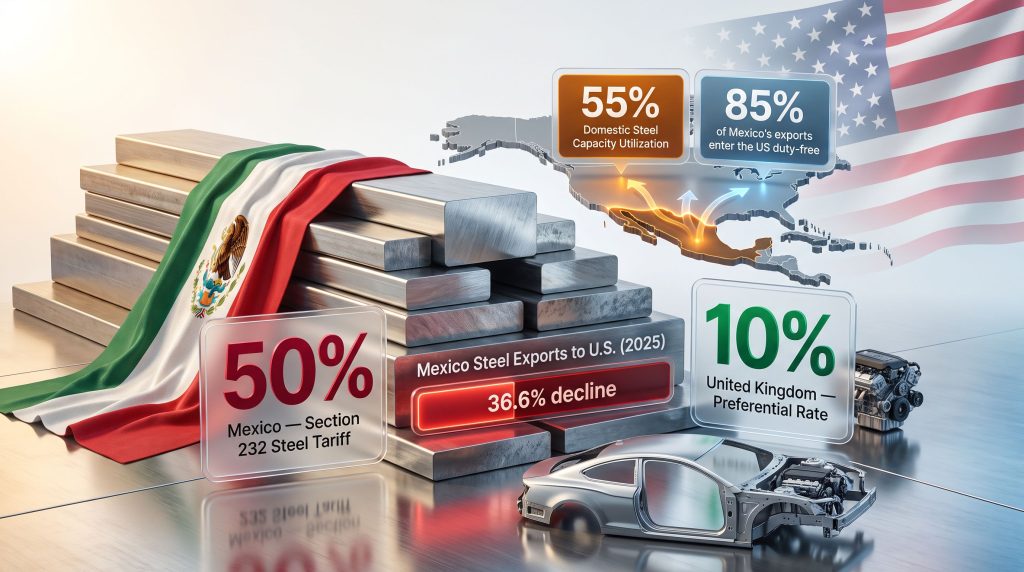
The central anomaly is straightforward: Mexico is the single largest purchaser of American steel globally, meaning the United States runs a steel trade surplus with its southern neighbour. Yet under Section 232 of the Trade Expansion Act of 1962, Mexican steel exporters face a 50% tariff rate when selling into the US market. The United Kingdom, by contrast, accesses that same market at a preferential 10% rate. That five-fold gap, applied to the US's top steel customer rather than a competitive threat, is precisely the structural inconsistency Mexico is pressing Washington to correct before fall negotiations close.
When big ASX news breaks, our subscribers know first
Understanding Section 232 and Why Mexico Argues It Doesn't Apply as Currently Structured
Section 232 authorises the US President to impose tariffs on imported goods when those imports are determined to threaten national security. The statute was originally designed with strategic industries in mind, particularly US steel and aluminium tariffs and related commodities, where domestic production capacity is considered vital to defence readiness. The logic follows that if foreign imports suppress domestic production to unsustainable levels, America's ability to manufacture military and industrial goods in a crisis becomes compromised.
The problem Mexico identifies is that this national security framing was never intended to apply uniformly across trading relationships with fundamentally different characteristics. A country that absorbs large volumes of American steel, generating a surplus for US producers, is not suppressing domestic capacity — it is sustaining it.
| Trade Partner | Section 232 Steel Tariff Rate | US Steel Trade Position |
|---|---|---|
| Mexico | 50% | US runs a surplus (Mexico is largest buyer) |
| United Kingdom | 10% | Negotiated preferential rate |
| China | 100%+ | US runs a significant deficit |
| European Union | Quota-based system | Mixed, sector-dependent |
The table above illustrates the asymmetry. Mexico sits in a structurally different category from China or other economies where excess capacity genuinely displaces American production, yet it absorbs the same punitive tariff architecture. Economy Minister Marcelo Ebrard has consistently characterised this as a calibration failure, arguing that the tariff rate should reflect actual bilateral trade dynamics rather than a generalised stance toward steel-exporting nations.
Notably, Mexico has been building out domestic smelting and processing capacity since 2018, specifically to reduce its reliance on steel imports and avoid triggering US tariff measures. This investment trajectory, which aligns with US industrial policy goals of encouraging nearshore production capacity, has not yet translated into preferential tariff treatment — a gap Mexico intends to raise directly in September. Furthermore, the tariff impact on supply chains across the broader North American manufacturing network has made this issue increasingly urgent for both sides.
Quantifying the Damage: What 50% Tariffs Have Done to Mexico's Steel and Automotive Sectors
The economic impact of existing tariff policy is no longer theoretical. Multiple measurable indicators confirm that the combined weight of Section 232 steel duties and the separate 25% automotive tariff applied to vehicles failing USMCA content thresholds has created significant structural stress across key Mexican industries.
- Mexico's steel exports to the United States fell by 36.6% in 2025, a decline that represents both lost revenue and underutilised industrial capacity
- Domestic steel capacity utilisation has dropped to 55%, well below the 80%-plus thresholds at which integrated steel producers typically achieve sustainable margins
- Automotive shipments contracted by 5.1% year-over-year in the first four months of 2026
- Up to 350,000 manufacturing jobs in Mexico's automotive supply chain have been identified as being at risk under the current tariff structure
Structural Threshold Alert: When steel capacity utilisation falls below 60%, producers face compounding pressure across three dimensions simultaneously: margin compression, workforce attrition, and a pullback in long-term capital investment. Each of these effects reinforces the others, creating a feedback loop that accelerates sectoral decline faster than headline export figures alone would suggest.
The 55% utilisation figure deserves particular attention from an industry perspective. In integrated steelmaking, fixed costs — including blast furnace maintenance, energy contracts, and labour — do not scale proportionally with output reductions. A facility running at 55% capacity is not simply earning 45% less revenue; it is frequently absorbing losses on each additional unit of production while its fixed-cost base remains largely unchanged. This dynamic makes prolonged underutilisation structurally dangerous in ways that are not always visible in aggregate trade statistics.
Downstream Exposure: Which Sectors Face the Greatest Risk?
The tariff burden extends well beyond steel producers themselves. The downstream industrial chain carries concentrated exposure across several categories:
- Automotive original equipment manufacturers (OEMs) and Tier 1 suppliers face simultaneous pressure from the 50% steel input cost increase and the 25% finished-vehicle tariff for units not meeting USMCA rules-of-origin thresholds
- Auto parts manufacturers absorb dual input cost inflation and reduced export competitiveness relative to suppliers in lower-tariff jurisdictions
- Industrial equipment and machinery producers face potential additional exposure under the pending Section 301 investigation
- Medical device manufacturers have been flagged as a high-exposure sector under the broader excess-capacity probe, despite operating in a sector with limited overlap with the national security rationale underlying Section 232
Consequently, the US-China trade war impact on global supply chains has further complicated Mexico's position, as Washington simultaneously pressures its southern neighbour to restrict Chinese steel flowing through third-country channels.
The USMCA Joint Review: How the Mechanism Works and What September Represents
The USMCA includes a mandatory joint review clause requiring the United States, Mexico, and Canada to formally assess the agreement's operational performance every six years. According to CSIS analysis of the USMCA review, the July 2026 joint review meeting did not produce an automatic 16-year extension of the agreement, which means the pact now enters a rolling annual review cycle while remaining in legal force. This procedural outcome elevates the importance of each successive negotiating round, since unresolved disputes accumulate rather than reset.
The negotiating record through mid-2026 reflects genuine progress alongside persistent friction. At the start of the 2025–2026 review cycle, 54 unresolved US demands remained on the table. Entering the 2026 cycle, that figure had fallen to 14, representing a 74% reduction. Mexico, for its part, has presented 13 counter-demands of its own, concentrated on steel tariffs, aluminium duties, automotive trade terms, and the Rapid Response Labour Mechanism.
This narrowing pattern follows a deliberate structure that Mexican officials have described as sequential elimination: each completed round closes the issues that have been resolved while carrying forward the remaining contested points. The shrinking agenda reflects real diplomatic work, but it also means the issues that survive into September are the hardest ones — those where domestic political constraints on the American side have so far prevented agreement.
The September round in Washington will be the fourth formal session of the current review cycle. Ebrard has characterised it as decisive for preserving Mexico's competitive position relative to other US trading partners, particularly given that the UK's 10% rate now serves as an explicit benchmark against which Mexico can argue its own case.
The Section 301 Wildcard: A Parallel Tariff Track That Could Arrive Before September
Separate from the USMCA review, the Office of the United States Trade Representative has been conducting a Section 301 investigation into structural excess manufacturing capacity across 16 economies, including Mexico, China, the European Union, Japan, and South Korea. Unlike Section 232, which targets national security risks from specific commodities, Section 301 addresses unfair trade practices more broadly, and a ruling can result in sector-specific tariff increases across a wide range of industries.
A USTR decision on the excess-capacity probe could arrive as early as August 2026, potentially landing before the September USMCA round begins. That timing creates a significant strategic variable for Mexican negotiators: a new tariff ruling could either create additional urgency for a comprehensive deal in September or, alternatively, introduce new complications that harden the US negotiating position.
| Sector | Section 301 Exposure Level |
|---|---|
| Automotive and auto parts | High |
| Industrial machinery | High |
| Computing and electronics | Moderate to High |
| Medical devices | Moderate to High |
| Steel and aluminium | High (overlapping with Section 232) |
Mexico's stated approach is to treat the USMCA review and the Section 301 exposure as a single consolidated negotiating track rather than two parallel processes. This integration strategy reflects a recognition that any tariff gains achieved through the USMCA review could be partially or fully offset by a Section 301 ruling that introduces new duties on the same export categories. In addition, US tariffs on metal supply chains more broadly have demonstrated how cascading duty structures can undermine even carefully negotiated bilateral arrangements.
Is Mexico's Case for UK-Parity Economically and Diplomatically Viable?
Mexico's argument for a reduction in the Mexico steel tariffs USMCA review process targets — specifically to the UK's 10% rate — rests on three mutually reinforcing pillars:
- The surplus logic: The US runs a steel trade surplus with Mexico, which structurally contradicts the national security justification for Section 232's highest tariff bands
- The investment alignment argument: Mexico's sustained investment in domestic steelmaking capacity since 2018 reflects an industrial posture consistent with reducing import dependence — a goal the US has explicitly supported for allied trading partners
- The UK precedent: Washington's willingness to extend a 10% preferential rate to the UK demonstrates that differentiated tariff treatment based on bilateral trade dynamics is both legally available and politically achievable within the Section 232 framework
That said, several factors complicate Mexico's negotiating position in ways that officials have acknowledged:
- US pressure for a regional Chinese steel barrier: Washington has been pushing Mexico to align with stricter trade measures targeting Chinese steel flowing through third-country supply chains. Mexico's willingness to cooperate on this issue may be the most significant variable determining how far the US is prepared to move on tariff rates
- Political uncertainty around USMCA itself: Public scepticism from President Trump about the long-term future of the agreement creates an unpredictable backdrop for any concession-based negotiation
- Section 301 timing risk: A new tariff ruling arriving in August could fundamentally alter the negotiating environment before September talks begin, either by strengthening Mexico's urgency argument or by giving US negotiators additional leverage
However, one stabilising factor in the bilateral relationship is the trade baseline that already exists. Approximately 85% of Mexico's exports to the United States continue to enter duty-free under USMCA rules of origin, a figure that both sides have acknowledged. This substantial baseline of tariff-free trade provides a foundation of economic interdependence that gives both parties an interest in managing the remaining disputes constructively. Canada and Mexico's coordinated push for steel tariff relief has further reinforced the diplomatic momentum heading into September.
The next major ASX story will hit our subscribers first
Three Scenarios for September: What Different Outcomes Would Mean in Practice
Understanding the range of possible outcomes from the September round requires distinguishing between the economic mechanics of each scenario and the political conditions that would need to be in place for each to materialise.
Scenario 1: Partial Tariff Reduction
Mexico secures a reduction from 50% to an intermediate rate, potentially in the 25% range, with a structured pathway toward UK-parity conditional on Section 301 outcomes and Chinese steel barrier commitments. This outcome would partially relieve pressure on steel producers and automotive suppliers without requiring Washington to grant full parity with the UK deal. It represents the most diplomatically achievable near-term result.
Scenario 2: Full UK-Parity at 10%
Mexico obtains the same preferential rate applied to UK steel, triggering a meaningful recovery in export volumes, a reduction in capacity utilisation pressure from 55% toward more sustainable operating levels, and renewed confidence in long-term automotive and industrial investment. This outcome requires USTR to formally accept the trade surplus argument as sufficient grounds for differentiated treatment under Section 232.
Scenario 3: No Change, Section 301 Adds New Duties
The September round stalls without a steel tariff agreement, and a Section 301 ruling introduces additional duties on automotive, industrial, and medical device sectors before or alongside the talks. Under this scenario, steel capacity utilisation falls further below the 55% threshold, job losses in manufacturing accelerate, and Mexico's competitive position relative to other US trading partners deteriorates meaningfully.
Disclaimer: The scenarios above represent analytical projections based on publicly available information and current negotiating dynamics. They do not constitute financial or investment advice. Actual outcomes will depend on US domestic political conditions, USTR rulings, and bilateral diplomatic developments that remain subject to significant uncertainty.
Frequently Asked Questions: Mexico Steel Tariffs and the USMCA Review
What Are the Current Section 232 Steel Tariffs on Mexico?
Mexico currently faces a 50% tariff on steel exports to the United States under Section 232 of the Trade Expansion Act of 1962, compared with the 10% rate extended to UK steel exporters.
Why Does Mexico Believe the Current Tariff Structure Is Inconsistent?
Mexico is the largest purchaser of US steel globally, meaning the United States runs a trade surplus with Mexico in the sector. This trade relationship inverts the standard national security rationale for the highest Section 232 tariff bands, which were designed to protect American steel producers from competitive displacement by foreign suppliers.
When Is the Next USMCA Review Round Scheduled?
The fourth formal joint review round is scheduled for September 2026 in Washington, D.C.
What Is the Section 301 Excess-Capacity Investigation?
USTR has been conducting a Section 301 probe into structural manufacturing overcapacity across 16 economies including Mexico. A ruling introducing new tariffs on automotive, industrial machinery, computing, and medical device sectors could arrive as early as August 2026, potentially preceding the September USMCA round.
How Many USMCA Disputes Remain Unresolved?
Unresolved US demands within the review process fell from 54 to 14 between the 2025 and 2026 cycles. Mexico has presented 13 of its own demands, focused primarily on steel, aluminium, automotive tariffs, and the Rapid Response Labour Mechanism.
What Share of Mexico's Exports Enter the US Duty-Free?
Approximately 85% of Mexico's exports to the United States continue to enter duty-free under existing USMCA rules of origin.
What September 2026 Will Actually Test
The upcoming USMCA review round in Washington will serve as a test of whether the agreement's review mechanism can function as a genuine dispute-resolution instrument, or whether it is becoming a managed forum for deferring rather than resolving structural asymmetries.
Mexico's consolidated approach — linking the Mexico steel tariffs USMCA review directly to its Section 301 exposure — signals a more sophisticated diplomatic posture than treating each tariff instrument in isolation. The global commodity tariff effects rippling through interconnected supply chains have made it increasingly clear that piecemeal negotiations are insufficient for resolving the structural contradictions embedded in current policy.
A country experiencing a 36.6% decline in steel exports, operating industrial capacity at 55% utilisation, and facing potential new duties across automotive, machinery, and medical device sectors cannot afford to negotiate each trade track independently. The distance between a 50% tariff and a 10% tariff is not simply an arithmetic question. It encodes a judgement about whether a trading relationship is characterised by economic partnership or competitive threat. For Mexico, the September round is about changing that encoding before the costs of the current structure become irreversible for the industries most exposed to it.
Want to Track the Commodity and Mining Opportunities Emerging From Global Trade Shifts?
Discovery Alert's proprietary Discovery IQ model delivers real-time alerts on significant ASX mineral discoveries, instantly translating complex market dynamics — including those reshaping steel, aluminium, and industrial commodity supply chains — into actionable investment opportunities. Explore how major mineral discoveries have historically generated substantial returns on Discovery Alert's dedicated discoveries page, and begin your 14-day free trial today to position yourself ahead of the broader market.