July 31, 2026
The Downstream Divide: Why the World's Real Energy Crisis Has Nothing to Do With Crude Oil Prices
Energy markets have a perception problem. For decades, investors, policymakers, and media commentators have treated crude oil benchmarks as the definitive barometer of global energy stress. When Brent or WTI moves sharply, headlines follow. Yet the crude price is, in a fundamental sense, only half the story. The commodity that actually powers freight trucks, heats homes, lifts aircraft, and drives combine harvesters is not crude oil. It is the finished, processed product that emerges from a refinery. And in 2026, it is precisely those finished products that are disappearing from global markets at an alarming rate, driving a global fuel crunch that crude oil price trends alone cannot explain.
The global fuel crunch now underway is a downstream phenomenon. Understanding why requires separating two concepts that financial markets routinely conflate: crude oil supply and refined fuel availability. They are related, but they are not the same thing. In the current environment, the gap between them is widening in ways that carry serious consequences for economic growth, inflation, and energy security across multiple continents.
When big ASX news breaks, our subscribers know first
The Refined Products Problem: Why Crude Supply Data Can Mislead
Crude oil in its raw form is commercially useless to end consumers. A tanker full of West Texas Intermediate cannot fuel a diesel generator in rural Southeast Asia, power a commercial airliner, or heat a home in northern Europe. Before crude oil can perform any of those functions, it must pass through a refinery — a capital-intensive industrial facility that separates the hydrocarbon mixture into discrete product streams including gasoline, diesel, jet fuel, heating oil, and petrochemical feedstocks.
This processing step is where the 2026 global fuel crunch originates. Crude availability is one input into the system. Refining capacity is the binding constraint that determines what actually reaches end-users. When refining capacity is damaged, retired, geographically disrupted, or politically restricted, finished fuel supply declines regardless of how much crude is pumped from the ground.
This distinction matters enormously right now because the popular narrative around oil markets in 2026 has focused heavily on crude oil price trends driven by Middle East conflict. The more consequential story, however, is that the world's refining infrastructure is simultaneously being squeezed from four independent directions, creating a shortage that no single policy lever can quickly resolve.
What Is Driving the Global Fuel Crunch in 2026?
Geopolitical Disruption: The Persian Gulf's Dual Role in Global Fuel Supply
The Strait of Hormuz is conventionally described as a crude oil chokepoint. What this framing omits is that the Gulf states were historically significant exporters of refined petroleum products, not merely raw crude. Countries across the Gulf region operated substantial downstream refining capacity specifically designed to supply finished fuels to Asian and European import markets.
Active conflict in the Persian Gulf region has disrupted both dimensions of this export role simultaneously. Upstream production at some facilities has been curtailed, while the distribution and export of finished products has been compromised by tanker routing disruptions, port security threats, and insurance cost escalation. The result is a compound supply shock: less crude leaving the region and less refined product reaching destination markets.
Iran's rejection of proposals to jointly manage Hormuz transit arrangements, combined with ongoing tanker incidents, signals that this disruption is not a short-term aberration. Two oil tankers reportedly abandoned transit attempts through the strait in recent weeks, a development that illustrates the operational reality faced by shipping operators navigating the corridor.
Russia's Extended Export Ban: A Supply Shock Within a Supply Shock
Prior to the current conflict environment, Russia held the position of the world's second-largest exporter of refined petroleum products after the United States. That supply has been severely curtailed. Ukrainian drone strikes caused substantial damage to Russian refining infrastructure over recent years, reducing throughput capacity at key facilities. Moscow's policy response has been to extend diesel and gasoline export bans through 2027, prioritising domestic fuel availability over export revenue.
This decision has removed a material volume of diesel from global markets at precisely the moment when supply from other sources is also constrained. Diesel markets were already operating with thin inventory buffers heading into 2026, and furthermore, Russia's withdrawal from the export market has converted a tight situation into a critical one. Some Russian refineries have partially resumed operations, but the export ban remains firmly in place as domestic energy security takes precedence.
Western Refinery Closures: The Structural Capacity Erosion Nobody Fixed
A less headline-grabbing but structurally significant factor in the global fuel crunch is the multi-year trend of refinery decommissioning across Europe and the broader Western world. Energy transition pressures accelerated the retirement of refining infrastructure deemed incompatible with long-term decarbonisation goals. Refineries that closed between 2020 and 2025 cannot be rapidly restarted. The equipment has been decommissioned, the specialist workforce has dispersed, and in many cases the physical assets have been repurposed or demolished.
This creates a structural ceiling on how quickly Western refining capacity can respond to demand signals, no matter how attractive refining margins become. The industry built these assets over decades. Rebuilding meaningful capacity takes years, not weeks.
China's Fuel Export Quotas: The Policy Constraint That Amplifies Everything
China operates substantial refining overcapacity relative to its domestic consumption needs. In a market operating under normal supply conditions, Chinese surplus refined product would flow into global markets and help balance shortfalls elsewhere. That mechanism is blocked by Beijing's strict export quota system, which limits the volume of refined products that Chinese refiners are permitted to export.
Commodity research analysts have identified China's quota policy as carrying comparable weight to Russia's refinery capacity reductions as a driver of global fuel tightness. At current crude oil price levels, China has shown no inclination to relax these restrictions. The quota system functions as a domestic energy security buffer, and releasing it would require a policy reversal that Beijing has given no indication of making.
How Severe Is the Global Fuel Shortage Right Now?
Key Metrics Snapshot
| Metric | Current Status | Significance |
|---|---|---|
| U.S. refinery fuel output | ~17 million barrels/week (highest since Sept. 2019) | Near-maximum operational capacity |
| Crack spread (crude-to-product ratio) | Hit $70/barrel — record high | Signals extreme product scarcity premium |
| U.S. crude inventories | Declining under refinery draw pressure | Risk of feedstock shortfall at high run rates |
| Diesel market status | Critically tight globally | Winter heating oil build season approaching |
| Jet fuel inventories (Europe/Asia) | Below seasonal norms | Aviation sector under acute pressure |
| Russia's export ban duration | Extended through 2027 | Extended supply gap with no near-term resolution |
| Saudi Aramco Ras Tanura refinery | 400,000 bpd offline after Houthi strike | Direct downstream capacity loss in key export hub |
Why Record U.S. Refinery Output Is Not Closing the Gap
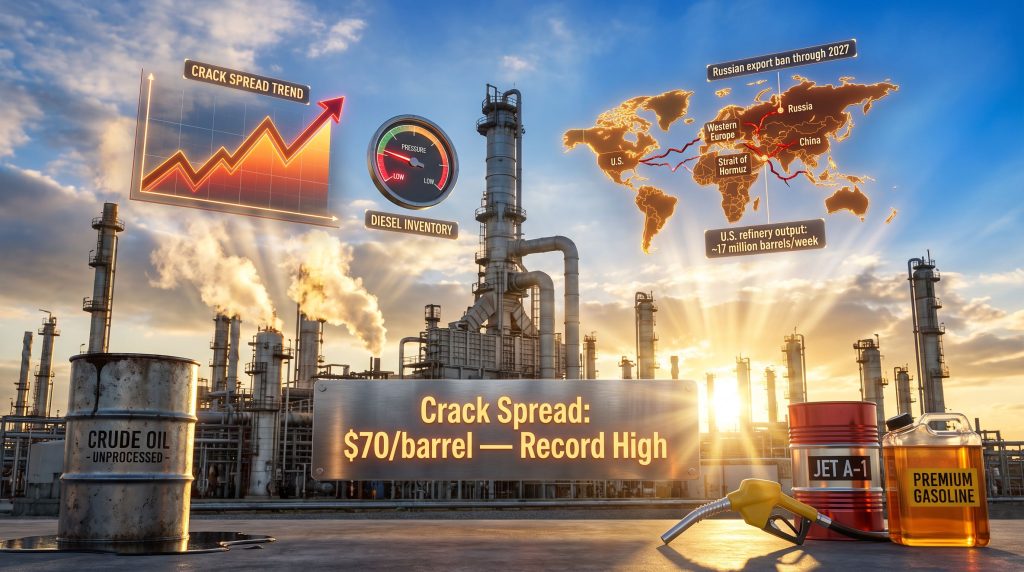
U.S. refineries produced approximately 17 million barrels of fuel per week as of late July 2026, the highest output since September 2019 according to Energy Information Administration data. Refining margins, measured by the crack spread — the price differential between crude oil feedstock and the finished products derived from it — reached a record $70 per barrel earlier in July.
Despite this extraordinary performance, American refinery output cannot arithmetically offset the simultaneous removal of Gulf product exports, Russian diesel supply, and Chinese quota-restricted surplus capacity from global markets. The volumes are simply incomparable in scale to the combined shortfall.
There is also a secondary vulnerability emerging. Running refineries at maximum throughput draws down domestic crude inventories. Commodity research analysts have noted that record-high crack spreads are incentivising refiners to operate at maximum rates, consequently generating a meaningful drawdown in U.S. crude stockpiles. If feedstock availability becomes constrained, refiners will be forced to reduce run rates, potentially worsening the finished fuel shortage that high utilisation was intended to address.
The crack spread reaching $70 per barrel is not just a market signal, it is a warning flare. It means the gap between what crude costs and what finished fuel is worth has never been wider, reflecting a refined product market under extraordinary stress.
Which Fuel Types Are Most at Risk?
Diesel: The Economy's Most Vulnerable Fuel
Diesel occupies a uniquely critical position in the global economy. Unlike gasoline, which primarily serves passenger vehicle transport, diesel powers the industrial backbone of modern civilisation:
- Long-haul freight and logistics networks
- Agricultural machinery including tractors, harvesters, and irrigation pumps
- Construction and mining equipment
- Industrial generators and backup power systems
- Heating oil for residential and commercial buildings in the northern hemisphere
This breadth of application means that diesel price escalation creates cascading inflationary effects across virtually every sector of the real economy. Food production costs rise. Freight costs rise. Industrial energy bills increase. These are not optional expenditures that can be deferred.
The timing of the current crunch is particularly problematic because the October-to-February northern hemisphere winter season creates an annual surge in heating oil demand derived from diesel distillate. Countries across Europe, northern Asia, and North America must build heating fuel inventory before temperatures drop. That build cycle is beginning now, against a backdrop of critically depleted diesel stocks.
Goldman Sachs has publicly identified the diesel crunch as the most significant threat currently facing global oil markets, reflecting how acute the situation has become in the eyes of institutional commodity analysts. Indeed, expert warnings of worsening fuel conditions suggest that global emergency stockpiles are nearing exhaustion, adding further urgency to the outlook.
Jet Fuel: Aviation's Quiet Pressure Point
Jet fuel inventories across European and Asian hubs are running below seasonal norms. Airlines are facing acute cost pressures, with the risk of route rationalisation and surcharge escalation as carriers attempt to pass through higher fuel costs. Aviation fuel tightness also feeds directly into freight and logistics cost inflation, given the scale of air cargo operations that serve global supply chains.
The Disproportionate Impact on Import-Dependent Emerging Economies
Nations in Southeast Asia, Sub-Saharan Africa, and Latin America face a structurally worse outcome than developed economies for several reasons:
- Higher fuel intensity: Diesel plays a proportionally larger role in electricity generation and agricultural production in lower-income economies where grid infrastructure is less developed.
- Limited hedging capacity: Governments and businesses in emerging markets have less access to financial instruments for locking in future fuel prices.
- Foreign currency pressure: Sustained elevated dollar-denominated fuel prices create balance-of-payment stress for import-dependent nations with limited reserves.
- Less policy flexibility: Emergency reserve drawdowns and subsidy programmes are constrained by fiscal capacity.
How Are Governments and Industries Responding?
Emergency Measures and Industry Adaptation
The response landscape is fragmented but increasingly active. Key developments include:
- A U.S.-Saudi consortium has announced plans for a $5 billion Gulf refinery located outside Hormuz exposure, representing a direct infrastructure response to the vulnerability exposed by the current conflict.
- Japan has backed overseas pipeline initiatives to diversify crude and product import routes away from Hormuz dependency, while separately exploring domestic refining capacity expansion.
- Australia is evaluating new refinery construction to reduce import reliance after the current crisis exposed the risks of the country's heavy dependence on imported refined products.
- Commodity trading firms including Glencore have reported substantial trading profits as they reposition supply flows to exploit regional price differentials, with Glencore reporting $3.3 billion in trading profit as market dislocations created arbitrage opportunities.
- Shipping and logistics operators are rerouting around conflict zones, adding transit time and cost across multiple trade lanes. These global supply chain stress factors are compounding the downstream pressure already present from geopolitical disruptions.
The next major ASX story will hit our subscribers first
What Does the Global Fuel Crunch Mean for Inflation and Economic Growth?
The Economic Transmission Mechanism
Fuel price shocks do not remain contained within the energy sector. They propagate through the broader economy via several channels simultaneously. Diesel price escalation raises input costs for food production, driving grocery inflation. Higher freight costs feed into the price of virtually every manufactured and transported good. Industrial energy bills constrain margins and investment capacity.
The macroeconomic consequences are already visible. Economists have revised India's GDP growth forecast downward in direct response to oil price shock transmission effects, illustrating how energy-import-dependent emerging economies are disproportionately exposed to the consequences of the global fuel crunch. In addition, oil market disruptions driven by trade tensions are further amplifying these effects.
Scenario Analysis: Three Possible Trajectories
| Scenario | Key Conditions | Timeline | Probability |
|---|---|---|---|
| Rapid de-escalation | Persian Gulf ceasefire, Hormuz reopening, Russian export ban lifted | 3-6 months minimum for inventory rebuild | Low near-term |
| Prolonged disruption through winter | Continued conflict, no policy reversal from Russia or China | Crunch persists through Q1 2027 | Moderate-to-high |
| Geographic escalation | Conflict spreads to additional infrastructure nodes | Acute fuel rationing across multiple regions | Low but non-trivial |
The prolonged disruption scenario is particularly concerning given the seasonal demand dynamics described above. A winter heating season colliding with critically low diesel stocks and no resolution to any of the four structural supply constraints would represent a genuine demand-destruction event in vulnerable economies.
How Does the Current Fuel Crunch Compare to Previous Energy Crises?
| Crisis Period | Primary Driver | Most Affected Fuel | Duration | Economic Impact |
|---|---|---|---|---|
| 1973 OPEC Embargo | Geopolitical supply cutoff | Gasoline | ~6 months | GDP contraction, stagflation |
| 1979 Iranian Revolution | Production collapse | Crude/gasoline | ~2 years | Double-digit inflation |
| 2005 Post-Katrina | Refinery damage | Gasoline/diesel | ~3 months | Regional price spikes |
| 2021-2022 Post-COVID | Demand recovery + underinvestment | Diesel/gas | ~18 months | Global inflation surge |
| 2026 (Current) | Multi-source: war + policy + capacity | Diesel/jet fuel | Ongoing | GDP downgrades, rationing risk |
What distinguishes the current crisis from every historical precedent in this table is the multi-source, multi-mechanism nature of the supply constraint. Previous crises typically had a single dominant cause that could be addressed through a targeted response. The 1973 embargo ended when the political decision to lift it was made. Post-Katrina refinery damage was repaired. The current shortage, however, requires simultaneous resolution of a Middle East conflict, a Russian policy reversal, a Chinese quota relaxation, and structural refinery capacity additions. None of these are near-term certainties, and OPEC market influence over production decisions adds yet another layer of complexity to any resolution timeline.
The Energy Transition Paradox
One of the less-discussed dimensions of the global fuel crunch is the paradox it has created for energy transition policy. Western refinery closures, accelerated in part by decarbonisation mandates and the anticipation of declining long-term fossil fuel demand, have directly contributed to the structural capacity erosion amplifying the current shortage.
At the same time, the oil price shock environment has triggered a 35% surge in global electric vehicle sales, as consumers facing punishing fuel costs accelerate the shift to electrification. This creates a tension within energy policy: the transition is being accelerated by the very fossil fuel scarcity that premature infrastructure retirement helped create.
Several jurisdictions that had committed to refinery closure timelines are now reconsidering those decisions in light of the energy security implications made starkly visible by the current crisis. The intersection of decarbonisation ambition and near-term supply security is proving more complicated than transition roadmaps assumed.
Frequently Asked Questions: Global Fuel Crunch Explained
Why are fuel prices rising even when crude oil supply seems adequate?
Refined products require processing through refining infrastructure before they reach consumers. When refining capacity is constrained, export policies restrict product flows, or distribution networks face disruption, finished fuel prices rise independently of crude benchmarks. The current crunch is fundamentally a refined product supply problem, operating largely separately from crude availability.
Which countries face the greatest exposure to the fuel shortage?
Nations combining high fuel import dependency with limited foreign currency reserves face the worst outcomes. Economies across Southeast Asia, Sub-Saharan Africa, and Latin America — where diesel is central to power generation, agriculture, and freight, and where price increases cannot be easily absorbed — are most vulnerable.
What is a crack spread and why does it matter?
A crack spread measures the price differential between crude oil feedstock and the refined products derived from it. A record crack spread of approximately $70 per barrel in mid-2026 indicates that refined fuel is extraordinarily scarce relative to the crude used to produce it. It is a primary indicator of downstream market stress and a key driver of refiner profitability.
How long could the fuel crunch persist?
Resolution depends on variables including the trajectory of Middle East conflict, Russia's domestic refinery recovery timeline, China's export quota decisions, and Western refining capacity additions. Without significant geopolitical de-escalation, the shortage could extend through the northern hemisphere winter of 2026–2027.
Is the U.S. Strategic Petroleum Reserve relevant to the refined product shortage?
Strategic petroleum reserves primarily address crude oil supply disruptions rather than refined product shortfalls. SPR releases can marginally ease feedstock availability for refiners but do not directly resolve the refining capacity constraints or export policy restrictions that are the root causes of the current shortage.
Key Takeaways
The 2026 global fuel crunch is the product of four simultaneously active supply constraints: Middle East conflict disrupting Gulf product exports, Russia's extended diesel export ban through 2027, structural Western refinery capacity closures, and China's restrictive fuel export quota policy. U.S. refineries operating at their highest output since pre-pandemic levels remain mathematically insufficient to offset the combined shortfall. Diesel faces the most acute near-term pressure, with northern hemisphere winter demand set to intensify stress on already-depleted inventories.
The critical structural insight is that this shortage cannot be resolved by a single intervention. It demands simultaneous resolution across geopolitical, policy, and infrastructure dimensions — a convergence that historical precedent suggests takes considerably longer to achieve than markets typically price in.
This article is provided for informational and educational purposes only and does not constitute financial, investment, or trading advice. Energy market forecasts, scenario analyses, and price projections involve inherent uncertainty and should not be relied upon as predictions of future outcomes. Readers should conduct independent research and consult qualified advisors before making investment decisions.
Want to Know Which ASX Resource Companies Are Positioned for the Energy Transition Ahead?
Discovery Alert's proprietary Discovery IQ model delivers real-time alerts on significant ASX mineral discoveries — including the commodities central to both traditional energy infrastructure and the accelerating shift toward electrification — ensuring subscribers can identify actionable opportunities before the broader market reacts. Explore historic discoveries and their remarkable returns on Discovery Alert's dedicated discoveries page, and begin your 14-day free trial today to secure a market-leading edge.