July 31, 2026
When Chokepoints Become Weapons: The Hormuz Crisis in Strategic Perspective
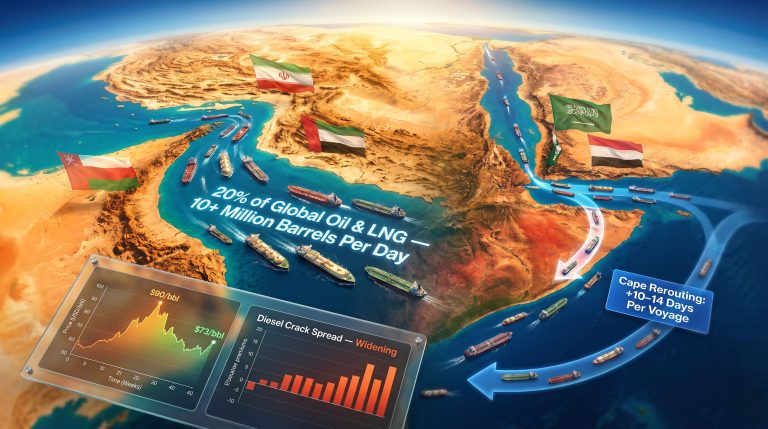
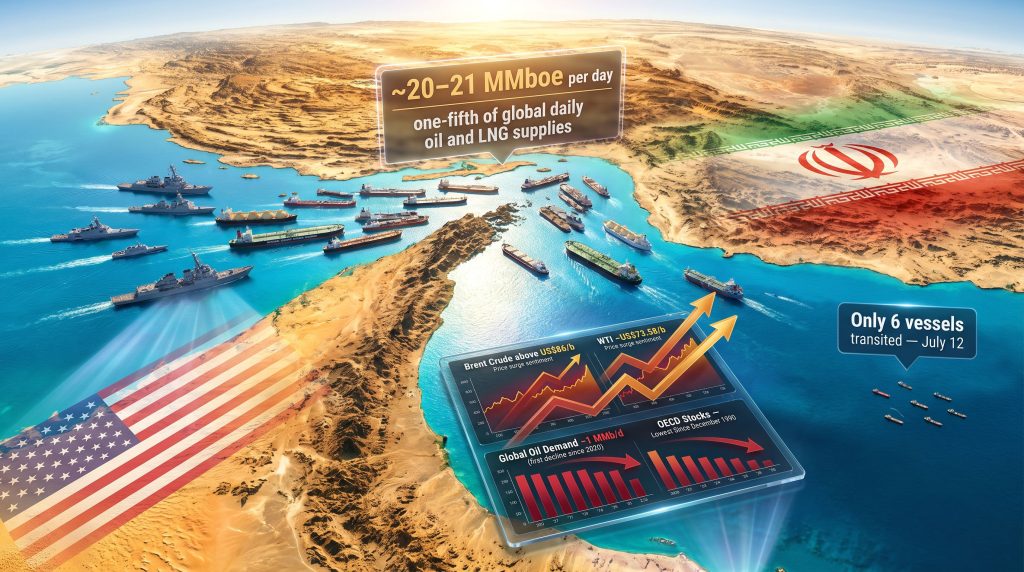
Throughout modern energy history, the world's most consequential supply disruptions have rarely originated from geological scarcity. They have emerged from geography, specifically from the handful of maritime passages through which the bulk of global hydrocarbon trade must physically move. No waterway illustrates this vulnerability more starkly than the Strait of Hormuz, a 21-mile-wide channel separating the Arabian Peninsula from Iran, through which approximately 20 to 21 million barrels of oil equivalent per day transited under normal conditions before the current conflict began. The US blockade of the Strait of Hormuz has fundamentally reshaped how energy markets price geopolitical risk.
That figure represents roughly one-fifth of all daily global oil and liquefied natural gas supplies. It also represents a concentration of systemic risk so extreme that any prolonged disruption carries consequences for energy importers from Tokyo to Hamburg to Mexico City. Understanding why this crisis matters requires first examining what makes the strait structurally irreplaceable, and then considering how a fragile ceasefire collapsed into renewed military confrontation in one of the most compressed and volatile escalation sequences the global energy market has witnessed in decades.
When big ASX news breaks, our subscribers know first
Why the Strait of Hormuz Has No Short-Term Substitute
The Strait of Hormuz functions as the singular exit point for oil and LNG exports from Kuwait, Iraq, the UAE, Qatar, and the majority of Saudi Arabian and Iranian production destined for international markets. Unlike the Suez Canal or the Panama Canal, which are artificial waterways constructed and maintained by specific nations, Hormuz is a natural geographic feature. This distinction carries both legal and operational consequences.
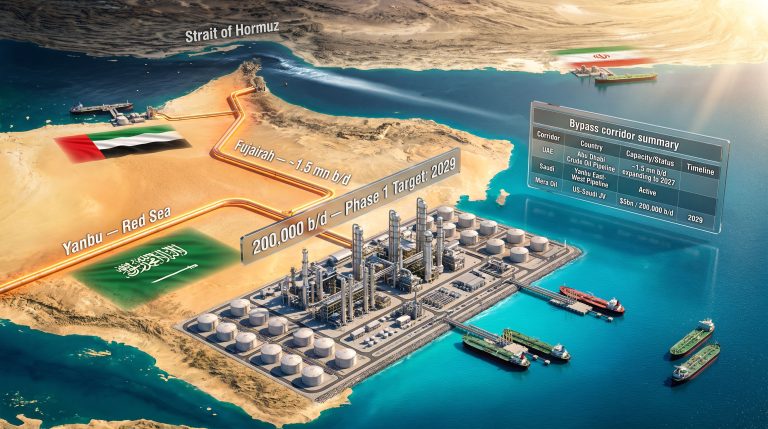
From an operational standpoint, there are no pipeline alternatives capable of absorbing the full volume of traffic that normally transits the strait. The East-West Pipeline across Saudi Arabia and the Abu Dhabi Crude Oil Pipeline provide partial bypass capacity, but their combined throughput remains a fraction of Hormuz volumes. Goldman Sachs has estimated that expanded pipeline infrastructure bypassing Hormuz could protect more than 60% of pre-war Gulf oil exports by the end of 2028, a structurally significant figure that nonetheless offers no relief during a crisis occurring in 2026.
Historically, the strait has been used as a pressure point in multiple confrontations. The "Tanker War" episodes of the 1980s during the Iran-Iraq conflict established the precedent for using commercial shipping as a proxy battlefield. What distinguishes the current situation is the combination of a formal US naval blockade, active military strike campaigns, a proposed and rapidly withdrawn transit toll, and simultaneous collapse of a ceasefire agreement, all unfolding within a matter of weeks. Furthermore, the oil price geopolitics of this region have long shaped global energy strategy, making the current escalation particularly consequential.
The Ceasefire That Collapsed Before It Could Take Hold
The June 2026 Memorandum of Understanding between the United States and Iran was intended to establish a framework for navigational rights through the strait. In practice, it produced the opposite: a document whose disputed language gave both parties a basis to claim the other was violating its terms almost from the moment of signing. The core disagreement centred on who held authority over transit through the waterway.
Iran's seizure of a Cypriot-flagged vessel served as the proximate trigger for renewed escalation. Tehran claimed the container ship had failed to comply with its rules for passing through the strait, a framing Washington rejected entirely. On July 13, 2026, President Trump notified Congress that US forces had resumed strikes against Iran, declared the United States the "Guardian of the Hormuz Strait," and reinstated the naval blockade on Iranian shipping. The blockade formally took effect at 4 p.m. Eastern Time on July 14.
This was not the first activation of the blockade. It had been imposed in mid-April 2026, lifted in mid-June following the ceasefire agreement, and then reimposed in July after the ceasefire's collapse. That cyclical pattern of imposition, partial relief, and renewed restriction is itself a distinct market phenomenon: it prevents the kind of sustained price normalisation that would allow commodity traders, fiscal planners, and sovereign oil exporters to calibrate their positions with any confidence.
What the Blockade Actually Covers, and What It Does Not
The scope of the US naval blockade is more targeted than a full closure of the strait would be, though vessel traffic data tells a more complicated story about its practical effects.
According to US Central Command, the blockade applies specifically to vessels entering or departing Iranian ports, or carrying Iranian cargo. Non-Iranian commercial shipping retains the right to transit freely, and humanitarian cargoes including food and medical supplies are described as permitted subject to inspection. Washington also revoked the licence that had previously permitted Iranian oil exports, compounding the supply disruption from an entirely separate policy instrument.
| Blockade Parameter | Status |
|---|---|
| Iranian-port vessels | Subject to interception and capture |
| Non-Iranian cargo ships | Permitted to transit |
| Humanitarian cargo | Permitted, subject to inspection |
| Freedom of navigation (neutral states) | Officially preserved per CENTCOM |
| Iranian oil export licence | Revoked by Washington |
The distinction between blocking Iranian maritime activity and closing the strait entirely matters enormously in legal and diplomatic terms, but vessel tracking data suggests the physical reality diverges sharply from official parameters. According to satellite-tracking firm Kpler, only six vessels transited the strait on July 12, the lowest daily count recorded in five weeks. The following day, Sunday July 13, saw just 14 vessels make the passage, a monthly low. Under normal operating conditions, dozens of vessels transit daily carrying the full 20 to 21 MMboe load. When daily counts fall into single or low double digits, the strait is functionally near-closed regardless of what diplomatic statements claim about freedom of navigation.
The 20% Transit Toll: A 24-Hour Policy Experiment
Alongside the blockade reinstatement, Trump announced via Truth Social that Washington would impose a 20% fee on all cargo transiting the Strait of Hormuz, framing the charge as reimbursement for US security provision in the waterway. No mechanism for calculation, collection, or enforcement was disclosed at the time of announcement.
The global maritime industry responded within hours. Key objections included:
- Hapag-Lloyd characterised the fee as fundamentally wrong, arguing international straits must remain open without transit charges
- The German Shipowners' Association warned the measure could be legally impermissible and risked setting a precedent for fees across other strategic waterways globally
- The International Maritime Organization stated its opposition to fees imposed on vessels passing through international maritime straits
- Industry representatives drew a legal distinction between artificial waterways such as the Panama and Suez canals, where tolls fund infrastructure, and Hormuz as a natural strait that requires no such funding argument
The legal architecture underpinning this opposition is rooted in the United Nations Convention on the Law of the Sea (UNCLOS), which establishes the right of transit passage through straits used for international navigation. Unlike canals, which exist under bilateral treaty frameworks granting the host state considerable commercial authority, natural straits fall under a distinct legal regime that explicitly preserves transit rights without fees or obstruction. The IMO's position carries significant institutional weight, though the organisation lacks enforcement mechanisms capable of compelling US compliance.
Legal scholars have noted that legitimising transit fees or blockades in natural straits could establish a precedent with cascading implications for other strategic chokepoints, from the Strait of Malacca to the Bab-el-Mandeb.
However, according to analysis of the blockade's legal framework, the risks attached to this approach extend well beyond immediate market disruption, potentially reshaping international maritime law for decades.
Less than 24 hours after the announcement, Trump withdrew the toll proposal, stating he had decided to replace the 20% fee with trade and investment commitments from Gulf states into the United States. No specific countries, values, or timelines were identified. The naval blockade remained in place. The episode encapsulates a broader pattern: dramatic policy announcements made through social media without operational detail, followed by rapid reversal under market and diplomatic pressure, while the underlying military confrontation with Iran continues beneath the policy noise.
How Oil Markets Have Processed the Escalation
Immediate Price Impacts
Price responses to the reinstated blockade were immediate and sharp. Brent crude surged approximately 5% to approach US$80 per barrel following the initial blockade and toll announcement, with West Texas Intermediate rising more than 3% to approximately US$73.58/b on the same session. During trading on July 14, Brent climbed above US$86/b as continued attacks on vessels and ongoing US military operations sustained supply concern. Prices partially retraced after the toll withdrawal but remained elevated on tanker safety uncertainty.
At the retail level, American drivers were paying an average of US$3.87 per gallon, up seven cents week-on-week, reflecting how quickly upstream disruption transmits through the distribution chain to end consumers. In addition, the broader crude oil market overview context helps explain why markets were already positioned for heightened sensitivity before this escalation began.
Why Price Discovery Has Become Unreliable
What makes the current pricing environment particularly difficult to trade is the combination of intraday volatility, policy reversals within 24 hours, and a physical market whose true closure status is best read through vessel count data rather than official statements. Commodity traders increasingly treat Kpler's daily strait transit numbers as the most reliable real-time indicator of Hormuz status, more informative than diplomatic communiques or social media posts. Monitoring crude oil price trends has consequently become as much an exercise in geopolitical analysis as in traditional supply-demand modelling.
The next major ASX story will hit our subscribers first
The IEA's July 2026 Assessment: Damage Already Recorded
The International Energy Agency's July 10 Oil Market Report documented the structural demand damage accumulated before the latest escalation. The findings establish the baseline from which the reinstated blockade operates:
| Global Oil Market Metric | Data Point |
|---|---|
| Projected 2026 demand contraction | -1 MMb/d (first decline since 2020) |
| IEA downgrade vs. May 2026 forecast | -700 Mb/d |
| Q2 2026 delivery decline (year-on-year) | -5 MMb/d |
| June 2026 production rebound | +4.1 MMb/d |
| Output gap vs. pre-war levels | -9.4 MMb/d |
| Global inventory drawdown rate | -3.8 MMb/d (since conflict began) |
| OECD government stocks | Lowest since December 1990 |
The partial reopening of the strait in June had enabled a +4.1 MMb/d production rebound, but output still sat 9.4 MMb/d below pre-war levels, and OECD government stockpiles had fallen to their lowest point since December 1990 as emergency releases accelerated. The IEA framed a lasting peace agreement not merely as a desirable outcome but as a prerequisite for market normalisation, a condition that remains unmet.
The 2026 demand contraction of 1 MMb/d marks only the second annual decline in global oil consumption in the post-financial crisis era, the first having been the pandemic collapse of 2020. That comparison is instructive: the 2020 decline was driven by demand destruction from lockdowns. The 2026 contraction is driven by supply disruption elevating prices to the point where consumption contracts, a structurally different mechanism with different implications for recovery speed.
Regional Military Escalation and the Risk of Miscalculation
US Central Command carried out a broad campaign of strikes against Iranian military infrastructure, targeting air defences, coastal radar installations, and Revolutionary Guard small boat formations. Iran responded with drone and missile attacks directed at Jordan, Bahrain, Kuwait, and Oman, all of which reported successful air defence interceptions with no casualties confirmed.
The pattern of Iranian retaliation targeting Gulf states that host US military facilities introduces a dimension of regional instability beyond the strait itself. Gulf states face an acute strategic dilemma: they rely on US security guarantees for territorial protection, but their economies are deeply exposed to any sustained disruption of Hormuz traffic. The strait is simultaneously their lifeline for oil exports and the corridor through which potential military escalation would most consequentially flow.
The risk of miscalculation in this environment is not a theoretical concern. A single naval engagement between US forces and Iranian vessels, or an accidental strike on a neutral commercial tanker, could trigger an escalatory response that moves the conflict from a targeted blockade to a full strait closure scenario. Furthermore, the broader geopolitical trade tensions reshaping global commerce in 2025 and 2026 have reduced the diplomatic buffers that might otherwise dampen such escalation dynamics.
Mexico's Fiscal Exposure: The Price Spike That Doesn't Fully Materialise
For Mexico, the Hormuz crisis creates a paradox that fiscal planners at the SHCP are navigating in real time. The ministry's 2027 Pre-Criteria had revised the 2026 oil price assumption upward to US$77.3/b in April, but with Brent tracking back toward US$72/b in late June and early July, second-half revenues appeared likely to fall below even that adjusted figure.
The reinstated blockade temporarily changes that calculus. Brent at or above US$80/b nominally restores Mexico's price environment above both budget references. However, several structural factors prevent the headline price spike from translating directly into equivalent fiscal benefit:
- Export volume shortfall: PEMEX exported approximately 431 Mb/d in the January-May 2026 period, roughly 20% below the SHCP's annual export target. Lower volumes mean lower total revenue regardless of unit price.
- Quarterly averaging mechanics: The revenue Mexico captures over a fiscal quarter is determined by the average of dozens of daily settlements, not the price recorded on the day of a dramatic policy announcement. A 5% spike that partially reverses within 24 hours contributes marginally to the quarterly average.
- Volatility as a planning enemy: The policy cycle of blockade announcement, toll proposal, toll withdrawal, and military continuation all within 48 hours is precisely the condition that makes revenue forecasting for sovereign fiscal management most unreliable.
Goldman Sachs estimates that expanded bypass pipeline capacity could protect more than 60% of pre-war Gulf oil exports by end-2028, but that structural shift lies well beyond Mexico's current fiscal year horizon. Moreover, the trade war oil impact layered on top of the Hormuz disruption creates compounding revenue uncertainty for export-dependent economies like Mexico's. The IEA's prerequisite framing around peace as a condition for normalisation remains the most operationally relevant analytical lens for Mexico's energy and budget planning, and that condition is currently moving further away, not closer.
Three Scenarios for the Strait's Future
The trajectory of the US blockade of the Strait of Hormuz and its global energy market implications depends on which of three structural scenarios ultimately prevails:
Scenario 1: Negotiated Settlement. A durable US-Iran agreement restores full transit rights, global supply recovers toward pre-war levels, and energy markets normalise over a 12 to 18 month horizon. OECD inventories rebuild gradually and the demand contraction of 2026 reverses. This scenario requires political conditions not currently in evidence.
Scenario 2: Prolonged Partial Blockade. Intermittent openings and closures persist, tanker risk premiums remain structurally elevated, shipping insurers price Hormuz exposure into global freight costs, and producers accelerate investment in bypass infrastructure. Commodity markets operate in a permanently elevated volatility regime.
Scenario 3: Full Strait Closure. A miscalculation or deliberate escalation triggers complete closure. Global oil markets face a supply shock with no post-1973 parallel. Emergency strategic reserve releases cannot offset the volume gap. Price spikes transmit rapidly into global inflation and demand destruction simultaneously.
The IEA's July report implicitly frames the probability distribution across these scenarios as weighted toward continued instability rather than resolution, given the speed at which the June ceasefire disintegrated and the absence of any durable negotiating framework.
Frequently Asked Questions: US Blockade of the Strait of Hormuz
What is the US blockade of the Strait of Hormuz?
A US naval operation initiated in 2026 targeting vessels entering or leaving Iranian ports, while permitting non-Iranian shipping to transit the strait freely. Ships violating the blockade risk interception, diversion, and capture by US naval forces.
When was the Hormuz blockade imposed?
The blockade was first imposed in mid-April 2026, lifted in mid-June 2026 following a ceasefire memorandum, and reimposed on July 14, 2026, after the ceasefire collapsed.
Does the US blockade close the Strait of Hormuz entirely?
Not officially. The stated scope targets Iranian-port vessels and Iranian cargo only. However, vessel tracking data showed daily transit counts falling to as low as 6 ships, indicating near-complete physical closure at peak escalation moments regardless of official policy parameters.
Is the US blockade of the Strait of Hormuz legal under international law?
This is actively contested. The US frames it as a lawful naval blockade under the laws of armed conflict. Iran describes it as an illegal act of aggression. The IMO holds that no state holds authority to obstruct or impose fees on shipping in internationally used natural straits.
What happened to the 20% Hormuz transit toll?
Trump announced the toll on July 13, 2026, via Truth Social with no enforcement mechanism specified. Within 24 hours he withdrew the proposal, replacing it with a reference to prospective Gulf state investment commitments to the US, without identifying countries, values, or timelines.
How much oil passes through the Strait of Hormuz normally?
Under pre-conflict conditions, approximately 20 to 21 MMboe per day transited the strait, representing roughly one-fifth of global daily oil and LNG supplies.
What impact has the Hormuz crisis had on oil prices?
Brent crude surged approximately 5% to approach US$80/b on the initial blockade announcement, later climbing above US$86/b during July 14 trading. WTI rose more than 3% to approximately US$73.58/b on the same session.
This article contains forward-looking assessments, scenario projections, and references to third-party forecasts including IEA and Goldman Sachs estimates. These projections involve material uncertainty and should not be interpreted as investment advice or as guarantees of future market outcomes. Readers should conduct independent analysis before making decisions based on the information presented.
Want To Identify the Next Major Mineral Discovery Before the Market Catches On?
While geopolitical disruptions like the Hormuz crisis reshape global commodity markets, Discovery Alert's proprietary Discovery IQ model scans ASX announcements in real time, instantly alerting subscribers to significant mineral discoveries across more than 30 commodities — turning complex data into actionable investment opportunities. Explore Discovery Alert's discoveries page to see the historic returns major finds have delivered, and begin your 14-day free trial today to position yourself ahead of the broader market.