July 31, 2026
When Labour Costs Meet the World's Lowest-Cost Iron Ore Corridor
The global iron ore market operates on razor-thin tolerance for supply disruptions. Port Hedland, the beating heart of Australia's Pilbara export machine, handles more bulk commodity tonnage than almost any other single port on the planet. When workers at that port signal industrial action, the ripple effects travel instantly from Western Australian mine sites to Chinese steel mill procurement desks and Singapore Exchange futures screens. Understanding why that signal was sent on July 30, 2026, requires looking well beyond a single bargaining dispute.
The BHP WA iron ore strike notification filed for August 9, 2026, is the most visible expression of a deeper structural tension that has been building across Australia's remote resource workforce for several years. It raises questions not just about one company's labour relations, but about the long-term sustainability of the fly-in fly-out workforce model that underpins the entire Pilbara production system.
When big ASX news breaks, our subscribers know first
The Anatomy of a Bargaining Breakdown
Six to Nine Months Without Resolution
Industrial disputes rarely emerge suddenly. The enterprise agreement negotiations between BHP and the Combined BHP Ports Union had been grinding forward without resolution for approximately six to nine months before the strike notification was lodged. That duration is itself a signal: when talks stretch across half a year without a settlement, it typically reflects a fundamental gap in the positions of both sides rather than a technical disagreement over minor clauses.
The union's core demands centred on four interconnected issues:
- Pay parity across roles with comparable responsibilities and operational risk profiles
- Clearer job classification structures to reduce ambiguity about what workers are entitled to earn at different career stages
- Defined career progression pathways that give long-serving employees a transparent route toward higher-grade positions
- Improved working conditions at Pilbara port facilities, where the physical environment is among the most demanding in the Australian resources sector
None of these demands is unusual in isolation. What makes the current dispute significant is the convergence of all four simultaneously, combined with a labour market backdrop that has strengthened the union's bargaining position considerably since previous agreement cycles.
The FIFO Labour Market Has Fundamentally Shifted
One of the least-discussed drivers of the current dispute is the structural tightening of skilled labour availability across Western Australia's resource regions. The fly-in fly-out workforce model, which BHP and its Pilbara peers have relied upon for decades, depends on a consistent pipeline of workers willing to accept remote postings, roster cycles, and the lifestyle trade-offs associated with Pilbara operations.
Post-pandemic labour market dynamics have disrupted that pipeline in ways that are not yet fully reflected in public commentary. Key shifts include:
- Competing demand for skilled trades and maintenance workers across the broader resources and construction sectors
- Rising cost-of-living pressures in Perth and other major cities that have intensified pay parity demands among FIFO workers
- A generational shift in workforce expectations around work-life balance, classification transparency, and career certainty
- Growing coordination capacity among unions operating across port, maintenance, and logistics functions within the Pilbara
These factors collectively explain why pay parity has emerged as the central flashpoint. FIFO workers in the Pilbara are acutely aware of what comparable roles pay at competing operations, and the information asymmetry that once allowed large miners to maintain wage differentials has eroded significantly in the digital age.
BHP's Pilbara Operation: Scale That Makes Every Stoppage Count
Seven Mines, One Critical Port
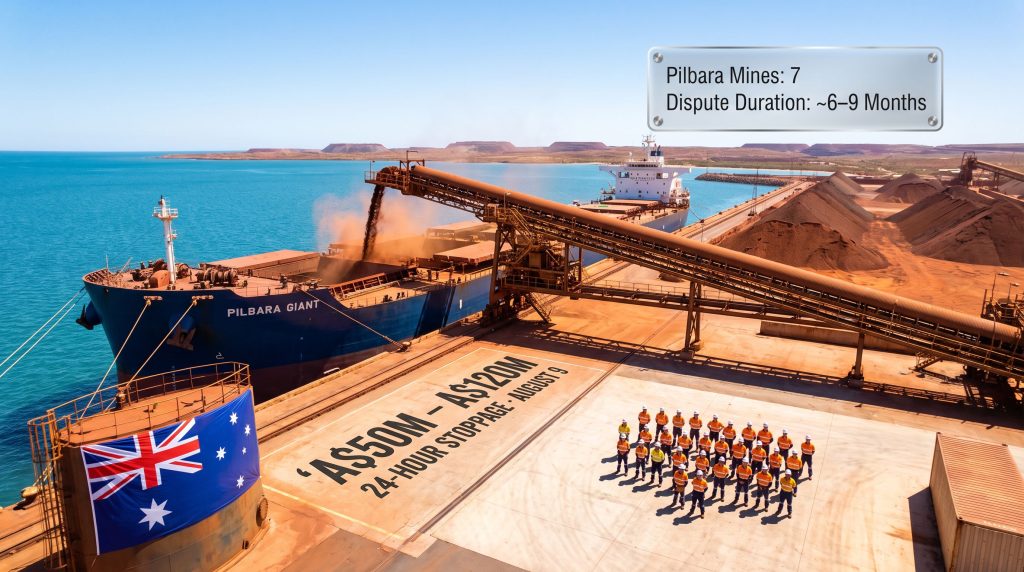
BHP operates seven iron ore mines across the Pilbara region of Western Australia, including the Jimblebar operation. The ore extracted across these mines flows through a dedicated rail network to Port Hedland, where it is loaded onto bulk carriers bound primarily for Chinese steel mills. The sheer concentration of high-grade ore extraction, efficient rail logistics, and deep-water port access in a single geographic corridor is what makes the Pilbara one of the most strategically important mineral producing regions on earth.
Pilbara iron ore benefits from naturally high iron content, typically in the range of 57% to 62% Fe across major product grades, with BHP's signature Pilbara Blend product being one of the most recognised iron ore brands in the global seaborne market. This grade consistency matters enormously to steel mill buyers, who use ore chemistry to calibrate their blast furnace inputs. Disruptions to Pilbara supply are therefore not simply a tonnage problem but a quality supply problem that cannot be immediately substituted. Furthermore, Australia's iron ore advantages in grade consistency and proximity to Asian markets reinforce why any supply disruption draws immediate global attention.
Port Hedland's Operational Chokepoint Logic
Port Hedland's significance to global iron ore supply cannot be overstated. It is regularly cited as the world's largest bulk export port by total tonnage. For BHP specifically, the port serves as the single point through which the output of seven mines must flow before reaching export markets. This concentration creates what logistics analysts describe as a chokepoint structure, where a relatively small number of port workers exercise leverage that is highly disproportionate to their headcount.
The estimated number of workers involved in the notified action ranges from approximately 63 to around 200, depending on whether the count includes direct strikers or also encompasses broader strike supporters and affiliated roles. That relatively modest headcount, controlling a port that processes tens of millions of tonnes of ore annually, illustrates precisely why port and maintenance workers occupy such a powerful position in the industrial relations calculus. BHP workers voting for strike action at this critical hub underscores the structural leverage that even a small workforce can wield.
| Metric | Detail |
|---|---|
| BHP Pilbara mines in operation | 7 (including Jimblebar) |
| Primary export terminal | Port Hedland, Western Australia |
| Typical Pilbara ore grade | 57%–62% Fe (iron content) |
| Estimated striking workers | ~63 to ~200 |
| Negotiation period before strike notice | ~6–9 months |
| Notified strike duration | 24 hours (August 9, 2026) |
| Estimated daily revenue exposure | A$50 million – A$120 million |
| Preceding action | Eight-hour stoppage, mid-July 2026 |
Quantifying the Economic Exposure
What A$50 Million to A$120 Million Actually Means
Industry and media estimates of daily revenue exposure from a Port Hedland stoppage range between A$50 million and A$120 million, and the wide band in that estimate is itself informative. The lower end reflects scenarios where BHP's contingency operations maintain partial throughput, stockpiles at port buffer vessel loading schedules, and supervisory staff maintain minimum operational continuity. The upper end reflects a scenario where loading ceases entirely and vessels anchored offshore accumulate demurrage costs on top of lost shipment revenue.
BHP has publicly confirmed that contingency plans are in place to maintain safe operations during any industrial action period, and the company reaffirmed its commitment to progressing negotiations through the Fair Work Commission's formal dispute resolution framework.
The July Precedent: Why Headlines Can Mislead
The mid-July 2026 eight-hour stoppage at Port Hedland was historically notable as the first significant industrial strike action in the Pilbara region in decades. Yet the operational outcome was considerably less dramatic than initial estimates implied. According to reporting on BHP's record production at the time, ships continued being loaded during the action, suggesting BHP's contingency deployment was effective enough to maintain throughput continuity.
This gap between theoretical revenue exposure and actual operational disruption is critical for investors to understand. A notified strike and an effective shutdown are not the same event.
This precedent creates an important analytical distinction. The August 9 notification should be read as a measure of bargaining pressure, not as a certain production loss event. The actual impact will depend heavily on the effectiveness of BHP's contingency workforce deployment, port stockpile levels, and whether vessels reschedule or wait.
Iron Ore Markets and the China Demand Chain
Why Chinese Steel Mills Watch Port Hedland Closely
China absorbs the large majority of Australia's seaborne iron ore exports. For Chinese steel mills, Pilbara ore is not simply a commodity input but a benchmark product against which other sources are priced and blended. The predictability of Pilbara supply, both in volume and in chemistry, is embedded into blast furnace operating models at major integrated steel producers across Hebei, Jiangsu, and Liaoning provinces.
Even a 24-hour disruption at Port Hedland, if it coincides with lean inventory buffers at receiving ports, can create short-term tightening in spot availability. Singapore Exchange iron ore futures, which serve as the primary price discovery mechanism for the Asian seaborne market, have historically shown sensitivity to Pilbara operational news even when the underlying physical disruption is modest. Consequently, the iron ore demand prospects flowing from Chinese mill activity remain a key variable in how markets interpret any Pilbara supply event.
Brazil as the Alternative: Freight Differentials Matter
Brazil's Vale represents the only other iron ore producer capable of supplying volumes at a scale comparable to Australian output. However, the freight cost differential between Brazilian and Australian ore for Asian buyers is substantial. Brazilian iron ore travels approximately three times the distance to reach Chinese ports compared to Pilbara ore, meaning that even when Brazilian ore achieves spot price parity on an FOB (free-on-board) basis, Chinese buyers still face higher landed costs.
This freight disadvantage for Brazilian ore means there is no seamless short-term substitution available if Pilbara supply tightens. A sustained escalation of industrial action at BHP's WA operations would therefore translate more directly into market pricing pressure than a comparable disruption at a less strategically positioned supply source. In addition, the global iron ore tariff impact continues to add further complexity to procurement decisions for Asian buyers weighing their supply options.
Escalation Scenarios: Three Pathways From Here
Scenario 1: Settlement Before August 9
The Fair Work Commission provides a structured mediation pathway that both parties have engaged with. BHP's financial incentive to avoid disruption during peak shipping season is substantial. If the commission facilitates an interim agreement covering the core classification and pay parity disputes, strike action can be suspended pending formal enterprise agreement ratification. This remains the most commercially efficient outcome for BHP shareholders.
Scenario 2: Strike Proceeds, Limited Operational Impact
If August 9 proceeds as notified, the most likely outcome based on the July precedent is a 24-hour period of elevated industrial tension with partial operational continuity maintained through contingency deployment. The symbolic value of the action for the union may outweigh its direct operational impact, and both parties may return to negotiations with sharpened positions.
Scenario 3: Rolling Stoppages Escalate Through Q3 2026
The highest-risk scenario for investors involves a breakdown in post-August 9 negotiations triggering a series of protected industrial actions extending across the third quarter of 2026. Under Australian workplace law, once workers enter a period of protected industrial action, the bar for further stoppages is meaningfully lower than the initial notification threshold. Cumulative disruption across multiple rolling actions could materially affect BHP's Q3 2026 production guidance and force a revision to annual iron ore shipment targets.
The broader Australian resources sector is watching this dispute carefully. Multiple enterprise agreements across Pilbara operators are scheduled for renegotiation in 2026, meaning the outcome of the BHP negotiation could set a precedent that flows across the entire region's industrial relations landscape.
The next major ASX story will hit our subscribers first
What Investors Should Track From Here
Beyond the August 9 date itself, several indicators will determine whether this dispute represents a contained industrial relations event or a more structurally significant shift in Pilbara labour dynamics. Furthermore, broader considerations around China steel and iron ore market conditions and iron ore surplus risks may amplify or dampen how markets respond to any escalation:
- Fair Work Commission activity: Additional protected action notices filed after August 9 would represent a material escalation signal requiring reassessment of production guidance assumptions
- BHP's Q3 2026 production report: Any tonnage revisions or qualifications attributable to industrial action would crystallise the financial impact currently captured only in theoretical revenue exposure estimates
- Sector read-through: If BHP reaches a settlement that meaningfully improves pay and classification terms, similar demands at Rio Tinto's Pilbara operations and Fortescue's port facilities may follow as unions benchmark against the outcome
- Iron ore spot price movement on SGX: Sustained price moves above what iron ore demand fundamentals would justify may indicate the market is beginning to price in supply risk rather than treating the dispute as transient
The BHP WA iron ore strike notification is, at its core, a workforce story embedded within a commodity market story. The Pilbara's unmatched combination of ore grade, infrastructure scale, and proximity to Asian demand has historically insulated BHP's iron ore division from sustained operational disruption. Whether that insulation holds through the second half of 2026 will depend less on the economics of iron ore and more on the resolution of a labour market tension that has been building quietly for years.
Disclaimer: This article contains forward-looking assessments, scenario projections, and estimated financial figures sourced from industry reporting and publicly available information. These are not guarantees of future outcomes. Investors should conduct independent due diligence before making decisions based on information contained in this article.
Want to Stay Ahead of Significant ASX Mineral Discoveries Before the Broader Market Reacts?
While Pilbara supply disruptions dominate commodity headlines, Discovery Alert's proprietary Discovery IQ model scans ASX announcements in real time, instantly alerting subscribers to significant mineral discoveries across over 30 commodities — explore historic discovery returns on Discovery Alert's discoveries page to understand the scale of opportunity, then begin your 14-day free trial at Discovery Alert to position yourself ahead of the market.