July 31, 2026
The Shipping Lane That Moves the World: Inside the Hormuz Traffic Crisis
Global energy markets are built on assumptions of continuity. The assumption that tankers will move, that crude will flow, and that the infrastructure connecting producers to consumers will remain functional. When those assumptions break down, the consequences ripple outward with remarkable speed. Strait of Hormuz tanker traffic is the single most consequential test of that continuity assumption in 2026, and the data emerging from vessel tracking platforms tells a story that markets are still struggling to fully price.
When big ASX news breaks, our subscribers know first
The Geography of Irreplaceability
Understanding why Strait of Hormuz tanker traffic matters so profoundly requires understanding what the strait actually does within the global energy architecture. The waterway is a narrow passage connecting the Persian Gulf to the Gulf of Oman, and from there to the Indian Ocean and onward to Asian refining hubs. Under normal operating conditions, the strait handles roughly 20% of global oil and LNG supply daily, with more than 100 vessels crossing in both directions each day.
Is There Any Alternative Route?
What makes this chokepoint structurally irreplaceable is the near-complete absence of viable alternatives for most Gulf producers. Saudi Arabia maintains pipeline access to the Red Sea port of Yanbu and to the Mediterranean terminal at Sidi Kerir, but the combined capacity of these routes represents only a fraction of normal Hormuz throughput. For producers like the UAE, Kuwait, and Iraq, there is effectively no alternative. Their crude exits via Hormuz or it does not exit at all.
The strait functions alongside the Bab el-Mandeb strait in the southern Red Sea as one of two critical pressure points in Middle Eastern energy logistics. When both face simultaneous disruption, as is currently the case, the effect is not merely additive. It is multiplicative, forcing operators to choose between high-risk direct transits and significantly longer, costlier diversions around the Cape of Good Hope. Furthermore, crude oil price trends indicate that such supply shocks historically translate into rapid benchmark movements.
A Traffic Count That Tells a Disturbing Story
The scale of the disruption to Strait of Hormuz tanker traffic becomes starkly apparent when vessel counts are placed in historical context. Real-time data from vessel tracking platforms provides the clearest picture of how dramatically throughput has fallen.
| Period | Recorded Daily Vessel Count | Operational Context |
|---|---|---|
| Pre-conflict baseline | 100+ vessels/day | Normal operations |
| Spring 2026 (peak disruption) | ~7 vessels/day | Extreme restriction; wide diversion |
| July 9, 2026 | 13 vessels (Wednesday) | Down from 33/day the prior week |
| July 13, 2026 | 6 vessels | Two-month low; renewed strikes |
| Late July 2026 | 14 vessels (Wednesday) | Partial recovery phase |
| June 2026 brief reopening | 25 vessels (Thursday) | Post-arrangement uptick |
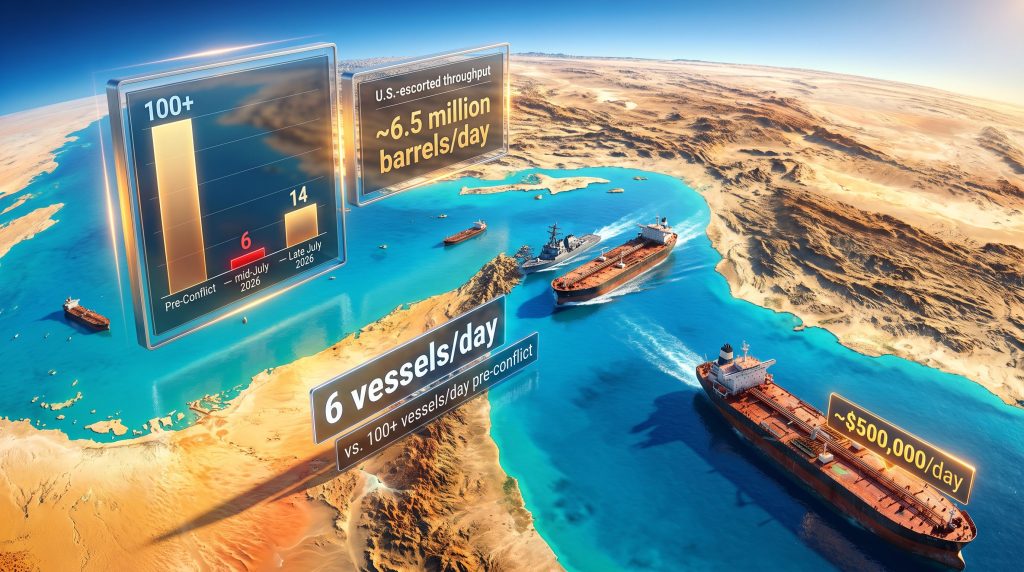
The mid-July low of six vessels represents a reduction of more than 94% from normal daily throughput. To put that in commodity terms, it means that a waterway responsible for roughly one-fifth of the world's oil and LNG supply was, on that day, functionally closed to commercial traffic.
The partial recovery to 14 vessels per day in late July 2026 may look encouraging in isolation, but it remains approximately 86% below pre-conflict norms. The direction of change matters, but so does the absolute level.
Why Published Vessel Counts Are Likely an Undercount
One critically underappreciated dimension of the current data environment is that all published vessel counts are almost certainly understating actual traffic levels. Several dynamics contribute to this:
- Vessels are increasingly operating with their AIS (Automatic Identification System) transponders switched off, making them invisible to standard vessel tracking platforms
- The LPG carrier CYH Yongchun was documented transiting the strait with its transponder disabled, confirming the practice is active
- South Korean-controlled VLCC V Glory was observed approaching the Gulf of Aden before going dark, while the Saudi-flagged tanker Samha exhibited the same behaviour
- Market intelligence firms tracking vessel movements explicitly acknowledge that their figures carry revision caveats as new data emerges
Transponder suppression is not new to high-risk maritime corridors, however the scale of its adoption in the current environment is unusual. For market analysts, this creates a structural gap between reported and actual traffic volumes. For commercial operators, it is a pragmatic survival strategy that introduces its own operational risks, including reduced collision avoidance capability and navigational complexity.
Military Escorts and the New Logic of Energy Shipping
The partial recovery in Strait of Hormuz tanker traffic is not occurring organically. It is being actively enabled by an unprecedented military logistics operation. U.S. Energy Secretary Chris Wright confirmed in late July 2026 that the U.S. Navy is actively escorting oil and gas shipments through the strait, with approximately 6.5 million barrels of oil per day exiting the Gulf under military protection during the most recent reporting week.
This represents a genuinely novel precedent in the history of global energy logistics. Military naval escort of commercial energy shipping at this scale has no direct peacetime parallel. The closest historical analogies are the convoy protection systems of wartime maritime history, not the commercial frameworks that have governed global shipping for the past four decades.
Several structural implications follow from this arrangement:
- Commercial operators are now operationally dependent on military scheduling and capacity allocation
- The volume of escorted throughput is constrained by naval resources, not commercial demand
- The arrangement creates geopolitical obligations and dependencies that extend well beyond the immediate shipping context
- Non-U.S.-flagged vessels face a different risk calculus, as the escort umbrella may not extend uniformly across all commercial operators
In addition, a Norwegian-flagged products tanker was observed preparing to exit the strait, suggesting that non-American commercial operators are also testing the route, either under the escort framework or independently. Consequently, OPEC market influence over production decisions is being complicated by the physical inability to consistently move barrels through the strait.
Freight Rates as a Risk Barometer
Few indicators capture the market's assessment of Hormuz risk more precisely than VLCC spot freight rates. The provisional booking of the crude supertanker Jamaica Prosperity at approximately $500,000 per day to collect a Persian Gulf cargo for delivery to China, fixed at Worldscale 465 points by the shipping unit of a Chinese charterer, provides a concrete data point for the risk premium currently embedded in Persian Gulf logistics.
To contextualise this figure: standard VLCC spot rates under normal market conditions typically trade at a fraction of this level. The $500,000 per day provisional rate reflects:
- War risk insurance premiums that have escalated sharply since mid-2026
- Operational uncertainty about whether the transit will be physically executable
- Charterer willingness to pay elevated rates to maintain supply chain continuity
- The provisional rather than firm nature of the booking, which itself signals ongoing uncertainty about route viability
The fact that Chinese charterers are absorbing these costs reflects both the strategic importance of Persian Gulf crude to Chinese refiners and the absence of sufficient alternative supply at comparable prices. It also signals that at least some commercial actors believe the risk, while extreme, is manageable at current escort and security levels.
Red Sea Pressure: Bab el-Mandeb and the Mediterranean Diversion
The Hormuz situation cannot be fully understood in isolation from simultaneous disruption at the Bab el-Mandeb strait in the southern Red Sea. On Wednesday of the reporting week, just 21 commodity vessels crossed Bab el-Mandeb, down sharply from 38 the prior day. Russian crude dominated the cargo mix, accounting for approximately 3.5 million barrels of the throughput, with Western commercial traffic largely absent.
The northern Red Sea is facing distinct but related pressures. Two LNG carriers were struck at Egypt's Damietta port near the Suez Canal entrance, with no party claiming responsibility at the time of reporting. The attack forced a significant rerouting response:
- The Japanese-flagged VLCC Takamatsu Maru diverted to Egypt's Mediterranean coastal terminal at Sidi Kerir, bypassing the Red Sea entirely
- VLCCs Bidbid and VL Prosperity arrived at and began loading from Sidi Kerir, with previously confirmed destinations in Asia
- Three additional VLCCs, Olympic Luck, DHT Gazelle, and DHT Mustang, departed Yanbu and are currently idling off Sidi Kerir with no confirmed onward destination
- Iranian-linked Suezmaxes Chloe and Kariz sailed into the Hormuz strait and are now idling near Iran's Bandar Abbas port
The simultaneous pressure on both chokepoints is effectively bifurcating global tanker routing. Some operators are accepting elevated risk for direct transits. Others are taking the Mediterranean diversion via Sidi Kerir. Still others are idling in holding patterns, waiting for the security environment to clarify before committing to a route.
The emergence of Sidi Kerir as an active alternative discharge point for Asian-bound crude is a structural adaptation with long-term logistics implications. If the diversion persists, it could reshape procurement patterns and refinery feedstock arrangements across Northeast Asia.
Furthermore, these oil logistics risks extend well beyond freight costs, creating downstream uncertainty for refiners reliant on consistent Persian Gulf feedstock delivery schedules.
The next major ASX story will hit our subscribers first
Qatar's LNG Resumption: A Signal Worth Watching
Among the most significant individual shipping events of late July 2026 was the departure of the LNG carrier Al Areesh from Qatar, carrying the country's first LNG cargo in three weeks. Qatar is the world's largest LNG exporter, and a three-week suspension of its export programme carries substantial consequences for European and Asian gas markets. The disruption to global LNG supply from this single corridor illustrates just how concentrated the world's gas export infrastructure has become.
The resumption of even a single LNG shipment carries symbolic and practical weight. It demonstrates that:
- The transit corridor is sufficiently functional for high-value gas cargoes under current conditions
- Qatari export terminals have either resumed operations or maintained readiness during the disruption
- LNG buyers in Europe and Asia have at least partial visibility on resuming contracted supply deliveries
However, a single shipment does not constitute a normalisation of LNG export volumes. Qatar's normal export capacity significantly exceeds what a single vessel represents, and the broader question of sustained throughput remains open.
Three Scenarios for How This Resolves
Investor and commercial operator positioning in the current environment is necessarily scenario-dependent. Three broad trajectories are plausible from the current situation:
Scenario 1: Sustained Military Escort Stabilisation
Traffic gradually rebuilds toward 40 to 60 vessels per day under continued U.S. naval escort. Freight rates remain elevated but stable. Asian supply chains adapt to higher delivered costs and longer planning horizons.
Scenario 2: Escalation and Functional Closure
Further retaliatory action or expansion of the conflict zone triggers suspension of commercial transits. Strategic petroleum reserves accelerate release globally. Cape of Good Hope diversion becomes the default for all non-escorted vessels, adding 10 to 15 days of voyage time and significant additional cost to Asian crude deliveries. This oil market disruption scenario would compound existing trade tensions affecting energy supply chains.
Scenario 3: Negotiated Framework and Gradual Reopening
A diplomatic arrangement allows commercial traffic to resume under agreed terms. Traffic recovers toward 70 to 80 vessels per day within weeks. Freight rates normalise over three to six months, though war risk premiums likely remain elevated for 12 to 18 months as insurers price residual uncertainty.
The current data most closely reflects a tension between Scenarios 1 and 2, with military-escorted partial throughput providing a functional floor while escalation risk prevents full commercial normalisation.
Key Metrics at a Glance
| Metric | Current Value |
|---|---|
| Pre-conflict daily vessel count | 100+ vessels/day |
| Lowest recorded 2026 count | 6 vessels/day (mid-July 2026) |
| Late July 2026 recovery level | 14 vessels/day |
| U.S.-escorted daily oil throughput | ~6.5 million barrels/day |
| Normal strait share of global supply | ~20% of global oil and LNG |
| VLCC provisional freight rate | ~$500,000/day |
| Bab el-Mandeb Wednesday count | 21 vessels (down from 38 prior day) |
| Russian crude via Bab el-Mandeb | ~3.5 million barrels |
Frequently Asked Questions
How many tankers normally pass through the Strait of Hormuz each day?
Under normal pre-conflict operating conditions, more than 100 vessels cross the Strait of Hormuz daily in both directions, collectively carrying approximately 20% of the world's oil and LNG supply to global markets.
How far has Hormuz tanker traffic fallen in 2026?
At its lowest point in mid-July 2026, vessel tracking data recorded just six tankers transiting the strait in a single day. That represents a reduction of more than 94% from normal daily throughput levels, though actual traffic may be somewhat higher due to transponder-dark vessels that are invisible to tracking systems. Detailed tanker movement analytics provide further granularity on how these figures have shifted week by week.
Is the U.S. military escorting oil tankers through Hormuz?
Yes. U.S. Energy Secretary Chris Wright confirmed in late July 2026 that the U.S. Navy is actively involved in escorting energy shipments through the strait, with roughly 6.5 million barrels per day exiting the Gulf under that protection framework during the most recent reporting week.
Why do vessels turn off their transponders near Hormuz?
Switching off AIS transponders reduces a vessel's visibility to potential attackers in high-threat maritime environments. While this lowers targeting risk, it also eliminates collision avoidance data sharing and means these vessels are excluded from published traffic counts, causing those counts to understate actual transit volumes.
What happens to oil prices if Hormuz stays disrupted?
A sustained reduction in Hormuz throughput creates upward pressure on global crude benchmarks through supply tightness. This effect is compounded by elevated freight rates and war risk insurance premiums that increase delivered crude costs for importing nations. The magnitude of any price impact depends on the duration of disruption, the pace of strategic reserve releases, and the capacity of non-Gulf producers to absorb displaced demand.
Disclaimer: This article contains forward-looking scenario analysis and market assessments based on publicly available vessel tracking data and reported figures as of late July 2026. All vessel count data is subject to revision as new tracking information emerges. Nothing in this article constitutes financial or investment advice. Readers should conduct independent research before making any commercial or investment decisions related to energy markets or shipping.
Want to Stay Ahead of the Resource Discoveries Reshaping Energy Markets?
Geopolitical disruptions like the Hormuz crisis routinely accelerate demand for domestic mineral and energy discoveries — and Discovery Alert's proprietary Discovery IQ model instantly identifies significant ASX mineral announcements the moment they hit the market, turning complex discovery data into actionable insights for investors at every level. Explore historic discoveries and their extraordinary returns or start your 14-day free trial today to position yourself ahead of the next major find.