July 31, 2026
The Geopolitics of Mineral Dependency: Why Resource-Technology Alliances Are Reshaping Global Trade
The global economy is entering a period where access to specific minerals is becoming as strategically consequential as access to oil was in the twentieth century. South Korea Chile lithium and copper cooperation exemplifies this shift, with nations that once measured energy security in barrels now measuring industrial security in tonnes of lithium carbonate and kilometres of copper wire. This transformation is not happening gradually — it is compressing decades of supply chain evolution into a handful of years, forcing consuming nations to forge deep bilateral commitments with resource-rich counterparts before competitive windows close.
Against this backdrop, the resource-technology alliance taking shape between South Korea and Chile represents one of the most structurally coherent bilateral mineral partnerships to emerge from the current wave of critical minerals demand diplomacy. It is built not on hope, but on an already-substantial commercial foundation, now elevated to the highest levels of political governance.
When big ASX news breaks, our subscribers know first
Chile's Unmatched Dual Resource Position
Few nations in the world hold dominant positions in even one critical mineral category. Chile, however, holds dominant positions in two simultaneously, and the combination is strategically extraordinary.
Chile commands the world's largest known lithium reserves, concentrated primarily in the Atacama Desert's lithium brine systems — among the highest-grade, lowest-cost lithium sources on the planet. The Atacama's salar brines are notable not just for their volume but for their lithium-to-magnesium ratios, which directly influence processing costs and battery-grade purity outcomes. High magnesium content in competing brine operations elsewhere requires additional processing stages, increasing costs and reducing yield quality.
Chilean brine chemistry is, in this respect, a genuine geological competitive advantage. Furthermore, Chile's lithium strategy continues to evolve as the government seeks to attract value-adding partners rather than simply export raw materials.
Simultaneously, Chile produces roughly one-quarter to one-third of global copper output annually, making it the single most consequential copper jurisdiction for any nation seeking supply security. Copper's role in the energy transition extends well beyond simple wiring — it is foundational to EV motor windings, charging infrastructure, grid modernisation, renewable energy installations, and, critically, semiconductor interconnects in advanced chip fabrication.
Despite this extraordinary resource endowment, Chile has historically exported raw or minimally processed minerals, capturing only a fraction of the value generated across the downstream supply chain. The strategic imperative to attract technology partners capable of shifting this dynamic is one of Chile's core industrial policy objectives.
South Korea's Structural Mineral Vulnerability
South Korea occupies the opposite position in the global resource hierarchy. Its economy is anchored by some of the world's most sophisticated manufacturing industries — including global leaders in lithium-ion battery cell production, semiconductor fabrication, and consumer electronics — yet its domestic mineral endowment is negligible relative to the inputs these industries require.
This creates a structural dependency that no amount of technological sophistication can eliminate. Korean battery manufacturers require consistent, large-volume supplies of battery-grade lithium carbonate and lithium hydroxide to maintain production scale at their gigafactory operations globally. Korean semiconductor fabricators, in addition, require high-purity copper for advanced chip interconnects. Both categories of demand are growing, not stabilising.
What Makes Korea's Vulnerability Particularly Acute?
What makes this vulnerability particularly acute is the competitive landscape for mineral supply. As Japan, the European Union, the United States, and China simultaneously pursue their own bilateral mineral agreements with resource-rich nations, the window for securing preferential access is narrowing. Korean industrial conglomerates active in the EV supply chain have already been sourcing lithium carbonate directly from Chilean operations for several years — meaning the commercial logic for a deeper partnership was established well before the diplomatic architecture caught up.
According to the Baker Institute, Chile's contributions to the energy transition through copper and lithium supply are becoming increasingly central to consuming nations' industrial strategies, further underlining Korea's urgency to formalise its position.
Five MOUs, One Strategic Vision: What Was Agreed in Santiago
The presidential summit held in Santiago in July 2026 between South Korean President Lee Jae Myung and Chilean President Jose Antonio Kast produced five memorandums of understanding spanning a deliberately broad institutional scope. The architecture of the agreements is worth examining carefully, because the breadth of domains covered signals a relationship being built for long-term depth rather than short-term optics.
| MOU Domain | Strategic Purpose |
|---|---|
| Mineral Resources Partnership | Lithium and copper supply chain cooperation elevated to ministerial governance |
| Investment Promotion (KOTRA–InvestChile) | Structured pathway for Korean capital into Chilean value chains |
| Maritime Safety and Security | Logistical corridor protection for bilateral resource trade flows |
| Antarctic Research Cooperation | Scientific diplomacy and soft-power alignment |
| Police Cooperation | Institutional trust-building across bilateral governance frameworks |
The mineral resources MOU is the centrepiece, committing both governments to:
- Information-sharing frameworks covering geological data, resource assessments, and extraction methodologies
- Technology cooperation focused on eco-friendly extraction processes, tailings recycling, and lithium processing efficiency
- Human capital exchanges involving technical experts, researchers, and industry professionals across the minerals value chain
- Ministerial-level oversight, removing the relationship from bureaucratic management and placing it within senior government governance
The KOTRA–InvestChile investment promotion agreement deserves particular attention. By creating a structured institutional mechanism between Korea's trade and investment agency and Chile's foreign investment promotion body, this MOU reduces the friction costs for Korean industrial capital seeking operational footholds in Chilean mining and processing. Mid-tier Korean firms that previously faced informational and regulatory barriers to Chilean market entry now have a formalised facilitation pathway.
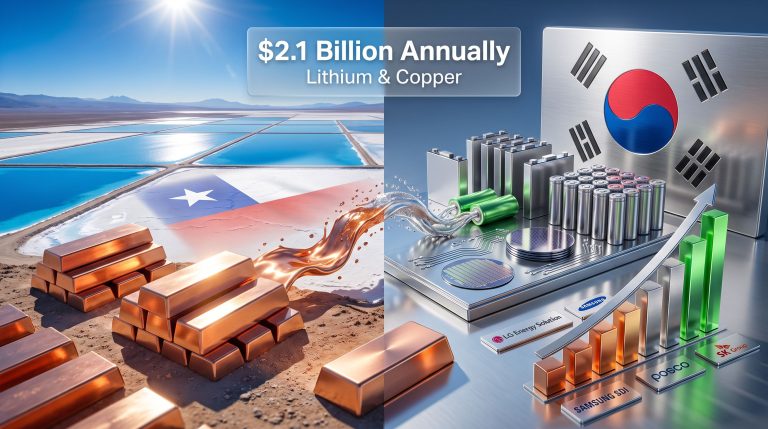
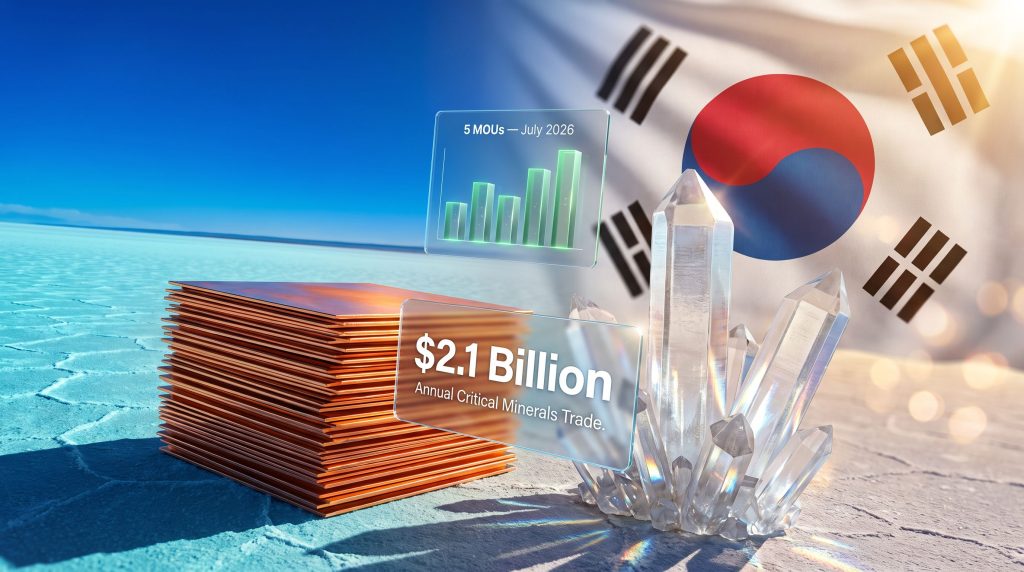
Key structural insight: The $2.1 billion in critical mineral trade flows that South Korea's presidential office identified as the current annual baseline represents existing commercial activity, not projected growth. The diplomatic framework being constructed is designed to protect and expand a supply relationship that is already commercially significant.
The Lithium Quality Dimension: Why Atacama Brine Matters to Battery Manufacturers
Not all lithium is equal, and the distinction matters enormously to battery manufacturers competing on cell economics. Lithium sourced from the Atacama's brine operations is characterised by its suitability for producing battery-grade lithium carbonate with relatively fewer processing steps compared to hard-rock spodumene sources or lower-grade brine operations in other jurisdictions.
For Korean battery cell manufacturers, this translates into a direct cost and quality advantage. Battery-grade lithium carbonate requires purity levels exceeding 99.5%, and the chemical characteristics of Atacama brine make achieving this threshold more cost-efficient than many competing sources. As Korean manufacturers face intensifying margin pressure in the global EV battery market, the economics of Chilean lithium supply become increasingly central to their competitive positioning.
How Does Direct Extraction Technology Factor In?
The tailings recycling dimension mentioned in the bilateral dialogue adds another layer of technical significance. Advances in direct lithium extraction offer genuine potential to improve lithium recovery rates from existing operations while simultaneously reducing the ecological footprint of extraction in the sensitive Atacama ecosystem. Korean industrial technology — developed through experience in advanced materials processing and environmental management systems — is well positioned to contribute to this agenda.
Copper's Compounding Demand Drivers
Copper's strategic importance to the Korea–Chile partnership extends across multiple demand vectors that are each growing independently, creating a compounding demand dynamic that analysts tracking the metal's long-term supply fundamentals find particularly compelling. The ongoing copper supply crunch is, consequently, making Chilean production even more strategically valuable to consuming nations.
- Electric vehicles consume approximately three to four times more copper than equivalent internal combustion engine vehicles, driven by motor windings, battery connections, and onboard charging systems
- Data centre infrastructure has emerged as a major incremental copper demand source, with AI-driven compute expansion requiring substantial copper in power distribution, cooling systems, and server interconnects
- Grid modernisation programs globally are driving copper demand for transmission and distribution upgrades
- Semiconductor fabrication uses copper for chip interconnects in advanced nodes, a demand category directly relevant to South Korea's semiconductor industry
Rio Tinto's first-half 2026 results, which recorded the company's highest earnings in four years, explicitly attributed strong performance to data centre-driven copper demand — illustrating that the metal's demand story has broadened well beyond the EV narrative alone. (Reuters, Mining Weekly, July 2026)
The next major ASX story will hit our subscribers first
A Decade of Escalating Commitment: The Relationship Timeline
The July 2026 summit did not emerge in isolation. It represents the culmination of an accelerating sequence of bilateral engagements that began with a foundational trade architecture and progressively deepened toward strategic resource governance.
- 2004 — South Korea and Chile establish one of Korea's earliest free trade agreements, creating the commercial foundation for all subsequent cooperation
- 2022–2023 — Bilateral engagement intensifies around mineral supply chains, with delegation visits and working-level MOUs focusing on lithium development and supply-chain coordination
- May 2024 — The Korea–Chile Resource Cooperation Committee convenes in Santiago, producing substantive discussions on lithium supply stability, eco-friendly extraction, and tailings recycling
- March 2025 — Finance-level officials from both governments embed the resource relationship within macroeconomic policy dialogue, focusing on stable supply chain frameworks for lithium and copper
- July 2026 — Presidential summit in Santiago produces five MOUs, elevates mineral cooperation to ministerial governance, and restarts the Korea–Chile FTA Joint Committee for the first time in approximately a decade
The four-year compression from working-level MOUs to presidential-level commitment reflects a structural acceleration driven by global EV adoption rates, intensifying battery supply chain competition, and the broader metals geopolitics reshaping critical mineral access following supply chain disruptions of the early 2020s.
The FTA Modernisation Dimension: Updating a 2004 Framework for 2026 Realities
The Korea–Chile Free Trade Agreement was a landmark achievement when it was concluded in 2004 — one of Korea's first bilateral trade pacts. However, the industrial landscape of 2004 bore almost no resemblance to the critical minerals economy of 2026. The original agreement contained no provisions specifically governing critical mineral trade flows, battery supply chain rules of origin, or investment protections for lithium and copper processing operations, because these concerns simply did not exist at the required policy level when the pact was drafted.
Restarting the FTA Joint Committee after approximately a decade of dormancy signals a serious intent to address this gap. A modernised agreement could introduce:
- Critical mineral-specific trade provisions governing supply volumes, pricing frameworks, and offtake security mechanisms
- Updated investment chapters providing Korean firms with stronger legal protections for capital deployed in Chilean mining and processing
- Rules of origin provisions relevant to battery supply chains, particularly significant given evolving trade policy in major consumer markets including the United States and European Union
- Technology transfer frameworks that formalise the exchange of Korean processing expertise for Chilean supply access
How This Partnership Compares to Competing Mineral Alliances
| Consuming Nation | Primary Mineral Strategy | Chile Engagement Level |
|---|---|---|
| South Korea | Bilateral MOUs, FTA modernisation, corporate investment | Presidential-level, 5 MOUs (July 2026) |
| Japan | Government-backed offtake agreements, JOGMEC financing | Active, multiple cooperation agreements |
| European Union | Critical Raw Materials Act, strategic partnerships | Growing engagement, less formalised |
| United States | IRA domestic content incentives, allied nation sourcing | FTA partner, strong copper trade relationship |
South Korea's approach is notable for its institutional depth. Rather than relying primarily on corporate offtake agreements or domestic subsidy mechanisms, Korea is constructing a multi-layered governmental architecture — combining ministerial-level oversight, investment promotion mechanisms, FTA modernisation, and presidential-level political commitment — to secure and expand its Chilean mineral relationship. As one analysis of Chile's export partnerships notes, the country's copper and lithium exports are increasingly being channelled through structured bilateral frameworks rather than spot markets, reflecting the strategic nature of demand.
Chile's Industrial Upgrading Agenda: Beyond Raw Export
For Chile, the partnership's strategic value extends well beyond stable export revenues. The KOTRA–InvestChile mechanism creates a structured channel for Korean industrial technology and capital to support Chile's domestic processing capacity development. Korean partners offer expertise in lithium carbonate and lithium hydroxide refining, battery precursor chemical manufacturing, and advanced environmental management systems — precisely the capabilities Chile needs to move up the mineral value chain.
The eco-friendly extraction dimension is particularly significant given Chile's regulatory and social licence environment in the Atacama. Community and environmental concerns around water usage and ecosystem impact in the Atacama are among the most scrutinised in global mining, and Chilean regulatory requirements reflect this. Korean industrial technology, developed within demanding environmental compliance frameworks, represents a credible contributor to Chile's sustainable extraction agenda.
Outlook: The Critical Test of Diplomatic Frameworks
MOUs and presidential commitments create enabling conditions, but they do not guarantee capital deployment or operational outcomes. The true measure of South Korea Chile lithium and copper cooperation will be determined by what happens in the months and years following the Santiago summit.
Three structural trends the agreement accelerates are worth monitoring closely:
- Ministerial-level governance of resource supply chains — elevating critical mineral security from trade ministry portfolios into direct senior government oversight
- Technology-for-resources exchange models — where consuming nations offer industrial technology and capital in exchange for stable mineral supply arrangements, creating mutual economic value rather than purely extractive relationships
- FTA modernisation as a critical minerals instrument — repurposing existing trade agreement frameworks to embed mineral supply security provisions that were never anticipated in original drafts
Monitoring KOTRA–InvestChile activity, Korean corporate announcements regarding Chilean operations, and the pace of FTA modernisation negotiations will provide the clearest leading indicators of whether this diplomatic framework translates into real economic outcomes. For an annual trade baseline of $2.1 billion that both governments explicitly aim to expand, the commercial stakes of getting this transition right are substantial.
Disclaimer: This article contains forward-looking analysis and references to geopolitical and market trends. Such analysis reflects the author's interpretation of publicly available information and should not be construed as financial or investment advice. Readers should conduct their own research before making investment decisions.
Want to Capitalise on the Next Major Mineral Discovery Before the Broader Market?
Discovery Alert's proprietary Discovery IQ model delivers real-time alerts on significant ASX mineral discoveries — cutting through complex geological and commodity data to surface actionable investment opportunities the moment they are announced. Explore Discovery Alert's dedicated discoveries page to see how historic mineral discoveries have generated substantial returns, and begin your 14-day free trial today to position yourself ahead of the market.