July 16, 2026
Port Hedland's Chokepoint Problem: When the World's Largest Iron Ore Terminal Goes Quiet
Global commodity markets have a well-documented vulnerability that most participants only truly appreciate when it crystallises: single-point-of-failure infrastructure. In bulk commodity logistics, concentration risk is not theoretical. It is baked into the geography of resource endowments, and nowhere is this more visible than in the Pilbara region of Western Australia, where the BHP Port Hedland strike of July 2026 demonstrated just how sharply one port can shape steel production schedules across an entire continent.
The industrial action that unfolded at Port Hedland on 16 July 2026 is not simply a wage dispute. It is a live demonstration of how labour relations, export infrastructure concentration, and internal compensation inconsistencies can converge into a supply chain stress event with consequences that extend well beyond the eight hours in question.
When big ASX news breaks, our subscribers know first
Why Port Hedland Carries Systemic Weight in Seaborne Iron Ore Markets
Port Hedland is not merely the largest bulk iron ore export terminal on earth by throughput volume. It is the sole exit point for all of BHP's Western Australian iron ore production. There are no alternative berths, no redundant pathways, and no bypass options. When Port Hedland experiences disruption, the entirety of BHP's Pilbara output is affected simultaneously.
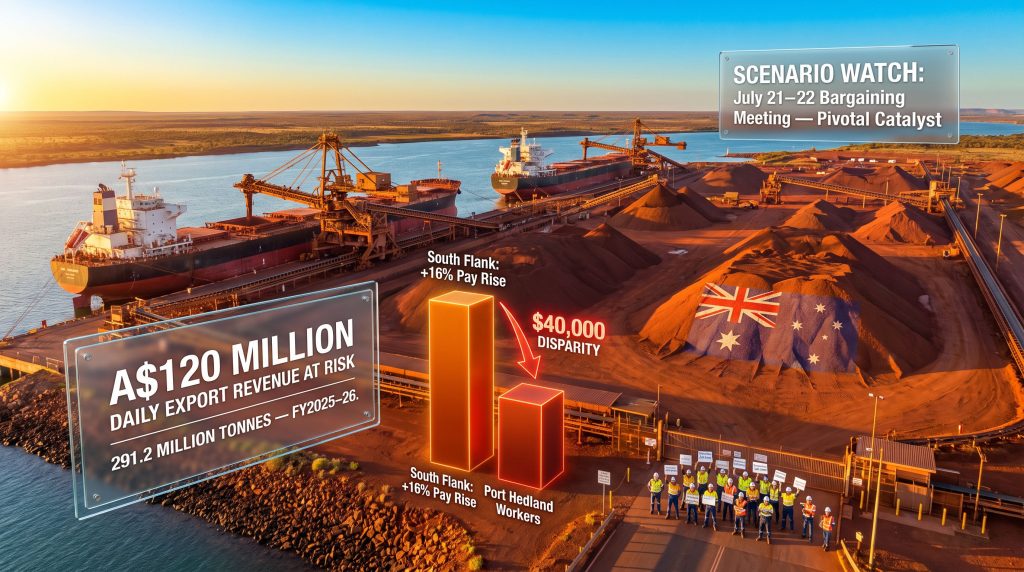
To understand the scale involved, BHP's Western Australian iron ore operations produced 291.2 million tonnes on a 100% basis in the fiscal year from July 2025 to June 2026, according to the company's full-year operational review. That figure represents a substantial share of the global seaborne iron ore trade, which totals roughly 1.5 billion tonnes annually.
The port functions not merely as a logistics facility but as a pricing anchor for seaborne iron ore. Vessel scheduling data from Port Hedland feeds directly into freight rate calculations, laycane windows, and demurrage cost estimates that underpin how Chinese, Japanese, and South Korean steel mills budget their raw material procurement. When loading schedules are disrupted, the ripple effects travel through shipping markets, steel futures, and procurement strategies simultaneously.
Furthermore, iron ore demand trends are closely linked to Port Hedland's throughput, making any disruption there a globally watched event. What makes Port Hedland uniquely exposed compared to other major iron ore export hubs is precisely this absence of redundancy. Rio Tinto, for instance, operates across two primary export terminals in Western Australia — Dampier and Cape Lambert — providing a degree of operational flexibility that BHP structurally lacks for its Pilbara volumes.
The Internal Wage Architecture That Made a Strike Inevitable
Understanding why this dispute reached industrial action requires examining a compensation structure that has quietly developed inconsistencies over many years.
Enterprise agreement negotiations between BHP and its combined port unions commenced in October 2025, covering approximately 450 employees in the Port Hedland maritime workforce, excluding contractors. After nine bargaining sessions spanning roughly seven months, no agreement had been reached by 16 July 2026. The final pre-strike meeting occurred on 14 July, with the next scheduled session set for 21-22 July 2026.
The wage gap driving the dispute is both specific and well-documented. Port Hedland maritime workers are seeking a $25,000 annual pay increase, citing remuneration disparities of up to $40,000 between their roles and equivalent positions at BHP's South Flank and Mining Area C mining operations. Workers at those sites received a 16% pay rise under their respective enterprise agreements, creating what unions argue is an internal benchmark that BHP's own compensation decisions have established.
The wage disparity is not an external comparison to a competitor's workforce. It is a structural inconsistency within BHP's own employee base, across sites that are geographically proximate and perform operationally comparable functions.
This internal benchmark argument gives the unions considerable moral and negotiating leverage. It is far more difficult for an employer to justify wage gaps when the comparison group is its own workforce rather than industry peers or competitors.
A historically important context: Port Hedland maritime workers operated for years under fragmented individual contracts rather than a unified enterprise agreement framework. The shift toward a collective EA structure is itself relatively recent, and the absence of a legacy enterprise agreement means workers had limited institutional protection during previous wage cycles when comparable mining roles received substantial increases.
The Three Unions, the Combined Bargaining Bloc, and What That Means
The industrial action was coordinated across three unions operating as a combined bargaining bloc, creating cross-trade leverage that a single-union dispute would not possess.
| Union | Full Name | Primary Coverage |
|---|---|---|
| WMWA | Western Mine Workers Alliance (AWU + MEU WA branches) | Mining and port operations |
| ETU | Electrical Trades Union | Electrical and instrumentation trades |
| AMWU | Australian Manufacturing Workers' Union | Maintenance and manufacturing trades |
Approximately 150-200 of the 450 covered employees participated in the initial eight-hour strike action. The WMWA structure itself is worth understanding: it represents a partnership between the Australian Workers Union and the Mining and Energy Union's Western Australian branches, combining two historically distinct labour organisations into a coordinated negotiating entity.
This multi-union configuration is strategically significant. Electrical and maintenance trades are not interchangeable with general maritime operations workers. A combined stoppage across all three trades creates operational disruptions that cannot be partially offset by redeploying workers from unaffected classifications.
Quantifying the Financial Exposure: What Eight Hours Actually Costs
The economic framing of this dispute requires separating the immediate cost of a single action from the forward-looking cost of escalation.
| Economic Metric | Estimated Value |
|---|---|
| BHP daily iron ore export revenue at risk | |
| Export revenue loss from two disrupted shipments | |
| Western Australian government royalty loss (two vessels) | ~A$4 million |
| Broader daily royalty exposure if full operations halt | ~A$7 million |
The strike was deliberately timed to coincide with a double-up day — a scheduled maintenance overlap period when additional workers are on-site — amplifying the potential operational footprint of the action. The work stoppage ran from 14:00 to 22:00 AWST (06:00 to 14:00 GMT), a window specifically targeting two bulk carrier loading cycles.
This precision matters analytically. An eight-hour targeted disruption to two specific vessel loadings is a very different operational event from a generalised work stoppage. It signals that unions have detailed operational knowledge of the port's scheduling mechanics, which is itself an indicator of how strategically sophisticated the industrial action campaign has become.
The Western Australian Chamber of Minerals and Energy estimated the combined export revenue and royalty loss from the two affected shipments at approximately A$57 million — a figure that will concentrate the attention of state government officials who depend on iron ore royalties as a significant pillar of WA's fiscal position. Consequently, the iron ore price decline risk that analysts had flagged as a medium-term concern now intersects with acute supply disruption risk in the near term.
Historical Rarity and Its Market Psychology Implications
One of the least appreciated aspects of this dispute is its extreme rarity within the operational history of the facility.
The last comparable industrial action at Port Hedland occurred in 2008, meaning the July 2026 strike represents the first significant labour disruption at the port in approximately 18 years. In the broader context of Western Australian mining sector industrial relations, this is described as the most significant disruption in roughly 25 years.
This historical gap creates a specific market psychology dynamic that investors and commodity traders should not underestimate. When a facility operates without meaningful labour disruption for nearly two decades, traders, steel mills, and logistics planners stop incorporating strike probability into their risk models in any meaningful way.
The institutional memory of how to price, hedge, or operationally plan around Port Hedland industrial action has effectively been absent from active market participants for a generation of analysts. The practical consequence is that markets are likely to overreact to sentiment relative to actual supply fundamentals in the early stages of this dispute, particularly if the 21-22 July bargaining meeting fails to produce resolution.
The next major ASX story will hit our subscribers first
BHP's Contingency Position and Its Real Limitations
BHP confirmed the existence of operational contingency strategies designed to maintain continuity during the strike period. For major bulk commodity exporters, these typically include:
- Pre-loading vessels ahead of scheduled strike windows
- Drawing down stockpile inventory to maintain vessel queue integrity
- Deploying supervisor-grade and non-union workforce personnel for essential operations
- Compressing loading schedules on either side of the action window to partially offset the gap
However, the precision of the unions' targeting creates inherent limits on what contingency planning can achieve. A surgical disruption to two specific vessel loadings within a defined eight-hour window does not allow for blanket pre-positioning responses. Stockpile drawdown only works if cargo has already been prepared and is accessible for accelerated loading outside the strike window.
Ship demurrage calculations begin immediately when vessel schedules slip, adding costs that accumulate regardless of whether iron ore volumes are ultimately delivered.
Scenario Watch: The critical variable is not what happened on 16 July. It is what gets announced before or immediately after the 21-22 July bargaining session. Protected action notices filed in advance of that meeting would represent a material escalation signal.
If rolling or extended industrial action follows a failed July bargaining session, BHP's contingency buffer narrows considerably, vessel scheduling queues begin accumulating slippage, and the operational disruption crosses from a one-event cost to a sustained supply reliability concern.
Regulatory Framework and Political Dimensions
Australia's industrial relations framework under the Fair Work Commission requires unions to complete a defined procedural pathway before protected industrial action can proceed. The combined port unions satisfied all these requirements — a fact publicly acknowledged by Federal Resources Minister Madeleine King, who indicated that workers had followed all required procedures and were legally entitled to withdraw their labour.
The Fair Work framework provides structured pathways for dispute resolution, including compulsory conciliation and, in extreme cases, intervention orders. However, it does not compel either party to accept terms, and the timeline for Commission proceedings means that a legal route to resolution, if pursued, would likely extend uncertainty rather than resolve it quickly.
Chamber of Minerals and Energy Chief Executive Aaron Morey publicly urged unions to call off the action on 15 July 2026, warning that an expanding union presence in the Pilbara region risks affecting the long-term competitiveness of Australia's iron ore dominance in global export markets. This is a concern that extends beyond the immediate dispute: if the Port Hedland maritime workforce secures significant wage gains through collective action, the template is immediately available to other workforces across the Pilbara.
The two-level political dynamic is worth noting. Western Australia's state government holds a direct fiscal interest in rapid resolution through its royalty revenue exposure. The federal government governs the enterprise agreement framework through the Fair Work system. These are not always aligned interests, and the gap between state fiscal urgency and federal industrial relations process timelines can itself become a source of friction in how the dispute is managed publicly.
Asian Steel Mill Exposure and Supply Chain Alternatives
China remains the dominant destination for BHP's Pilbara iron ore, underpinning blast furnace-based steel production across major industrial provinces. Japanese and South Korean integrated steelmakers also hold significant procurement exposure to Port Hedland volumes. Indeed, the broader dynamics of China steel and iron ore consumption mean any sustained disruption to BHP's supply chain will reverberate across Asian steel markets with considerable force.
For short-duration disruptions of under 48 hours, the mechanism of market response is typically sentiment-driven price movement rather than a fundamental supply shortfall. Chinese port stockpiles of iron ore have historically provided a buffer of several weeks of mill consumption, meaning a single eight-hour strike does not immediately threaten steel production continuity.
The scenario that changes this calculus is escalation. If industrial action extends or recurs, the procurement response from Asian mills becomes more structural:
- Accelerated procurement from Rio Tinto's Pilbara operations or Fortescue
- Increased contracting with Brazilian suppliers, primarily Vale, from the Carajas and other ore systems
- Spot market activity across multiple origins to rebuild buffer stocks
The comparative supply chain risk across major iron ore suppliers underlines BHP's structural vulnerability:
| Supplier | Primary Export Hub | Alternative Pathways | Recent Strike History |
|---|---|---|---|
| BHP | Port Hedland (sole WA exit) | None for WA ore | First action since 2008 |
| Rio Tinto | Dampier and Cape Lambert | Dual-port redundancy | Periodic minor actions |
| Fortescue | Port Hedland (shared infrastructure) | Limited | Occasional stoppages |
| Vale (Brazil) | Ponta da Madeira, Tubarão | Multiple terminals | Periodic labour disputes |
One factor that adds complexity for Chinese mills considering alternative procurement is ore quality differentiation. BHP's Pilbara Blend products, which include both lump and fines components, are specifically blended to deliver consistent iron grade and chemistry profiles that many Chinese blast furnaces have been calibrated around.
Substituting Brazilian ore, which carries different gangue mineralogy and alumina-to-silica ratios, is not a straightforward operational decision. It typically requires furnace burden adjustments that take time to optimise and can temporarily affect productivity or coke rates. This means the ore quality dimension adds stickiness to BHP's customer relationships that pure volume metrics alone do not capture.
Three Forward Scenarios for the July 21-22 Bargaining Meeting
Scenario 1: Negotiated Settlement (Base Case)
BHP agrees to a wage structure that meaningfully closes the gap with South Flank and Mining Area C benchmarks, landing in the vicinity of the unions' $25,000 annual increase target. Industrial action ceases, an EA is ratified, and operations return to full capacity within days. The market impact is limited to sentiment-driven volatility that dissipates quickly. BHP's FY2027 production guidance remains intact.
Scenario 2: Partial Agreement with Residual Risk (Moderate Probability)
BHP and the unions reach a wage framework but remain in disagreement on rostering arrangements, allowance structures, or contract duration. Strike action pauses but the underlying tension persists. Furthermore, protected action notices remain possible. The market assigns a small but persistent uncertainty premium to Port Hedland supply reliability for the duration of the agreement negotiation period.
Scenario 3: Breakdown and Escalating Action (Tail Risk, High Impact)
Negotiations collapse at the July 21-22 session. Unions escalate to rolling strikes or work bans. BHP pursues Fair Work Commission intervention, extending the timeline through legal process. Iron ore spot prices react to a genuine supply reliability signal. Asian mills begin activating alternative procurement channels.
The WA government's royalty shortfall becomes a politically visible fiscal issue. This scenario would represent the most significant sustained disruption to Pilbara iron ore exports in a generation. In addition, iron ore market tariffs and broader geopolitical pressures could amplify the market reaction if this tail risk scenario materialises.
The Broader Labour Relations Precedent and Its Long-Term Implications
This dispute is occurring against a backdrop of renewed union engagement across Australia's resources sector, partly reflecting legislative adjustments to the Fair Work framework that have enhanced collective bargaining rights in recent years. The historic strike facing BHP has drawn national attention precisely because its implications extend so far beyond a single enterprise agreement.
The concern articulated by the CME — that a growing union presence in the Pilbara could affect industry competitiveness — is not simply about this one negotiation. If Port Hedland maritime workers achieve wage parity with BHP's mining operations workforce, the outcome establishes a documented precedent. Other Pilbara workforces, across Rio Tinto, Fortescue, and ancillary service operators, will observe the outcome and assess its applicability to their own EA negotiations.
The labour relations landscape across the entire region could shift in a relatively compressed timeframe if the Port Hedland resolution validates the collective bargaining strategy employed here. For investors in Australian iron ore producers, the long-term question is whether an increasingly unionised Pilbara workforce represents a structural cost headwind that will compress margins at the asset level, or whether it represents a normalisation of wage conditions that was overdue given the sustained profitability of Pilbara operations over the past decade.
The answer likely differs by operator cost position. Tier-one assets like BHP's Pilbara mines, with their exceptionally low cost-of-production base, can absorb wage increases that would be materially damaging to higher-cost operations elsewhere in the iron ore production cost curve. Australia's iron ore export competitiveness rests on the intersection of ore quality, logistics efficiency, and cost structure. Events like the BHP Port Hedland strike test all three dimensions simultaneously, and the resolution or escalation of this dispute will provide a meaningful data point for how each of those pillars holds under labour relations pressure.
Key Takeaways for Investors and Market Participants
- Port Hedland is BHP's only export pathway for all Western Australian iron ore, creating a concentration risk with no structural alternative
- The dispute centres on a documented internal wage disparity within BHP's own workforce, providing unions with a factually strong bargaining position
- The July 21-22 bargaining session is the pivotal near-term catalyst; watch for protected action notices as the clearest escalation signal
- A near-two-decade strike-free record means markets lack recent precedent for pricing sustained Port Hedland disruption risk, elevating the probability of sentiment-driven overreaction
- Ore quality differentiation creates customer stickiness that partially insulates BHP from rapid procurement substitution, but this effect diminishes if disruption extends beyond several weeks
- The outcome will likely set wage benchmarks that reverberate across the broader Pilbara labour market well beyond this single enterprise agreement
Disclaimer: This article contains forward-looking analysis and scenario projections based on publicly available information as of the publication date. It does not constitute financial advice. Commodity markets are subject to rapid change, and actual outcomes may differ materially from scenarios presented. Readers should conduct independent research before making any investment or procurement decisions.
Want to Stay Ahead of ASX Mineral Discoveries Shaped by Commodity Supply Shocks Like This?
When infrastructure disruptions ripple through iron ore markets, identifying the next significant ASX mineral discovery becomes even more critical for investors seeking asymmetric returns — Discovery Alert's proprietary Discovery IQ model delivers real-time alerts the moment major discoveries are announced, turning complex market signals into actionable investment opportunities. Explore how historic mineral discoveries have generated substantial returns by visiting Discovery Alert's dedicated discoveries page, then begin your 14-day free trial to position yourself ahead of the market.