July 16, 2026
The Hidden Architecture of a Once-in-a-Generation Commodity Supercycle
Every few decades, a convergence of technological, geopolitical, and industrial forces creates a structural shift so profound that entire national economies are either lifted or left behind depending on how they respond. The critical minerals boom in emerging markets is producing exactly that kind of moment for the world's mineral-rich developing economies. What makes this cycle different from previous commodity booms is not just the scale of demand, but the complexity of what is being demanded.
These are not bulk commodities where extraction and export represent the full economic story. Critical minerals sit at the intersection of chemistry, metallurgy, and advanced manufacturing, which means the nations that control not just the ore in the ground, but the knowledge and infrastructure to transform it, will capture an entirely different order of economic value.
When big ASX news breaks, our subscribers know first
The Structural Demand Case: What Is Actually Driving Critical Mineral Markets?
Beyond the Energy Transition Narrative: A Multi-Vector Demand Story
The popular framing of critical mineral demand as an energy transition story is technically accurate but strategically incomplete. The full demand picture is far more complex and, for investors and policymakers alike, far more consequential. Three distinct but interacting technology waves are simultaneously drawing from the same finite pool of mineral supply.
Electric vehicle manufacturing requires lithium, cobalt, nickel, and manganese in quantities that scale almost linearly with fleet adoption. Renewable energy infrastructure consumes copper, rare earth elements for permanent magnets, and silicon for solar cells. Artificial intelligence data centres, often overlooked in critical mineral discussions, require substantial volumes of copper for wiring and cooling infrastructure, alongside specialty metals used in semiconductor fabrication.
When these three demand curves are overlaid, the resulting pressure on upstream supply becomes structurally unlike anything the mining industry has previously encountered. Furthermore, the global battery metals landscape is evolving rapidly as manufacturers seek to diversify away from geopolitically exposed supply chains.
How Electric Vehicles, Renewable Infrastructure, and AI Are Converging on the Same Supply Base
The convergence problem is not merely one of volume. It is also one of timing. All three technology categories are scaling simultaneously rather than sequentially, creating a compressed demand window that limits the mining sector's ability to respond with new supply. Greenfield mine development from discovery to first production typically spans eight to sixteen years, meaning supply responses to today's demand signals will not materialise until the mid-2030s at the earliest.
This lag creates the central investment thesis around critical minerals: the supply-demand gap is not a short-term dislocation but a structural feature of the next decade.
Demand Projections That Redefine Strategic Importance
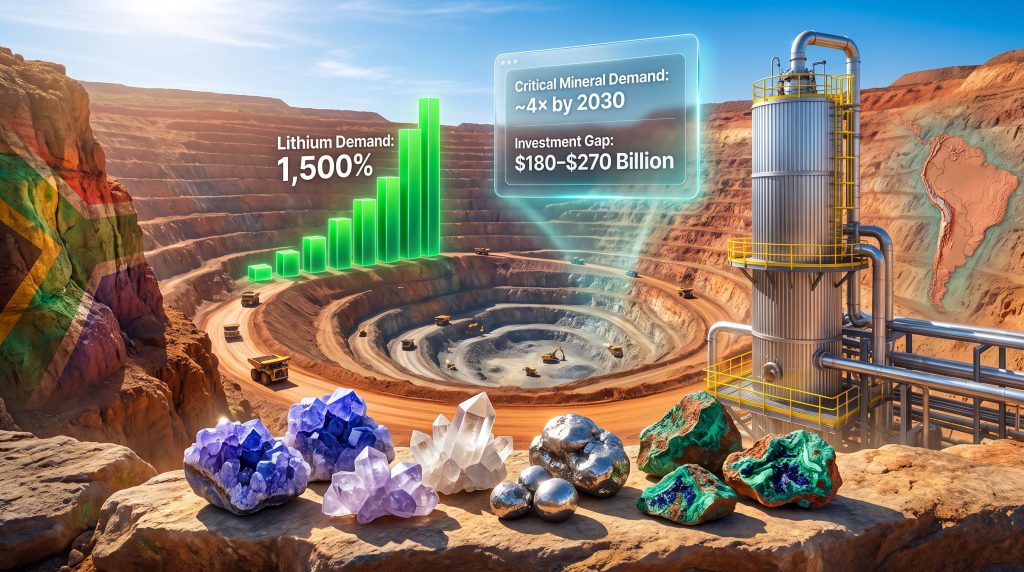
The numbers attached to this structural shift are genuinely extraordinary. According to the International Energy Agency, critical mineral demand is forecast to grow nearly fourfold by 2030 and more than 3.5 times by 2050 under net-zero scenarios. Lithium faces a potential demand increase of 1,500% under the most aggressive electrification pathways, representing one of the most extreme supply-demand asymmetries in modern commodity history.
These projections do not reflect optimistic outlier scenarios; they represent the central case in established policy frameworks across the IEA, World Bank, and UNCTAD.
These figures are forecasts based on modelled scenarios and should not be interpreted as guaranteed outcomes. Actual demand trajectories will depend on policy continuity, technology substitution rates, and macroeconomic conditions.
Where Are the World's Critical Mineral Reserves Actually Located?
Africa, Latin America, and Asia-Pacific: The Emerging Market Triad
The geographic distribution of critical mineral reserves is heavily concentrated in developing economies, a fact that sits at the core of the current geopolitical realignment. The Democratic Republic of Congo holds roughly 70% of global cobalt reserves. The Lithium Triangle spanning Chile, Argentina, and Bolivia contains the majority of the world's economically viable lithium brine deposits. Indonesia controls the largest known nickel reserves globally, while several African nations collectively hold a dominant share of platinum group metals and manganese.
| Region | Key Minerals | Share of Global Reserves | Current Processing Capacity |
|---|---|---|---|
| Africa | Cobalt, Manganese, PGMs | ~30% of proven critical mineral reserves | Predominantly raw extraction |
| Latin America (Lithium Triangle) | Lithium, Copper | Dominant global lithium reserves | Limited downstream refining |
| Asia-Pacific (excl. China) | Nickel, Rare Earths | Significant but fragmented | Varies widely by nation |
| China | Rare Earths, Graphite | Moderate reserves | ~50% of global refining market value |
Reserve Concentration vs. Processing Capacity: A Critical Disconnect
The table above reveals the central paradox of the critical minerals boom in emerging markets. Nations holding the majority of reserve endowments control a comparatively small share of processing infrastructure. China, despite holding moderate reserves in several categories, has built an extraordinary processing and refining capacity that translates reserve access into genuine industrial leverage.
This gap between reserves and processing is not accidental; it reflects decades of underinvestment in downstream infrastructure across the developing world and deliberate, long-term industrial policy in China. In addition, the critical minerals demand surge is intensifying pressure on nations to act swiftly before the opportunity narrows.
Why Reserve Richness Alone Does Not Translate to Economic Sovereignty
A nation that exports unprocessed ore effectively exports the majority of its mineral wealth. The economic value captured at the mining and raw extraction stage represents only a fraction of the total value embedded in the final product chain. Lithium carbonate, for example, commands a price premium many times greater than spodumene ore. Battery-grade lithium hydroxide commands a further premium above that.
Nations that supply ore while importing refined inputs for their own manufacturing sectors are effectively subsidising foreign industrial capacity with their own geological endowment.
What Does Moving Up the Value Chain Actually Mean for Mineral-Rich Developing Nations?
Raw Ore vs. Refined Product: Understanding the Value Gap
The concept of value chain ascent sounds intuitive, but the economics deserve explicit illustration. At the raw ore stage, a tonne of mineral material may be worth tens to hundreds of dollars. At the refined chemical precursor stage, that same mineral input may be worth thousands of dollars per tonne. At the battery-grade or semiconductor-grade specification, the value compounds further.
The difference between these stages is not simply processing cost but also intellectual property, technical expertise, quality certification, and market access.
Nations that export unprocessed ore capture only a fraction of the final product's economic value. Moving into refining, precursor chemical production, and battery-grade material manufacturing can multiply revenue capture by orders of magnitude, fundamentally altering sovereign economic trajectories.
The Refining and Processing Opportunity: Where Margins Are Made
The refining and processing segment is where the majority of economic margin in critical mineral supply chains is generated. This is also where China's dominance is most pronounced. Chinese companies process roughly half of global lithium, more than 60% of cobalt, and an even higher proportion of rare earth elements at the refined stage.
This concentration is not merely a commercial advantage; it is a geopolitical pressure point that Western governments have identified as a strategic vulnerability. Consequently, the relationship between critical minerals and energy security has never been more central to national policy agendas.
Case Study: Indonesia's Nickel Processing Pivot as a Policy Blueprint
Indonesia's nickel boom provides the most cited example of a developing nation forcing value chain ascent through trade policy. The country's decision to ban raw nickel ore exports in 2020 resulted in a dramatic increase in domestic processing investment, the establishment of nickel smelting and intermediate product facilities, and a structural shift in how Indonesian nickel revenues are captured.
The policy was contested internationally but proved effective in attracting downstream manufacturing capital. By 2023, Indonesia had become a significant producer of nickel intermediates for battery supply chains. The Indonesian model is now studied closely by other mineral-rich nations considering similar export restriction frameworks.
Case Study: The Democratic Republic of Congo's Cobalt Leverage and the Gap Between Potential and Realisation
The DRC's cobalt situation illustrates the opposite dynamic. Despite controlling the majority of global cobalt reserves, the country captures a disproportionately small share of the value created downstream. A combination of governance challenges, inadequate infrastructure, and underdeveloped processing capacity has meant that cobalt leaves the DRC primarily as hydroxide concentrate, with the majority of refining occurring in China.
Closing this gap represents both the country's greatest economic opportunity and its most persistent structural challenge.
How Large Is the Investment Gap Holding Emerging Markets Back?
The $180 to $270 Billion Shortfall: Quantifying the Infrastructure Deficit
The financing challenge associated with closing the processing gap is substantial. Estimates suggest that meeting 2030 critical mineral supply targets requires between $180 billion and $270 billion in new mining and processing investment globally. The current identified pipeline falls dramatically short of this figure.
What the UNCTAD Mining Project Pipeline Reveals About Capital Flows
UNCTAD has identified approximately 110 new mining projects valued at around $39 billion currently in the development pipeline. Of this total, roughly $22 billion has been directed toward 60 projects located in developing countries. However, this covers only a small fraction of the total investment required. The gap between what is currently planned and what is needed to meet demand projections by 2030 is not a rounding error; it is a structural deficit that will shape commodity markets for the remainder of the decade.
| Investment Metric | Figure |
|---|---|
| Estimated investment needed by 2030 | $180 billion to $270 billion |
| UNCTAD identified project pipeline | ~$39 billion across 110 projects |
| Projects directed to developing countries | ~$22 billion across 60 projects |
| Structural financing gap | Estimated $140+ billion shortfall |
Why Private Capital Is Necessary but Insufficient
Private capital flows toward critical mineral projects where risk-adjusted returns are attractive. However, the combination of geological risk, political risk, infrastructure gaps, and long development timelines in many emerging market jurisdictions means that purely commercial capital will not fill the gap on its own. Multilateral financing institutions including the World Bank Group, the African Development Bank, and bilateral development finance agencies are increasingly recognised as necessary catalysts to de-risk early-stage projects and unlock subsequent private investment.
What Are the Biggest Risks Threatening Emerging Market Gains From the Critical Minerals Boom?
The Commodity Dependence Trap: When Booms Deepen Vulnerability
History offers abundant evidence that commodity wealth, if mismanaged, produces economic fragility rather than resilience. Nations where resource revenues exceed 60% of export earnings are particularly exposed to the volatility inherent in commodity cycles. When mineral prices decline, the absence of diversified industrial capacity means government revenues collapse simultaneously with external balances.
The critical minerals boom creates an opportunity to break this pattern, but only if surplus revenues are deliberately channelled into diversification and downstream capacity rather than consumed by short-term expenditure growth.
China's Refining Dominance: A Geopolitical Chokepoint in the Supply Chain
China's processing dominance creates an asymmetric vulnerability in global supply chains that is difficult to address quickly. Building refining capacity at scale requires capital, energy, technical expertise, and time. Western nations and their industrial partners cannot replicate China's processing infrastructure within the timeframes dictated by energy transition demand.
For emerging market nations, China's dominance cuts both ways. It represents competition in the processing space but also a potential investment partner and offtake market. The strategic calculus involves balancing access to Chinese capital and market connectivity against the risk of creating new forms of processing dependency.
Environmental and Social Governance Failures: The Hidden Cost of Rapid Extraction
Nations that prioritise extraction volume over governance quality risk environmental degradation, community displacement, and social instability. These outcomes can rapidly erode the long-term economic benefits of mineral endowments and deter the very foreign investment needed to build downstream capacity.
The ESG dimension of critical mineral extraction is not merely a compliance consideration; it is a commercial one. Increasingly, battery manufacturers and original equipment manufacturers in the automotive sector face mandatory due diligence requirements on their mineral supply chains. According to UNCTAD's analysis of critical mineral opportunities and risks, projects associated with environmental damage or community conflict risk exclusion from high-value supply chains entirely, regardless of their geological quality.
The next major ASX story will hit our subscribers first
How Are Sovereign Credit Profiles and Industrial Policy Being Reshaped?
Moody's Framework: How Mineral Endowments Are Beginning to Influence Sovereign Risk Assessments
Moody's has identified the critical minerals boom as a material factor in sovereign credit analysis. According to the agency's assessment, the evolving critical minerals landscape is likely to influence sovereign credit profiles, industrial strategies, and global investment patterns as governments and companies seek more resilient, diversified, and secure supply chains.
Nations that successfully develop downstream processing capacity stand to benefit from improved external revenue quality, reduced export concentration risk, and stronger fiscal positions over time. This represents a notable shift in credit methodology, as historically, mining-dependent economies were often viewed as higher-risk credits precisely because of commodity price exposure.
Industrial Policy Levers Available to Mineral-Rich Governments
Governments with significant mineral endowments have several policy tools available to accelerate value chain ascent:
- Export restrictions on unprocessed ore to incentivise domestic processing investment
- Mandatory local processing requirements tied to mining licence conditions
- State-owned enterprise participation in downstream refining and chemical production ventures
- Strategic investment zones offering fiscal and regulatory incentives for processing infrastructure
- Bilateral offtake agreements structured to include technology transfer and skills development components
- Sovereign wealth fund mechanisms to recycle mineral revenues into industrial diversification
The African Green Minerals Strategy: A Continental Framework for Value Capture
The African Union's push toward a coordinated minerals strategy reflects recognition that fragmented national approaches leave the continent collectively weaker in negotiations with large foreign capital allocators. A continental framework creates the potential for resource complementarity, where nations with different mineral endowments participate in shared regional processing infrastructure rather than competing independently for the same downstream investment capital.
Furthermore, the development of critical minerals in Australia demonstrates how a well-governed, resource-rich nation can use policy frameworks to attract strategic investment and establish credible supply chain positions.
Emerging Market vs. Developed Economy Approaches: A Strategic Comparison
The strategic objectives and policy tools of emerging market governments differ substantially from those of developed economies in the critical minerals space.
| Strategic Dimension | Emerging Market Approach | Developed Economy Approach |
|---|---|---|
| Primary Objective | Value chain ascent and revenue diversification | Supply security and geopolitical alignment |
| Key Policy Tools | Export restrictions, processing mandates | Free trade agreements, strategic stockpiling |
| Investment Source | FDI attraction, multilateral finance | Government-backed offtake agreements |
| Primary Risk | Governance failure, commodity dependence | Over-reliance on geopolitically exposed sources |
| Long-Term Goal | Industrial base expansion | Domestic supply chain resilience |
The divergence in objectives creates both tension and complementarity. Western nations seeking supply security are willing to pay a premium for diversified, transparent supply chains. Emerging market nations seeking investment capital for downstream infrastructure need the anchor demand that long-term offtake agreements provide.
What Strategic Scenarios Could Define the Next Decade for Critical Mineral Emerging Markets?
Scenario 1: The Successful Industrialiser
In this pathway, a mineral-rich nation combines policy discipline, targeted infrastructure investment, and strategic partnership agreements to build a functional domestic processing industry by 2035. Mineral revenues are recycled into energy infrastructure, technical education, and logistics capacity. Sovereign credit quality improves, export revenue diversifies, and the country's position in global battery or semiconductor supply chains becomes structurally embedded.
Scenario 2: The Persistent Raw Exporter
In the second scenario, institutional weaknesses, governance failures, or capital allocation errors mean that the processing transformation never materialises. The nation continues to export low-value ore during the peak demand window, capturing minimal economic value from its geological endowment. When mineral prices eventually soften, as all commodity cycles eventually do, the country lacks the industrial base to cushion the impact.
Scenario 3: The Geopolitical Pivot Nation
The third pathway involves a nation leveraging its mineral endowment primarily as a diplomatic asset rather than an industrial one. Strategic agreements with major powers exchange preferential mineral access for infrastructure funding, military cooperation, or debt restructuring. This approach can generate short-term capital inflows but risks recreating dependency relationships that limit long-term sovereignty.
The divergence between these scenarios will largely be determined by three variables: the quality of domestic governance institutions, the speed of processing infrastructure investment, and the degree to which nations can negotiate technology transfer alongside capital inflows, rather than accepting capital in exchange for raw access alone.
Frequently Asked Questions: Critical Minerals Boom in Emerging Markets
What Are Critical Minerals and Why Do They Matter for Emerging Markets?
Critical minerals are raw materials considered essential to modern technological and industrial systems, where supply disruption would cause significant economic harm. They include lithium, cobalt, nickel, manganese, rare earth elements, graphite, and copper, among others. For emerging markets, they matter because they represent a pathway to industrial development that bypasses the traditional manufacturing-led growth model.
Which Emerging Markets Are Best Positioned to Benefit From the Critical Minerals Boom?
Nations combining large reserve endowments with improving governance, functional energy infrastructure, and proximity to major demand markets are best positioned. Indonesia, Chile, the DRC, Zambia, and several West African nations are frequently cited, though positioning depends heavily on which specific minerals experience the strongest demand growth.
How Does China's Dominance in Mineral Processing Affect Developing Nations?
China's control of roughly half or more of global refining capacity in key minerals gives it pricing leverage and supply chain influence that affects the commercial terms available to developing country producers. It also creates Western demand for alternative supply chains, which is generating new investment interest in non-Chinese processing capacity across emerging markets.
What Is the Difference Between Mining and Value-Added Processing in Critical Minerals?
Mining involves extracting ore from the ground and producing a concentrate. Value-added processing involves chemically transforming that concentrate into refined metal, battery-grade compound, or precursor chemical. The price differential between ore and refined battery-grade material can exceed tenfold in categories like lithium, making the processing stage commercially decisive.
Can Emerging Markets Realistically Close the Processing Gap Before 2030?
For most nations, full closure of the processing gap by 2030 is unlikely given the capital requirements and infrastructure lead times involved. However, meaningful progress is achievable in specific mineral categories where investment conditions are favourable. Indonesia's experience demonstrates that significant transformation is possible within a decade with consistent policy commitment.
How Does the Critical Minerals Boom Affect Sovereign Credit Ratings?
Credit agencies including Moody's are beginning to incorporate mineral endowment and processing capacity development into sovereign credit frameworks. Nations that successfully develop downstream industries stand to improve their external balance quality and fiscal stability, which are factors that positively influence credit assessments over medium-term horizons.
The Path Forward: Turning Mineral Endowment Into Lasting Economic Transformation
The Three Pillars of Successful Value Chain Ascent
Across the case studies and analytical frameworks examined above, three conditions appear consistently in successful mineral industrialisation stories:
-
Governance and institutional quality: Resource revenues must be channelled into productive capacity rather than absorbed by rent-seeking structures. Nations where resource management is transparent and revenues are reinvested demonstrate systematically better long-term outcomes.
-
Infrastructure investment at scale: Physical processing, reliable energy supply, and logistics connectivity are prerequisites for any downstream industry. These investments often require public capital or multilateral support to initiate, with private capital following once commercial viability is demonstrated.
-
Strategic partnership architecture: International agreements must deliver technology transfer, skills development, and market access alongside capital. Agreements that provide financing in exchange for raw material access without knowledge transfer components perpetuate the very dependency they appear to address.
Why the Current Window Is Historically Narrow
The demand window for critical minerals is not indefinitely open. Technology substitution is already occurring in some categories as manufacturers seek to reduce exposure to supply-constrained or politically sensitive minerals. Sodium-ion batteries, for example, are advancing as a potential partial substitute for lithium-ion in certain applications.
If substitution accelerates, the commercial imperative driving investment into alternative supply chains weakens. This creates time pressure for mineral-rich emerging markets. The nations that establish credible processing capacity during the current peak demand window will secure long-term positions in supply chains.
Key Metrics to Watch as the Critical Minerals Landscape Evolves Through 2030
- Lithium carbonate and hydroxide price spreads relative to spodumene ore prices, indicating value chain capture
- Share of national mineral exports leaving as refined product versus raw concentrate
- Volume of announced processing and refining investment in key producer nations
- Progress of bilateral mineral partnership agreements that include technology transfer provisions
- UNCTAD and IEA updates to the identified project pipeline and financing gap estimates
- Sovereign credit rating trajectories for mineral-rich developing economies
The critical minerals boom in emerging markets is not a guaranteed windfall. It is a conditional opportunity, one that rewards the nations with the institutional capacity, strategic vision, and investment discipline to transform geological endowment into genuine industrial power. The structural demand signals are clear. What remains uncertain is which countries will be positioned on the right side of the value chain when the decade's most consequential commodity cycle reaches its peak.
Want to Track the ASX Mineral Discoveries Shaping the Next Commodity Supercycle?
Discovery Alert's proprietary Discovery IQ model delivers real-time alerts on significant ASX mineral discoveries — instantly translating complex geological data into actionable investment insights for both short-term traders and long-term investors. Explore historic discoveries and their extraordinary returns, then begin your 14-day free trial at Discovery Alert to position yourself ahead of the market before the next major find is announced.