July 17, 2026
When Industrial Peace Ends: Reading the Signals Behind the BHP Port Hedland Strike
Across commodity supercycles and decades of record output, the Pilbara region of Western Australia has built a reputation as the world's most reliable iron ore production corridor. That reputation rests not only on geology but on the industrial stability that underpins continuous export operations. When that stability fractures, the consequences extend far beyond any single wage negotiation. The BHP strike in Port Hedland that commenced on July 16-17, 2026 represents precisely that kind of fracture, and understanding its full significance requires looking well beyond the headline figures.
When big ASX news breaks, our subscribers know first
The Architecture of a Dispute: Seven Months in the Making
Industrial disputes of this magnitude rarely materialise overnight. The breakdown at Port Hedland followed approximately seven months of failed enterprise bargaining that began in October 2025, culminating in a workforce rejection of BHP's proposed agreement on July 16, 2026.
The company's offer was not trivial on its face. A 16% pay increase across four years would represent a meaningful nominal wage gain in many industries. However, the rejection reveals something important about how resource sector workers evaluate compensation: headline percentage figures mean little when the baseline itself is contested.
At the heart of the dispute is an alleged pay disparity of up to AU$40,000 per year between workers performing equivalent roles at Port Hedland and their counterparts at BHP's South Flank and Mining Area C operations. This is not a minor rounding difference. It represents a structural inequality embedded in individually negotiated employment contracts that management sets unilaterally, without the transparency benchmarks or binding commitments that enterprise agreements provide.
Workers at Port Hedland were not simply seeking a pay rise. They were seeking the elimination of a system where identical skills command dramatically different pay depending on which part of BHP's Pilbara network employs you.
This distinction matters enormously for understanding why the 16% offer was rejected. If your baseline is already AU$40,000 below a comparable colleague, a 16% uplift on that lower base still leaves a significant gap. Furthermore, the mathematics of percentage-based increases actually entrench rather than resolve underlying pay inequity.
Three Unions, One Front: The Combined Ports Unions
The dispute is not being prosecuted by a single union but by a coordinated bloc, which itself signals the degree of workforce cohesion behind the action. Reporting from the Australian Financial Review noted the strike was strategically timed to hit BHP at a particularly critical operational moment.
| Union | Workforce Represented |
|---|---|
| Electrical Trades Union (ETU) | Electrical and technical tradespeople |
| Australian Manufacturing Workers' Union (AMWU) | Manufacturing and maintenance workers |
| Western Mine Workers Alliance | Broader Port Hedland site workforce |
The ETU's national leadership characterised the dispute as fundamentally about recognition and fair compensation for high-skill work in a demanding environment. The AMWU's state leadership framed it as a question of whether workers share proportionately in the profits their labour generates. These are not merely rhetorical positions. They reflect a broader shift in how resources sector unions are approaching bargaining in an era of record corporate profitability.
The formation of a combined negotiating front across three distinct unions represents a level of industrial coordination that has not been seen in the Pilbara for decades. In addition, industry observers have noted this as a potentially significant development for enterprise bargaining across the broader sector, particularly given Australia's iron ore dominance in global commodity markets.
Operational Scale: What 200 Workers Can Cost
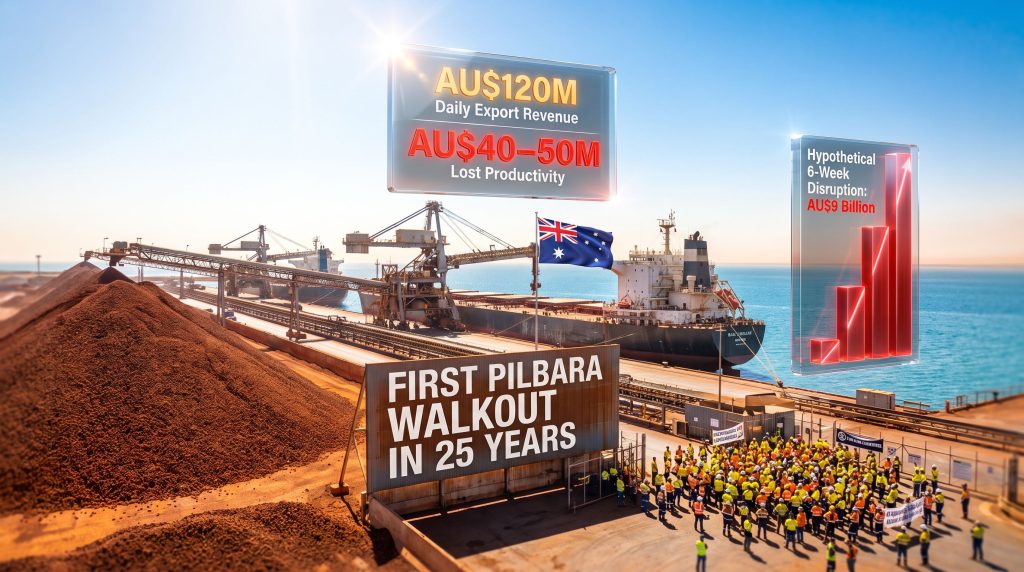
The eight-hour work stoppage on July 17, 2026 involved approximately 200 workers, representing roughly 44% of the Port Hedland terminal's total workforce of around 450 employees. The action ran from 2:00 PM to approximately 10:00 PM AWST, with more than 100 union officials, members, and supporters gathering at the terminal gates.
BHP deployed contingency measures, including non-union personnel, to maintain operational continuity. The company remained on track to load seven iron ore vessels by the conclusion of the strike window, consequently limiting immediate supply chain disruption. Workers also agreed to return if any safety emergency arose during the stoppage.
Despite this, the financial cost of even a single partial-day disruption at this scale illustrates why the stakes are so high:
| Scenario | Estimated Financial Impact |
|---|---|
| Single 8-hour strike (July 16-17, 2026) | AU$40-50 million in lost BHP productivity |
| Daily iron ore revenue through Port Hedland | AU$120 million per day |
| Hypothetical 6-week disruption | AU$9 billion in national export revenue |
| WA Government royalty loss (6-week scenario) | AU$500 million in foregone royalties |
Note: These figures are estimates and projections. Actual financial impacts depend on BHP's contingency capacity, prevailing iron ore prices, and the duration of any future industrial action. Investors and stakeholders should treat forward projections as indicative rather than definitive.
One lesser-known factor that may have amplified the operational impact of the July 17 stoppage is its timing. The strike coincided with a scheduled double-up maintenance day, a regular operational practice where maintenance crews conduct intensive planned work alongside standard operations. When a double-up day and a partial workforce walkout overlap, the compounding effect on throughput capacity can be disproportionate to the number of workers involved. The Pilbara iron logistics network, already operating near capacity, is particularly sensitive to such compounding disruptions.
Port Hedland's Irreplaceable Role in Global Steel Supply
To contextualise why this dispute carries implications far beyond BHP's balance sheet, it is worth understanding what Port Hedland actually represents in global commodity flows.
Port Hedland is Australia's largest bulk export terminal and one of the highest-volume iron ore shipping facilities anywhere in the world. The Pilbara iron ore it exports is the primary feedstock for blast furnace steelmaking across Asia, with China steel demand being the dominant driver. The ore grades exported from BHP's Pilbara operations, while not the highest-grade product globally, are valued for their consistency, volume availability, and established supply chain integration with Asian mill configurations.
A sustained disruption to Port Hedland throughput does not merely inconvenience BHP. It forces steel mills to seek alternative sources at short notice, compressing spot market supply and potentially driving price volatility. For instance, iron ore futures can shift significantly when even temporary supply anxiety enters the market. Iron ore price trends suggest that sustained disruption at this scale would have meaningful knock-on effects across global commodity markets.
The Minerals Council of Australia warned that prolonged industrial action risks signalling to international buyers and investment partners that Australian resource supply is not as reliable as the country's long-standing export record suggests.
MCA CEO Tania Constable stated publicly that a protracted dispute of this nature risks damaging Australia's reputation as a dependable iron ore supplier, and that the wider message sent by industrial unrest in the Pilbara extends well beyond any single employer-union negotiation. The MCA estimated that a six-week disruption would cost the national economy AU$9 billion in export revenue while depriving the Western Australian government of AU$500 million in royalty income.
Why This Dispute Feels Different from Past Pilbara Conflicts
The BHP strike in Port Hedland is widely described as the most significant industrial action at the terminal in over 25 years. That historical framing deserves unpacking.
The Pilbara has not been free of labour tension over the past quarter-century. However, what makes the current situation distinct is the convergence of several structural conditions:
- Record corporate profitability: BHP reported record iron ore production and shipments for FY2026, making it difficult for management to argue that pay improvements are unaffordable.
- Real wage erosion: Cost-of-living pressures across Australia have intensified worker scrutiny of whether nominal wage offers represent genuine purchasing power gains.
- Individual contract proliferation: The spread of individually managed employment contracts across parts of the Pilbara workforce has created visible and measurable pay inequities that are now being challenged through collective action.
- Coordinated union strategy: The formation of a combined bargaining front signals a more deliberate and coordinated industrial campaign than has been typical in recent Pilbara disputes.
- Timing relative to BHP investment announcements: The dispute coincides with BHP's announcement of a AU$1.35 billion investment to develop the Ministers North iron ore project, a juxtaposition that union representatives and workers are unlikely to overlook.
Furthermore, the WA resources sector impact extends well beyond BHP's own operations, meaning the stakes for resolution are elevated at both a corporate and a state economic level.
The next major ASX story will hit our subscribers first
The July 22 Inflection Point and What Resolution Would Require
Both parties are scheduled to resume formal negotiations on Tuesday, July 22, 2026. Union representatives have characterised this meeting as BHP's final opportunity to prevent further and potentially more disruptive industrial action. Additional protected strikes are being prepared if the company does not substantially revise its position.
BHP has indicated a preference for resolving the dispute through Fair Work Commission facilitation rather than direct negotiation, a position the Combined Ports Unions have rejected in favour of enterprise bargaining. This procedural disagreement reflects a deeper strategic divergence: BHP's preferred pathway keeps the dispute within a formalised institutional framework where outcomes are more predictable, while unions seek a directly negotiated agreement that delivers binding pay structures.
For a resolution to hold, industry analysts suggest any settlement would likely need to include:
- A binding enterprise agreement replacing the existing individual contract structure.
- Pay benchmarking against comparable BHP Pilbara operations to close the up-to-AU$40,000 annual wage gap.
- Transparent pay structures with clear role-equivalent compensation bands.
- Formal recognition of the skills premium associated with remote, high-demand industrial work.
The Broader Pilbara Precedent: Why the Sector Is Watching Closely
Perhaps the most consequential dimension of the BHP strike in Port Hedland is not what it means for BHP specifically, but what a union success could catalyse across the broader Pilbara workforce.
The MCA's warning about unions seeking broader influence over the Pilbara labour market reflects a genuine concern among major operators. If collective bargaining delivers tangible pay parity outcomes at Port Hedland, it creates a documented precedent that other Pilbara workforces can reference in their own negotiations. This is particularly significant given that individual employment contracts have become widespread across the sector, and the inequities they generate are increasingly difficult to defend when record profitability makes affordability arguments less credible.
The recent appointment of a new Western Australian Mines Minister adds a layer of policy uncertainty to the landscape. How the state government calibrates its response to prolonged industrial unrest, balancing royalty revenue dependency against labour relations considerations, could consequently shape the regulatory and political environment in which this and future disputes are resolved.
For investors, the immediate financial exposure of a single-day partial strike is manageable. The more material risk, however, is a scenario where unresolved grievances produce a cycle of rolling stoppages that erodes BHP's ability to meet customer shipment commitments, introduces a discount to Australian iron ore supply reliability, and invites comparative scrutiny of labour relations practices across the sector.
Disclaimer: This article contains forward-looking estimates and projections based on publicly available information and industry analysis. These figures are subject to significant uncertainty. Nothing in this article constitutes financial advice. Readers should conduct independent research before making investment decisions.
Frequently Asked Questions: BHP Strike in Port Hedland
What is the BHP strike in Port Hedland about?
The strike centres on a pay equity dispute between BHP and approximately 200 unionised workers at Australia's largest bulk export terminal. Workers are seeking a binding enterprise agreement, pay parity with colleagues at other BHP Pilbara sites, and an end to individually set employment contracts that have created wage gaps of up to AU$40,000 for equivalent roles.
When did the BHP Port Hedland strike begin?
Protected industrial action commenced on July 16-17, 2026, with an eight-hour work stoppage running from 2:00 PM to approximately 10:00 PM AWST. This marks the first protected strike at the Port Hedland terminal in over 25 years.
How much could the strike cost BHP and the Australian economy?
The single-day stoppage is estimated to have cost BHP between AU$40 million and AU$50 million in lost productivity. Port Hedland generates approximately AU$120 million in daily iron ore export revenue. A hypothetical six-week disruption could cost the national economy AU$9 billion in export revenue and deprive the Western Australian government of AU$500 million in royalties.
What unions are involved in the BHP Port Hedland strike?
Three unions form the Combined Ports Unions negotiating bloc: the Electrical Trades Union (ETU), the Australian Manufacturing Workers' Union (AMWU), and the Western Mine Workers Alliance.
What happens if BHP and the unions cannot reach an agreement?
Negotiations are scheduled to resume on July 22, 2026. Unions have indicated this represents BHP's final opportunity to avert further and potentially more prolonged industrial action. If talks fail, additional protected strikes are anticipated.
Did BHP maintain iron ore shipments during the strike?
Yes. BHP deployed contingency measures including non-union workers and remained on track to load seven iron ore vessels by the end of the strike window, limiting immediate supply chain disruption.
Want to Stay Ahead of Major Shifts in the ASX Resources Sector?
Discovery Alert's proprietary Discovery IQ model delivers real-time alerts on significant ASX mineral discoveries, instantly translating complex resource data into actionable investment insights — ensuring subscribers are positioned ahead of the broader market. Start your 14-day free trial today and explore historic examples of exceptional discovery returns that illustrate just how transformative early positioning can be.