
August 6, 2026
When Leadership Appointments Reveal More Than They Appear To
The transition from interim to permanent executive appointments in junior mining is rarely a quiet administrative process. It is, in most cases, a deliberate signal delivered to capital markets at a carefully chosen moment. For investors who track pre-production mining companies, these signals carry disproportionate weight relative to the attention they typically receive. Bunker Hill Mining appoints permanent CFO ahead of commercial production start — and that headline, on closer inspection, communicates considerably more than a routine personnel update.
Understanding why requires a closer look at the financial and operational architecture that underpins a mine restart, the unique regulatory complexity that shapes one of North America's most historically significant polymetallic districts, and what the recent leadership consolidation at Bunker Hill Mining Corporation (TSX: BNKR | OTCQB: BHLL) communicates about where this operation stands in its journey toward commercial production.
When big ASX news breaks, our subscribers know first
The Strategic Logic Behind CFO Permanency in Pre-Production Mining
In the junior mining lifecycle, the role of Chief Financial Officer evolves dramatically as a project moves from exploration through development and into production. During redevelopment and commissioning, a CFO is primarily managing capital draw-downs, compliance obligations, and investor reporting. As a project crosses into commercial production, that same role expands to include revenue recognition, concentrate sales accounting, hedging strategy, cost reporting under production-stage accounting standards, and increasingly complex debt covenants.
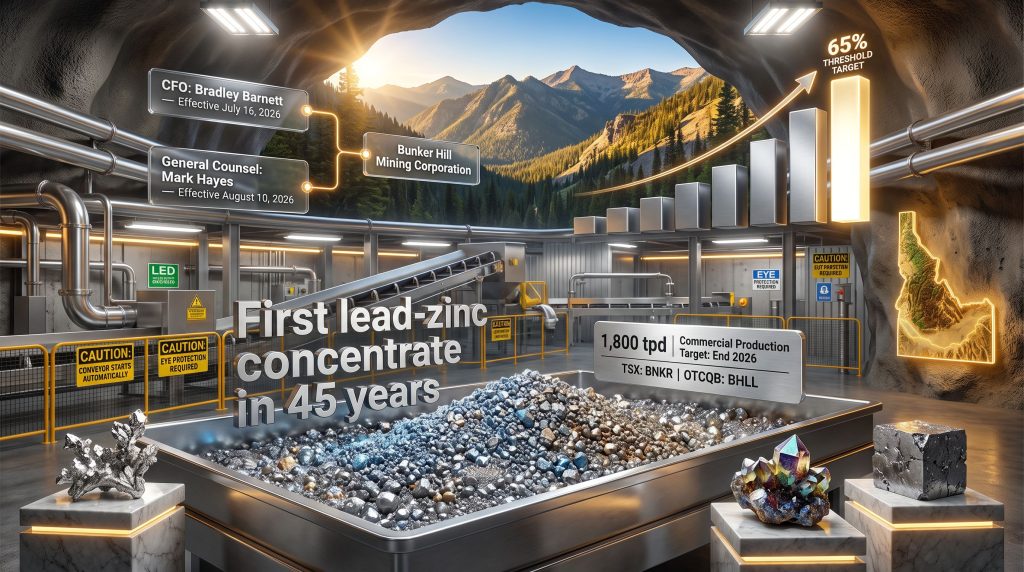
This transition in financial complexity is precisely why the confirmation of Bradley Barnett as permanent CFO, effective July 16, 2026, carries real informational content. Barnett had been serving in an interim capacity since April 2024, navigating the company's financial operations through the redevelopment and commissioning of the historic Bunker Hill mine. The board's decision to formalise his appointment is a clear statement that:
- The company's financial trajectory has been validated at the highest governance level
- Leadership continuity is being prioritised as production milestones approach
- The institutional groundwork for revenue-stage reporting is being put in place
In junior mining, the gap between interim and permanent CFO status is not merely symbolic. It reflects board-level judgement about whether the financial architecture of the business is ready for the demands of a commercially operating mine.
Furthermore, understanding the broader context of junior mining risks helps illustrate why this kind of governance signal matters so disproportionately to investors at this stage of the development cycle.
Bunker Hill Mining and the Coeur d'Alene District: Context That Shapes Everything
The Bunker Hill mine sits within Idaho's Silver Valley, part of the broader Coeur d'Alene Mining District, which ranks among the most historically productive polymetallic corridors in North America. The district has yielded enormous volumes of silver, lead, and zinc across more than a century of mining activity, making it a region with well-understood geology but substantial regulatory complexity owing to decades of legacy contamination.
The mine itself has been closed for approximately 45 years, making its current redevelopment one of the more ambitious mine restart programmes underway in the United States. The operation recently achieved a milestone that the industry had not witnessed from this asset in nearly half a century: the production of its first lead-zinc concentrate, formally marking the transition from commissioning into active ramp-up. According to a recent company update, Bunker Hill remains on track for concentrate production delivery within its stated timeline.
| Metric | Detail |
|---|---|
| Processing Capacity Target | 1,800 tonnes per day (tpd) |
| Commercial Production Threshold | 65% of tpd sustained for 90 days |
| Primary Commodities | Silver, Zinc, Lead |
| Location | Silver Valley, Idaho, USA |
| Exchange Listings | TSX: BNKR / OTCQB: BHLL |
| Expected Commercial Production | End of 2026 |
| Mine Closure Duration | Approximately 45 years |
Defining the Commercial Production Trigger
Commercial production at Bunker Hill is formally defined as sustaining throughput at 65% of the 1,800 tonne-per-day processing capacity for a continuous 90-day period. This definition aligns broadly with industry-standard thresholds used at comparable base metal operations, where sustained throughput over an extended window is required before production-stage accounting and revenue recognition formally commence.
The 90-day requirement is operationally significant. Underground mines with complex ore bodies, ageing infrastructure being recommissioned after multi-decade closures, and active remediation obligations running in parallel to production represent environments where short-term throughput spikes can mask deeper operational instability. The 90-day window is designed to filter out those temporary surges and confirm genuine operational continuity.
Mark Hayes: Why Legal Architecture Matters at This Stage
Alongside the CFO confirmation, Bunker Hill announced the appointment of Mark Hayes as General Counsel, effective August 10, 2026. Hayes brings more than a decade of legal and strategic experience across mining, natural resources, and energy, including senior roles within Rio Tinto's copper and borates businesses supporting major operational and growth initiatives across the Americas.
Most recently, Hayes served as head of legal for Nuton, Rio Tinto's copper leaching technology venture, where his responsibilities spanned strategic investments, commercial agreements, governance frameworks, and environmental matters at the intersection of cutting-edge mineral processing and regulatory compliance.
His areas of expertise span a notably broad legal terrain for a mine at this stage of development:
- Mergers and acquisitions
- Project development and environmental permitting
- Regulatory compliance frameworks
- Commercial negotiations and offtake agreements
- Joint venture structuring and corporate governance
Why Superfund-Literate Legal Counsel Is Not Optional Here
The Bunker Hill mine restart is not a conventional recommissioning story. It represents something that had never been achieved before in more than five decades of US environmental policy: the first commercial mining operation to resume within an active US EPA Superfund-designated cleanup site since the programme's establishment in 1969.
This distinction is operationally and legally consequential. Active Superfund designation means that mining operations must coexist with, and be structured to support, ongoing environmental remediation. The compliance obligations, monitoring requirements, reporting frameworks, and liability structures that flow from this are materially more complex than those facing a conventional mine restart on unencumbered land.
Chairperson Richard Williams described Hayes's combination of operational mining experience, transactional depth, and regulatory knowledge as precisely what the company needs as it advances toward commercial production and continues developing its long-term growth strategy.
The Superfund Dimension: A Regulatory Precedent Being Written in Real Time
The US EPA Superfund programme has been operational since 1969. In the more than 55 years since its establishment, no commercial mining operation had successfully restarted within an active Superfund site. That fact alone positions the Bunker Hill restart as a case study in regulatory navigation that extends well beyond this single project.
For investors and industry observers, the implications are layered. In addition, these mining permitting challenges are rarely straightforward, and the Superfund context adds a further dimension that distinguishes this restart from conventional redevelopment programmes.
- Precedent value: A successful restart model at Bunker Hill could provide a replicable framework for dozens of dormant US mining assets located within or adjacent to Superfund-designated zones.
- Compliance infrastructure: The environmental monitoring, operational separation protocols, and remediation coordination required to satisfy EPA conditions represent a genuine operational overhead that investors should factor into cost modelling.
- Legal complexity as a moat: The knowledge and relationships required to navigate active Superfund production are not easily replicated, creating a degree of operational expertise that functions as a competitive barrier.
- Regulatory timeline risk: Permitting and compliance timelines within Superfund-regulated environments can be subject to variability that differs from conventional mine permitting.
The Bunker Hill mine's position inside an active Superfund site is simultaneously its greatest regulatory challenge and, if successfully navigated, its most compelling differentiator as a proof-of-concept for responsible mine redevelopment in legacy industrial landscapes.
How This Executive Build-Out Fits Bunker Hill's Broader Corporate Strategy
The CFO confirmation and General Counsel appointment reflect a stated strategic priority: concentrating senior executive leadership within the United States, in close proximity to the operation, regulatory bodies, and key stakeholders. For a mine navigating EPA compliance obligations, ramp-up operational complexity, and the early stages of commercial concentrate sales, domestic leadership proximity is not incidental.
The CFO-General Counsel pairing also represents what might be described as the minimum viable financial-legal leadership structure for a mine transitioning from development-stage to revenue-generating entity. Together, these roles anchor:
- Capital allocation and financial reporting as production scales
- Revenue recognition and concentrate offtake agreement management
- EPA compliance and environmental reporting obligations
- Corporate governance frameworks for potential future capital raises or strategic partnerships
- M&A readiness as the company's long-term growth strategy evolves
Consequently, the broader context of mining consolidation trends in 2025 and beyond suggests that having robust legal and financial leadership in place may also position Bunker Hill more attractively should strategic partnership opportunities emerge.
The next major ASX story will hit our subscribers first
Key Risk and Catalyst Framework for Investors
The following analysis is provided for informational purposes only and does not constitute financial advice. Investing in junior mining companies involves material risk, including the potential loss of capital. Forecasts and timelines are subject to change.
Near-Term Catalysts to Monitor
- Formal achievement of the 65% tpd threshold sustained across 90 consecutive days, triggering commercial production recognition
- First concentrate shipments and any associated offtake agreement disclosures
- Quarterly operational updates tracking throughput progression toward the end-2026 commercial production target
- General Counsel integration and initial legal framework announcements post-August 10
Risk Factors Specific to This Operation
| Risk Category | Specific Factor | Mitigation Signal |
|---|---|---|
| Regulatory | EPA Superfund compliance during active ramp-up | Experienced General Counsel with environmental background appointed |
| Financial | Capital allocation and reporting pre-revenue | Permanent CFO with redevelopment-phase experience confirmed |
| Operational | Throughput ramp-up to 1,800 tpd | First concentrate already produced during commissioning |
| Market | Zinc, lead, and silver spot price volatility | Diversified three-commodity output provides partial natural hedge |
| Legal | Offtake, JV, and governance complexity | Tier-1 mining legal expertise with transactional experience secured |
| Geological | Metallurgical recovery rates versus feasibility assumptions | Historically well-characterised Coeur d'Alene ore body |
| Structural | Capital cost overruns during commissioning-to-production transition | Active ramp-up underway with concentrate production confirmed |
However, investors should also consider the impact of commodity price volatility on zinc, lead, and silver when modelling expected returns from operations at this stage of the production cycle.
What Junior Mining Investors Often Overlook About Executive Sequencing
There is a recognisable pattern in how junior and transitional mining companies build out their management teams as projects approach production. Technical appointments, operational hires, and site-level management tend to come first, driven by immediate physical requirements. Financial and legal leadership consolidation typically follows, and when it does, it reflects a shift in organisational priority from building the mine to managing the business that operates it.
Bunker Hill's current executive sequencing fits this pattern precisely. With first concentrate already produced and the 90-day commercial production clock now the defining operational variable, the formalisation of financial stewardship and legal architecture is timed to match the operational moment. Furthermore, a detailed recent announcement from the company outlines the full scope of this management transition for those seeking additional context.
For investors monitoring the latest news that Bunker Hill Mining appoints permanent CFO alongside the General Counsel hire, the combined signal is one of institutional readiness, not merely administrative housekeeping. The company is configuring its leadership structure for the demands of a commercially operating mine, and doing so within one of the most complex regulatory environments that any North American mine restart has ever confronted.
Frequently Asked Questions
What does the news that Bunker Hill Mining appoints permanent CFO mean for investors?
The confirmation of Bradley Barnett as permanent CFO removes a layer of leadership uncertainty at a critical pre-commercial production stage. It communicates board confidence in the company's financial management and signals readiness to transition into revenue-generating operations by end of 2026.
When is commercial production expected at Bunker Hill Mine?
Commercial production is targeted for the end of 2026, contingent on sustaining throughput at 65% of the 1,800 tpd processing capacity for a continuous 90-day period.
What metals does Bunker Hill Mine produce?
The operation produces silver, zinc, and lead concentrates from Idaho's Coeur d'Alene Mining District, one of North America's most historically significant polymetallic producing regions.
Why is the Bunker Hill restart considered a historic regulatory milestone?
It represents the first instance of commercial mining recommencing within an active US EPA Superfund-designated cleanup site since the programme was established in 1969, a period spanning more than 55 years.
Who is Mark Hayes and what does he bring to Bunker Hill?
Hayes joins as General Counsel effective August 10, 2026, bringing over a decade of legal experience across mining, natural resources, and energy, including senior roles within Rio Tinto's copper and borates businesses and most recently as head of legal for Rio Tinto's Nuton copper leaching venture.
How long was Bunker Hill Mine closed before this restart?
The mine was closed for approximately 45 years before the current redevelopment and restart programme commenced.
Want to Track the Next Major Mining Milestone Before the Market Does?
Discovery Alert's proprietary Discovery IQ model scans ASX announcements in real time, delivering instant alerts on significant mineral discoveries and translating complex data into clear, actionable insights for investors at every experience level — explore historic discoveries and their returns to understand the scale of opportunity, then begin your 14-day free trial at Discovery Alert to position yourself ahead of the broader market.