
July 8, 2026
When Labour Peace Fractures: Understanding the Fault Lines Behind the BHP Port Hedland Strike
Decade-long stretches of industrial calm in major resource economies rarely end quietly. They tend to accumulate pressure gradually, through widening pay gaps, rising living costs, shifting workforce structures, and the slow erosion of trust between labour and management. When the break finally arrives, it arrives decisively. That is precisely what is unfolding at Port Hedland in 2026, where BHP workers strike has ended nearly two decades of relative industrial peace and thrust Australia's most consequential export terminal into a period of deep uncertainty.
Understanding why this dispute has reached a flashpoint requires stepping back from the immediate headlines and examining the structural forces that made this outcome not just possible, but arguably inevitable.
When big ASX news breaks, our subscribers know first
The Anatomy of the Dispute: Pay Parity at the Centre
At its core, the BHP workers strike in Port Hedland is a pay equity dispute, but characterising it simply as a wage negotiation understates its complexity. Workers represented by the Australian Manufacturing Workers' Union (AMWU) and the Electrical Trades Union (ETU) have identified a compensation gap of up to $40,000 per year between employees performing functionally identical roles within the same Pilbara operational environment.
This is not a dispute about cost-of-living adjustments or incremental wage growth. It reflects a structural divergence in how different workforce classifications are compensated for equivalent skilled labour, a practice that has become increasingly difficult to defend as pay transparency grows across the resources sector.
More than 450 unionised maintenance workers have endorsed protected industrial action following negotiations that stretched across more than seven months without resolution. The sheer duration of those talks, combined with the absence of meaningful progress on the core pay parity issue, signals that the distance between BHP's position and union demands is not a matter of fine-tuning. It reflects a fundamental disagreement about workforce cost architecture.
A third union, the Australian Workers' Union (AWU), representing over 100 additional workers, has separately applied to the Fair Work Commission for its own strike ballot, raising the prospect of a coordinated multi-union action that would dramatically expand the scope of any work stoppage.
A Near-Unanimous Workforce: Reading the Strike Ballot Results
One of the most significant and underreported aspects of this dispute is the margin of the strike vote. Industrial action votes in the resources sector frequently reflect a divided workforce, with meaningful minorities opposing action due to income security concerns. What emerged from the Port Hedland ballot was categorically different.
| Union | Vote in Favour of Protected Industrial Action |
|---|---|
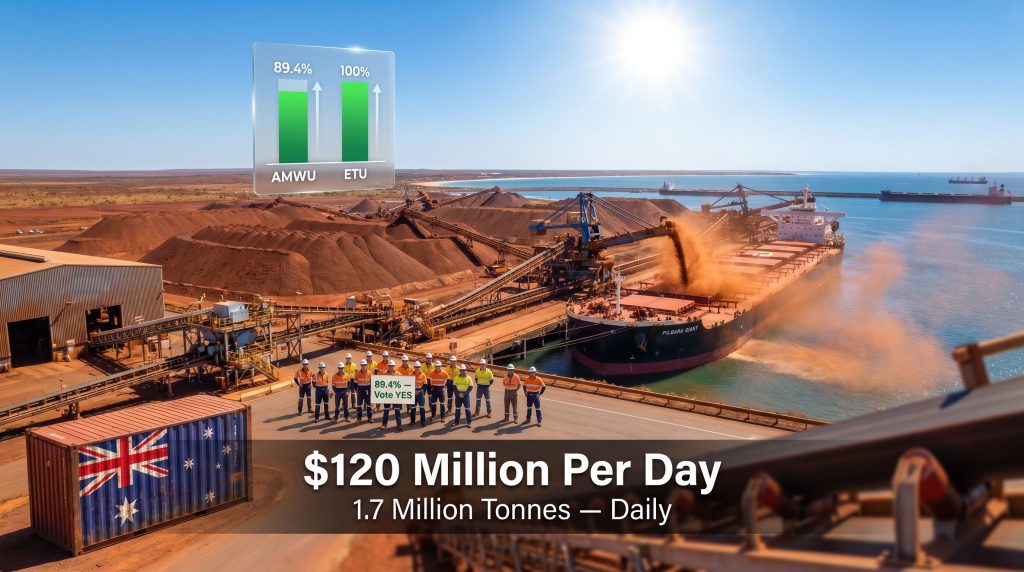
| Australian Manufacturing Workers' Union (AMWU) | 89.4% |
| Electrical Trades Union (ETU) | 100% |
| Australian Workers' Union (AWU) | Ballot pending |
A 100% vote by ETU members is a rare and significant signal. It suggests not just frustration, but a unified, resolute workforce with no meaningful internal dissent. The AMWU's 89.4% endorsement rate reinforces this picture. These are not marginal mandates that BHP can credibly interpret as ambivalent. They represent a workforce with a clear, shared grievance and the collective resolve to act on it.
The strength of a strike mandate matters beyond its symbolic value. A near-unanimous vote reduces the likelihood that BHP can rely on internal workforce divisions to weaken union bargaining leverage during negotiations.
How Protected Industrial Action Works Under Australian Law
For those less familiar with Australian industrial relations mechanics, protected industrial action operates within a specific legal framework under the Fair Work Act 2009. Workers who follow procedural requirements, including the filing of a strike notice, are shielded from civil liability for losses caused to the employer during the action.
Critically, a mandatory five-day notice period must be served before any stoppage can commence. This cooling-off window is designed to create space for last-minute negotiation, though in practice it also provides employers with time to activate contingency operations. The first concrete action, an eight-hour work stoppage, was confirmed for July 16, representing the opening move in what unions have signalled could escalate into sustained industrial action.
Port Hedland: The Global Stakes of a Local Dispute
To appreciate the international significance of the BHP workers strike, it is essential to understand exactly what Port Hedland represents within global commodity supply chains. Port Hedland is not simply Australia's largest port. It is the single largest iron ore export terminal on Earth, processing approximately 1.7 million tonnes of iron ore exports per day.
The port serves as BHP's primary gateway to steel manufacturers across Asia, with China, Japan, and South Korea among its largest customer markets. Furthermore, Australia's iron ore dominance in global supply is heavily concentrated through Pilbara operations, meaning any sustained disruption carries consequences that extend well beyond national borders.
The Pilbara region more broadly accounts for a dominant share of global seaborne iron ore supply. BHP, alongside Rio Tinto and Fortescue, has made the Pilbara the world's most concentrated iron ore production zone. This concentration is a double-edged reality: it delivers extraordinary operational efficiency under normal conditions, but it also means that a single major disruption has the capacity to reverberate through global steel production timelines.
Iron ore is not a commodity where buyers can easily switch suppliers on short notice. The seaborne iron ore market operates on long-term shipping logistics and supply contracts, meaning even a two to three week disruption can create cascading delays in blast furnace scheduling at major steelmaking facilities across Asia.
The Hidden Geography of Iron Ore Quality
A dimension of this dispute that rarely enters mainstream coverage is the quality profile of BHP's Pilbara iron ore. Port Hedland exports predominantly medium-grade iron ore, typically in the range of 58 to 62 percent iron (Fe) content, blended across BHP's Mining Area C, South Flank, and other Pilbara operations.
This grade profile is important because Asian blast furnace operators have calibrated their production processes around consistent Pilbara supply specifications. A supply disruption does not merely reduce volume; it can force sinter plant and blast furnace operators to reformulate their ore blends using alternative sources with different chemical compositions and gangue mineral profiles, increasing operational complexity and cost. This technical dimension adds an underappreciated layer of urgency to resolving the BHP workers strike, extending the real cost of disruption well beyond the port gate.
The Financial Calculus: What a Stoppage Actually Costs
The financial exposure from a full operational stoppage at Port Hedland is not modest.
| Stakeholder | Estimated Daily Financial Impact |
|---|---|
| BHP (lost export revenue) | ~$120 million per day |
| Western Australian Government (lost royalties) | ~$7 million per day |
These figures transform this dispute from a bilateral enterprise bargaining matter into something with direct fiscal consequences for the state government. The WA resources sector impact on state revenue is substantial, given that Western Australia's iron ore royalty stream is one of its most significant funding sources. Consequently, the state government has an inherent financial interest in the resolution of this dispute, even without taking any formal position in the negotiations.
Scenario Modelling: The Escalation Pathway
Scenario A: Contained Eight-Hour Stoppage (July 16)
- BHP's contingency operations may partially offset throughput losses during a brief single-shift stoppage
- The primary impact is reputational and signalling-based, demonstrating union resolve rather than delivering maximum economic pressure
- Global iron ore spot markets are unlikely to react significantly to a single-day event
Scenario B: Sustained Multi-Week Action Involving All Three Unions
- If the AWU ballot succeeds and all three unions coordinate, the combined workforce disruption could exceed BHP's contingency capacity
- A two to four week sustained stoppage could produce cumulative revenue losses estimated at $1.5 billion to $2 billion
- Seaborne iron ore spot prices could experience upward pressure as Asian buyers seek alternative supply, benefiting Brazilian producers such as Vale in the short term
- Shipping and logistics markets would experience secondary disruption as vessel scheduling adjustments cascade through the supply chain
Disclaimer: These scenario projections are based on current export volumes and prevailing commodity price estimates. Actual outcomes will depend on operational contingency effectiveness, the duration and coordination of industrial action, and market responses that cannot be predicted with certainty.
The Legal Precedent That Changed the Negotiating Landscape
A critical piece of context that directly shapes the current dispute is BHP's recent defeat in the High Court of Australia regarding pay parity at its Queensland coal operations. Earlier in 2026, the High Court rejected BHP's application to appeal a Fair Work Commission ruling that had found more than 2,000 mine workers at three BHP coal mines in Queensland were entitled to the same wages as their permanent full-time counterparts.
The Court found the appeal had insufficient prospects of success. The outcome delivered those workers a permanent $30,000 annual pay rise. For Pilbara unions now demanding resolution of a $40,000 pay gap, this ruling is not merely a precedent. It is a blueprint.
The timing of the Port Hedland escalation, coming within months of the High Court ruling, strongly suggests that the Queensland outcome materially emboldened the Pilbara workforce and lowered their threshold for accepting a negotiated compromise short of genuine pay equity.
The next major ASX story will hit our subscribers first
Political Dimensions: A Government With Competing Interests
Federal Resources Minister Madeleine King publicly expressed support for the rights of Port Hedland workers to receive fair compensation, while simultaneously encouraging both parties to pursue a negotiated resolution. This dual message reflects the Labor government's genuinely competing interests in the dispute.
On one hand, the government has made strengthening collective bargaining rights a centrepiece of its industrial relations agenda since coming to office. Openly opposing a strike vote with an 89% to 100% mandate would be politically inconsistent with that agenda and would risk alienating core union constituencies.
On the other hand, Port Hedland underpins a significant portion of Australia's export income and generates royalty flows that fund public services in Western Australia. Moreover, the global iron ore market is already navigating considerable uncertainty in 2025 and 2026, meaning any prolonged disruption to throughput carries macroeconomic consequences that no federal government can be indifferent to.
Industry bodies have taken a sharply contrasting position, framing strike action at Australia's most important export facility as damaging to Australia's reputation as a reliable resource supply partner. This argument is a recurring rhetorical pattern in Australian resources sector industrial disputes and one that unions consistently challenge.
Why Nearly Two Decades of Industrial Peace Broke Down
The extended period of labour stability in the Pilbara was not accidental. It was underpinned by a specific set of conditions:
- Historically elevated commodity prices during the 2000s and early 2010s super-cycle that supported above-inflation real wage growth
- A relatively cooperative enterprise bargaining environment between the major miners and unions
- The geographic isolation of the Pilbara, which made workers financially dependent on maintaining employment in a region with limited alternative opportunities
- Company towns and fly-in fly-out (FIFO) work arrangements that created structural barriers to collective industrial action
However, several of these conditions have eroded significantly. The Pilbara is now recognised as one of Australia's most expensive regional living environments, and the cost-of-living pressures facing FIFO workers have intensified the urgency of wage demands. In addition, China iron ore demand and the broader dynamics of the China steel and iron ore market have added further complexity to how miners price and manage their workforce costs.
Meanwhile, the proliferation of contract labour arrangements and multi-tier workforce structures has created visible pay disparities within worksites that are difficult to rationalise to workers performing the same physical tasks under the same safety risks. The first significant strike vote at Port Hedland in approximately 20 years is therefore less a sudden rupture than the culmination of a slow structural shift in the workforce's tolerance for inequality within its own ranks.
Key Decision Points: What Happens Next
| Milestone | Detail |
|---|---|
| Five-day notice period | Legally required before protected action commences |
| July 16 | Initial eight-hour stoppage by AMWU and ETU members |
| AWU ballot outcome | Pending Fair Work Commission approval; could add 100+ workers |
| Fair Work Commission intervention | Available if either party applies for suspension or termination of action |
The pathway to resolution remains open but narrow. BHP's concessions so far have not fully addressed the structural pay gap at the heart of this dispute. Consequently, BHP's willingness to address the structural pay gap, either through full parity or a credible, time-bound multi-year pathway, will likely determine whether this dispute remains a contained signalling event or escalates into a prolonged economic confrontation with consequences well beyond the port gates of Port Hedland.
Frequently Asked Questions
What is the BHP Port Hedland strike about?
Maintenance workers are seeking pay parity, specifically closing a gap of up to $40,000 per year between workers in identical roles, alongside improvements to workplace safety standards. Negotiations have continued without resolution for more than seven months.
When does the BHP Port Hedland strike begin?
An initial eight-hour stoppage was confirmed for July 16, following the mandatory five-day notice period required under the Fair Work Act 2009.
How much could the strike cost BHP each day?
A full operational stoppage is estimated to cost BHP approximately $120 million per day in lost revenue, with Western Australia losing around $7 million per day in iron ore royalties.
Which unions are involved?
The AMWU and ETU have both endorsed protected industrial action. The AWU has separately applied for its own strike ballot at the Fair Work Commission.
Is this the first major industrial action at Port Hedland in recent history?
Yes. This is the first significant strike vote at Port Hedland in approximately 20 years, making it the most consequential labour dispute in the Pilbara region since 2008.
How has BHP responded?
BHP has indicated it is maintaining dialogue with unions and has contingency plans in place to sustain operations during any stoppage, though specific operational details have not been publicly disclosed.
Want to Stay Ahead of Major ASX Mineral Discoveries Amid Market Volatility?
When industrial disputes like the BHP Port Hedland strike ripple through global commodity markets, identifying the next significant mineral discovery becomes even more critical — Discovery Alert's proprietary Discovery IQ model delivers real-time alerts on significant ASX mineral discoveries, turning complex data across more than 30 commodities into clear, actionable insights. Explore how historic discoveries have generated substantial returns on Discovery Alert's dedicated discoveries page, and begin your 14-day free trial today to position yourself ahead of the broader market.