July 24, 2026
Why Australian Iron Ore Labour Disputes Carry Global Consequences
Few bottlenecks in global commodity supply chains are as consequential as the handful of bulk export terminals that handle the world's seaborne iron ore trade. When labour unrest threatens one of these facilities, the ripple effects extend far beyond the immediate industrial dispute, touching steel production schedules across Asia, freight markets in the Pacific, and the earnings forecasts of some of the world's largest mining companies. The BHP Port Hedland strike vote, initiated in late May 2026, represents exactly this kind of concentrated systemic risk, and understanding its mechanics requires looking well beyond the headline figures.
When big ASX news breaks, our subscribers know first
Port Hedland: The Anatomy of a Chokepoint
Port Hedland, situated on the Pilbara coast of Western Australia, holds the distinction of being the largest bulk commodity export terminal on the planet by annual throughput. Its significance to global iron ore supply is difficult to overstate. The port serves as the exclusive logistics endpoint for BHP's entire Western Australian iron ore export program, drawing ore via dedicated heavy-haul rail corridors from a network of inland Pilbara mines including Mining Area C, South Flank, and Newman.
What makes Port Hedland structurally irreplaceable within BHP's operating model is the absence of any alternative routing. Unlike some mineral supply chains where throughput can be redirected through secondary ports or alternative rail networks, BHP's Pilbara system is engineered as a closed loop. Ore moves from mine to rail to port in a tightly sequenced flow, and Port Hedland sits at the terminus of that sequence with no bypass option.
The Iron Ore Quality Dimension
Beyond logistics, the port handles predominantly high-grade Pilbara blend fines and lump products, which carry meaningful premiums over lower-grade alternatives in Asian steel markets. Pilbara lump ore, which can be charged directly into blast furnaces without sintering, typically commands a lump premium of between $0.10 and $0.30 per dry metric tonne unit depending on market conditions. This grade premium means that any supply disruption from Port Hedland is not simply a volume problem for steel mills; it also forces buyers to source chemically inferior substitutes, increasing production costs and potentially affecting finished steel quality.
The 62% Fe iron ore fines benchmark is the dominant pricing reference for seaborne iron ore, and BHP's Pilbara products consistently grade at or above this threshold. Australia's iron ore advantages mean supply shortfalls from Port Hedland carry disproportionate pricing implications relative to equivalent tonnage losses from lower-grade producers.
The BHP Port Hedland Strike Vote: What Triggered It
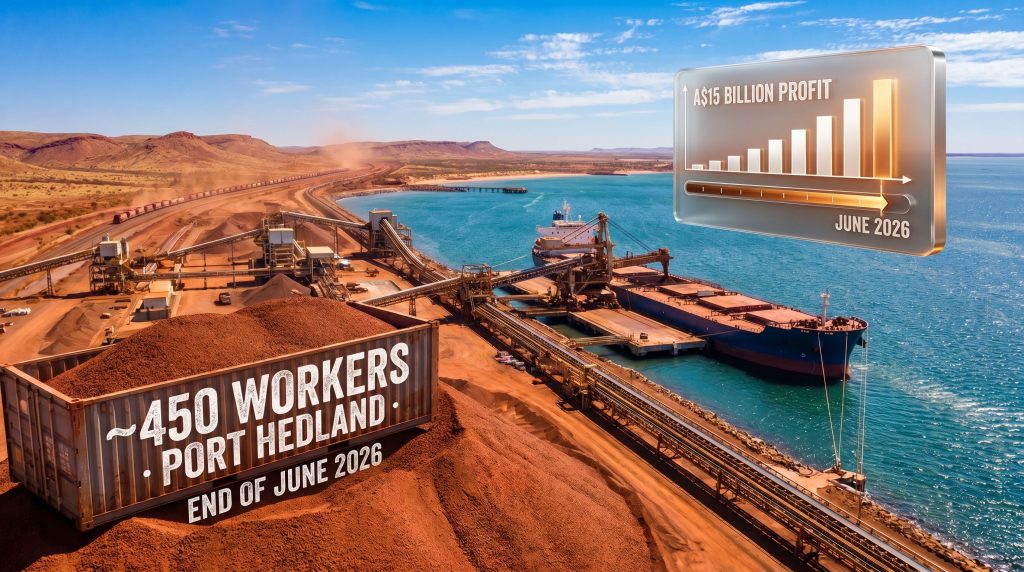
The BHP Port Hedland strike vote was formally initiated by the Electrical Trades Union (ETU) in late May 2026, following approximately six months of enterprise bargaining negotiations that failed to produce an agreement acceptable to the workforce. The ETU represents around 200 of the approximately 450 workers covered under BHP's port labour agreement, with its members occupying critical electrical and control systems roles within the port's operational infrastructure.
The ballot authorises a range of escalating industrial actions, from 15-minute rolling stoppages through to full 24-hour work shutdowns. According to reporting by the AFR, the ETU publicly indicated it anticipated members would vote in favour of action, with the earliest possible commencement of protected industrial action falling by the end of June 2026 if negotiations remain unresolved.
The Rail Workforce: A Compounding Variable
What distinguishes this dispute from prior single-site labour actions is the simultaneous mobilisation of a separate rail workforce. Approximately 350 rail workers, including train drivers operating BHP's Pilbara iron ore rail network, have separately voted in favour of protected industrial action. Their proposed measures include speed restrictions, overtime bans, and outright work stoppages.
This dual-front structure creates an operational vulnerability that BHP's contingency planning must address on two fronts simultaneously. Electrical workers at the port hold system-critical roles involving the control and operation of ship loaders, conveyor systems, and port infrastructure. These are not easily substitutable functions. Rail drivers, meanwhile, control the physical flow of ore from mine to port. Disruption at either node independently would reduce throughput; disruption at both simultaneously risks near-complete suspension of export operations.
Union and Workforce Breakdown
| Union | Workforce Covered | Proposed Actions |
|---|---|---|
| Electrical Trades Union (ETU) | ~200 port electrical workers | Work stoppages (15 min to 24 hrs) |
| Rail and Train Driver Unions | ~350 rail workers | Speed bans, overtime bans, stoppages |
| Australian Workers' Union (AWU) | Broader workforce representation | Bargaining support via Offshore Alliance |
| Maritime Union of Australia (MUA) | Port and offshore workers | Coordinated industrial action |
What Workers Are Demanding and Why the Profitability Argument Matters
The core bargaining demands driving the BHP Port Hedland strike vote span several dimensions of employment conditions:
- Improved base pay with transparent classification structures
- Guaranteed annual wage increases calibrated to cost-of-living movements
- Enhanced roster change consultation processes giving workers greater advance notice
- Improved FIFO accommodation standards, particularly relevant for remote Pilbara workers
- Stronger dispute resolution mechanisms embedded in the enterprise agreement
- Greater certainty around overtime entitlements and penalty rate arrangements
The ETU's state secretary characterised BHP's negotiating posture across six months as producing minimal meaningful movement, and framed the company's offers as falling well short of what the workforce considered fair given BHP's financial performance.
The profitability dimension of this dispute is analytically significant. BHP reported approximately A$15 billion (roughly US$10.73 billion) in profit in its most recent financial year. Union representatives have publicly argued that this financial performance creates both the capacity and the obligation for BHP to share a greater proportion of returns with the workers whose labour generates them. This framing transforms the dispute from a conventional wage claim into a broader profit-sharing argument, which carries different negotiating dynamics and public legitimacy calculus.
Furthermore, BHP's iron ore strategy and the scale of recent earnings make it increasingly difficult for the company to publicly resist profit-sharing arguments, adding another layer of complexity to the bargaining environment.
Investor note: The profit-sharing framing used by the ETU reflects a broader post-pandemic shift in labour relations across the Australian resources sector. As commodity supercycles inflated miner earnings between 2021 and 2025, union bargaining positions increasingly referenced corporate profitability as a justification for above-CPI wage demands. This represents a structural shift in how enterprise agreements are contested, not a temporary anomaly.
Operational Risk Scenarios: From Minor Disruption to Full Export Suspension
Modelling the Range of Outcomes
| Disruption Scenario | Duration | Estimated Operational Impact |
|---|---|---|
| Short rolling stoppages | 15 min to 4 hrs | Minimal throughput reduction; manageable with contingency |
| Extended daily stoppages | 8 to 12 hrs | Meaningful export volume reduction; stockpile drawdown begins |
| Full 24-hour work stoppages | 1 to 3 days | Significant tonnage shortfall; vessel queuing and demurrage costs |
| Combined port and rail action | Multi-day | Potential near-complete export suspension from BHP's WA operations |
BHP has confirmed the existence of contingency operational frameworks designed to maintain safe operations during potential union disruptions. However, contingency plans in capital-intensive port environments face structural limitations. The specialised nature of electrical control work at a port of Port Hedland's scale means that non-union substitution carries both safety risks and regulatory exposure under Australian workplace health and safety frameworks.
A factor less widely appreciated outside the industry is the role of vessel queuing and demurrage costs in amplifying the economic impact of even short disruptions. Port Hedland typically handles a continuous queue of bulk carriers, and any delay in loading cycles compounds rapidly. Each day a Capesize vessel waits idle at anchor incurs demurrage charges that typically range between $15,000 and $30,000 per day depending on charter party terms. A multi-day stoppage affecting dozens of vessels simultaneously translates into tens of millions of dollars in direct costs beyond the lost export revenue.
How Market Pricing Responded
BHP shares were trading up 1.4% at A$61.45 at the time the strike ballot was announced, broadly tracking the S&P/ASX 200 index, which gained 1.2% on the same session. The muted equity market response suggests investors are currently pricing in a negotiated resolution rather than a prolonged industrial shutdown, consistent with the historical pattern of Australian resources labour disputes resolving before authorised action commences.
If escalation does materialise, iron ore price trends would depend heavily on the duration and scope of any disruption. Given BHP's dominant share of seaborne Pilbara supply, a sustained multi-day combined port and rail stoppage could exert meaningful upward pressure on 62% Fe fines benchmark pricing, particularly during periods of already constrained port inventories at Chinese steel mills.
The Broader Pattern: Australia's Resources Sector Labour Cycle
The BHP Port Hedland strike vote does not exist in isolation. It represents one node within a broader wave of enterprise bargaining contests playing out simultaneously across Australian resources in 2026.
The Offshore Alliance, comprising the Australian Workers' Union and the Maritime Union of Australia, was simultaneously engaged in bargaining with Inpex over conditions at the Ichthys LNG plant in Darwin. Planned strike action at Ichthys was deferred to June 2, 2026, as talks produced incremental progress. The coincidence of these disputes across iron ore and LNG reflects structural rather than coincidental timing.
Several macro-labour forces explain the concentrated timing:
- Cost-of-living acceleration has widened the gap between nominal wage settlements and real purchasing power, intensifying worker resolve for above-CPI increases
- Enterprise agreement expiry clustering across the sector means multiple major agreements reached during the 2022 to 2023 period are now simultaneously cycling through renegotiation
- Tight Western Australian labour markets have strengthened union bargaining leverage relative to the pre-pandemic period, when higher unemployment constrained industrial action risk
- Elevated corporate profitability across the 2021 to 2025 commodity cycle has created a credible reference point for worker demands that is difficult for employers to dismiss publicly
In addition, these iron ore market disruptions are occurring against a backdrop of shifting demand signals from Asia, making the timing of any prolonged export interruption particularly sensitive for downstream steel producers.
The next major ASX story will hit our subscribers first
Historical Precedent and What It Suggests About Resolution Probability
Australian resources sector history offers a reasonably consistent pattern: protected action ballots tend to accelerate negotiated outcomes rather than result in prolonged operational stoppages. The 2022 to 2023 Woodside and Chevron LNG disputes, which attracted significant global attention due to their potential impact on Asian LNG markets, ultimately resolved through negotiated outcomes without extended production losses.
The Fair Work Commission provides a structured pathway for either party to seek suspension or termination of protected action on public interest grounds. This mechanism has historically served as both a safety valve and a negotiating accelerant, as the prospect of compelled arbitration often motivates parties toward voluntary agreement.
Consequently, the China steel and iron ore market will be closely monitoring whether a negotiated resolution emerges before any authorised action commences, given the downstream implications for steel mill procurement schedules and inventory management.
Analytical perspective: What makes the current BHP Port Hedland dispute structurally more complex than most historical precedents is the simultaneous targeting of both port electrical infrastructure and rail haulage. Prior Pilbara disputes have generally involved single-site or single-function industrial action. The dual-front coordination between port electrical workers and rail workers represents an elevated tactical sophistication that increases the leverage available to unions and complicates BHP's contingency response.
Furthermore, the Construction, Forestry and Maritime Employees Union has warned that the growing threat of Pilbara strikes risks Western Australian jobs and living standards more broadly, underscoring how the dispute's consequences extend well beyond BHP's balance sheet.
Key Dates and Decision Points to Monitor
- Ballot period: ETU members vote within a two-week window from the ballot's initiation in late May 2026
- Strike authorisation: The ETU has publicly stated it anticipates members will endorse industrial action
- Earliest commencement: Protected action could begin by end of June 2026 without a new agreement
- Fair Work Commission pathway: Either party may apply for suspension of protected action on public interest grounds
- Ichthys LNG parallel: The deferred Offshore Alliance strike at Darwin's Ichthys plant provides a concurrent data point on resolution dynamics
What Investors and Industry Observers Should Watch
- Fair Work Commission filings will signal whether either party is escalating toward arbitration or seeking a cooling-off period
- Iron ore spot price movements in the 62% Fe fines benchmark as the June 2026 deadline approaches
- BHP operational updates for any reference to throughput guidance revisions or contingency activation
- Rail worker action specifics, particularly any implementation of speed restrictions, which would create measurable and immediate tonnage impacts without constituting an outright stoppage
- Enterprise agreement outcome terms as a precedent-setter for subsequent bargaining rounds across the broader Pilbara operating community
Disclaimer: This article contains forward-looking analysis, scenario modelling, and market commentary that involves uncertainty and speculation. Nothing in this article constitutes financial advice. Readers should conduct their own independent research before making any investment decisions. Historical precedent in industrial relations does not guarantee future outcomes.
Want to Stay Ahead of ASX Mineral Discoveries During Market-Moving Events Like This?
Discovery Alert's proprietary Discovery IQ model delivers real-time alerts on significant ASX mineral discoveries, instantly cutting through market complexity to surface actionable opportunities — explore the historic returns major discoveries have generated and begin your 14-day free trial at Discovery Alert to position yourself ahead of the market.