May 22, 2026
The Hidden Mineral Fortune Buried Inside the World's Most Complex Orebody
The global race to secure rare earth supply chains is reshaping how mining companies think about ore bodies they have operated for decades. Assets once valued purely for their primary commodities are now being re-examined through an entirely different lens, one where byproduct minerals previously treated as waste carry strategic value that rivals the primary product itself. Few deposits illustrate this phenomenon more vividly than Olympic Dam in South Australia, a site that has operated as a copper, gold, and uranium producer since 1988 but which quietly hosts one of the most mineralogically complex and REE-rich orebodies on the planet.
BHP rare earths extraction at Olympic Dam is no longer a theoretical concept being discussed in academic circles. A revised indenture agreement tabled in the South Australian parliament in May 2026 has transformed it into a regulatory obligation, one with a defined timeline, a fallback mechanism for third parties, and a direct line to a $16.7 billion investment framework that will fundamentally alter the scale of operations at the site over the next decade.
When big ASX news breaks, our subscribers know first
What Makes Olympic Dam Geologically Unique?
An Iron Oxide Copper-Gold System Unlike Any Other
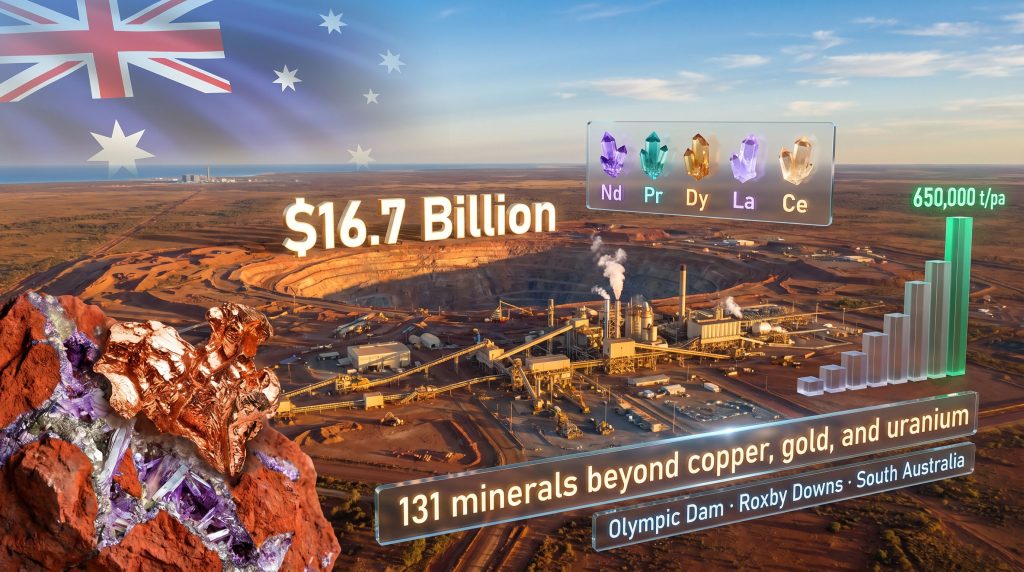
Olympic Dam belongs to a geological category known as an iron oxide copper-gold (IOCG) system, a deposit type characterised by its polymetallic complexity and its tendency to host a broad spectrum of minerals well beyond the primary commodities that justify mining in the first place. Furthermore, iron oxide copper-gold deposits like this one are notable globally for their compositional richness. What sets Olympic Dam apart is the sheer number of mineral species it contains — the orebody hosts 131 minerals beyond its primary copper, gold, and uranium outputs, reflecting the complex hydrothermal processes that formed the deposit approximately 1.59 billion years ago.
REE-bearing phases within the orebody occur primarily as bastnäsite and monazite, two mineral species that are the primary REE hosts in many of the world's major dedicated rare earth mines. The critical difference at Olympic Dam is that these minerals occur in disseminated form throughout a massive low-grade orebody, rather than in the higher-grade concentrations found at standalone REE operations like Mount Weld in Western Australia or Bayan Obo in China.
Independent geological assessments by PorterGeo have noted that deeper zones of the Olympic Dam orebody may host higher-grade REE accumulations than those currently captured in the primary resource model. Recent deep drilling programs have confirmed that mineralisation remains open at depth in structurally controlled zones below the existing resource envelope, which means the true REE endowment of the deposit could be materially larger than current estimates suggest.
The REE Inventory at Olympic Dam: What Is Present and Why It Matters
The rare earth elements identified within the Olympic Dam system span the full spectrum of commercial significance, from widely used industrial elements to the most strategically sensitive magnet metals driving the energy transition.
| Rare Earth Element | Primary Industrial Application | Strategic Classification |
|---|---|---|
| Neodymium (Nd) | Permanent magnets for EV motors and wind turbines | Critical |
| Praseodymium (Pr) | High-strength NdPr alloy magnets, aerospace components | Critical |
| Dysprosium (Dy) | High-temperature magnet performance, defence systems | Strategic |
| Lanthanum (La) | Battery electrodes, fluid catalytic cracking | Critical |
| Cerium (Ce) | Polishing powders, optical glass, catalysts | Monitored |
Neodymium and praseodymium, collectively traded as NdPr oxide, are the most commercially significant elements present. These two elements are the functional core of neodymium-iron-boron (NdFeB) permanent magnets, the technology that powers the electric motors in battery electric vehicles and the generators in utility-scale wind turbines. Without a reliable supply of NdPr, neither technology can scale to the volumes required for net-zero emissions targets. This is precisely why the revised Olympic Dam indenture specifically names neodymium and praseodymium as mandatory assessment targets.
Dysprosium deserves particular attention from an investor perspective. It is added to NdFeB magnets in small quantities to extend their operational temperature range, making them functional in the high-heat environments found inside EV powertrains and industrial motors. Dysprosium is significantly rarer than neodymium, with far fewer known deposits globally, and its supply is dominated almost entirely by Chinese production. Consequently, any credible dysprosium co-recovery pathway at Olympic Dam would represent a strategically meaningful diversification of supply.
The 2026 Indenture Agreement: A Regulatory Turning Point
What the New Legislative Framework Actually Requires
South Australia's revised Olympic Dam indenture, tabled in the state parliament in May 2026, is the first update to the regulatory framework governing the site in nine years. The previous indenture was structured around the site's established copper, uranium, and gold operations. The 2026 version reflects a fundamentally different strategic environment, one where the same REE-bearing minerals previously treated as processing waste have become the subject of national supply chain policy.
The key obligations introduced by the new framework are:
- BHP must complete a formal technical and economic feasibility assessment of REE extraction at Olympic Dam within two years of the agreement's commencement
- The assessment must specifically address the recoverability of neodymium and praseodymium, reflecting Australia's national critical minerals demand prioritisation framework
- If BHP concludes that viable extraction is not achievable under its existing operational model, the agreement provides a third-party commercialisation pathway, under which other entities may gain rights to pursue REE recovery from the site's waste streams
- The indenture also sets a hard deadline of May 2036 for BHP to cease all groundwater extraction from the Great Artesian Basin, with a transition plan required by May 2031
Why the Third-Party Pathway Creates a Secondary Market Opportunity
The third-party fallback clause is perhaps the most commercially significant provision in the entire agreement. It effectively eliminates the risk of Olympic Dam's REE endowment remaining permanently stranded due to internal capital allocation decisions at BHP. If the feasibility study returns an unfavourable result, the resource does not disappear; it becomes accessible to specialised processors and junior critical minerals developers who may be willing to operate at different economic thresholds.
The REE-bearing tailings and processing residues at Olympic Dam represent a long-accumulating stockpile of mineralised material that has been generated continuously since the site began operations in 1988. Unlike primary ore that must be mined and moved at cost, waste stream REE processing works with material that is already above ground, already crushed, and already concentrated to some degree through the existing processing circuit. This fundamentally changes the capital economics for any party that gains access to it.
Olympic Dam's REE story carries a characteristic that distinguishes it from most greenfield critical minerals projects: the feedstock already exists in substantial volumes, and it is being added to every day that the copper operation runs.
For junior REE developers and specialised processors operating in Australia, the third-party clause in the 2026 indenture is worth monitoring closely as BHP's two-year feasibility window progresses toward its expected completion around mid-2028.
The Processing Challenge: Why Grade Has Always Been the Barrier
Low Concentration, High Complexity
BHP has previously acknowledged in submissions to Australia's Critical Minerals Strategy that Olympic Dam holds significant potential as a REE source, while simultaneously identifying low REE grade as the primary commercial constraint. This is not a trivial qualification. The economics of REE processing are highly sensitive to feed grade because the separation of individual rare earth elements from each other requires multi-stage hydrometallurgical processing that is both capital-intensive and chemically demanding.
A dedicated REE mine like Mount Weld operates at total rare earth oxide (TREO) grades typically exceeding 8% to 10%, which justifies the construction of a standalone concentration and separation facility. Olympic Dam's disseminated REE mineralisation occurs at concentrations that are a fraction of that level in the primary ore stream. Research from Monash University has confirmed that while the absolute tonnage of REE-bearing material at Olympic Dam is very large, the concentration levels in the ore stream flowing through BHP's existing hydrometallurgical circuit are insufficient to justify extraction under conventional processing economics.
The existing infrastructure at Olympic Dam is optimised for copper smelting and uranium solvent extraction. REE minerals are not selectively captured at any stage of that circuit; they pass through and report to tailings. Retrofitting REE recovery into an operating copper smelter without disrupting throughput and product quality presents significant engineering complexity.
Emerging Technologies That Could Rewrite the Economics
Researchers at the Australian National University (ANU) have developed an active extraction programme specifically targeting REE recovery from Olympic Dam mine waste, using molten alkali salt processing to convert low-grade REE-bearing minerals into more recoverable chemical forms. The significance of this approach lies in its feedstock model: rather than attempting to extract REEs from primary ore competing with copper in the main processing circuit, the molten salt process treats waste stream material as its input.
This distinction matters enormously from a commercial standpoint. A waste stream processing approach:
- Avoids any modification to BHP's primary copper smelting and refining circuit
- Works with material that has zero opportunity cost relative to the main production stream
- Can be scaled independently based on REE market conditions without affecting copper output targets
- Eliminates the need for a standalone mining operation since the feedstock is already produced as a byproduct of copper extraction
Separately, two-stage smelting studies currently underway at Olympic Dam are being examined as potential process integration points where REE separation could become technically viable as a byproduct step within an upgraded smelting sequence. If either of these pathways advances to commercial proof of concept, the feasibility calculus for BHP rare earths extraction at Olympic Dam shifts substantially.
If molten alkali salt processing is proven at Olympic Dam scale, the methodology could be applied to other IOCG systems globally that contain dispersed REE mineralisation but have historically been developed solely for their primary commodities.
Capital Scale and the Throughput Multiplier Effect
A $16.7 Billion Investment That Changes the REE Equation Indirectly
The revised indenture does not merely create a REE assessment obligation in isolation. It simultaneously unlocks the largest capital investment programme in Olympic Dam's history, and that investment programme has a direct bearing on the economics of any future REE co-recovery operation.
The investment framework breaks down as follows:
| Capital Decision | Scope | Timeline |
|---|---|---|
| Copper refinery expansion | $4 billion facility expansion near Roxby Downs | Immediate decision pathway unlocked |
| Mine and concentrator expansions | Up to $12.7 billion in additional investment decisions | To be committed before 2032 |
| Production target | Double South Australian copper output to 650,000 tpa | Mid-2030s |
Olympic Dam has produced more than 300,000 tonnes of copper annually across the past three consecutive years. Doubling that output to 650,000 tonnes per annum requires a proportional increase in ore throughput, which means a proportional increase in the volume of REE-bearing material flowing through or past any co-recovery circuit.
This is the throughput multiplier effect: higher copper throughput does not just generate more copper, it generates more of every mineral present in the ore, including REEs. As throughput scales, the fixed costs of any co-recovery circuit are spread across a larger REE mass, improving unit economics without any change in REE grade or technology.
BHP's copper production across its global portfolio exceeded 2 million tonnes in fiscal year 2025, a 28% increase over three years, with a target range of 1.9 to 2 million tonnes in fiscal 2026. Olympic Dam is central to this growth trajectory and to BHP's long-term positioning as a critical minerals supplier.
Geopolitical Context: Why Western Governments Need Olympic Dam to Succeed
China's Structural Dominance and the Supply Chain Vulnerability It Creates
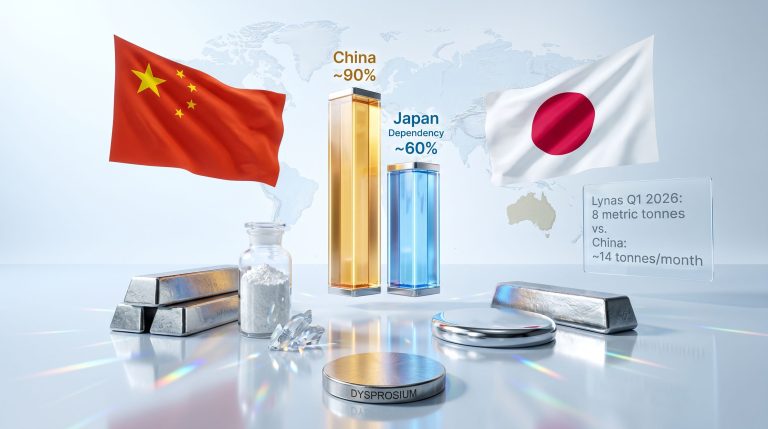
China's rare earth strategy has resulted in control of approximately 60 to 70% of global REE mining output and an even larger share of the separation, processing, and magnet manufacturing that transforms raw REEs into usable industrial inputs. For electric vehicle manufacturers in Europe, the United States, Japan, and South Korea, this concentration represents a structural supply chain vulnerability that has been explicitly identified in national security reviews across all four jurisdictions.
The most acute vulnerability lies specifically in the magnet metals segment, where neodymium and praseodymium prices are set largely by Chinese supply and demand dynamics. A Western-world REE source of meaningful scale, capable of producing NdPr at commercially significant volumes, would represent a genuine diversification of supply chain risk for magnet manufacturers and, by extension, for automakers and wind turbine producers dependent on those magnets.
Olympic Dam's geological endowment means that a successful BHP rare earths extraction programme at the site would contribute NdPr supply from a jurisdiction with strong rule of law, established infrastructure, long-term regulatory frameworks, and proximity to growing Asian demand centres. These are characteristics that command a premium in the strategic minerals market now emerging outside of China's sphere of influence.
South Australia's Integrated Copper Province Ambition
BHP's Copper SA division operates Olympic Dam alongside Prominent Hill and Carrapateena, both acquired through the A$9.6 billion OZ Minerals acquisition in 2023, creating an integrated copper province spanning multiple world-class deposits within the same geological terrane. Exploration activity at Oak Dam, located within the same IOCG province, could eventually support a fourth operation in the portfolio.
The spatial concentration of these assets within a single Australian state creates operational synergies that extend beyond copper. A REE processing facility serving the Olympic Dam waste stream could, in principle, also process REE-bearing material from other operations within the province, creating a hub-and-spoke model that improves the economics of what would otherwise be a marginal co-recovery operation at any single site.
The next major ASX story will hit our subscribers first
Water, Environment, and the Desalination Solution
The Great Artesian Basin Constraint
Olympic Dam's expansion plans carry an environmental obligation that is unusual in its specificity and enforceability. The site has historically relied on groundwater extraction from the Great Artesian Basin, one of the world's largest underground freshwater systems and a resource of enormous ecological and cultural significance to communities across inland Australia.
The revised indenture establishes a firm regulatory boundary: BHP must cease all Great Artesian Basin groundwater extraction by May 2036, with a detailed transition plan submitted to the South Australian government by May 2031. This is not a soft aspiration but a legally binding indenture commitment tied to the investment approvals framework.
Meeting the expanded copper production targets of 650,000 tonnes per annum by the mid-2030s while simultaneously eliminating groundwater dependency requires a credible alternative water source at significant scale. BHP and the South Australian government are jointly advancing a seawater desalination facility near Port Augusta designed to supply the water volumes required to support the full expansion programme throughout the 2030s.
The desalination pathway is strategically important beyond water supply. It removes a long-standing social licence risk that has created friction between the mining operation and regional communities and environmental advocates. Furthermore, a fully desalinated water supply model positions the expanded Olympic Dam operation as one of the more environmentally responsible large-scale mining projects in Australia, a characteristic that increasingly matters to institutional investors applying ESG screening criteria to resource sector allocations.
Scenarios, Timelines, and What Investors Should Watch
Three Pathways to REE Commercialisation
The Olympic Dam REE story does not follow a single predetermined trajectory. Depending on the outcome of BHP's feasibility study, the pace of technology development, and the behaviour of NdPr oxide prices, three materially different commercialisation scenarios could unfold over the next decade.
| Scenario | Key Trigger Conditions | Indicative Timeline | REE Output Potential |
|---|---|---|---|
| BHP-led co-recovery circuit | Feasibility confirms viability; NdPr prices sustained | Post-2028 | Moderate byproduct volumes tied to copper throughput |
| Third-party waste stream processing | BHP declares non-viable; third party acquires rights | 2028 to 2032 | Variable based on processor capability and technology |
| Technology breakthrough unlocks economics | ANU molten salt or equivalent process proven at scale | 2030 and beyond | Potentially significant given waste stream accumulation |
Key Indicators to Monitor Over the Next 24 to 36 Months
For analysts and investors tracking the Olympic Dam REE narrative, the following developments will be the most informative leading indicators:
- BHP feasibility study outcomes expected around mid-2028, which will determine whether the primary or third-party pathway activates — completing a definitive feasibility study of this scope typically takes 18 to 24 months of intensive technical and economic work
- ANU research programme milestones on molten alkali salt processing, particularly any pilot-scale demonstration results published through 2026 to 2027
- NdPr oxide price trends, since co-recovery economics are directly geared to the prevailing magnet metal price and any sustained price recovery strengthens the feasibility case
- Concentrator expansion timeline, as the throughput increase underpins the unit economics of co-recovery and represents the most tangible near-term indicator of the scale of ore processing that will generate REE-bearing waste streams
- South Australian government signals regarding the operationalisation of the third-party rights framework in the event of a non-viable BHP determination
Disclaimer: The scenario analysis and investment observations presented in this article are informational and analytical in nature. They do not constitute financial advice. Past performance of commodity prices and mining projects is not indicative of future outcomes. Readers should seek independent financial advice before making any investment decisions.
Olympic Dam's REE optionality is a long-duration thesis embedded within a world-class copper asset. Its value does not depend on a near-term production catalyst. It grows progressively as processing technology matures, as NdPr prices reflect tightening Western supply, and as the sheer throughput scale of an expanded copper operation makes co-recovery economics increasingly compelling.
Frequently Asked Questions
Does BHP Currently Produce Rare Earth Elements at Olympic Dam?
No. As of 2026, BHP does not commercially extract REEs at Olympic Dam. REE-bearing minerals including bastnäsite and monazite are present throughout the orebody but report to tailings and waste streams under the existing copper processing circuit. This is due to the absence of REE-specific recovery infrastructure and the sub-economic grade challenge at current technology and pricing levels.
Why Does Low Grade Create Such a Significant Barrier at Olympic Dam Specifically?
Unlike standalone REE mines such as Mount Weld, which operate at total rare earth oxide grades of 8% or higher, Olympic Dam's REEs are disseminated through a massive polymetallic orebody at concentrations that have historically failed to meet the economic thresholds required to justify co-recovery infrastructure. The grade challenge is compounded by the fact that retrofitting REE extraction into an active copper smelting circuit without disrupting primary production is a significant engineering undertaking. South Australia's mineral commodities overview provides additional context on the state's broader rare earth resource base.
What Would Change if the ANU Molten Salt Processing Technology Is Proven at Scale?
A successful demonstration of molten alkali salt processing at Olympic Dam scale would allow REE recovery from accumulated waste streams without modifying BHP's primary copper circuit at all. The feedstock already exists in substantial volumes above ground, which means capital requirements and timeline risks are materially lower than for a conventional REE mining and processing project.
What Happens After the Two-Year Feasibility Window Closes?
If BHP's assessment, expected around mid-2028, concludes that REE extraction is not technically or economically viable under BHP's operational model, the 2026 indenture framework provides a mechanism for third parties to gain access to Olympic Dam's REE streams. This prevents permanent stranding of the resource and creates a potential secondary market opportunity for specialised processors and developers. The AusIMM critical minerals assessment of Olympic Dam provides further technical context on the knowns and unknowns that will shape that determination.
Want to Track the Next Major Critical Minerals Discovery Before the Market Moves?
Discovery Alert's proprietary Discovery IQ model delivers real-time alerts on significant ASX mineral discoveries — including critical minerals and rare earth opportunities — instantly translating complex geological data into actionable insights for investors at every level. Explore why historic discoveries have generated extraordinary returns and begin your 14-day free trial at Discovery Alert to position yourself ahead of the market.