
August 24, 2026
The Geopolitics of Scarcity: Understanding China's Rare Earth Export Restrictions to Japan
Rare earth supply chains have never operated purely on commercial logic. Since the early 2000s, the global distribution of rare earth mining, processing, and export has functioned as much as a geopolitical instrument as an industrial one. No bilateral relationship illustrates this more sharply than the ongoing friction between China and Japan over critical mineral flows, a tension that has resurfaced in 2025 and 2026 with renewed intensity and broader industrial consequences than many observers anticipated.
The current episode of China rare earth exports to Japan being curtailed is not simply a trade dispute. It is the latest chapter in a structural story about technological dependence, mineral sovereignty, and the limits of rare earth supply chains diversification.
When big ASX news breaks, our subscribers know first
Why Heavy Rare Earths Are Japan's Deepest Vulnerability
To understand the stakes of the current standoff, it helps to distinguish between the two broad categories of rare earth elements: light rare earths (LREEs) and heavy rare earths (HREEs). While LREEs such as cerium and lanthanum are relatively abundant and processed by multiple countries, HREEs including dysprosium, terbium, and yttrium are far scarcer and geologically concentrated in ways that make non-Chinese supply chains structurally difficult to build.
The reason HREEs matter so intensely to Japan's industrial economy comes down to magnet performance. High-coercivity neodymium-iron-boron (NdFeB) magnets, which are the dominant magnet type used in electric vehicle motors, industrial robotics, wind turbines, aerospace systems, and defence hardware, require dysprosium and terbium additions to maintain magnetic performance at elevated temperatures. Without these HREE additions, magnets lose coercivity at operating temperatures, making them unsuitable for demanding applications.
Japan is the largest manufacturer of rare earth magnets outside China. Its magnet industry anchors a downstream industrial ecosystem worth hundreds of billions of dollars in annual output. The dependency is therefore not abstract. It is embedded in the production processes of companies that supply the global automotive, electronics, and defence sectors.
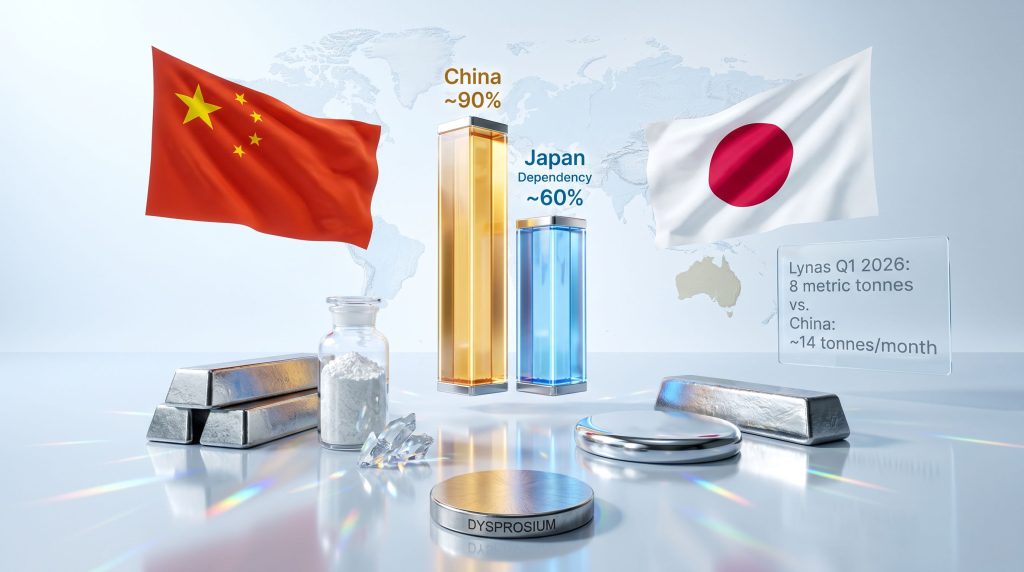
The critical distinction between mining and processing is often overlooked in public debate. China holds approximately 60% of global rare earth mining output, but controls around 90% of global rare earth refining and separation capacity. This means that even nations with domestic ore deposits frequently rely on Chinese processing infrastructure to convert raw material into usable separated oxides.
Key Materials at the Centre of the 2026 Restrictions
The materials targeted in the current China rare earth exports to Japan restrictions are precise and strategically chosen:
| Material | Primary Industrial Use | Export Status to Japan (Q1 2026) | 2024 Monthly Export Volume to Japan |
|---|---|---|---|
| Dysprosium | EV and defence magnets | Suspended (trace shipments only) | ~14 tonnes/month (combined with terbium) |
| Terbium | High-performance magnets | Suspended | Included above |
| Yttrium Oxide | Aerospace components, phosphors | Near-total halt | Not publicly disclosed |
| Gallium | Semiconductor chip manufacturing | Suspended | Not publicly disclosed |
According to Chinese customs data, exports of dysprosium, terbium, yttrium oxide, and gallium to Japan have effectively ceased since December 2025, with only marginal yttrium shipments recorded. This is not an informal slowdown. It is a deliberate and publicly announced policy, with Beijing tightening China's export restrictions in January 2026 and again twice in February of that year.
Comparing 2026 to 2010: Similarities, Differences, and What the Record Actually Shows
The 2010 rare earth episode between China and Japan has become foundational geopolitical folklore, cited repeatedly as proof that Beijing has long used mineral access as diplomatic leverage. The triggering event involved a maritime collision near the Senkaku/Diaoyu Islands, after which Chinese rare earth flows to Japan reportedly declined. The narrative became so embedded that it shaped Japanese industrial policy for the following decade.
However, academic analysis published through CEPR/VoxEU raises important complications. Detailed trade data suggests that the 2010 disruption may not have been a formally declared export ban targeted specifically at Japan. Instead, broader export quota reductions affecting all trading partners may have produced the observed decline, with Japan's experience perhaps not uniquely severe relative to other buyers. The episode's significance may lie more in the geopolitical signal it sent than in its actual trade mechanics.
The 2026 situation is structurally different in several important respects:
| Dimension | 2010 Episode | 2026 Episode |
|---|---|---|
| Diplomatic Trigger | Senkaku/Diaoyu maritime incident | Taiwan-related diplomatic dispute (November 2025) |
| Materials Affected | Broad rare earth categories | Targeted: dysprosium, terbium, yttrium, gallium |
| Formal Announcement | Disputed, no confirmed public ban | Publicly announced export controls (January-February 2026) |
| Corporate Targeting | General industry impact | Named conglomerates including Mitsubishi Heavy Industries divisions |
| Japan's Preparedness | Minimal stockpiles | Moderate stockpiles and partial supply diversification |
| Alternative Supply Maturity | Near-zero | Early-stage, with Lynas Rare Earths producing HREEs outside China |
The 2026 restrictions are more surgical and more transparently political. Targeting named conglomerates, particularly divisions involved in shipbuilding and aero engine manufacturing, signals that the export control architecture is being deployed with precision against strategically sensitive sectors rather than as a blunt economic instrument.
Japan's Rare Earth Dependency Today: Progress Made, Gaps That Remain
Japan's response to the 2010 episode was substantive. The country invested heavily in strategic stockpiling, funded alternative producers, and pursued engineering solutions to reduce HREE content in magnets. These efforts produced measurable results.
According to World Economic Forum data on Japan's mineral strategy, Japan reduced its reliance on Chinese rare earths from approximately 90% at the time of the 2010 dispute to around 60% today. That is a significant structural shift achieved over fifteen years of deliberate industrial policy.
Yet the improvement masks persistent vulnerabilities:
- For specific HREEs such as dysprosium and terbium, Chinese dependency remains far higher than the headline 60% figure suggests.
- Processing dependency is effectively near-total. Even ore sourced outside China typically requires Chinese refineries to produce separated oxides suitable for magnet manufacturing.
- Japan's strategic stockpile program provides a buffer against short-term disruption, but government officials have not publicly disclosed volumes or precisely how long reserves can sustain industrial demand under extended embargo conditions.
- Magnet manufacturers including Shin-Etsu have already halted acceptance of new orders for dysprosium-containing magnet products, which research analysts at Project Blue identify as a leading indicator of upstream supply exhaustion that typically precedes broader production slowdowns.
Components manufacturer TDK has publicly stated it does not currently anticipate major impact and is diversifying supply sources. Mitsubishi Motors indicated in February 2026 that it had secured rare earth supplies through mid-year. These statements reflect near-term insulation but do not address what happens if restrictions extend beyond six to twelve months.
China Continues Exporting Finished Magnets While Halting Raw Materials
One of the more strategically significant and underappreciated dimensions of the current situation is that China is continuing to export finished rare earth magnets to Japan's automotive industry and other industrial customers at normal volumes, even as raw material flows have been cut off.
This asymmetry is deliberate and revealing. By halting upstream material flows while maintaining downstream finished product exports, China is simultaneously applying pressure on Japan's domestic processing and magnet manufacturing sector while preserving its own commercial position in Japanese industrial supply chains. The effect is to accelerate Japan's dependency on Chinese value-added products rather than Chinese raw materials, a subtle but important shift in the nature of the leverage being applied.
This dynamic illustrates a broader principle in China's rare earth strategy: the goal is not simply to restrict access but to shape where value is captured. Maintaining finished magnet exports while cutting raw material flows encourages Japanese manufacturers to source completed components from China rather than processing domestically.
The Scale of the Alternative Supply Challenge
The most cited benchmark for non-Chinese HREE supply is Lynas Rare Earths, the Australian company in which Japan has invested and which became the first commercial producer of separated terbium and dysprosium outside China. In the first quarter of 2026, Lynas produced approximately 8 metric tonnes of combined dysprosium and terbium.
China was exporting roughly 14 metric tonnes per month of the same two materials to Japan in 2024 alone.
The arithmetic is unambiguous. Even at its current production rate, Lynas could replace less than two months of Japan's pre-restriction monthly HREE imports in an entire quarter of output. Japan has also launched rare earth projects in Australia and France, and a gallium project in Australia, but these carry multi-year development timelines before meaningful production volumes can be achieved.
Furthermore, the rare earth processing challenges involved in scaling these alternative facilities cannot be understated, as building separation and refining capacity requires specialist expertise that has historically been concentrated in China.
The scenario implications of an extended embargo are significant:
| Scenario | Duration of Halt | Estimated Industrial Impact | Mitigation Capacity |
|---|---|---|---|
| Short-Term Disruption | 1 to 4 months | Manageable via stockpiles | High, existing reserves buffer impact |
| Medium-Term Pressure | 4 to 12 months | Magnet production slowdowns, price escalation | Moderate, partial Lynas supply and recycling contribution |
| Extended Structural Cutoff | 12+ months | Automotive, defence, and electronics production constraints | Low, alternative supply insufficient at required scale |
The next major ASX story will hit our subscribers first
Gallium and the Semiconductor Dimension
While rare earth magnet materials dominate the headlines, the simultaneous suspension of gallium exports to Japan introduces a separate but equally serious supply chain risk. Gallium is a critical input for compound semiconductors, particularly gallium nitride (GaN) and gallium arsenide (GaAs) devices used in radar systems, power electronics, and advanced telecommunications infrastructure.
China accounts for approximately 80% of global primary gallium production according to the US Geological Survey. Japan's response includes a dedicated gallium project in Australia, but as with HREE alternatives, domestic and allied production capacity is years away from meaningful scale.
The dual targeting of both HREE and gallium supply chains in the same restriction package suggests a coordinated intent to apply pressure across multiple strategically sensitive industrial domains simultaneously.
China's Parallel Deployment of Export Controls: Japan and the United States
The restriction on China rare earth exports to Japan did not emerge in isolation. Beijing has been applying export controls on rare earth materials to the United States during the same period, as part of ongoing trade war escalations. This parallel deployment across two separate bilateral disputes strongly indicates that the China rare earth trade strategy has become a standardised instrument within China's foreign economic policy framework rather than a reactive measure specific to any single territorial disagreement.
This interpretation carries important implications for the strategic community:
- The threshold for triggering rare earth export restrictions appears to be lowering as China becomes more comfortable deploying this instrument.
- The simultaneous targeting of both Japan and the United States complicates coordinated allied responses, as each country faces its own distinct diplomatic calculus.
- China bears real costs from these restrictions, including reputational damage as a reliable supplier and potential long-term acceleration of competitor investment in alternative supply chains. The mutual vulnerability dimension provides a theoretical off-ramp that Japan's Trade Minister Ryosei Akazawa, who visited China in late May 2026, was reportedly seeking to explore.
What Genuine Supply Chain Resilience Requires
The gap between current alternative supply capacity and Japan's industrial requirements points toward a multi-dimensional resilience strategy that no single policy lever can address alone:
- Processing infrastructure investment: Mining new deposits without parallel investment in separation and refining capacity replicates the structural dependency at a different geographic location rather than resolving it.
- Recycling and urban mining: Japan generates significant quantities of end-of-life rare earth-containing products. Urban mining programs targeting discarded motors, drives, and electronic devices could recover meaningful HREE quantities, though building this infrastructure at industrial scale requires time and sustained investment.
- Magnet engineering innovation: Reducing dysprosium and terbium loading in NdFeB magnets through grain boundary diffusion techniques and alternative alloy designs decreases per-unit HREE consumption, offering a demand-side contribution to the resilience equation.
- Allied coordination: Australia, the United States, Canada, and European nations are all developing rare earth supply chain buildout strategies. Coordinating these efforts through frameworks like the Minerals Security Partnership could aggregate supply capacity that no single country can achieve independently.
Frequently Asked Questions: China Rare Earth Exports to Japan
What rare earth materials has China restricted from export to Japan in 2026?
China has restricted dysprosium, terbium, yttrium oxide, and gallium. These restrictions were publicly announced through a series of tightened export control measures beginning in January 2026, with additional tightening in February.
Did China formally ban rare earth exports to Japan in 2010?
Academic research published through CEPR/VoxEU challenges the widely accepted narrative of a formal targeted ban. Trade data analysis suggests the 2010 disruption may have reflected broader export quota reductions affecting all trading partners rather than a Japan-specific embargo. However, the episode reshaped Japanese industrial policy regardless of its precise technical character.
How long can Japan's rare earth stockpile buffer industrial supply?
The Japanese government has not publicly disclosed stockpile volumes or precise duration estimates. The strategic reserve program was substantially expanded after 2010 and provides a buffer against short-term disruption, but analysts generally regard it as insufficient to absorb an extended multi-year supply cutoff at current industrial consumption rates.
What industries in Japan are most at risk from rare earth supply disruptions?
The highest-risk sectors are rare earth magnet manufacturing, which feeds automotive electrification and industrial robotics supply chains, aerospace and defence systems requiring high-performance permanent magnets, and semiconductor manufacturing dependent on gallium supply.
Why does China have such dominant control over heavy rare earth processing?
HREE deposits are geologically concentrated in specific provinces of China, particularly in ionic adsorption clay deposits in southern China where elements like dysprosium and terbium occur in extractable concentrations. Processing these unconventional ore types requires specialised solvent extraction and separation technology in which China has invested at industrial scale over decades, creating a capability gap that other nations are only beginning to close.
The Strategic Calculus: What the China-Japan Rare Earth Standoff Reveals
The current disruption in China rare earth exports to Japan is neither purely a bilateral trade dispute nor simply a repeat of historical precedent. It represents the maturation of a geopolitical strategy in which control over critical mineral processing infrastructure functions as a durable foreign policy instrument.
Japan's position, while genuinely improved since 2010, illustrates the limits of diversification strategies that address mining access without fully resolving processing dependency. The country has made real progress. It has reduced headline Chinese rare earth reliance from 90% to around 60%, built meaningful stockpiles, funded pioneer producers like Lynas Rare Earths, and invested in magnet engineering innovation. Yet the production arithmetic shows that the gap between available alternative supply and industrial requirements remains enormous and will not close before 2030 under any realistic scenario.
This article contains forward-looking analysis and scenario modelling based on publicly available data as of mid-2026. Readers should note that supply chain conditions, diplomatic circumstances, and production capacities are subject to rapid change. Nothing in this article constitutes investment or commercial advice.
Want To Stay Ahead of Critical Mineral Discoveries Shaping Strategic Supply Chains?
Discovery Alert's proprietary Discovery IQ model delivers real-time alerts on significant ASX mineral discoveries — instantly translating complex geological data into actionable investment insights for both short-term traders and long-term investors. Explore how historic mineral discoveries have generated extraordinary returns, then begin your 14-day free trial at Discovery Alert to position yourself ahead of the market.