May 22, 2026
The Invisible Bottleneck Driving Billions Into Non-Chinese Rare Earth Projects
Every electric vehicle motor, offshore wind turbine, and advanced defence guidance system shares a common dependency that most investors have only recently begun to appreciate. Buried inside each of these technologies is a small but irreplaceable component: a high-performance permanent magnet. And at the heart of every high-performance permanent magnet is neodymium-praseodymium oxide, a refined rare earth product that China currently produces in overwhelming volumes relative to the rest of the world combined.
This is not a temporary market imbalance. It is a structural reality that has accumulated over decades of deliberate industrial policy, and it is now colliding with an equally powerful counter-force: Western governments and private capital markets determined to build alternative rare earth supply chains before the next geopolitical disruption makes the cost of inaction impossible to ignore.
The Arafura Rare Earths share sale backed by Gina Rinehart, announced in May 2026, is best understood within this context. It is not simply a capital raise for a single Australian mining project. It represents a specific and increasingly replicable model for how Western-aligned rare earth supply can actually get built.
When big ASX news breaks, our subscribers know first
Understanding the NdPr Market: Why This Mineral Is Different
NdPr oxide occupies a uniquely inelastic position in the critical minerals landscape. Unlike lithium, which faces ongoing substitution pressure from sodium-ion battery chemistries, or cobalt, which manufacturers have actively worked to reduce through cathode reformulation, NdPr has no commercially credible substitute in high-performance permanent magnet applications.
The physics of neodymium-iron-boron magnets, which are the dominant magnet type in EV traction motors and direct-drive wind turbines, create a hard ceiling on substitution. No other material combination currently delivers equivalent magnetic flux density at the weight and temperature tolerances that modern engineering demands.
This demand inelasticity is compounded by two structural forces:
- EV adoption curves are accelerating across major markets, with each battery-electric vehicle requiring approximately 0.5 to 1 kilogram of NdPr depending on motor configuration
- Wind energy buildout is equally NdPr-intensive, particularly as the industry shifts toward direct-drive permanent magnet generators that eliminate gearboxes and reduce maintenance cycles in offshore installations
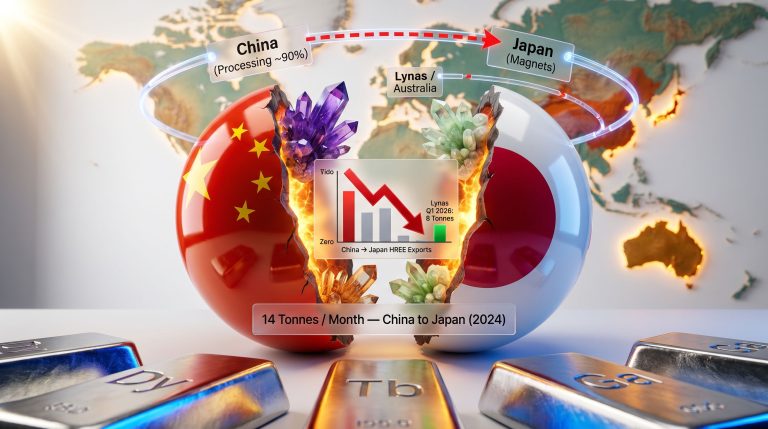
Against this backdrop, China controls an estimated 85 to 90% of global refined NdPr output. Furthermore, China's export restrictions have intensified the urgency for Western nations to develop alternative supply. The supply response from non-Chinese producers has been structurally limited by the long development timelines characteristic of rare earth projects, which typically require between 10 and 15 years from discovery to sustained production. This timeline gap, combined with inelastic demand growth, is the fundamental investment thesis underpinning the current wave of capital flowing into projects like Nolans.
The Nolans Project: Scale, Geology, and Strategic Positioning
Located in Australia's Northern Territory, the Nolans project is targeting NdPr oxide as its primary commercial output, which places it at the highest-value end of the rare earths market rather than in the lower-margin bulk concentrate segment.
This distinction matters more than it might initially appear. Many rare earth projects produce mixed rare earth carbonate or concentrate, which still requires further processing before it can be used in magnet manufacturing. Nolans is designed to produce separated NdPr oxide, meaning the product reaches the supply chain at a point where it can feed directly into magnet precursor manufacturing. The rare earth processing challenges involved in achieving this level of separation add significant complexity, but also considerable value-chain depth, making the project more commercially attractive to downstream buyers who need supply security at the refined product level.
Project Metrics at a Glance
| Project Metric | Detail |
|---|---|
| Location | Northern Territory, Australia |
| Total Capital Cost | ~A$1.6 billion |
| Primary Output | Separated NdPr oxide |
| Offtake Target Secured | ~93% of binding target |
| Projected Ranking (Australia) | 3rd largest rare earths operation by decade-end |
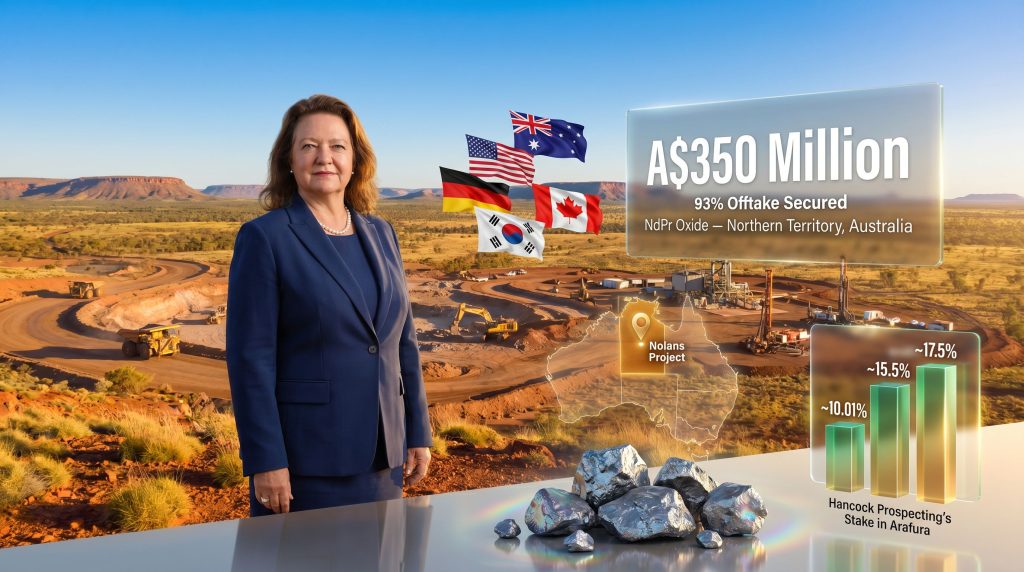
| Equity Component Funding | A$350 million placement |
One factor that distinguishes Nolans from many competing rare earth development projects globally is the mineralogy of the deposit itself. The Nolans Bore deposit is a calcium phosphate-hosted rare earth system, which is relatively uncommon in global rare earth geology. The deposit contains elevated concentrations of the high-value magnet rare earths, including neodymium and praseodymium, which gives the project a favourable NdPr fraction relative to total rare earth oxide content. This compositional profile is a key reason the project can target premium NdPr oxide production rather than relying on bulk volume economics.
How the A$350 Million Capital Raise Is Structured
The placement follows a two-tranche architecture that balances execution speed with shareholder governance requirements. This structure is now standard practice for large-scale Australian mining placements, and understanding its mechanics is essential for evaluating the raise's significance.
Tranche 1: Immediate Placement
- Size: approximately A$175.5 million
- Issue price: A$0.260 per share
- Discount to last closing price: 16.1%
- No shareholder approval required, enabling rapid capital deployment
Tranche 2: Conditional Placement
- Size: approximately A$174.5 million
- Subject to shareholder approval before proceeding
The 16.1% discount to the prior closing price is worth examining carefully. In institutional placements of this scale, a discount is not a sign of distress. It is a transactional mechanism that compensates large investors for absorbing significant new share volume quickly, and it provides the issuing company with certainty of execution. The implicit message from the market is that the project's risk-adjusted return profile justifies accepting dilution at current prices.
According to David Tuckwell, CIO at ETF Shares, as reported by Reuters, the discount functions as the cost of securing significant capital quickly with execution certainty, while the raise itself signals how seriously investors and governments are taking the challenge of reducing global supply chain dependence on Chinese rare earth processing.
The combined proceeds from both tranches are earmarked to fully fund the equity component of Nolans project development. When combined with debt financing from export credit agencies across four nations, this completes the project's full capital stack. In addition, a rare earth offtake deal already secured by Arafura further underpins the commercial viability of the project at this stage of development.
Hancock Prospecting's Role: Cornerstone Strategy in Practice
Hancock Prospecting's A$85 million commitment to the current placement reflects a deliberate escalation of a long-standing strategic position rather than a new entry. Prior to this raise, Hancock held approximately 15.5% of Arafura. Post-completion, that stake is expected to reach approximately 17.5%, reinforcing its position as the company's largest individual shareholder.
Understanding the full context of Hancock's investment requires stepping back from this single transaction. Rinehart doubles down on her rare earths conviction with each successive placement, and her approach resembles the logic of a supply chain integrator building optionality across multiple production geographies rather than concentrating on a single asset.
Rinehart's Broader Rare Earths Portfolio
| Company | Nature of Rinehart/Hancock Exposure |
|---|---|
| Arafura Rare Earths | Largest shareholder; ~17.5% post-raise |
| Lynas Rare Earths | Strategic equity position |
| MP Materials (USA) | Equity exposure to US rare earths processing |
| Brazilian Rare Earths | Exposure to South American critical mineral assets |
| St George Mining | Exposure to Australian critical mineral exploration |
This multi-asset positioning hedges against single-jurisdiction risk in a sector where geopolitical, regulatory, and operational variables are highly jurisdiction-specific. It also provides Hancock with leverage across the non-Chinese rare earth supply chain at a formative moment, when the competitive landscape is still being established and asset valuations have not yet reflected the full demand trajectory.
The pattern of Hancock's Arafura investment is instructive. Each successive capital raise has been accompanied by measurable project de-risking, including offtake agreement execution, export credit agency commitments, and advancing engineering milestones. Hancock's willingness to increase its financial exposure at each stage follows the logic of a conviction investor who is reducing risk premium as development uncertainty resolves, rather than speculating on a pre-revenue exploration story.
Export Credit Agency Financing: What Sovereign Backing Actually Signals
One of the most analytically significant aspects of the Nolans project's capital structure is the involvement of export credit agencies from four nations: the United States, Canada, Germany, and South Korea. Each of these agencies independently conducts technical, commercial, environmental, and geopolitical due diligence before committing financing. The fact that all four reached a positive conclusion about the same project carries substantial signal value.
It is important to note that ECA involvement reflects each nation's independent assessment of the Nolans project's strategic value to their own supply chain security objectives. It does not represent coordinated government policy toward a single project, and it should not be interpreted as project-specific government endorsement beyond what each ECA's mandate covers.
However, what it does confirm is that:
- Germany and South Korea, both major manufacturers of EV components and industrial electronics, face acute supply chain exposure to Chinese rare earth disruption and have a direct industrial motivation to support alternative sources
- The United States has been accelerating critical mineral financing as part of broader supply chain security objectives, and the Nolans project meets the technical and commercial criteria that programmes of this nature require
- Canada's participation aligns with its established posture on critical mineral investment partnerships with allied nations
For private investors, ECA participation has a practical implication beyond strategic validation: it typically improves the cost and terms of project debt, which in turn improves equity returns for shareholders. Projects with sovereign debt backing often access capital at rates unavailable to purely private sector borrowers.
The next major ASX story will hit our subscribers first
Competitive Landscape: Where Nolans Sits in the Global NdPr Market
Outside China, large-scale separated NdPr oxide production is currently concentrated in a very small number of operations. Lynas Rare Earths, which processes Australian ore at its facility in Malaysia and is building additional processing capacity, and MP Materials in the United States, which is advancing domestic separation capability, represent the primary non-Chinese NdPr producers at meaningful scale.
Nolans, upon reaching production, would add a third significant node to this limited supply network. The global NdPr market is structurally undersupplied on a non-Chinese basis relative to the demand trajectory implied by current EV and wind energy growth projections. Even a fully operational Nolans project alongside Lynas and MP Materials would leave a substantial residual supply gap that the market will need to fill from projects that are currently earlier in development.
This context explains why approximately 93% of Arafura's binding offtake target has already been contracted. Buyers in South Korea and Germany, nations with significant permanent magnet and EV component manufacturing industries and zero domestic rare earth production, are competing for long-term supply agreements with the small number of non-Chinese producers capable of delivering at scale. Offtake scarcity is, consequently, a current market reality, not a projection. Moreover, Australia's critical minerals sector is increasingly positioned to absorb a disproportionate share of this contracted demand given its geological endowment and political stability.
Key Risk Factors for Investors to Monitor
Despite the strength of the project's commercial structure, several material risks warrant careful attention:
- Construction execution risk: A capital programme of approximately A$1.6 billion in a remote Northern Territory location carries inherent schedule and cost overrun exposure. Remote Australian mining projects have a mixed track record on capital cost discipline.
- NdPr price sensitivity: The project's economics are exposed to rare earth price cycles. Rare earth prices have historically been volatile, and a sustained period of low NdPr prices would pressure project returns even with contracted offtake.
- Tranche 2 shareholder approval: The second A$174.5 million tranche requires shareholder approval, which introduces procedural risk. While approval is typically achievable in well-supported placements, it is not guaranteed.
- Geopolitical volatility: Chinese export policy decisions regarding rare earths could reshape the competitive dynamics of the Western supply chain buildout, either accelerating urgency or, in a scenario of deliberate oversupply, compressing NdPr prices to levels that challenge project economics.
- Processing technology risk: Rare earth separation and processing is chemically complex, and achieving consistent separated NdPr oxide at commercial scale involves operational challenges that have historically surprised project developers.
A New Template for Critical Mineral Project Finance
Perhaps the most enduring significance of the Arafura Rare Earths share sale backed by Gina Rinehart lies not in its individual metrics, but in what it demonstrates about how strategic mineral projects can be financed in the current environment.
The capital structure assembled for Nolans combines:
- Sovereign debt from four national export credit agencies
- Cornerstone private equity from a high-conviction strategic investor with a multi-asset sector thesis
- Contracted revenue from industrial end-users in supply-constrained markets
- A phased equity placement structure that balances speed with governance
This combination addresses the principal barriers that have historically kept institutional capital away from rare earth equities: binary project risk, commodity price volatility, and long development timelines with uncertain exit pathways. By layering sovereign debt, contracted offtake, and cornerstone equity together, the Nolans financing model transforms what was once a high-risk speculative sector into something closer to infrastructure finance with commodity price exposure.
As David Tuckwell noted in Reuters coverage of the announcement, the raise represents a rare instance of a stock exchange producing a genuine new mid-tier miner, a category that rarely emerges from the rare earths sector given the industry's historically high development failure rate.
For Australia, the broader implication is a potential first-mover advantage in establishing itself as the primary Western-aligned NdPr supplier. Whether that advantage is sustained will depend on execution over the construction period ahead.
This article is intended for informational purposes only and does not constitute financial or investment advice. Rare earth markets, project economics, and equity valuations involve significant uncertainty. Readers should conduct independent research and consult qualified financial advisers before making investment decisions. Forward-looking statements and projections referenced in this article are subject to material risks and may not eventuate.
Want To Stay Ahead Of The Next Major Critical Mineral Discovery?
Discovery Alert's proprietary Discovery IQ model delivers real-time alerts on significant ASX mineral discoveries — instantly translating complex data across 30+ commodities into actionable insights for both short-term traders and long-term investors. Start your 14-day free trial today and explore why historic mineral discoveries have generated extraordinary returns for those positioned early.