May 22, 2026
The Rare Earth Supply Chain Problem That Ion-Adsorption Clay Could Help Solve
Roughly 85 to 90 percent of the world's refined rare earth elements still flow through Chinese processing facilities, a concentration of supply that has persisted for decades despite repeated attempts by Western nations to develop alternative sources. The structural vulnerability this creates is not theoretical. It shapes procurement decisions across the electric vehicle, defence, and clean energy sectors, where specific heavy rare earth elements (HREEs) like dysprosium and terbium are irreplaceable inputs for high-performance permanent magnets. Against this backdrop, the progression of the Viridis Colossus rare earth project installation license application in May 2026 carries implications that extend well beyond a single company's permitting calendar.
Understanding why this milestone matters requires stepping back from the regulatory mechanics and examining what makes the Colossus project geologically and strategically distinct, how Brazil's environmental licensing framework actually functions, and what the simultaneous advancement of financing, demonstration production, and contractor selection signals about the project's credibility.
When big ASX news breaks, our subscribers know first
Why Dysprosium and Terbium Define the Strategic Value Equation
Not all rare earth elements carry equal weight in the critical minerals demand conversation. Lanthanum and cerium, for instance, are abundant and relatively low-value. Dysprosium (Dy) and terbium (Tb) sit at the opposite end of the spectrum: they are scarce, expensive, and functionally irreplaceable in the neodymium-iron-boron (NdFeB) permanent magnets that power EV motors, wind turbine generators, and advanced defence systems.
The specific role of these elements is worth understanding in technical terms. NdFeB magnets lose magnetic strength at elevated temperatures, a property that limits their practical application in motors that generate significant heat. Adding dysprosium to the magnet alloy dramatically improves what engineers call coercivity, the magnet's resistance to demagnetisation under heat stress. Terbium performs a similar function and can partially substitute for dysprosium.
Without these two elements, the performance envelope of modern EV drivetrains and wind turbine generators narrows considerably. Furthermore, these constraints are at the core of why the rare earth supply chain continues to attract urgent attention from Western governments and industry alike.
This is precisely why the identification of Dy-Tb oxide grades exceeding 500 parts per million in the eastern expansion zone of the Colossus project is more than a geological footnote. At those grades, within an ion-adsorption clay-hosted deposit, the project enters a category of development assets that the global market has very few of outside southern China.
Understanding Ion-Adsorption Clay Deposits: Why They Matter for Processing Economics
Ion-adsorption clay (IAC) deposits are a deposit style that most Western investors and analysts are unfamiliar with, primarily because the overwhelming majority of known IAC deposits are located in China's Jiangxi, Fujian, and Guangdong provinces. These deposits form when rare earth elements weathered from granitic and volcanic source rocks become adsorbed onto the surface of clay minerals, particularly halloysite and kaolinite, over geological timescales.
What makes IAC deposits commercially attractive is not necessarily grade in the conventional hard-rock sense. It is the combination of mineralogical accessibility and HREE enrichment. Because the rare earth ions sit on clay surfaces rather than locked within crystalline mineral structures, they can typically be extracted using a relatively simple leaching process with ammonium sulfate or similar reagents.
This approach bypasses the energy-intensive cracking steps required for hard-rock rare earth ores like bastnäsite or monazite. Consequently, this processing simplicity has historically been a competitive advantage for Chinese producers and is now the characteristic that makes Colossus's deposit geology so significant for Western supply chain planners. A large-scale, HREE-enriched IAC deposit outside of China, with a demonstrated processing pathway, represents a genuinely rare strategic asset.
Brazil's Three-Stage Environmental Licensing Framework Explained
For those unfamiliar with Brazilian environmental regulation, the country operates a structured three-stage licensing system that governs all major industrial and mining developments. Each stage requires the completion of defined technical, environmental, and social conditions before progression is permitted.
| Licence Stage | Portuguese Term | Core Purpose | Colossus Status |
|---|---|---|---|
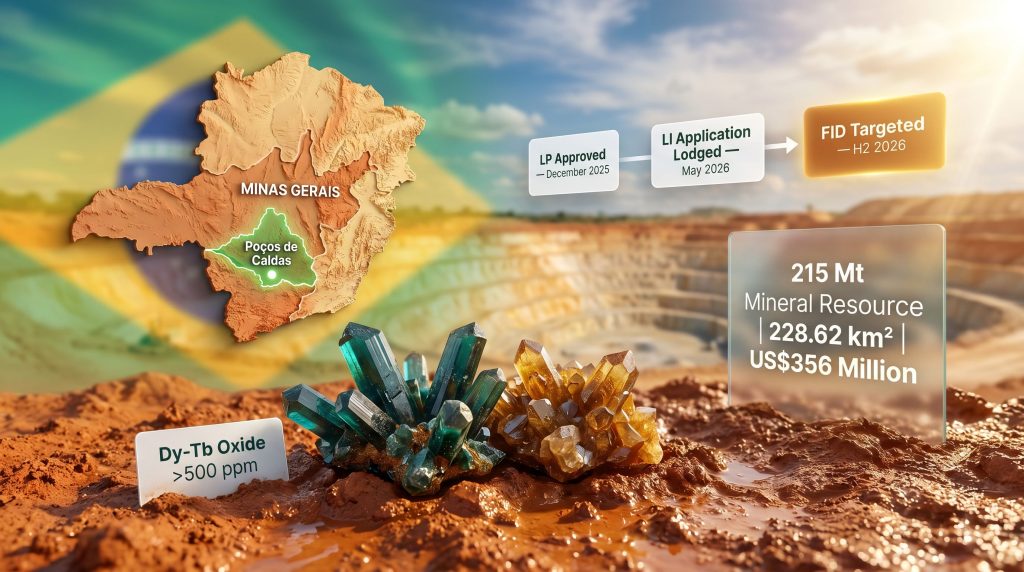
| Stage 1 | Licença Preliminar (LP) | Environmental and conceptual feasibility | Approved December 2025 |
| Stage 2 | Licença de Instalação (LI) | Construction authorisation | Application lodged May 2026 |
| Stage 3 | Licença de Operação (LO) | Operational commencement | Pending post-construction |
The Installation Licence, or Licença de Instalação (LI), is the gateway between planning and physical execution. It authorises a project to begin earthworks, site preparation, and infrastructure construction. Its grant signals that regulators are satisfied with the environmental control plans for the construction phase, not just the project's conceptual viability.
For the Colossus project, the LI application was formally lodged with FEAM (Fundação Estadual do Meio Ambiente), the Minas Gerais state environmental agency, in May 2026. FEAM operates within Brazil's broader CONAMA framework, which sets national environmental standards, but exercises state-level discretion in the assessment and approval of applications within Minas Gerais.
What the LI Submission Actually Contains
The technical depth of an LI submission is substantially greater than a Preliminary Licence application. For Colossus, the submission incorporated:
- A comprehensive Environmental Control Plan (Plano de Controle Ambiental, or PCA) covering construction, operational, and eventual closure activities
- Full completion of all environmental conditions established under the December 2025 Preliminary Licence approval
- Alignment with both state-level Minas Gerais requirements and federal environmental compensation obligations under CONAMA
- Integration of the completed definitive feasibility study, including detailed mine design, processing flowsheet, and supporting infrastructure specifications
- Multi-year socio-environmental programmes addressing community engagement, impact assessment, and ongoing stakeholder management
- Technical, environmental, and social studies developed over several years, reflecting the long baseline data collection period that underpins the submission's robustness
The inclusion of the completed DFS is particularly significant. It means the LI submission is not a conceptual document but a technically mature one, grounded in detailed engineering and resource estimates that have been subjected to formal feasibility-level scrutiny.
The Colossus Project: Scale, Location, and Resource Fundamentals
The Colossus project is situated within the Poços de Caldas Alkaline Complex in Minas Gerais, one of Brazil's most geologically significant provinces for rare earth mineralisation. The complex is an ancient eroded alkaline volcanic system, and the deep weathering profile over its alkaline rocks has created conditions favourable to the formation of ion-adsorption clay rare earth deposits.
| Project Parameter | Data |
|---|---|
| Total Mineral Resource | 215 Mt across contiguous concessions |
| Tenement Area | 228.62 km² |
| Eastern Expansion | 46% area extension along eastern boundary |
| Peak HREE Grades | Dy-Tb oxide >500 ppm in expansion zone |
| Pre-Feasibility Capital Estimate | US$356 million (including contingencies) |
| Location | Poços de Caldas, Minas Gerais, Brazil |
| Proximity to Sensitive Areas | Located away from environmental protection zones and indigenous communities |
The 46% area expansion along the eastern boundary is particularly noteworthy from a mine planning perspective. Rather than simply adding bulk tonnage, the expansion identified zones with elevated Dy-Tb grades that provide the project team with optionality to sequence mining toward higher-value ore during the operation's early years.
In project economics, front-loading higher-grade material through mine scheduling is a well-established technique for improving internal rates of return and reducing payback periods. Furthermore, the project's location away from environmental protection zones and indigenous territories represents a meaningful permitting advantage.
Brazilian mining projects that overlap with or are adjacent to these sensitive designations face substantially more complex and protracted approval processes, as demonstrated by several high-profile project delays elsewhere in the country over the past decade.
From Licence Application to Final Investment Decision: The Critical Path
The Viridis Colossus rare earth project installation license application sits within a broader parallel-path development strategy that is a hallmark of institutionally managed mining projects. Rather than treating each milestone as a sequential gate, the company has structured multiple critical-path workstreams to advance simultaneously.
- LI application lodged with FEAM, May 2026
- FEAM review and LI grant pending, regulatory timeline dependent
- EPCM contractor selection formal tender process currently underway
- Long-lead item procurement in progress as part of critical path activities
- Supply agreements and offtake contracts described as well advanced in negotiations
- Project financing being structured with export credit agency involvement; Export Finance Australia (EFA) has provided a non-binding conditional letter of support
- Final Investment Decision (FID) targeted for the second half of 2026
The involvement of Export Finance Australia (EFA) deserves specific attention. Export credit agencies are government-backed institutions that provide financing support to projects with export linkages to their home country. EFA's conditional letter of support signals that Australian institutional frameworks are engaged with a Brazilian rare earth project, reflecting the cross-border critical minerals cooperation that has become increasingly common as Western nations coordinate supply chain diversification strategies.
ECA-backed financing structures typically offer more favourable borrowing terms than purely commercial debt, and their involvement often serves as a credibility signal that draws in additional private lenders. For a US$356 million capital project, the composition and cost of the debt structure meaningfully affects project economics and therefore the threshold conditions for an affirmative FID. In addition, well-structured rare earth offtake agreements at this stage further reinforce lender confidence in the project's commercial viability.
The MREC Demonstration Plant: De-Risking for Financiers and Offtake Partners
One of the most strategically important recent developments in the Colossus story is the progression of the Mixed Rare Earth Carbonate (MREC) Demonstration Plant at the company's Colossus Rare Earths Processing and Research Centre (CPTR). The environmental licence for this facility was granted in April 2026, and the first production of MREC from actual Colossus clay feedstock was achieved in May 2026.
In the project financing world, demonstration-scale production from the actual ore body is a powerful de-risking tool. It provides empirical evidence that the processing chemistry works as modelled, reduces the technical risk perception among lenders and offtake partners, and creates tangible product samples that can support commercial negotiations.
Ion-adsorption clay deposits with elevated heavy rare earth content represent one of the most sought-after deposit types in the critical minerals sector globally, largely because their processing characteristics are considerably more straightforward than hard-rock alternatives, making demonstration-scale validation especially persuasive for downstream buyers.
ESG Credentials as a Financial and Commercial Prerequisite
Responsible development credentials have moved from a reputational consideration to a hard bankability requirement in critical minerals project finance. Institutional lenders, export credit agencies, and increasingly the Western manufacturers seeking to secure offtake agreements are applying frameworks such as the IFC Performance Standards and the Equator Principles as conditions of engagement.
For the Colossus project, the multi-year investment in environmental and social baseline studies, reflected in the depth of the LI submission, positions it within the upper tier of projects in terms of ESG documentation maturity. The socio-environmental programmes embedded in the PCA cover not only construction and operations but extend through to mine closure planning.
This level of forward-looking environmental governance distinguishes credible long-term operators from those treating compliance as a box-ticking exercise. Brazil's mining sector carries reputational baggage from several catastrophic tailings failures in Minas Gerais in particular, making robust ESG credentials not just a lender requirement but a social licence necessity in the region. Viridis's commitment to community engagement as a strategic priority reflects an awareness of this context, particularly given the energy transition minerals agenda that is driving increased global scrutiny of responsible sourcing.
The next major ASX story will hit our subscribers first
Competitive Positioning: Where Colossus Stands Among Global Rare Earth Development Projects
| Dimension | Colossus (Viridis) | Typical Peer Range |
|---|---|---|
| Capital Expenditure | US$356M including contingencies | US$200M to US$1B+ |
| Deposit Type | Ion-adsorption clay | Hard rock, carbonatite, clay |
| HREE Concentration Focus | Dy-Tb oxides >500 ppm in expansion zone | Highly variable |
| Licensing Jurisdiction | Minas Gerais, Brazil (FEAM) | Multiple global jurisdictions |
| Proximity to Sensitive Areas | Away from protected zones and indigenous communities | Project-specific |
| Processing Intermediate | MREC (Mixed Rare Earth Carbonate) | Varies by project |
| Demonstration Production | Achieved May 2026 | Rare at this project stage |
The combination of ion-adsorption clay geology, HREE-enriched ore zones, demonstrated processing capability, and a structured path toward a H2 2026 FID places Colossus among a very small number of development-stage rare earth projects globally that can credibly claim institutional-grade execution progress outside of China.
Brazil's broader rare earth development landscape is also evolving rapidly. New deposits are being identified in states beyond Minas Gerais, and the Brazilian Geological Survey (SGB) has been expanding its national rare earth data infrastructure. Viridis Mining's broader project vision and the Colossus asset's positioning within this evolving ecosystem further strengthen the institutional and commercial environment in which the project is advancing.
Frequently Asked Questions
What is the Viridis Colossus rare earth project installation license application?
Viridis Mining and Minerals formally lodged its Licença de Instalação application with FEAM, the Minas Gerais state environmental agency, in May 2026. This is the second of three required environmental approvals and authorises the project to begin physical construction once granted.
What preceded the Installation Licence application?
The Preliminary Licence (Licença Preliminar) was approved in December 2025, establishing the environmental feasibility of the project and setting conditions that were fully addressed before the LI submission was lodged.
When is the Final Investment Decision expected?
Viridis has targeted an FID for the second half of 2026, contingent on LI approval, completion of EPCM contractor selection, finalisation of project financing, and progression of supply agreements.
What is the total capital cost estimate for Colossus?
Based on the Pre-Feasibility Study, total project capital investment is estimated at US$356 million, inclusive of contingencies.
Why are dysprosium and terbium particularly significant for this project?
Dy and Tb are critical inputs for high-performance NdFeB permanent magnets used in EV motors and wind turbines. The Colossus eastern expansion zone has identified Dy-Tb oxide grades exceeding 500 ppm, positioning the project as a meaningful potential contributor to Western HREE supply chains.
What is the mineral resource size of the Colossus project?
The project hosts a mineral resource of 215 Mt across contiguous concessions, with a recent 46% area expansion along the eastern boundary providing further resource growth potential and mine planning flexibility.
Key Takeaways for Critical Minerals Market Observers
- Regulatory pace has been disciplined: The progression from LP approval in December 2025 to LI application in May 2026 reflects a roughly five-month execution cadence that compares favourably with typical rare earth project permitting timelines
- Parallel-path strategy reduces timeline risk: Simultaneous advancement across permitting, financing, EPCM selection, and demonstration production signals institutional-grade project management rather than a staged sequential approach
- HREE grade differentiation is a strategic asset: The presence of Dy-Tb oxide grades above 500 ppm in the expansion zone directly addresses the most constrained segment of the rare earth supply chain
- Demonstration-scale production adds credibility: First MREC production from Colossus clay feedstock achieved in May 2026 provides empirical process validation at a stage that most development projects have not reached
- ECA involvement strengthens financing credibility: Export Finance Australia's conditional letter of support introduces a structured debt framework that could materially reduce the cost of capital
- ESG depth matters for bankability: The multi-year environmental and social programme embedded in the LI submission aligns with the standards increasingly demanded by institutional lenders and Western offtake partners
The LI application marks the functional transition point between the planning phase and the execution phase for the Colossus project. With demonstration production achieved, financing structures taking shape, and contractor selection underway in parallel, the pathway toward a H2 2026 Final Investment Decision carries substantive technical and commercial underpinning.
This article contains forward-looking statements and projections based on publicly available information. Mining project timelines, capital estimates, regulatory outcomes, and financing arrangements are subject to change. Readers should conduct independent due diligence before making investment decisions. Nothing in this article constitutes financial advice.
Want to Stay Ahead of the Next Major Mineral Discovery?
Discovery Alert's proprietary Discovery IQ model delivers real-time alerts on significant ASX mineral discoveries — including critical minerals like rare earths — instantly transforming complex geological and market data into actionable investment insights for traders and investors at every experience level. Explore historic discoveries and the returns they generated, then begin your 14-day free trial today to position yourself ahead of the broader market.